
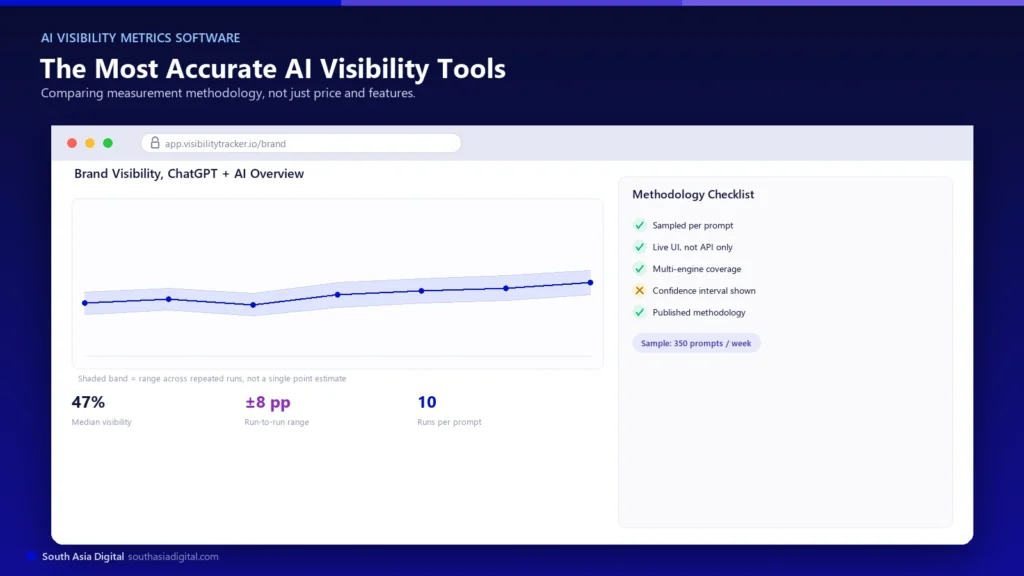
Every AI visibility tool shows you a number. What almost none of them show you is how sure they are of it, and that gap matters more than price or feature count. No vendor in this category has backend access to real ChatGPT or Google AI Overview server logs. OpenAI, Google, and Perplexity don’t hand that data to anyone, so every tool, cheap or expensive, is estimating your brand’s AI visibility, not measuring it directly.
We went looking for a clean answer, something like “Tool X is measurably more accurate than Tool Y.” We didn’t find one, and we’re not going to pretend we did, because no neutral cross-platform benchmark exists. What we found instead is more useful: real, checkable differences in how seven of these platforms collect their data, updated this month with a new methodology disclosure from Evertune and fresh cadence research from Profound. If price and features matter more to you than measurement rigor, our AI visibility tools roundup covers that side directly.
Written by the South Asia Digital SEO Team, a group focused on AI search, SEO, and generative engine optimization (GEO). Published: 2 September 2026. Last updated: 17 September 2026. Methodology and vendor documentation re-checked directly against each vendor’s current pages before this update.
Short Answer
There is no independently proven “most accurate” AI visibility tool in 2026. Based on publicly documented methodology, Ahrefs Brand Radar stands out for methodology transparency, Evertune for repeated per-prompt sampling (up to 100 runs per prompt per model), Scrunch AI for explicit refresh cadence, Profound and Peec AI for measuring the real consumer-facing AI interfaces rather than a bare API, and Semrush for the scale of its prompt dataset. These are different strengths, not proof that any one platform is universally the most accurate.
AI Visibility Accuracy Comparison at a Glance
| Tool | Strongest Verified Methodology Signal | Sampling / Refresh Disclosure | Main Limitation | Best For |
|---|---|---|---|---|
| Ahrefs Brand Radar | Most detailed public methodology documentation | Engine-specific refresh disclosed | Pre-collected dataset can miss out-of-sample mentions | Buyers prioritising transparency |
| Evertune | Up to 100 samples per prompt per model, with a published margin of error | Strong repeated-sampling disclosure | Methodology evidence is vendor-published, not independently validated | Teams prioritising sampling depth |
| Scrunch AI | Specific refresh cadence | Daily for 14 days, then 72-hour default | Hybrid API/browser split not fully disclosed | Teams wanting a clear refresh schedule |
| Profound | Real product/browser measurement plus published sampling-cadence research | Core prompts rerun daily | Independent validation still absent | Enterprise teams |
| Peec AI | Consumer-interface browser automation | Daily tracking | Exact runs per prompt not public | Teams avoiding API-only measurement |
| Semrush AI Visibility Toolkit | Large disclosed prompt dataset (317M+) | Daily/weekly depending on report | Dataset may not match every buyer’s exact prompt phrasing | Existing Semrush users / large datasets |
| Otterly.AI | Low-cost recurring monitoring | Daily monitoring stated | Limited public methodology detail | Budget-conscious monitoring |
We didn’t add a numeric “accuracy score” column on purpose. None of this is independently tested, and a fabricated score would be worse than no score at all.
How We Researched These AI Visibility Tools
We did not score these platforms on “accuracy” because no neutral ground-truth dataset exists that would let us verify an exact accuracy percentage across ChatGPT, Google AI Overviews, Gemini, Perplexity, and other generative systems.
Instead, we reviewed each vendor’s current methodology pages, technical documentation, help centre material, product documentation, and published research. We looked specifically for seven things: query method, per-prompt sampling, prompt-set size, refresh cadence, consumer interface versus API measurement, uncertainty or confidence disclosure, and published limitations.
We prioritised first-party documentation for factual claims about how each product works, and used independent research only to explain broader statistical or model-behaviour issues. Vendor-published research is labelled as such throughout, since it comes from the company being described, not a disinterested third party.
Research last checked: 17 September 2026. Evaluation criteria: query method, sampling depth, refresh cadence, platform coverage, citation versus mention detection, uncertainty disclosure, and methodology transparency.
What Makes an AI Visibility Tool Accurate?
AI visibility accuracy is not one metric. A useful measurement depends on whether the tool samples the right prompts, queries the relevant AI surface, repeats observations enough to reduce noise, detects mentions and citations correctly, and explains how much uncertainty remains.
Prompt-set quality
A tool is only as good as the prompts it tracks. A small, generic prompt list misses the specific questions your real buyers ask, no matter how many times each one gets sampled.
Runs per prompt
One run of a probabilistic system is a snapshot, not a score. More runs narrow the margin of error around that specific prompt, at the cost of more compute.
Consumer interface vs API
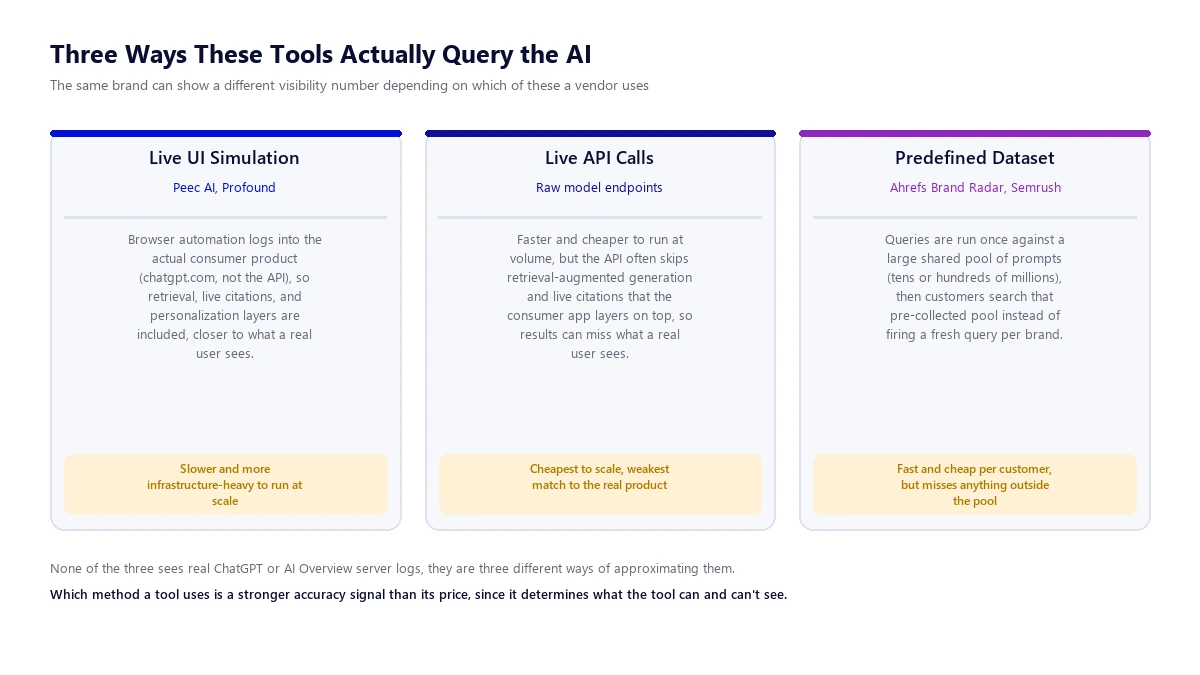
A raw API call often skips retrieval-augmented generation, live citations, and personalization that the real consumer product layers on top, so the two can disagree on the same question.
Refresh cadence
How often a tool re-queries a prompt determines how quickly its dashboard reflects a real change in the model or in your content, versus showing you stale data.
Citation detection
A citation is a direct link or sourced reference to your page inside an AI answer. Detecting this reliably requires parsing the actual answer structure, not just scanning for your brand name.
Mention detection
A mention is your brand named in the answer text, with or without a link. Mentions and citations are not the same signal, and a tool that conflates them can overstate or understate your real visibility.
Geographic and account-state variation
Logged-in versus logged-out state, chat history, and location can all shift an AI answer for the same prompt. A tool that doesn’t disclose which state it queries from is measuring one specific condition, not “the” answer.
Confidence intervals and uncertainty
A number without a stated margin of error looks more precise than it is. Whether a tool publishes this, and how it calculates it, is one of the clearest signals of methodology maturity in this category.
Model and version changes
Underlying models change without notice. A tool’s historical trend line can reflect a model update rather than any real change in your brand’s visibility, and few vendors flag this distinction.
The 7 AI Visibility Tools With Methodology Worth Comparing
We looked into every tool covered in our companion pricing article and kept the seven where we could find something specific and checkable about how the vendor collects its data, not just marketing language about “AI-powered insights.” AthenaHQ and SE Ranking’s AI Search Toolkit are real, useful products in this category, but we couldn’t find published methodology detail for either beyond standard product pages, so we left them out here rather than padding the comparison. Their pricing and feature sets are still covered in the full tools roundup.
Ahrefs Brand Radar
Ahrefs publishes the most detailed public methodology of any tool in this category, a dedicated write-up explaining exactly how Brand Radar’s data is collected and modeled, not a marketing page dressed up as documentation.
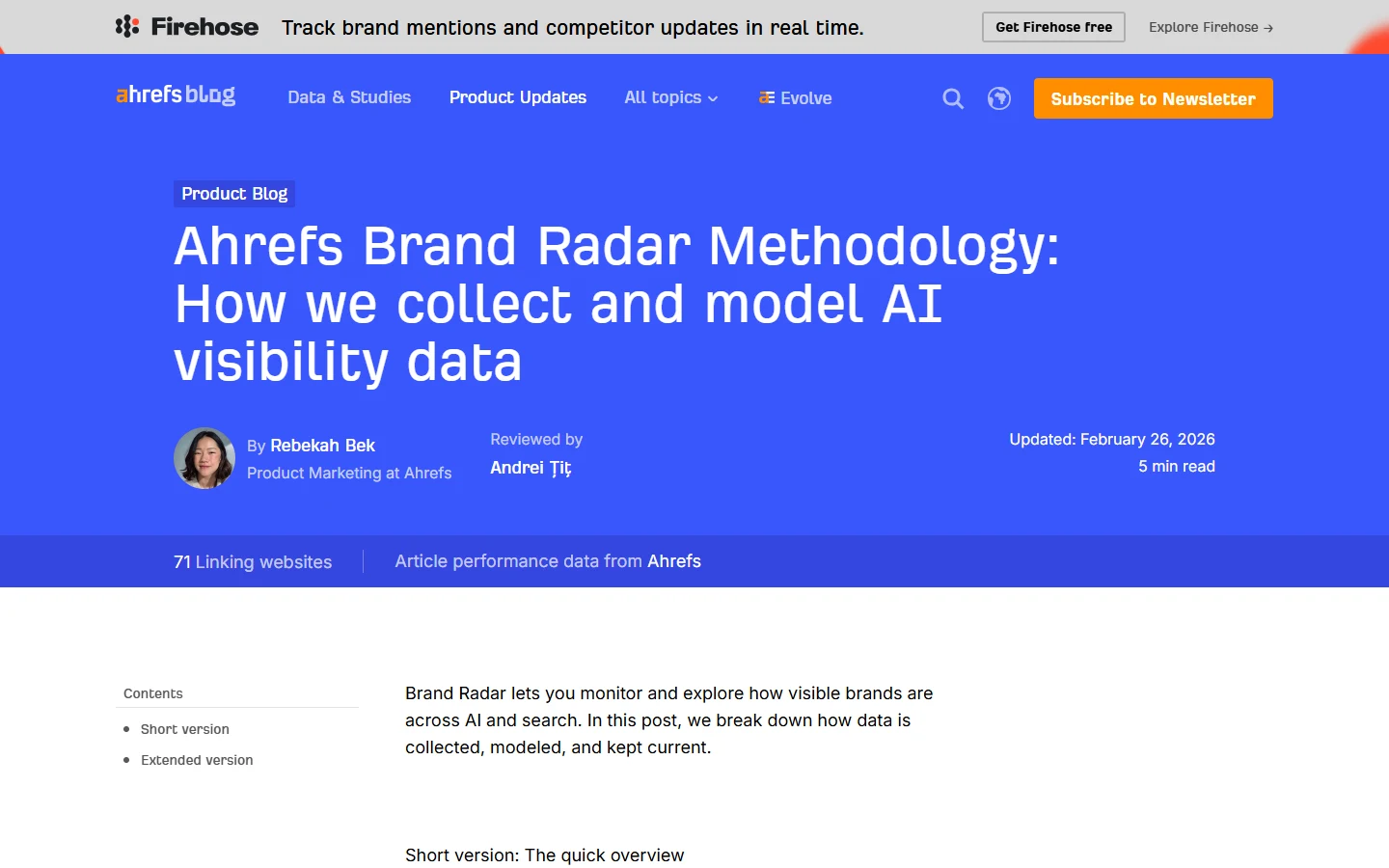
| Query Method | A predefined pool of roughly 88 to 100 million monthly prompts across seven engines, run through the free public web interfaces to reflect typical user experience, not fired live per customer |
| Sample & Refresh | ChatGPT, Perplexity, Gemini, and Copilot refresh monthly on a 90-day reporting window; Google AI Overviews and AI Mode refresh continuously |
| Disclosed Limitations | Ahrefs states its own coverage is “strongest in English,” that it does not filter out hallucinated or malformed links, and that its metrics are “directional indicators, not exact traffic counts” |
| Methodology Transparency | Highest of the seven: a dedicated public methodology post with real disclosed limitations |
| Pros | The only tool here that voluntarily documents its own weaknesses in writing instead of staying silent about them |
| Cons | A predefined dataset means a mention that falls outside the sampling window or the collected prompt pool doesn’t get counted, a real gap Ahrefs itself acknowledges |
| Best For | Buyers who weigh transparency heavily and want a vendor that shows real limitations instead of a spotless sales page |
Source last checked: 2 September 2026 (not re-fetched this update; no evidence found of a material change).
One more thing worth stating honestly: a competing AI-visibility vendor has published its own blog post claiming Brand Radar’s predefined-dataset approach undercounts real ChatGPT mentions by a wide margin in a specific test case. We’re not repeating that vendor’s exact number here, since it’s marketing content from a direct competitor, not neutral research, and we have no way to independently verify it.
Evertune
Evertune publishes one of the strongest sampling disclosures in this category. Its own FAQ states that it samples each prompt up to 100 times per model, and its research articles argue that repeated runs are necessary because generative answers are probabilistic. That is a meaningful methodology advantage on paper, although the accuracy claims still come from Evertune itself rather than an independent benchmark. Evertune also explicitly distinguishes base-model API responses from consumer-app responses, treating them as two separate signals rather than one.
| Query Method | Separately tracks base-model API responses and real consumer-app responses, rather than treating them as one signal |
| Sample & Refresh | Up to 100 runs per prompt per model; own research shows diminishing returns in margin-of-error reduction beyond roughly 100 repetitions. Refresh cadence for monitoring itself isn’t separately published beyond noting that live retrieval shifts in weeks and base-model knowledge shifts on training cycles |
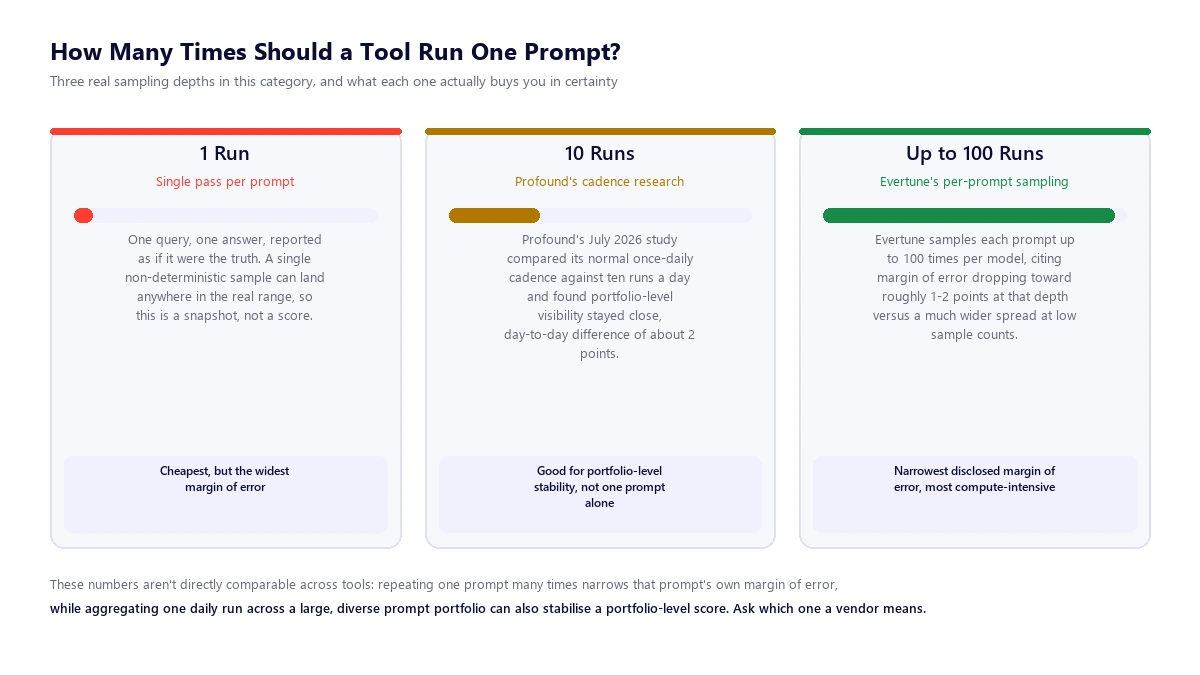
| Disclosed Limitations | Its own published analysis found a single sample can miss roughly 90% of the sources that a 100-sample run surfaces for the same prompt, meaning any low-sample competitor’s numbers may be substantially incomplete, though this comes from Evertune’s own research, not neutral testing |
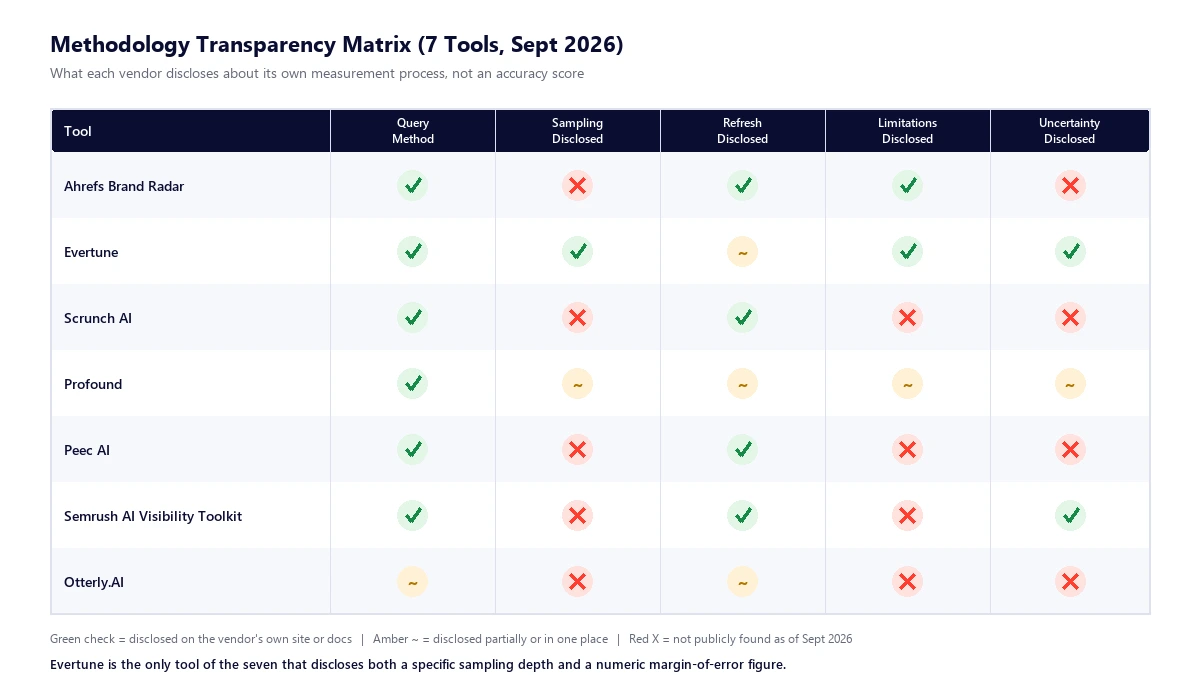
| Methodology Transparency | High: publishes specific sample counts and a numeric margin of error (roughly 1 point overall, 2 points at the topic level, at 100 samples), the only tool of the seven to do so |
| Pros | Unusually transparent repeated-sampling methodology, with real published numbers showing how margin of error narrows as sample count rises |
| Cons | Methodology evidence is vendor-published, not independently validated, and its public refresh cadence for live monitoring is less specific than Scrunch AI’s or Peec AI’s |
| Best For | Teams that prioritise statistical sampling depth over a low entry price |
Source last checked: 17 September 2026, verified directly against Evertune’s FAQ and two of its own published research articles.
Scrunch AI
Scrunch’s own FAQ discloses a hybrid collection method, both browser automation and official platform APIs, cross-checked against an internal reference dataset, and it publishes the most specific refresh-cadence numbers we found anywhere in this category.
| Query Method | A disclosed mix of browser automation and official platform APIs, measured against a continually updated internal dataset of responses collected directly from inside each AI platform |
| Sample & Refresh | New prompts refresh daily for the first 14 days, then shift to a default 72-hour refresh cadence, with a manual refresh available anytime |
| Disclosed Limitations | The exact split between browser automation and API use per engine isn’t published, so which method produced any given number isn’t verifiable |
| Methodology Transparency | High on refresh cadence specifics, partial on the hybrid method split |
| Pros | Genuinely specific, checkable refresh-cadence numbers, not a vague “daily” claim like most competitors |
| Cons | Hybrid methodology without a disclosed split ratio makes it harder to reason about consistency across engines than a single-method tool |
| Best For | Teams that want a documented, specific refresh schedule instead of an unspecified “real-time” claim |
Source last checked: 2 September 2026 (not re-fetched this update; no evidence found of a material change).
Profound
Profound captures data directly from the browser rather than the API, explicitly positioning this as showing “what your customers see.” Profound’s core methodology runs tracked prompts once per day. In a July 2026 experiment, its team compared that cadence against running the same prompts ten times a day and found the two stayed close, a typical day-to-day difference of about 2 percentage points at the portfolio level. This is useful evidence about Profound’s sampling philosophy, but it is still research published by Profound about its own system rather than an independent accuracy benchmark. The important distinction: per-prompt stability and portfolio-level stability are not the same thing, and Profound’s study is evidence about the latter, not the former.
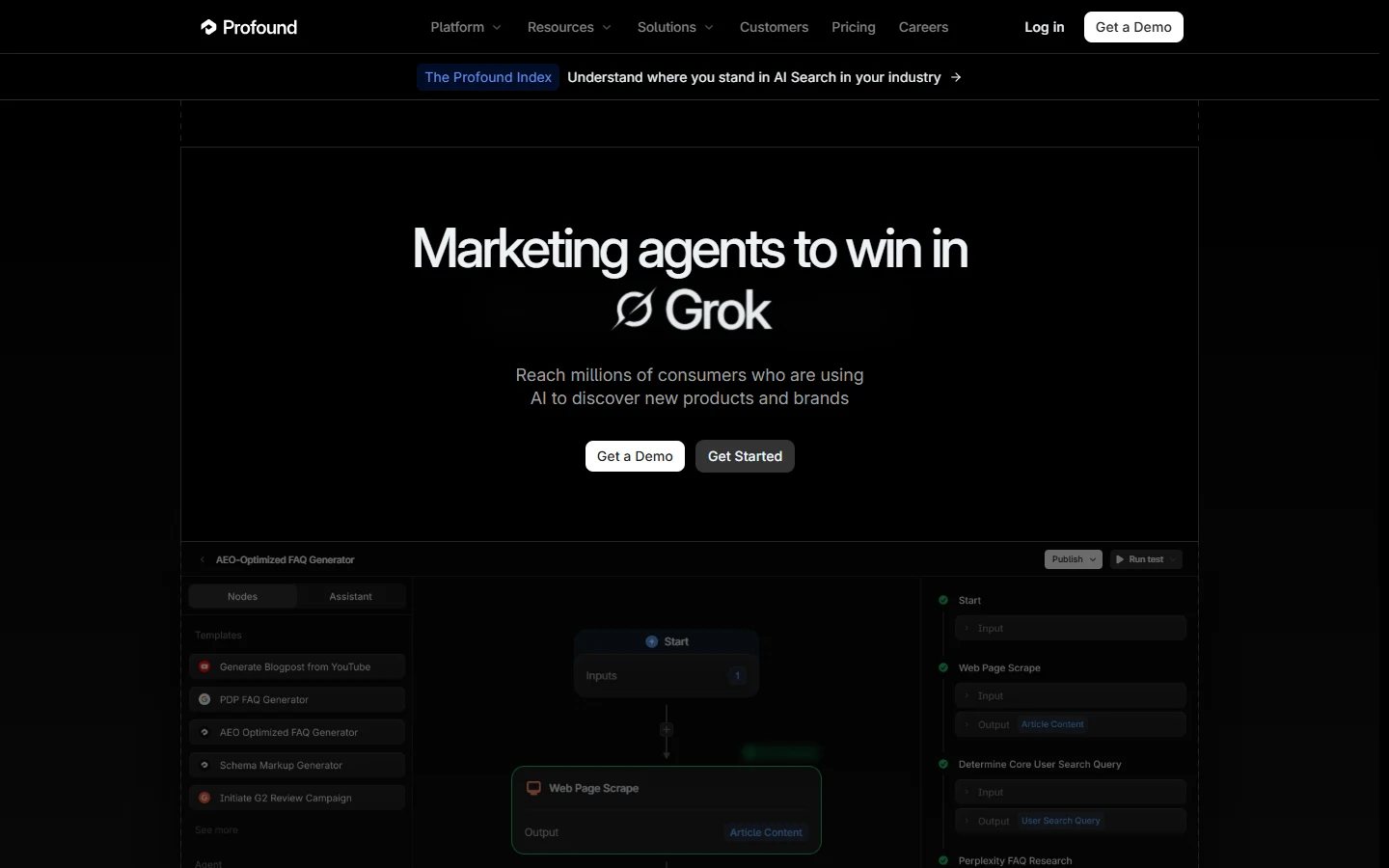
| Query Method | Live browser capture of the real consumer product, not the raw API, so retrieval and live citations are included in what’s measured |
| Sample & Refresh | Core tracked prompts re-run once daily; a July 2026 study found this stayed within about 2 points of a ten-runs-per-day setup at the portfolio level |
| Disclosed Limitations | The once-daily-is-enough finding is a portfolio-level result across many prompts; Profound’s own write-up notes the once-daily number already sits near the noise floor created by the platforms’ own drift, which repeated runs can’t remove |
| Methodology Transparency | Partial: strong on browser-based measurement and cadence research, thinner on per-prompt confidence intervals |
| Pros | Real product measurement plus a genuine, published cadence experiment, not just a marketing claim about “real-time” tracking |
| Cons | Portfolio-level stability evidence doesn’t tell a buyer how stable one specific prompt is on its own |
| Best For | Enterprise teams tracking a large prompt portfolio rather than a handful of individual queries |
Source last checked: 17 September 2026, verified directly against Profound’s July 2026 blog post.
Peec AI
Peec AI’s own documentation is explicit and specific about the one methodology choice that matters most: it queries AI platforms through browser automation that logs in and interacts the way a real person would, not through an API, precisely because API responses can differ from what a logged-in user really sees.
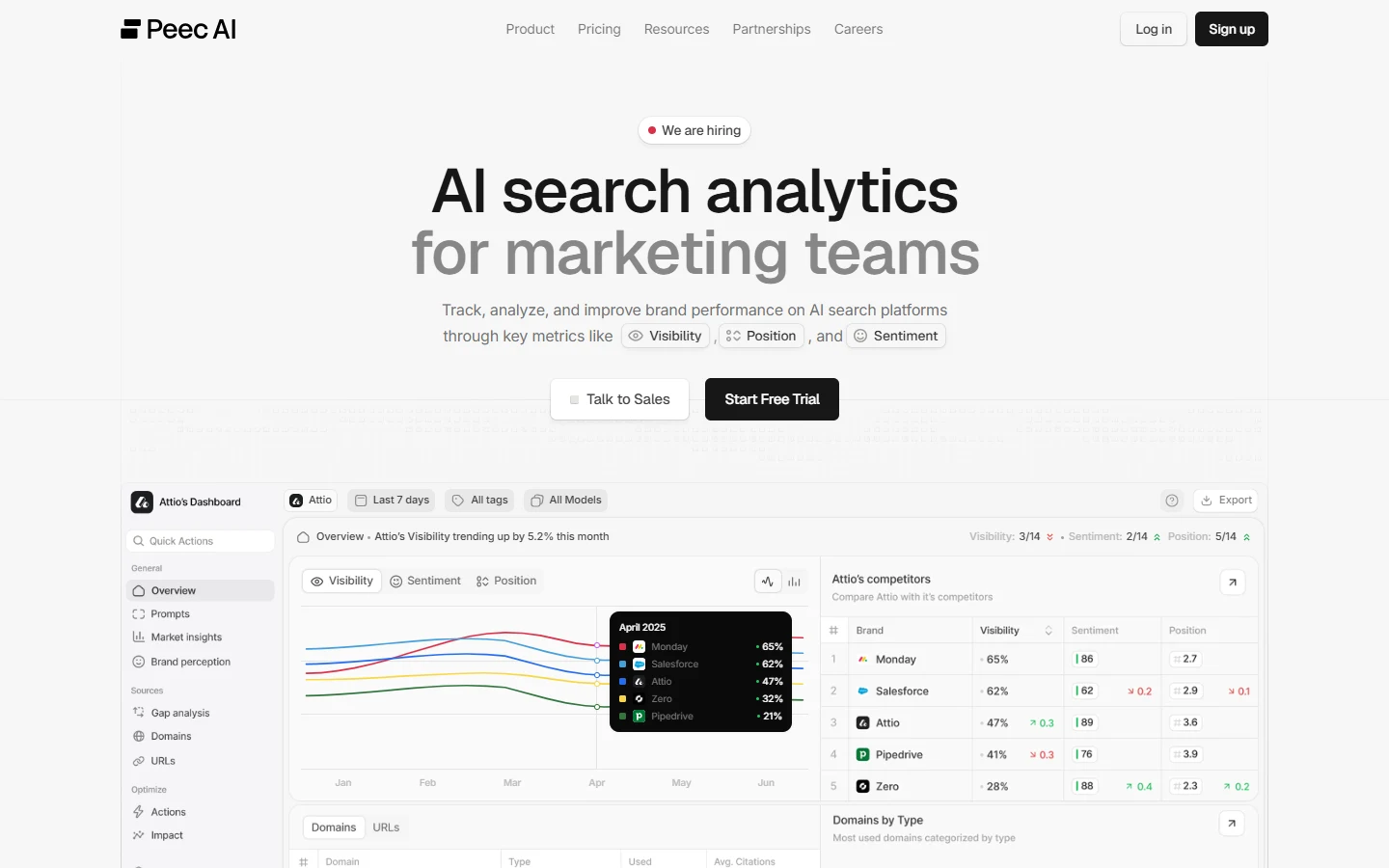
| Query Method | Browser automation that interacts with AI platforms through their real web interfaces, positioned explicitly against API-only competitors; a separate OpenAI Search API option exists as an add-on for teams who want it instead |
| Sample & Refresh | Prompts run across tracked platforms daily; the exact number of runs per prompt per day isn’t published |
| Disclosed Limitations | No public sample-size figure, so day-to-day fluctuation in a score is hard for a customer to distinguish from real change without asking Peec directly |
| Methodology Transparency | High on query method, low on sample size and uncertainty |
| Pros | Clearly documents and defends the UI-versus-API distinction, which is a real, well-reasoned accuracy argument, not just marketing language |
| Cons | Stops short of publishing the sample-size and confidence detail that would let a buyer verify how stable a given score really is |
| Best For | Teams that specifically want the consumer product experience measured, not an API approximation of it |
Source last checked: 2 September 2026 (not re-fetched this update; no evidence found of a material change).
Semrush AI Visibility Toolkit
Semrush takes a genuinely different approach from every other tool here: instead of firing live queries or simulating a browser session, its own knowledge base explains that it sources its prompts and responses from real AI search clickstream data and Google’s keyword dataset, at a scale (over 317 million prompts) none of the smaller tools can match.
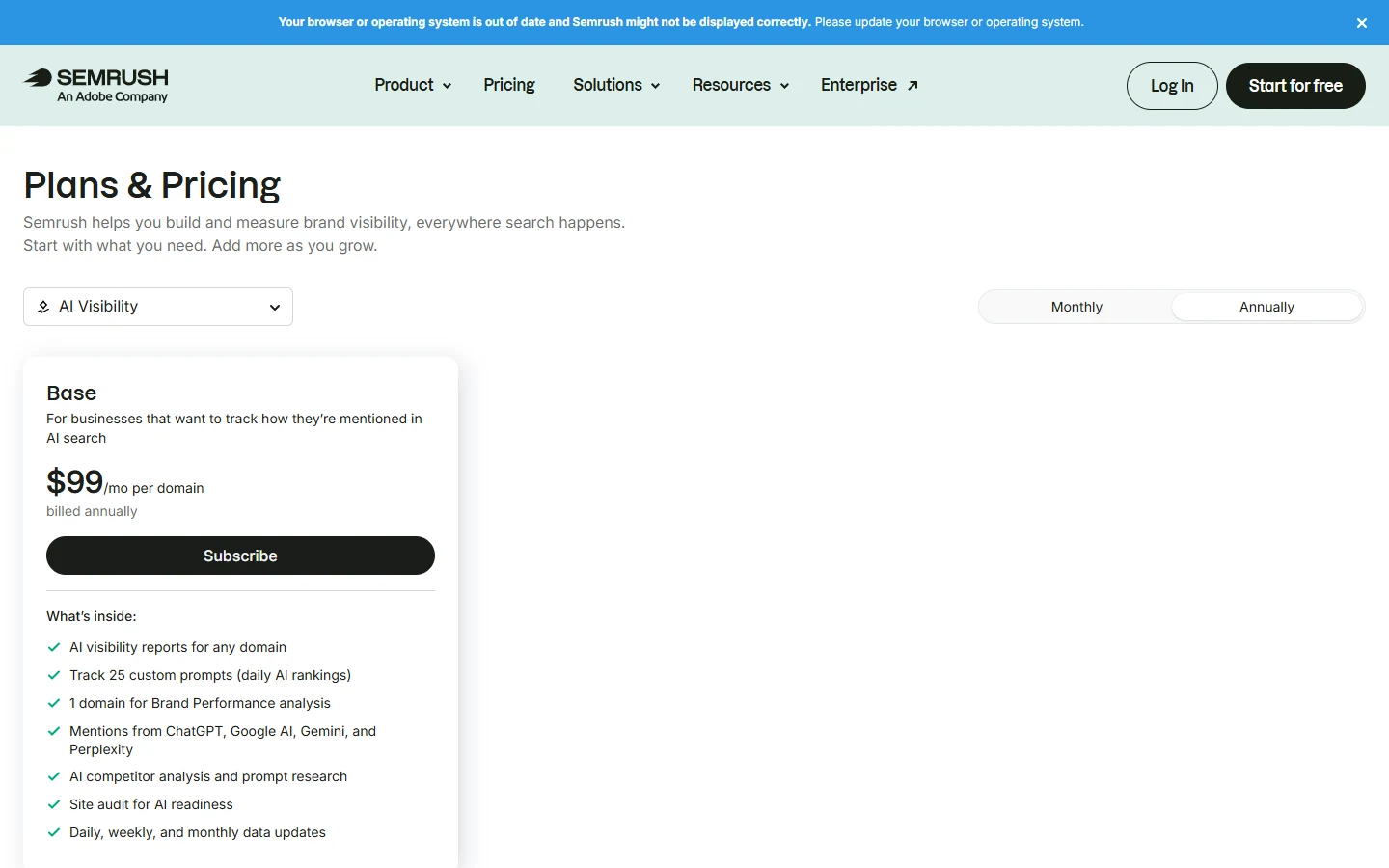
| Query Method | Real prompts and responses sourced from AI search clickstream data and Google’s keyword dataset, “not via any APIs of LLMs,” a third distinct approach from live querying |
| Sample & Refresh | 317 million-plus prompts in the underlying database; prompt data refreshes daily on a rolling basis, Brand Performance reports update weekly |
| Disclosed Limitations | Semrush states directly that “no platform can provide exact numbers on visibility” due to personalization, an unusually honest line for a pricing-adjacent page to include |
| Methodology Transparency | Moderate: dataset scale and sourcing method disclosed, per-prompt confidence detail is not |
| Pros | The scale of real, historical prompt data is larger than any single vendor could plausibly generate live, and the personalization caveat is stated plainly instead of buried |
| Cons | Prompts derived from clickstream and keyword data may not match the exact phrasing a real buyer would type into ChatGPT for your specific category |
| Best For | Teams already inside Semrush who want AI visibility built on the largest real-prompt dataset in this comparison |
Source last checked: 2 September 2026 (not re-fetched this update; no evidence found of a material change).
Otterly.AI
Otterly.AI is the cheapest real entry point into this category, and it’s also the one where we found the least public methodology detail. Its product pages describe daily monitoring across ChatGPT, AI Overviews, Perplexity, and Copilot, without specifying whether that monitoring runs through the API, a simulated browser session, or some mix of both.
| Query Method | Not publicly specified; product pages describe daily monitoring without stating API versus browser-based collection |
| Sample & Refresh | Prompts monitored on daily scheduled cycles; per-prompt run count not published |
| Disclosed Limitations | No dedicated methodology page found. One independent third-party reviewer estimated a roughly 91% citation-detection rate in its own testing, that’s the reviewer’s figure, not Otterly’s own published claim, and we found no independent replication of it elsewhere |
| Methodology Transparency | Lowest of the seven; no dedicated methodology documentation found |
| Pros | By far the lowest price of any tool in this category, a reasonable way to watch a trend line move even without a published methodology behind it |
| Cons | The least public methodology transparency of any tool covered in this comparison |
| Best For | Budget-conscious teams who accept a black-box methodology as the tradeoff for the lowest price in the category |
Source last checked: 2 September 2026 (not re-fetched this update; no evidence found of a material change).
Prompt-Level vs Portfolio-Level Sampling
Evertune argues for many repeated runs per prompt, up to 100 per model. Profound’s July 2026 research argues one daily sample can be sufficiently stable when aggregated across a large portfolio of prompts. These are not necessarily contradictory. Repeating one prompt many times can improve confidence about that individual prompt. Aggregating one observation across thousands of diverse prompts can also stabilise a portfolio-level visibility score. A buyer should therefore ask whether the metric they’re looking at is intended to describe one prompt, one topic, or an entire prompt portfolio, before judging the sampling method behind it.
Is There an Independent Accuracy Benchmark?
We looked specifically for this, since it’s the single piece of evidence that would actually answer the question this article is named for. We did not find one. There is no neutral, third-party research lab, academic study, or journalism outlet that has run the same set of prompts through Otterly.AI, AthenaHQ, Peec AI, Profound, Scrunch AI, Semrush, Ahrefs Brand Radar, Evertune, and SE Ranking side by side and scored each against a verified ground truth. What exists instead is a scattering of vendor-versus-vendor blog posts and each vendor’s own research about its own product. Until that changes, the honest way to judge these tools is exactly the way this article has: by how much they disclose about their own process, not by a scoreboard nobody has actually built.
How to Test an AI Visibility Tool Yourself
You don’t have to take a vendor’s methodology page on faith. Here’s a practical way to sanity-check one before you commit budget to it.
- Ask the vendor directly how many times it runs each prompt, and whether it queries an API, a browser-automated consumer interface, or a predefined dataset.
- Pick 5 to 10 prompts that genuinely matter to your brand and run them yourself, by hand, in ChatGPT, Perplexity, and Google AI Overviews on the same day.
- Compare your manual results to what the tool reports for the same prompts in the same week. Expect some drift, not an exact match, given personalization and model non-determinism.
- Repeat one prompt manually 5 to 10 times in a single sitting, logged out and then logged in, and note how much the answer itself varies. This gives you a rough personal sense of the noise floor before judging a vendor’s number against it.
- Ask the vendor for its exact definitions of “mention” and “citation,” in writing, since tools that conflate the two can overstate or understate real visibility.
- If the tool claims daily refresh, log into the dashboard on consecutive days and confirm the number actually moves independently of any content changes you’ve made.
- Request the vendor’s own published methodology page or technical documentation instead of a sales deck. If none exists, treat that absence itself as information.
- Track the directional trend, not the absolute number, for at least 4 to 6 weeks before making a budget decision based on the tool’s score.
Which Tool Should You Choose?
This is a best-fit-by-methodology-requirement list, not an accuracy ranking.
- If methodology transparency matters most: Ahrefs Brand Radar.
- If repeated per-prompt sampling matters most: Evertune.
- If you want the real consumer interface measured: Profound or Peec AI.
- If refresh cadence transparency matters: Scrunch AI.
- If you want a huge prompt dataset inside an existing SEO suite: Semrush AI Visibility Toolkit.
- If budget matters more than methodology transparency: Otterly.AI.
What This Means If You’re Choosing a Tool
Don’t expect any vendor conversation to end with a verifiable accuracy number, because that number doesn’t exist for any of them, and a salesperson who claims otherwise is telling you something no one can currently prove. What you can reasonably ask for is a straight answer to the questions this article is built around: how many times do you run each prompt, are you querying the real product or an API approximation of it, and can you show me the range around a given score, not just the score itself. If pricing and feature depth matter more to your decision than methodology once you’ve made this check, our full AI visibility tools comparison covers all eight tools by budget and use case. For how citations inside Google’s own AI features actually work, see our guide to Google AI Overview optimisation. And for how each engine’s non-determinism itself shows up for real users, our companion piece on whether ChatGPT gives the same answers to everyone covers the deeper version of the same problem these tools are all trying to work around. If Perplexity specifically is your priority engine, our Perplexity rank tracker comparison audits how seriously each tool treats it.
Frequently Asked Questions
Which AI visibility tool is the most accurate?
No independent 2026 benchmark proves that one AI visibility platform is universally the most accurate. Different tools measure visibility differently. Ahrefs publishes unusually detailed methodology documentation, Evertune discloses repeated sampling of up to 100 runs per prompt per model, Scrunch publishes a specific refresh cadence, and Profound and Peec AI focus on consumer-facing AI interfaces rather than relying only on raw APIs. These are methodology strengths, not independently verified accuracy rankings.
How accurate are AI visibility tools?
No vendor has backend access to real ChatGPT or Google AI Overview server logs, so every AI visibility tool is estimating, not measuring directly. Accuracy in this category is better understood as methodology quality (sampling depth, query method, disclosed limitations) than as a single verifiable percentage.
How do AI visibility tools measure brand visibility?
They query AI systems in one of three ways: live browser automation of the real consumer interface, direct API calls to the underlying model, or a predefined dataset of prompts collected at scale in advance. Each method sees a slightly different version of what a real user experiences, which is why two tools can report different numbers for the same brand.
How many times should an AI visibility tool run a prompt?
There’s no universal industry standard. Evertune’s own research shows margin of error narrowing sharply up to roughly 100 repetitions per prompt, with diminishing returns beyond that. Profound’s July 2026 study found that, at the portfolio level across many prompts, a single daily run tracked a ten-run-per-day setup within about 2 percentage points. Which number matters to you depends on whether you care about one prompt’s stability or a whole portfolio’s.
Is API tracking accurate for ChatGPT?
A raw API call typically skips the retrieval-augmented generation, live web citations, and personalization layers that the consumer-facing chatgpt.com product adds on top of the base model. That’s why tools like Peec AI and Profound specifically query the real product interface through browser automation instead of relying on the API alone, and why Evertune tracks API and consumer-app responses as two separate signals rather than one.
Is AI visibility a reliable metric?
It’s a directional signal, not a precise measurement. Model non-determinism, personalization, and the absence of any published confidence interval from most vendors mean a week-over-week move in a score could reflect real change or could just be noise. Track the trend over several weeks rather than treating any single number as exact.
What is the difference between mentions and citations?
A mention is your brand named in an AI answer’s text, with or without a link. A citation is a direct, sourced reference to your specific page. A tool that conflates the two can overstate your real visibility by counting a plain-text namedrop the same way it counts an actual linked source.
Can AI visibility scores be compared across tools?
Not directly. Different tools use different query methods, prompt sets, and sample sizes, so a “42%” from one platform and a “42%” from another aren’t measuring the same underlying thing. Compare methodology first, and treat any cross-tool score comparison as approximate at best.
Why do two AI visibility tools show different scores for the same brand?
Because they’re not asking the same question the same way. Differences in prompt set, query method (API versus browser versus predefined dataset), sample size, and mention-versus-citation definitions can all produce different numbers for the identical brand in the identical week, even before model non-determinism is factored in.
How do I test an AI visibility tool myself?
Run a handful of your own priority prompts by hand across ChatGPT, Perplexity, and Google AI Overviews, then compare those manual results to what the tool reports for the same prompts and week. Our full 8-step protocol is above, in “How to Test an AI Visibility Tool Yourself.”
How is this different from South Asia Digital’s other AI visibility tools article?
Our companion article compares these tools by price, features, and which buyer situation each fits. This article sets pricing aside entirely and compares only how rigorously and transparently each vendor collects its underlying data.
Measure AI Visibility. Then Improve It.
Measuring AI visibility tells you where your brand appears. Improving that visibility requires a different layer of work across content, entities, technical SEO, citations, and external authority. See our AI SEO services and Generative Engine Optimization services for the optimisation side of the process.
Get an AI Visibility Audit
Explore AI SEO Services