
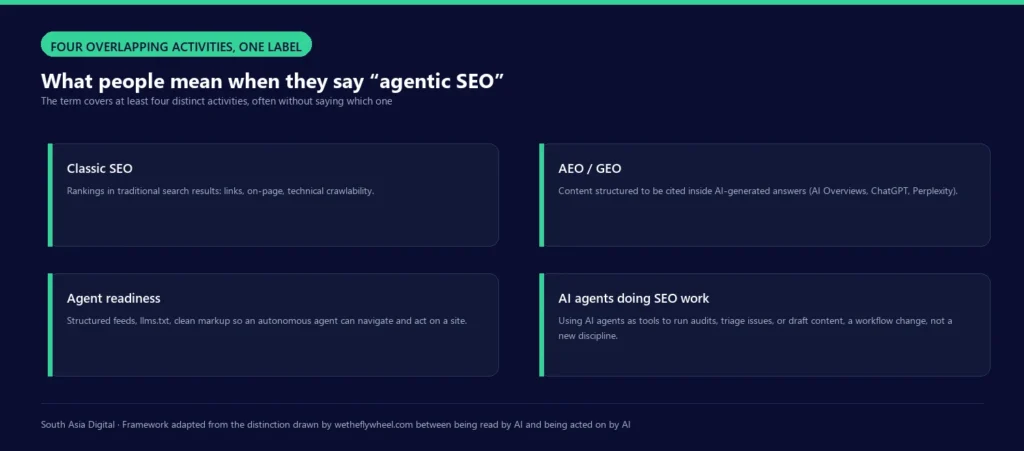
“Agentic SEO” gets used for at least three different things, often in the same article. Sometimes it means AI agents doing SEO work on a human’s behalf: running audits, drafting content, triaging issues. Sometimes it means optimizing a site so an AI shopping or browsing agent can navigate and complete a task on it, a separate skill from ranking well. And sometimes it is both, swapped mid-sentence without saying which one is meant. The term has existed in its current form for roughly two years, and the industry has not converged on one definition yet.
What does “agentic SEO” mean?
SEO automation splits into three tiers: manual work, workflow automation where a person builds and maintains a fixed pipeline (Zapier, n8n), and agentic work, where a person states the outcome and the agent plans, executes, and adapts the process itself, including recovering from its own errors. Ahrefs laid out this distinction in a May 2026 guide by Mateusz Makosiewicz, the clearest framing found in current coverage of the term, with concrete examples: triaging audit issues and opening pull requests, finding pages losing traffic, building cannibalization consolidation plans, and flagging pages AI tools cite that have gone stale. The same guide includes a caveat worth keeping: the underlying models are “not smarter than a chatbot, just more capable,” make the same reasoning errors a chatbot would, and still need human review on anything left running unattended for long.
SEOs are becoming “the human layer between businesses and AI systems,” not a role agents replace outright, according to Marie Haynes, a longtime SEO commentator known for her work on E-E-A-T, in a December 2025 interview with Search Engine Journal. Her prediction was “a lot of trial and error,” not a clean handoff, a useful counterweight to vendor framing that leans toward full automation.
Which vendors are building agentic SEO tools?
Ahrefs built Agent A, an agentic environment running on MCP servers with task-specific skills, documented directly in its own product pages. Adobe, having completed its acquisition of Semrush on April 28, 2026, named “agentic search optimization” directly in Semrush’s own customer FAQ as a capability it plans to fold into Adobe’s CX Enterprise suite alongside Adobe Experience Manager and Adobe Commerce, a rare case of a major vendor committing to the term in writing rather than in marketing copy.
The same acronym gets reused for something unrelated. Addy Osmani, an engineering director at Google Cloud, published an open-source tool he calls “Agentic Engine Optimization,” also abbreviated AEO, for structuring developer documentation so AI coding agents can parse it, a different audience from either “agentic SEO” or the more familiar “answer engine optimization.” Three live, incompatible expansions of the same acronym in circulation at once is a reasonable sign the terminology has not settled.
Only 17% of organizations had deployed AI agents as of 2026, according to Gartner’s Hype Cycle for Agentic AI, against a much larger share planning to within the next year or two, a gap Gartner’s own research group named directly: “agent washing,” vendors rebranding existing chatbots or automation tools as agentic without adding real autonomous capability. The content agency RZLT made a related argument: results in this space still come from site architecture and content strategy, not from the agent itself, so “agentic SEO” functions more as a workflow description than a purchasable product category.
How do AI agents complete tasks on a website?
OpenAI’s Agentic Commerce Protocol requires merchants to supply a structured product feed and implement a defined checkout specification before ChatGPT can complete a purchase on their behalf, documented directly in OpenAI’s own developer docs; a separate payment specification covers how payment providers plug in, and the whole protocol is published as an open specification co-developed with Stripe. That is one model: structured data, built for an agent to read programmatically.
Anthropic’s computer-use tool for Claude works on a different model entirely: the agent takes a screenshot, decides on an action such as a click or keystroke, and repeats, operating a computer the way a person would rather than calling an API. Anthropic’s own documentation recommends running this in an isolated environment with minimal privileges, keeping it away from sensitive data such as login credentials, restricting its internet access to an allowlist of domains, and requiring human confirmation before any action with meaningful real-world consequences. The same documentation warns that Claude can follow instructions it finds embedded in a web page even when they conflict with the user’s actual request, a prompt-injection risk Anthropic says it mitigates with classifiers on tool results, calling that protection “not ideal for every use case.”
| Agent type | How it reads a site | What a site needs to provide |
|---|---|---|
| ChatGPT commerce (ACP) | Structured data feed, no page rendering | Product feed and checkout spec implementation |
| Claude computer use | Screenshots, like a human looking at the screen | Clear, consistently rendered visual interface |
| Google Lighthouse’s agent audit | Checks WebMCP, llms.txt, layout stability | Experimental; not required for Google Search itself |
Google Search itself does not require or use llms.txt for AI Overviews or AI Mode, Search Engine Journal reported in May 2026, quoting Google’s John Mueller calling the idea of Markdown pages built specifically for bots “a stupid idea,” even though Lighthouse 13.3 added an experimental “Agentic Browsing” audit category that checks for exactly that file. The team building browser tooling and the team running Search have not reconciled what, if anything, a site needs to do here.
Why does agentic AI infrastructure keep changing this fast?
Google’s Project Mariner, an experimental browsing agent, shut down on May 4, 2026, according to the notice now shown on its own former landing page, with its underlying technology folded into Gemini Agent and related products. Less than a year separated its public debut from its retirement. A strategy built around a specific agent platform’s current behavior should expect that behavior, and sometimes the platform itself, to change before the strategy finishes paying off.
How is agentic SEO different from AEO and GEO?
Answer and generative engine optimization are about getting a page read and cited by AI systems; agent readiness is about getting a page acted on by an AI system on a user’s behalf, a distinction drawn clearly by an analysis published on wetheflywheel.com covering generative engine optimization. Work done for AEO or GEO, answer-first structure, clear entities, accurate structured data, tends to help with agent readiness too. The reverse is not guaranteed: a site an agent can successfully navigate and transact on is not automatically a site AI systems choose to cite.
How much traffic do AI agents send today?
AI referral traffic reached 0.32% of total website traffic in 2026, up from 0.24% in 2025 and 0.02% in 2024, according to SE Ranking’s own analysis, with organic Google search still sending roughly 134 times more visitors than AI platforms combined. A competing claim that AI agents already account for roughly a third of search traffic traces back to an unattributed Reddit post citing unnamed internal metrics and does not hold up against this better-documented figure. The growth rate is real and fast; the current share of traffic is still small.
What this means for a site right now
Most sites do not need a dedicated “agentic SEO” line item yet. Deployment is still low by Gartner’s own count, the infrastructure is still being rebuilt in public, Project Mariner lived less than a year, and even Google’s internal teams disagree on what a page needs to change. Three things hold up regardless of how the terminology settles: structure product and service data cleanly enough that it could feed a protocol like OpenAI’s ACP if that becomes relevant to the business, keep the AEO and GEO fundamentals in place since that work carries over no matter what agent-specific standards win out, and treat any pitch that sells “agentic SEO” as a packaged deliverable with the same skepticism Gartner applies to agent washing generally: ask what the agent does differently from a saved workflow, specifically.
Questions about agentic SEO
What is agentic SEO?
It most often refers to AI agents performing SEO tasks autonomously, audits, content drafts, issue triage, under a person’s direction rather than step-by-step control. A meaningful share of the content using the term is describing agent readiness instead: structuring a site so an AI shopping or browsing agent can navigate and complete a task on it. Both usages circulate, often without the distinction being made clear.
Is agentic SEO a real discipline or a marketing term?
Both, depending on the source. Real, documented products exist, including Ahrefs’ Agent A and Adobe’s stated plan to build “agentic search optimization” into Semrush. Gartner’s research also found that only 17% of organizations had deployed AI agents as of 2026, against much higher numbers of vendors marketing the term, which is the pattern Gartner calls “agent washing.” Treat specific product claims on their own merits rather than assuming the label guarantees real autonomous capability.
How is agentic SEO different from AEO or GEO?
AEO and GEO focus on getting a page read and cited inside an AI-generated answer. Agentic SEO, in its agent-readiness sense, focuses on getting a page successfully used by an autonomous agent completing a task, like a purchase. Work done for AEO and GEO generally supports agent readiness, but the reverse does not automatically follow.
What does a site need for an AI agent to act on it?
Requirements differ by what the agent is doing. OpenAI’s Agentic Commerce Protocol requires merchants to publish a structured product feed and implement its checkout specification before ChatGPT can complete a purchase. Screenshot-based agents like Claude’s computer-use tool need clear, consistently rendered interfaces rather than a special feed. Google’s experimental Lighthouse audit checks for an llms.txt file and general agent accessibility, though Google has stated this is not required for AI Overviews or AI Mode specifically.