
LLMO stands for large language model optimization. It doesn’t have one settled definition: the term gets used for three different things depending on which agency’s glossary you’re reading, and none of the three has the kind of peer-reviewed grounding its sibling term, GEO, does. This covers what LLMO is claimed to mean, how it differs from GEO and AEO, what Google’s own position on it is, and what’s worth doing regardless of which label eventually sticks.
What does LLMO stand for, and what does it mean?
LLMO is short for large language model optimization: structuring a brand’s content and online presence so large language models represent it accurately and favorably. Beyond that one-line definition, agencies and glossaries split into three framings that don’t fully agree with each other.
- Model-level framing: one glossary describes LLMO as optimization aimed at how the model itself understands and describes a brand, independent of any specific search surface.
- Umbrella framing: another source treats LLMO as the broadest category, with GEO, AEO, and AI Overview optimization as component strategies underneath it.
- Retrieval framing: a third source scopes LLMO narrowly, to how content gets retrieved and ranked inside a language model’s context window, including retrieval-augmented generation pipelines.
The practical effect: ask three different AI SEO vendors what LLMO covers and get three different answers. That doesn’t happen with GEO.
How is LLMO different from GEO?
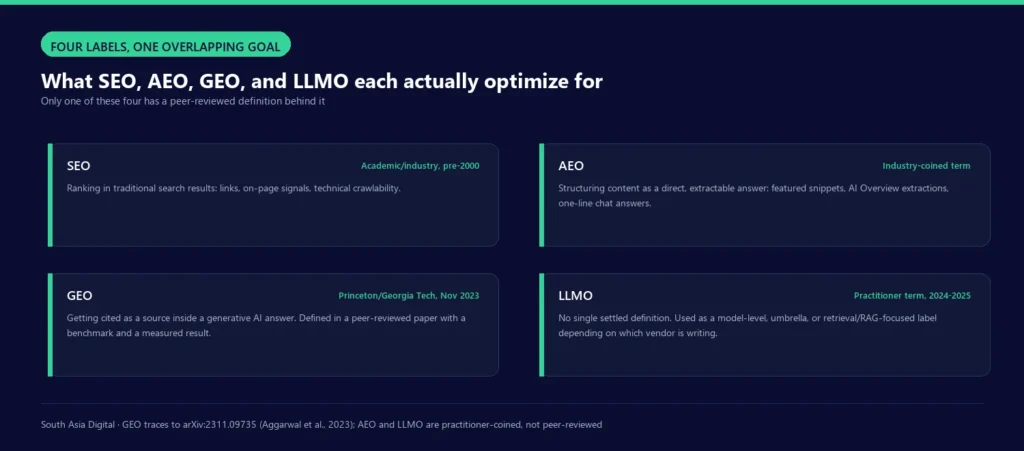
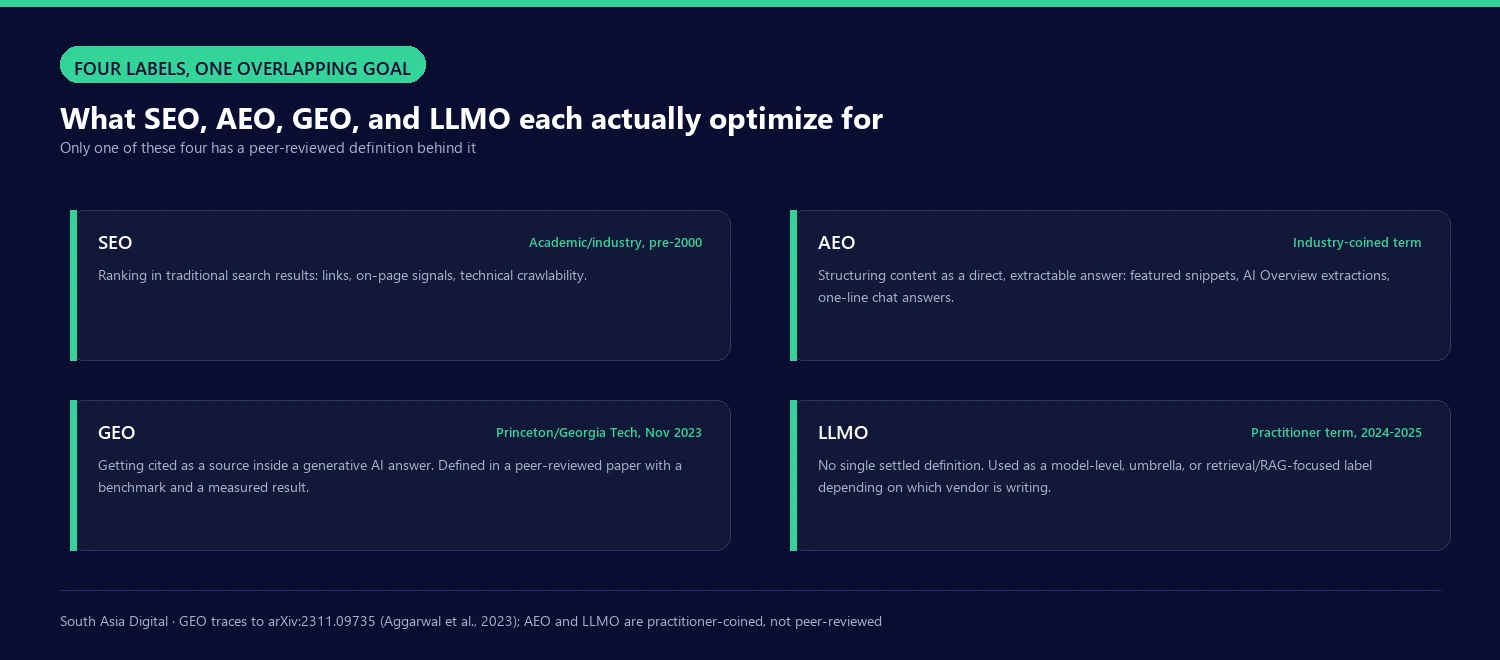
GEO has an answer that doesn’t depend on which agency you ask. The term comes from a peer-reviewed paper, GEO: Generative Engine Optimization, submitted to arXiv in November 2023 by researchers from Princeton, Georgia Tech, the Allen Institute for AI, and IIT Delhi, and later accepted to KDD 2024, one of the field’s major research conferences.
The paper defines GEO narrowly: a set of methods for raising a page’s visibility inside a generative engine’s synthesized answer. The authors tested it against a benchmark they built called GEO-bench, a large-scale set of real user queries paired with relevant web sources, and reported the strongest methods boosting visibility by up to 40%.
LLMO has no equivalent origin. It emerged from marketing and SEO practitioner discussion as ChatGPT scaled through 2024 and 2025, not from a published study, which is also why its definition hasn’t converged the way GEO’s has.
How is LLMO different from AEO and SEO?
AEO, answer engine optimization, is scoped more narrowly than either: structuring content so it can be extracted as a direct answer, a featured snippet, a Google AI Overview extraction, a one-line ChatGPT response, a Perplexity answer card. SEO is the original discipline underneath all three: rankings in traditional search results, driven by links, on-page signals, and technical crawlability.
One vendor estimate puts tactical overlap between all of these at around 90%, meaning the actual day-to-day work, structured content, clear entities, authoritative sourcing, looks close to identical regardless of which label sits on a proposal. That figure doesn’t come from a published study, so treat it as a rough estimate rather than a measured number, but it lines up with what the methods look like side by side.
A fifth term adds to the confusion: agentic SEO describes something else again, structuring a site so an AI agent can act on it directly, not just cite it. Different problem, different work.
Does LLMO have verifiable search volume behind it?
That claim doesn’t hold up to independent verification yet. A handful of vendor blogs cite Google Trends charts showing interest in “LLM optimization” rising, but the specific numbers behind those charts aren’t published. The clearest example found is a November 2024 Ahrefs snapshot, not current 2026 data. One agency blog claims “LLM SEO” search interest grew 23% month-over-month in early 2026, without naming a data source.
Measuring this directly is also harder than it sounds. Traditional keyword search behavior is repetitive and trackable. Conversational prompts to an LLM vary by phrasing in a way that doesn’t map cleanly onto Google Trends’ keyword-volume model. A client asking for LLMO search-volume data is asking for something that doesn’t currently exist in a reliable, citable form.
What does Google say about LLMO?
Google’s own AI optimization guide, published through Search Central in May 2026, doesn’t use the term LLMO at all. It addresses AEO and GEO by name and states its position directly: “optimizing for generative AI search is optimizing for the search experience, and thus still SEO.” The guide treats the underlying work as an extension of existing SEO fundamentals, not a separate discipline requiring new files or markup. It specifically states that llms.txt and similar AI-text files aren’t needed for Google Search and don’t affect visibility or rankings there.
That Google addresses AEO and GEO by name but has never addressed LLMO is informative on its own. The term hasn’t reached enough consensus usage to need a response from Google, which tracks with LLMO’s practitioner origin rather than an academic or platform-level one.
What should a site do instead of chasing the label?
Which of these four labels a proposal uses matters less than whether the underlying work gets done. Three things hold up regardless of how the terminology eventually settles: structured, entity-clear content a machine can parse accurately, the GEO and AEO fundamentals covered above; genuine brand presence across the platforms a model would plausibly draw from when forming an answer, not just backlinks pointing at a domain; and ongoing visibility tracking across AI Overviews, ChatGPT, and Perplexity rather than a one-time audit, since that’s the piece that tells you whether any of it is working. Building that tracking into a standing reporting cadence matters more than which acronym sits on the invoice.
If an agency pitches “LLMO” as a distinct, premium-priced service separate from the GEO and AEO work described above, ask what specifically it includes that the other two don’t. What an AI SEO service should include covers the full scope that question should get checked against. Based on how the term is used across the industry right now, the honest answer is usually nothing new.
Common questions about LLMO
What does LLMO stand for?
Large language model optimization: structuring a brand’s content and online presence so large language models represent it accurately and favorably. The term is used three different ways across the industry, model-level, umbrella, and retrieval-focused, and hasn’t settled on one definition.
Is LLMO the same as GEO?
Not quite. GEO comes from a peer-reviewed 2023 paper and is defined narrowly as getting cited inside a generative AI system’s synthesized answer. LLMO has no equivalent published origin and is defined differently by different sources, sometimes as a synonym for GEO, sometimes as a broader umbrella that includes it.
Is LLMO the same as AEO?
They overlap but aren’t identical. AEO focuses specifically on direct-answer formats like featured snippets and one-line chat responses. LLMO, depending on which source defines it, covers that plus broader model-level brand representation or retrieval mechanics. The practical tactics overlap heavily either way.
Does Google recognize LLMO as a ranking factor?
Google’s AI optimization guide doesn’t use the term LLMO at all. It addresses AEO and GEO directly and states that optimizing for generative AI search is still SEO, not a separate discipline. There’s no Google documentation that treats LLMO as a distinct ranking or citation factor.
Should a business pay for LLMO as a separate service from GEO or AEO?
Usually not as a separate line item. The day-to-day work behind all these labels overlaps heavily: structured content, clear entities, authoritative sourcing, and ongoing citation monitoring. A proposal that prices “LLMO” as something additional to GEO and AEO work should be able to say specifically what extra work that covers.
Written by Nadir Yaqoob, founder of South Asia Digital. Nadir has a software engineering background and runs the agency’s AI SEO and GEO work for SaaS and Shopify clients directly.