You know your site ranks. What you don’t know is whether ChatGPT mentions your brand when someone asks for a recommendation in your category, or whether Google’s AI Overview cites a competitor instead of you for the exact query you used to win. That gap, between “we rank” and “we get cited,” is what a new category of software now exists to measure.
For ongoing brand monitoring across ChatGPT, Perplexity, Google AI Overview, Gemini, and Copilot, the strongest picks are Otterly.AI for budget-conscious teams, Profound for enterprise-grade prompt-level analytics, Peec AI and Scrunch AI for agencies that want monitoring paired with optimization guidance, AthenaHQ for a free way to test the category, and the AI-tracking add-ons inside Semrush, Ahrefs, and SE Ranking if you’re already paying for one of those suites. Which one is right for you depends less on features and more on your budget, how many AI engines you need covered, and whether you’re already inside a platform that added this as a bolt-on.
One distinction worth making before the list: this article covers ongoing monitoring platforms, subscription software that repeatedly samples ChatGPT, Perplexity, and AI Overview over time and tracks how your visibility trends. That’s a different job from a free browser extension you run once to check whether a single page is technically AEO-ready. If what you need is a quick, no-cost spot-check of one page’s structured data and AI-crawler access, our roundup of SEO, AEO and GEO checker extensions covers that use case instead. The tools below are built for a different buyer: someone who wants a dashboard showing whether their brand’s AI visibility is going up or down, week over week, and how it compares to named competitors.
Quick Picks, By Use Case
- Best overall value: Otterly.AI, four core engines from $29/month, the cheapest real entry point into ongoing tracking.
- Best for enterprise depth: Profound, prompt-level analytics across up to nine AI engines on its Enterprise tier.
- Best if you want fixes, not just data: Peec AI, pairs citation tracking with specific content recommendations.
- Best free way to test the category: AthenaHQ’s Essential tier, a genuine free plan before any paid commitment.
- Best if you already pay for Semrush, Ahrefs, or SE Ranking: turn on their AI visibility add-on before buying a separate platform.
- What none of them do: guarantee a citation. Every tool here measures visibility; none of them can force ChatGPT or AI Overview to mention you.
How AI Visibility Tracking Software Actually Works
Most articles on this topic list features and pricing without explaining the mechanism, which matters because it sets honest expectations for what a subscription buys you. No AI visibility platform has backend access to real ChatGPT or Google AI Overview server logs. OpenAI, Google, and Perplexity don’t hand that data to third parties. So every tool in this category, from a $29 tool to a custom-priced enterprise one, does the same fundamental thing: it asks the AI a set of realistic questions, repeatedly, and counts what comes back.
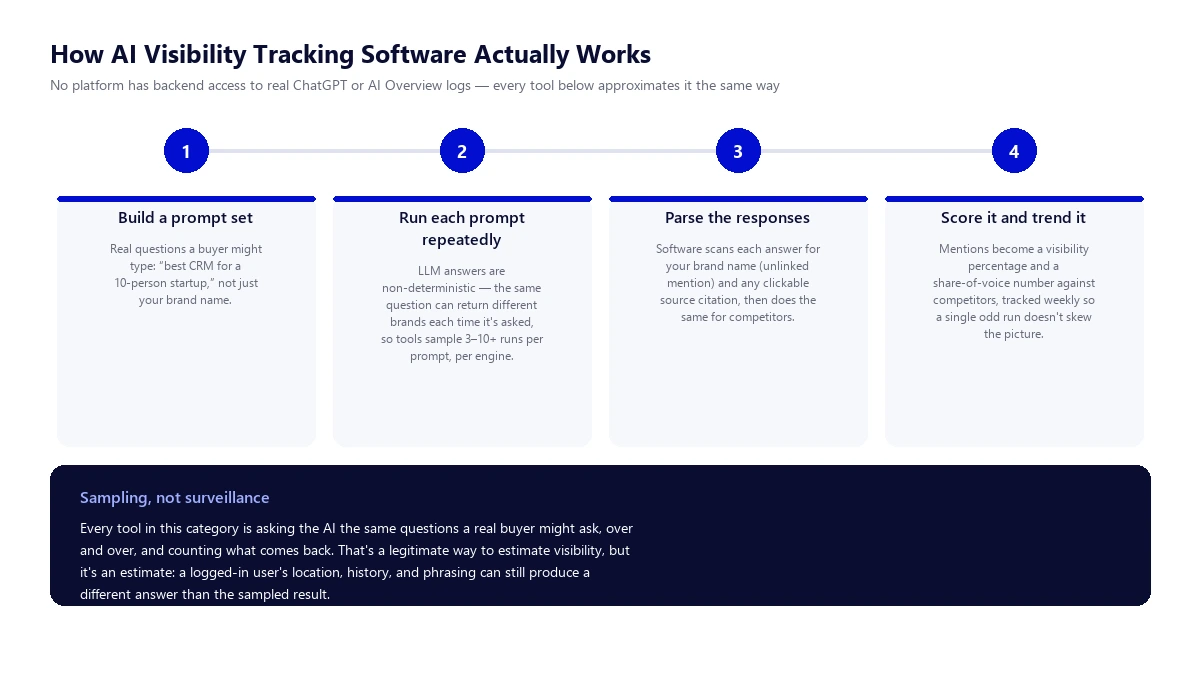
The reason this takes real engineering, not just an API wrapper, is that LLM answers are non-deterministic: asking “what’s the best project management tool for a small agency” twice can return a different list of brands both times, even with identical wording. A tool that pings an API once per prompt and reports a clean percentage is reporting a single dice roll dressed up as data. The platforms worth paying for run each prompt multiple times per engine, average the results, and hold the prompt set stable over weeks so a trend line means something. Some also run prompts through the consumer-facing interface itself, not only the raw API, since production AI search products layer retrieval-augmented generation and live citations on top of the base model in ways a bare API call can miss. We dug into exactly which of these tools disclose their real run counts, query methods, and confidence intervals in our methodology and accuracy comparison.
What this means practically: treat every visibility percentage or share-of-voice score as a well-informed estimate of what a typical user might see, not a literal count of real conversations. A logged-in user’s location, chat history, and exact phrasing can still produce a different answer than the sampled result. That’s not a flaw specific to any one vendor; it’s a structural limit of the entire category, and any sales page that implies otherwise is overselling. For the full breakdown of exactly which account-level factors, memory, custom instructions, model tier, browsing, location, cause this, see our explainer on whether ChatGPT gives the same answers to everyone.
Best AI Visibility Tools Compared
Every price and feature below was checked against the vendor’s own pricing or product page, not a secondhand roundup. This is a fast-moving category, several of these products have shipped new tiers or renamed features within the past few months, so treat this as a snapshot and re-check pricing before you buy.
| Tool | AI Engines Tracked | Starting Price | Best For |
|---|---|---|---|
| Otterly.AI | ChatGPT, AI Overviews, Perplexity, Copilot (Claude/Gemini/AI Mode as add-ons) | $29/mo (Lite, 15 prompts) | Cheapest real entry point into ongoing tracking |
| AthenaHQ | ChatGPT, Perplexity, AI Overviews, AI Mode, Gemini, Claude, Copilot, Grok | Free (Essential); $295/mo (Starter) | Testing the category at zero cost first |
| Peec AI | ChatGPT, Perplexity, Gemini, Copilot, AI Mode, AI Overviews (3 engines on Starter) | ~$95/mo (Starter, 50 prompts) | Monitoring paired with specific content fixes |
| Profound | ChatGPT (Starter) up to 9 engines including Perplexity, AI Overviews, Gemini, Claude, Grok (Enterprise) | $99/mo (Starter, ChatGPT only) | Enterprise-depth, prompt-level analytics |
| Scrunch AI | ChatGPT, Claude, Gemini, Perplexity, AI Mode, AI Overviews, Meta AI | $250/mo (Starter, annual billing) | Persona and agent-experience monitoring |
| Semrush AI Visibility Toolkit | ChatGPT, Google AI, Gemini, Perplexity | $99/mo (Base add-on) | Teams already inside the Semrush suite |
| Ahrefs Brand Radar | AI Overviews, AI Mode, ChatGPT, Copilot, Gemini, Perplexity (+YouTube/TikTok/Reddit beta) | €179/mo (select platforms) | Citation-source research at scale |
| SE Ranking (AI Search Toolkit) | AI Overviews, AI Mode, ChatGPT, Gemini, Perplexity | ~$89/mo (add-on) | Agencies running many client accounts cheaply |
The Tools, One by One
Otterly.AI
Otterly.AI tracks ChatGPT, Google AI Overviews, Perplexity, and Microsoft Copilot on its core plans, with Claude, Gemini, and Google AI Mode available as paid add-ons. Features include a brand visibility index, domain ranking against competitors, link citation analysis, and a Google Looker Studio connector for custom reporting.
| Pricing | Lite $29/mo (15 prompts) · Standard $189/mo (100 prompts) · Premium $489/mo (400 prompts) · Enterprise custom, from ~$1,000/mo |
| Engines Tracked | ChatGPT, AI Overviews, Perplexity, Copilot (core); Claude, Gemini, AI Mode (paid add-ons) |
| Pros | By far the cheapest genuine entry point into this category; four-engine core coverage is enough for most small and mid-size brands to start with |
| Cons | Cheap tiers cap you at a small prompt count; full six-to-seven-engine coverage requires stacking paid add-ons on top of the base price |
| Best For | A team testing whether AI visibility tracking is worth budgeting for long-term, without a $300+/month commitment |
AthenaHQ
AthenaHQ tracks a wide spread of engines and is one of the only tools in this list with a genuinely free tier rather than a time-limited trial, with content optimization agents, robots.txt and llms.txt management, and citation intelligence layered on top.
| Pricing | Essential free ($25 in credits) · Starter $295/mo (3,600 credits) |
| Engines Tracked | ChatGPT, Perplexity, AI Overviews, AI Mode, Gemini, Claude, Copilot, Grok |
| Pros | The free tier is a real way to see your own visibility numbers before paying anything; engine coverage is unusually broad even on the entry paid plan |
| Cons | The credit-based pricing model takes some getting used to compared to flat per-prompt tiers; the jump from free to Starter is steep |
| Best For | A first look at your brand’s AI visibility with zero financial commitment |
Peec AI
What differentiates Peec from a pure tracking tool is that it pairs the monitoring data with specific, actionable content recommendations instead of leaving you to interpret a dashboard alone.
| Pricing | Starter ~$95/mo (50 prompts, 1 project, billed annually); additional engines ~$35/mo each |
| Engines Tracked | ChatGPT, Perplexity, Gemini core; Copilot, AI Mode, AI Overviews available (self-serve tiers cap at 3 engines) |
| Pros | Genuinely bridges “here’s your visibility score” and “here’s what to change,” which fewer competitors do well |
| Cons | Annual-only self-serve billing and per-engine add-on pricing make the real monthly cost harder to predict upfront |
| Best For | Agencies and in-house teams that want the tool to suggest fixes, not just report numbers |
Profound
Profound is the closest thing this category has to an enterprise standard. Profound Agents, a credit-based autonomous content system, and AI-sourced traffic analytics with Google Analytics and Cloudflare integrations round out the platform.
| Pricing | Starter $99/mo (ChatGPT only) · Growth $399/mo (adds Perplexity + AI Overviews) · Enterprise custom (up to 9 engines) |
| Engines Tracked | ChatGPT (Starter) up to Gemini, Copilot, Grok, DeepSeek, Claude, Perplexity, AI Overviews (Enterprise), plus multi-company tracking |
| Pros | Deepest prompt-level analytics and engine coverage of any tool here, once you’re on Growth or Enterprise |
| Cons | The entry-level Starter tier is genuinely limited (ChatGPT only), so the useful version of Profound starts at $399/mo, not $99 |
| Best For | Larger brands and agencies that need granular, multi-engine data and are prepared to pay for it |
Scrunch AI
Scrunch’s distinguishing feature is persona-based “Agent Experience” monitoring, tracking how different AI systems represent your brand to different types of users, not just a flat visibility score.
| Pricing | Starter $250/mo annual, $300 month-to-month (3 users, 350 prompts, 5 page audits) · Growth $417/mo annual, $500 month-to-month (5 users, 700 prompts) |
| Engines Tracked | ChatGPT, Claude, Gemini, Perplexity, AI Mode, AI Overviews, Meta AI |
| Pros | Broad engine coverage including Meta AI, which few competitors track; the persona-monitoring angle is a genuinely different lens on the data |
| Cons | Pricing sits in the same range as Profound’s Growth tier without matching its enterprise engine count |
| Best For | Brands that care specifically about how AI agents represent them across different user personas or shopping contexts |
Semrush AI Visibility Toolkit
Semrush’s AI Visibility Toolkit slots AI tracking into a suite many teams already pay for, with daily AI rankings and AI-readiness site audits for one domain.
| Pricing | Base add-on $99/mo billed annually (25 custom prompts, 1 domain) · Semrush One bundle from $199/mo |
| Engines Tracked | ChatGPT, Google AI, Gemini, Perplexity |
| Pros | If your team already lives in Semrush for keyword and rank tracking, this slots into an existing workflow without a second login or invoice |
| Cons | Four engines and 25 prompts on the Base tier is thinner coverage than dedicated tools at a similar price point |
| Best For | Teams that want AI visibility folded into a suite they already pay for, not a standalone best-in-class tracker |
Ahrefs Brand Radar
Brand Radar draws on a claimed 473 million monthly prompts, plus beta tracking for YouTube, TikTok, and Reddit mentions.
| Pricing | €179/mo (select platforms) · €654/mo (full access, 2,500 monthly custom prompt checks) |
| Engines Tracked | Google AI Overviews, AI Mode, ChatGPT, Copilot, Gemini, Perplexity (+YouTube/TikTok/Reddit beta) |
| Pros | Strong citation-source analysis, showing which specific pages and domains are getting cited for your topic |
| Cons | Full access is priced in euros and lands well above most standalone competitors once you want every platform |
| Best For | Teams already on Ahrefs who want deep citation-source research, not just a visibility percentage |
SE Ranking (AI Search Toolkit / SE Visible)
SE Ranking logs both linked citations and unlinked brand mentions, which matters since AI answers reference brands by name far more often than they hand out clickable links.
| Pricing | AI Results Tracker add-on ~$89/mo · SE Visible standalone from $189/mo (450 prompts) |
| Engines Tracked | AI Overviews, AI Mode, ChatGPT, Gemini, Perplexity |
| Pros | Cheapest way to add multi-engine AI tracking onto an existing SEO subscription; counts unlinked mentions, not just links |
| Cons | The standalone SE Visible product refreshes weekly, not daily, slower than most dedicated competitors |
| Best For | Agencies managing many client accounts who need the feature at the lowest add-on price in this list |
Which Tool Fits Your Situation
Most “top 10” roundups in this space stop at a feature table. The more useful question is which of these fits your budget and buying situation, since a $95/month agency tool and a $399/month enterprise platform are solving genuinely different problems.
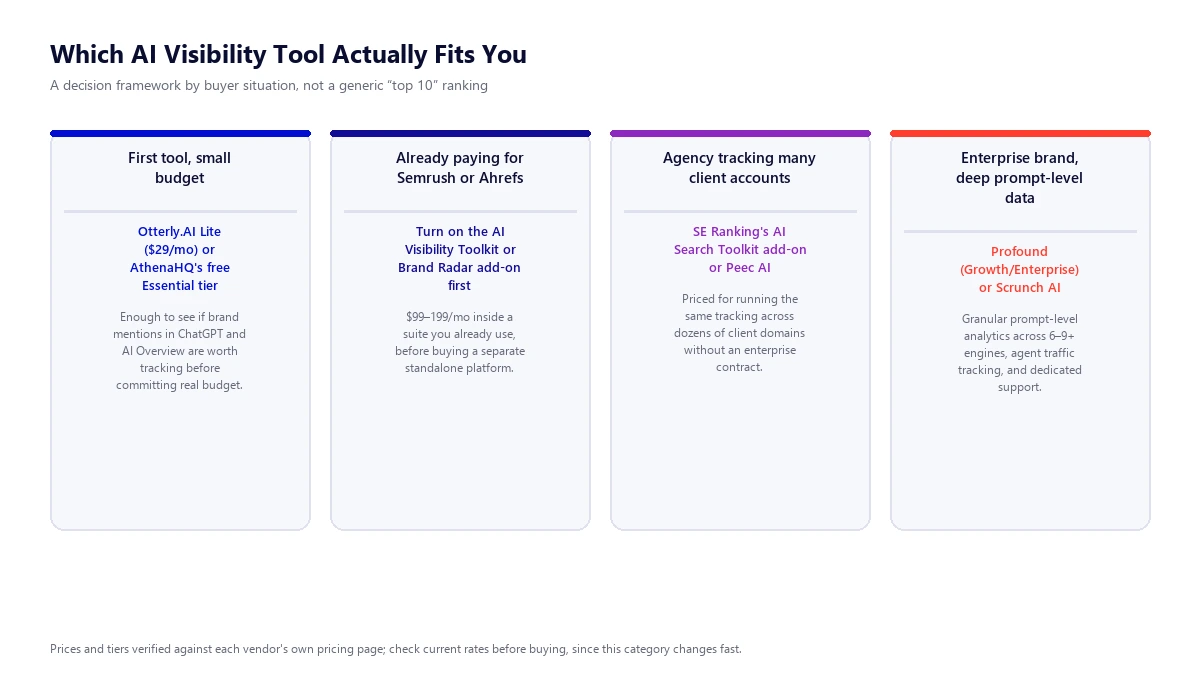
If this is your first AI visibility tool and budget is tight, start with Otterly.AI’s Lite plan or AthenaHQ’s free Essential tier instead of committing to an enterprise contract before you know whether the data changes anything you do. If you’re already paying for Semrush, Ahrefs, or SE Ranking for conventional SEO, turn on their AI visibility add-on first; it’s a smaller incremental cost than a new standalone subscription, and for many mid-size brands it’s genuinely enough. If you’re an agency tracking AI visibility across a roster of client accounts, SE Ranking’s add-on or Peec AI are priced closer to a per-client model than an enterprise seat. And if you’re a larger brand that needs prompt-level detail across six or more engines with dedicated support, Profound’s Growth or Enterprise tier, or Scrunch AI, are built for that scale, and priced accordingly.
What Actually Gets a Page Cited by AI Overview, ChatGPT, and Perplexity
Since South Asia Digital’s own work is on the technical SEO and AI-visibility side, it’s worth being direct about what correlates with getting cited, not vague advice to “create quality content.” This is also the structure this article itself follows, not just advice handed down from a distance.
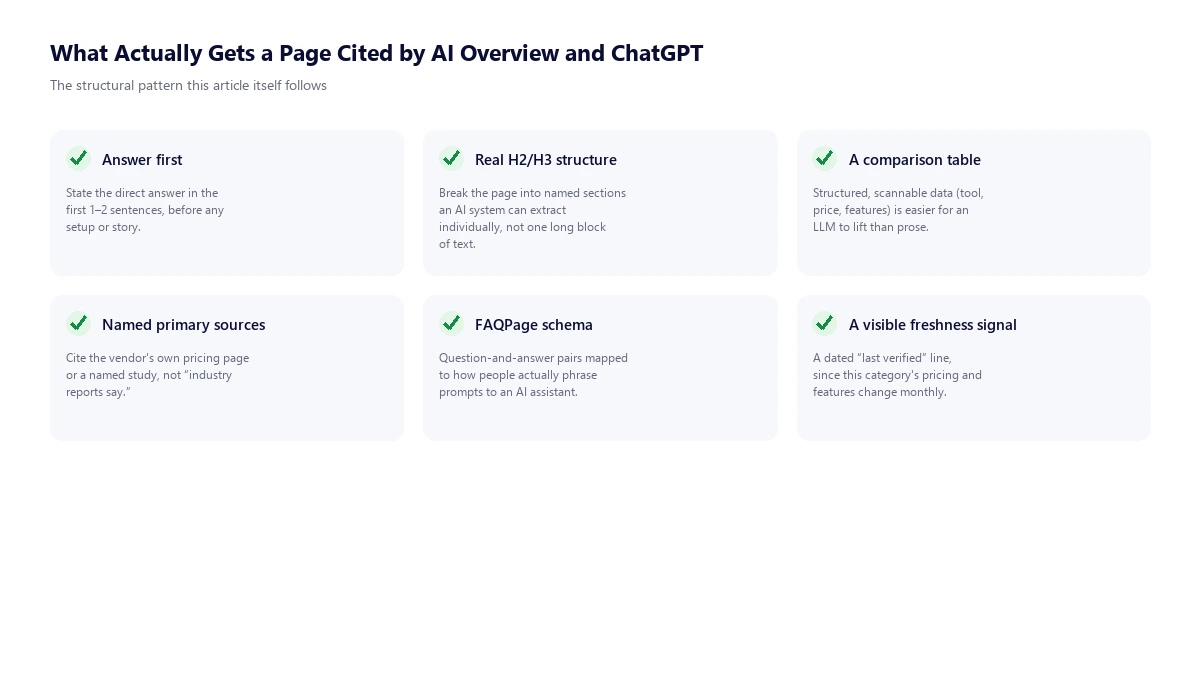
A direct answer near the top of the page, stated in one or two sentences before any scene-setting, gives an AI system something to lift immediately instead of forcing it to summarize a whole article to find your point. Genuine H2 and H3 structure lets a model extract one section without needing the rest, which is why a wall of undifferentiated text tends to get skipped over even when the underlying information is accurate. Comparison tables outperform the equivalent information in prose because structured, scannable data is easier for a model to parse and quote cleanly than a paragraph making the same points. Naming primary sources, a vendor’s own pricing page instead of “industry reports say,” gives the AI a citable, verifiable anchor for a claim instead of an unattributed generalization. FAQPage schema, paired with FAQ copy that mirrors how people phrase questions to an AI assistant, maps directly onto the question-and-answer format most AI search retrieval is built around. And a visible freshness signal matters more in a category like this one, where pricing and feature sets shift monthly, than it does for evergreen how-to content; an AI system has a real reason to prefer a page that shows it was recently checked over one that reads like it hasn’t been touched since last year.
Common Mistakes When Evaluating These Tools
- Buying single-engine coverage and calling it done. A tool that only tracks ChatGPT tells you nothing about your AI Overview or Perplexity visibility, and those numbers regularly diverge for the same brand and query.
- Treating a visibility percentage as a ranking. These are sampled estimates from repeated prompt runs, not a scoreboard with one correct number; expect week-to-week variance even with no changes on your end.
- Assuming a stack you already pay for has this covered. Not every SEO suite added AI tracking, and the ones that did often gate it behind a separate add-on instead of including it by default, so check before assuming.
- Ignoring unlinked mentions. AI answers reference brands by name without a clickable citation far more often than they link out; a tool that only counts links understates your real presence.
- Picking the platform with the most engines instead of the one matching your budget. Nine tracked engines you never look at is worse value than four you act on.
If tracking your AI visibility surfaces a real gap, thin content, missing structured data, or a page an AI system can’t confidently extract, that’s the same technical groundwork covered in our entity mapping guide, which explains how to structure a page so AI systems can extract facts from it in the first place, not just how to measure whether they currently do. For teams that would rather have this handled for them than build it in-house, our SEO services include AI Overview and answer-engine visibility work as part of standard technical SEO.
Frequently Asked Questions
What is the best AI visibility tool overall?
There isn’t one universal best tool, since the right pick depends on budget and how many AI engines you need tracked. Otterly.AI offers the cheapest genuine entry point at $29/month, Profound offers the deepest enterprise analytics starting near $399/month for real multi-engine coverage, and Peec AI and Scrunch AI sit in between with a stronger focus on actionable recommendations, not just tracking data.
Is there a free AI visibility tracking tool?
AthenaHQ offers a genuine free Essential tier with $25 in usage credits, not a capped-time trial, making it the most realistic no-cost way to see your own AI visibility numbers before paying for anything. Most other tools in this category offer free trials, not a permanent free tier.
How is this different from a free AEO or GEO checker extension?
A checker extension audits one page’s technical readiness (schema, AI crawler access, content structure) in a single spot-check, usually for free. The tools in this article are subscription platforms that repeatedly sample ChatGPT, Perplexity, and AI Overview over time to track whether your brand’s visibility and citation frequency is rising or falling, and how you compare to named competitors, which a one-time page audit cannot show.
Can these tools guarantee my brand gets cited by ChatGPT or AI Overview?
No. Every tool in this category measures and reports visibility; none of them can force an AI system to mention a specific brand. Some, like Peec AI and AthenaHQ, pair the tracking data with content recommendations intended to improve your odds, but citation itself is decided by the AI model, not the monitoring software.
How accurate are AI visibility percentages, really?
They’re estimates built from repeatedly sampling AI responses to a fixed prompt set, not a literal count of real user conversations, since no vendor has access to actual ChatGPT or AI Overview server logs. LLM answers are non-deterministic, so even a well-built tool will show some run-to-run variance; treat the trend over several weeks as more meaningful than any single day’s number.
Do I need a dedicated AI visibility tool if I already use Semrush or Ahrefs?
Not necessarily as a first step. Semrush’s AI Visibility Toolkit and Ahrefs Brand Radar both add AI tracking to suites many teams already pay for, at a lower incremental cost than a new standalone subscription. Move to a dedicated platform like Profound, Peec AI, or Scrunch AI once you need engine coverage, prompt volume, or persona-level detail those add-ons don’t provide.
Which AI engines should a visibility tool track?
At minimum, ChatGPT and Google AI Overview, since they carry the largest user bases, plus Perplexity if your audience skews toward research-heavy queries. Visibility figures regularly diverge between engines for the same brand and query, so a tool tracking only one platform will miss real blind spots where a competitor is winning citations elsewhere.