Type the same question into ChatGPT and Perplexity and you can get two completely different sets of sources back, not just two different-sounding answers. That’s not a bug in one of them. It’s because the two products are built to find and cite information in genuinely different ways, and most “AI visibility” software was designed around ChatGPT’s behavior first, with Perplexity folded in afterward.
Perplexity runs a live web search on every single query, with no exception and no offline mode. ChatGPT decides per query whether a live search is even worth running, and skips it most of the time. That one difference changes what a rank tracker needs to measure, and it’s why several tools that market themselves as covering Perplexity treat it as a lower-fidelity afterthought once you look past the feature list.
This guide covers both halves of that problem: what makes Perplexity’s citation behavior genuinely different from ChatGPT and Google AI Overview, and which real tools track it with genuine rigor, not just a checkbox. For the broader pricing and feature comparison across all the major AI visibility platforms, see our full AI visibility tools roundup; for how rigorously each of those tools measures anything at all, see our methodology and accuracy comparison. This piece sits between those two: it’s specifically about Perplexity, and about which tools are built for it, not just compatible with it.
Key Takeaways
- Perplexity searches the live web on every query, no exception. ChatGPT only triggers a live web search on a fraction of queries (one tested sample put it at roughly 42%), so a tool built around ChatGPT’s on/off search behavior isn’t measuring Perplexity the same way by default.
- Perplexity’s sourcing pattern leans community and real-time, not encyclopedic. Independent citation research puts Reddit as Perplexity’s single most-cited domain, while ChatGPT leans toward Wikipedia and other consensus references, and only around 11% of cited domains overlap between the two for the same queries.
- Four tools treat Perplexity as first-class from their entry tier: Otterly.AI, AthenaHQ, Semrush’s AI Visibility Toolkit, and SE Ranking’s AI Search Toolkit all include Perplexity on their cheapest (or free) plan, no upsell required.
- Two tools track Perplexity with real caveats worth knowing before you buy: Peec AI’s self-serve plans only track 3 of 6 possible engines, so Perplexity has to be actively chosen; Ahrefs Brand Radar refreshes Perplexity monthly, the same cadence as ChatGPT, while Google’s own AI Overviews refresh continuously.
- One major platform gates Perplexity behind an upsell entirely: Profound’s $99/month Starter tier is ChatGPT only. Perplexity doesn’t unlock until the $399/month Growth tier.
- None of this is about which tool has the prettiest dashboard. It’s about whether the tool’s underlying method matches how Perplexity behaves, or just lists Perplexity as a checkbox next to five other engines.
How Perplexity Actually Retrieves and Cites Sources, vs ChatGPT and AI Overview
Perplexity’s own Help Center describes the product as interpreting a question, searching the web in real time, and returning a cited, conversational answer built from what it finds, using underlying models that have included GPT-5 and Claude alongside Perplexity’s own Sonar models. That last detail matters more than it first appears: Perplexity isn’t one fixed model behaving one way. It’s a retrieval layer that can sit on top of more than one underlying model, which means a tracker measuring “Perplexity” is really measuring the retrieval and citation behavior of the product, not the quirks of a single language model the way a ChatGPT tracker mostly is.
The retrieval step itself is the biggest structural difference. Perplexity runs a live web search on every query it receives, full stop. There’s no mode where it just answers from memory the way a base language model does. ChatGPT works the opposite way by default: it decides, per query, whether the question needs a live search or whether its training data is enough. One independent test across 391 brand and product queries found that only about 42% actually triggered a live web search, with the rest answered from training data alone. Practically, that means a page can be well optimized and still get zero ChatGPT citations on a given query simply because ChatGPT never went looking, while the same query run through Perplexity always triggers a real retrieval pass.
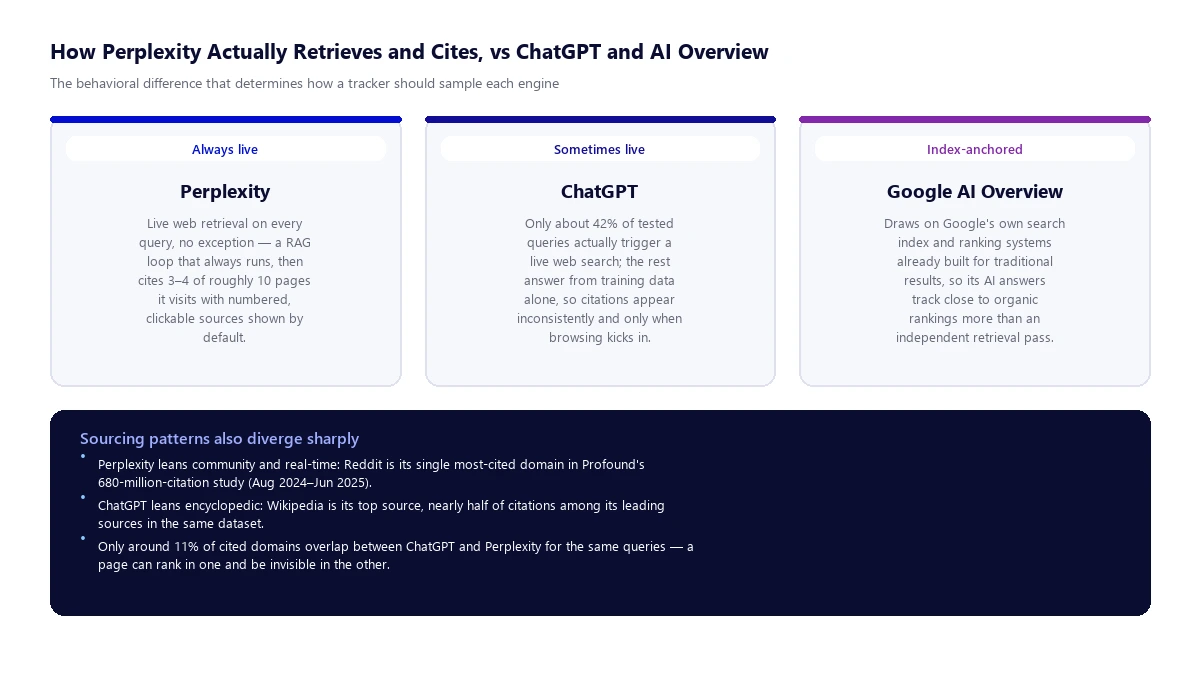
Google AI Overview takes a third approach again: it’s built on top of Google’s own search index and ranking systems, the same infrastructure that produces traditional results, so its AI answers tend to track closer to organic rankings than an independent retrieval pass does. This isn’t a minor implementation detail. It’s the reason a page can rank well in Google’s organic results and show up in AI Overview for the same query, while a completely different page wins the citation in Perplexity for that exact phrase.
The citation display itself is also more consistent in Perplexity than in ChatGPT. Every Perplexity answer includes numbered, clickable citations by default, visible without the user doing anything. ChatGPT only shows citations when a search actually ran, and even then the presentation is less uniform. Of roughly ten pages Perplexity’s retrieval typically visits for a query, independent analysis suggests only three to four are actually cited in the final answer, which means getting crawled isn’t the same as getting cited, and a tracker that only checks “did Perplexity visit my page” is answering the wrong question.
Sourcing patterns diverge sharply too, and this is where the two products feel most different if you’ve used both. A large citation-pattern study by Profound, covering roughly 680 million citations between August 2024 and June 2025, found Reddit to be Perplexity’s single most-cited domain, describing its overall pattern as prioritizing community discussions and peer-to-peer information. ChatGPT’s top source in the same dataset was Wikipedia, described as favoring authoritative knowledge bases and established media, with Wikipedia alone accounting for nearly half of citations among ChatGPT’s leading sources. The same research found only around 11% overlap in cited domains between ChatGPT and Perplexity for comparable queries, meaning a page that ranks well for AI citations in one can be functionally invisible in the other. Separately, Ahrefs’ own published Brand Radar methodology reports Perplexity processing roughly 14.6 million monthly prompts in its tracked dataset, close to ChatGPT’s and Gemini’s volume but a fraction of Google AI Overview’s 282 million, a useful reminder that Perplexity is a meaningfully smaller surface than Google’s own AI layer even though it gets talked about as a peer.
Freshness plays a bigger role in Perplexity’s citations than it does for ChatGPT or AI Overview. Multiple independent tests point the same direction: recently updated content gets cited noticeably more often than older pages covering the same topic, and Perplexity has also been shown to simply skip sites that block it in robots.txt, since the product depends on crawling a page live instead of pulling from a pre-built index. None of this is exotic; it follows directly from Perplexity’s real-time-retrieval design. But it means the technical accessibility and update cadence of a page matter more for Perplexity citations specifically than they do for a static training-data answer from ChatGPT. For the deeper explanation of how personalization, login state, and phrasing can also change what any one of these systems shows a given user, see our companion piece on whether ChatGPT gives the same answers to everyone.
What This Means When You’re Choosing a Tool to Track Perplexity
Our methodology comparison already found that AI visibility tools are uneven across engines in general, some query the real consumer product through browser automation, others rely on predefined datasets or the raw API, and almost none publish a confidence interval next to their headline number. Perplexity specifically sits at the sharper end of that unevenness, for a simple reason: because it always retrieves live, a tool that samples it infrequently or treats it identically to a training-data-first model like ChatGPT is more likely to miss real movement in the underlying picture.
In practice, this shows up as three different postures once you look past each vendor’s feature list, not just its logo grid. Some tools include Perplexity as a genuine first-class engine from their cheapest tier, with no separate charge and no reduced feature set. Some make Perplexity available but not guaranteed, competing with other engines for a limited number of tracked slots. And at least one major platform locks Perplexity out of its entry-level plan entirely, treating it as a premium add-on instead of a baseline feature.
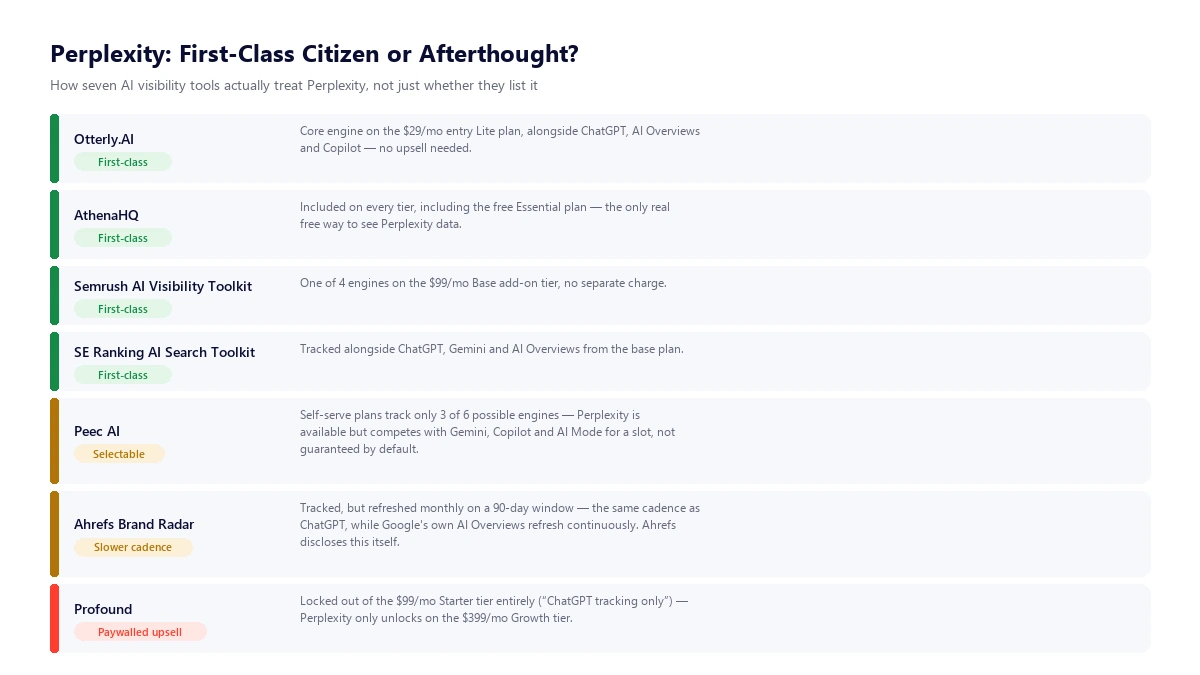
None of this means the paywalled or selectable tools are bad products. Profound’s depth once you’re on its Growth tier is real, and Peec AI’s content recommendations are genuinely useful. It means the sticker price and the feature-list checkmark next to “Perplexity” don’t tell you how that vendor treats it in practice, and that’s worth knowing before you commit a budget to tracking an engine that might turn out to be an add-on you have to pay more for later.
AI Visibility Tools Compared, by How They Actually Treat Perplexity
Every price and feature below was checked against the vendor’s own pricing or product page directly, not a secondhand roundup, since this exact search term turns up a large number of thin, templated “best Perplexity tracker” articles from sites with no independently verifiable product testing behind them. This is a fast-moving category; treat this as a snapshot and re-check pricing before you buy.
| Tool | Perplexity Treatment | Starting Price | Best For |
|---|---|---|---|
| Otterly.AI | First-class, core engine on every tier | $29/mo (Lite) | Cheapest genuine entry point with Perplexity included |
| AthenaHQ | First-class, included on the free tier too | Free (Essential) | Testing Perplexity visibility at zero cost |
| Semrush AI Visibility Toolkit | First-class, 1 of 4 base-tier engines | $99/mo (Base) | Teams already inside the Semrush suite |
| SE Ranking AI Search Toolkit | First-class, tracked from the base plan | ~$89/mo (add-on) | Agencies tracking Perplexity across many client accounts |
| Peec AI | Selectable, 1 of 3 slots on self-serve plans | ~€85/mo (Starter) | Teams that know they want Perplexity as one of their 3 engines |
| Ahrefs Brand Radar | Tracked, slower refresh than Google’s own AI surfaces | €179/mo (select platforms) | Buyers who value disclosed limitations over a spotless sales page |
| Profound | Paywalled upsell, not on the entry tier | $399/mo (Growth, for Perplexity) | Enterprise buyers who need deep multi-engine analytics anyway |
First-Class From Day One
Otterly.AI
Otterly.AI tracks Perplexity as one of four core engines on every paid tier, including the cheapest one, alongside ChatGPT, Google AI Overviews, and Microsoft Copilot. Claude, Gemini, and Google AI Mode are available as paid add-ons on top, but Perplexity itself has never required one.
| Pricing | Lite $29/mo (15 prompts) · Standard $189/mo (100 prompts) · Premium $489/mo (400 prompts) · Enterprise custom, from ~$1,000/mo |
| Perplexity Fidelity | Core engine on every tier including entry-level Lite, no add-on fee, tracked alongside ChatGPT/AI Overviews/Copilot from day one |
| Pros | The cheapest real way to get Perplexity data without an upsell; four-engine core coverage is enough for most small and mid-size brands to start with |
| Cons | The Lite tier caps you at 15 prompts, thin if you want to track many query variations; the vendor doesn’t publish per-prompt run counts specific to Perplexity |
| Best For | A team that wants Perplexity tracked from the first invoice, without paying extra for it later |
AthenaHQ
AthenaHQ is the only tool in this comparison that includes Perplexity on a genuinely free, permanent tier rather than a time-limited trial, and it stays included through every paid tier above that.
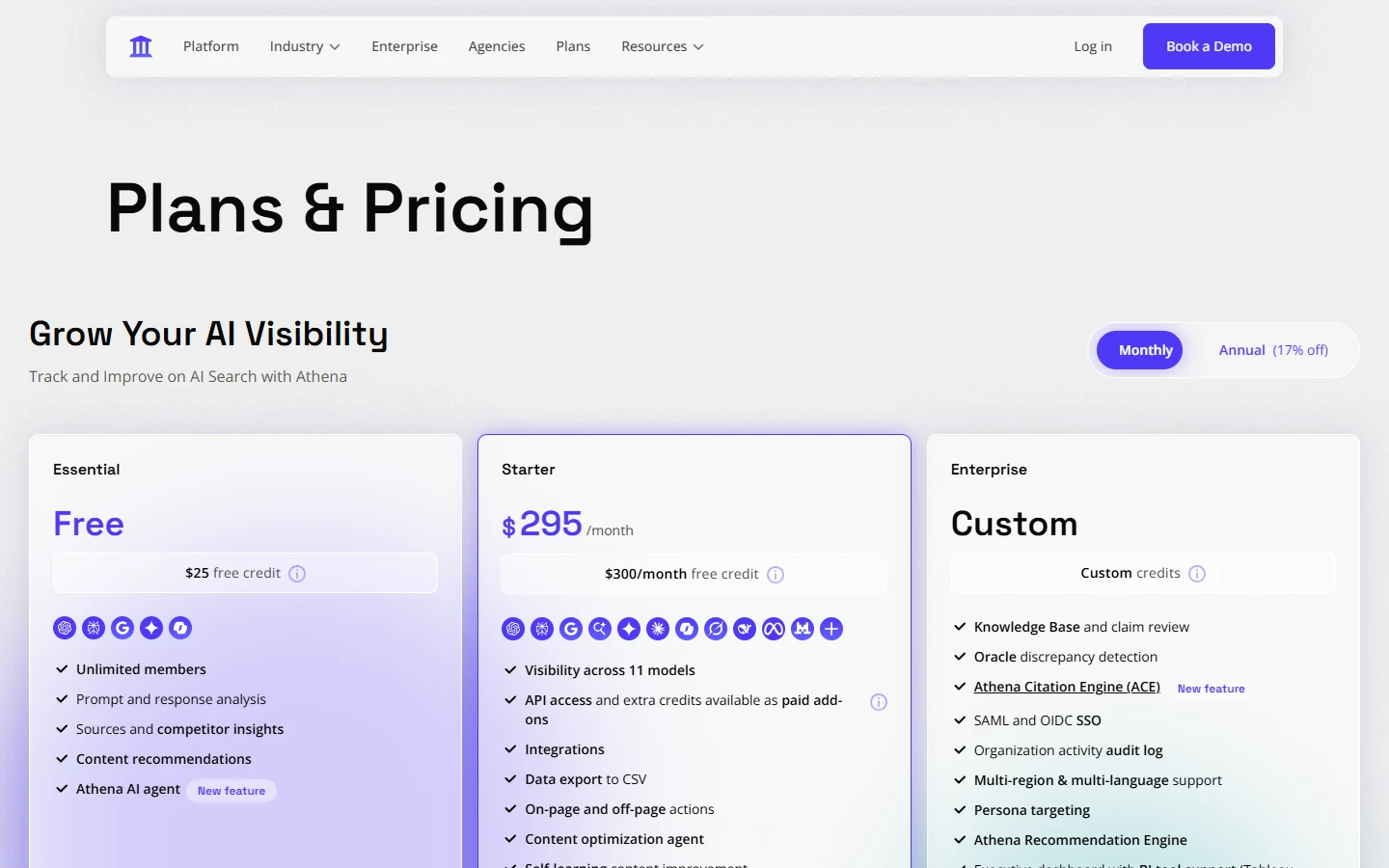
| Pricing | Essential free ($25 in credits) · Starter $295/mo (3,600 credits) · Enterprise custom |
| Perplexity Fidelity | Included on all three tiers, including the free Essential plan; Starter and Enterprise widen coverage to 9-11 engines total, still with no separate Perplexity charge |
| Pros | A real way to see your own Perplexity visibility numbers before spending anything; unusually broad engine coverage even on the entry paid plan |
| Cons | Credit-based pricing takes some getting used to; the jump from free to $295/mo Starter is steep |
| Best For | Checking your brand’s real Perplexity visibility with zero financial commitment first |
Semrush AI Visibility Toolkit
Semrush’s own pricing page confirms Perplexity mentions are tracked directly on the $99/month Base tier, alongside ChatGPT, Google AI, and Gemini, with no separate Perplexity charge inside a suite many marketing teams already pay for.
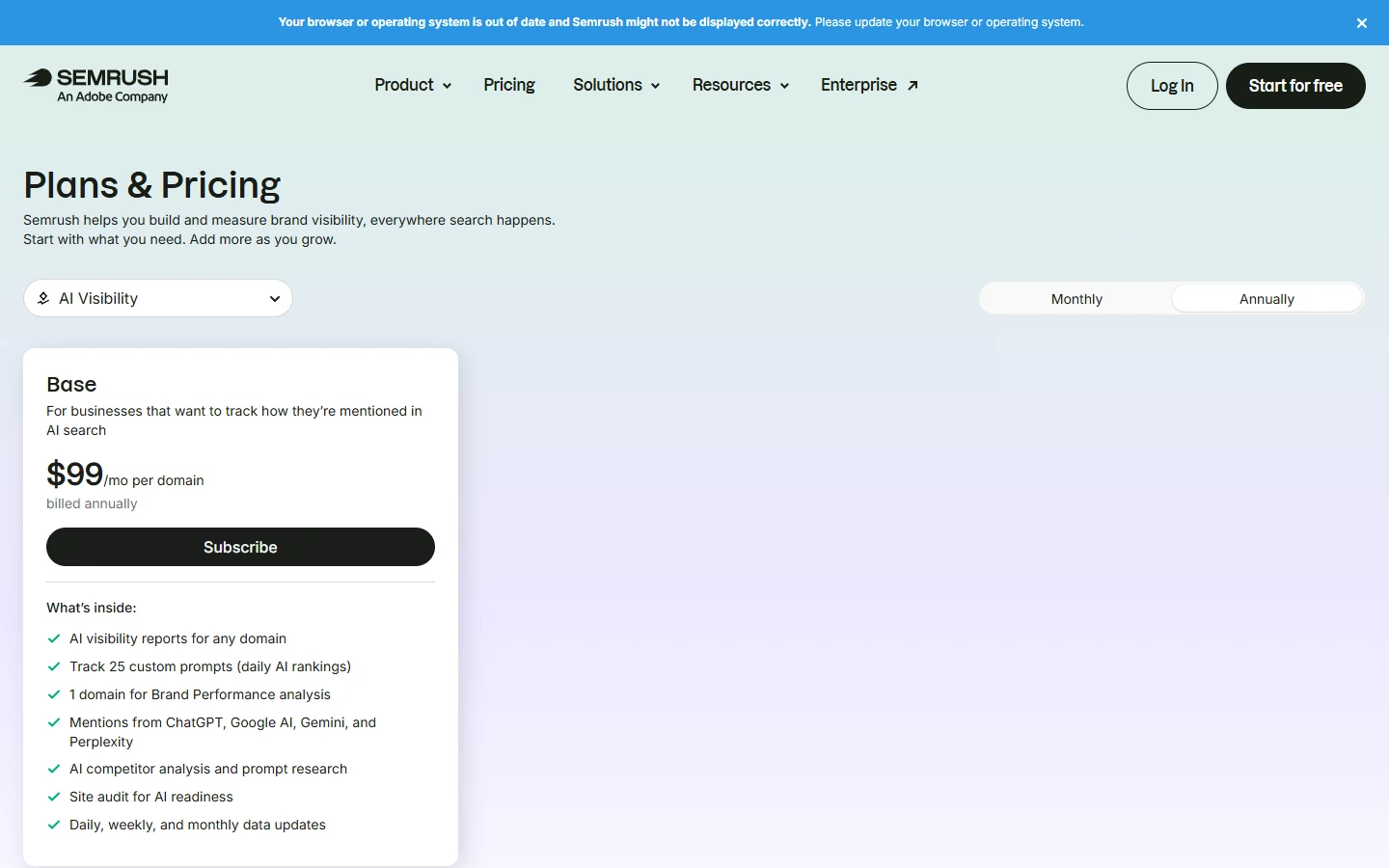
| Pricing | Base add-on $99/mo billed annually (25 custom prompts, 1 domain) · Semrush One bundle from $199/mo |
| Perplexity Fidelity | One of just 4 engines tracked on the base tier (ChatGPT, Google AI, Gemini, Perplexity), confirmed directly on the pricing page, not buried in a higher tier |
| Pros | If your team already lives in Semrush, Perplexity tracking slots in without a second login or invoice |
| Cons | 25 prompts and 1 domain on the Base tier is thin coverage compared to dedicated tools at a similar price |
| Best For | Teams that want Perplexity folded into a suite they already pay for, not a standalone tracker |
SE Ranking AI Search Toolkit
SE Ranking’s own product page shows Perplexity as one of five engines tracked from the base plan, alongside ChatGPT, Gemini, AI Overviews, and AI Mode, logging both linked citations and unlinked brand mentions.
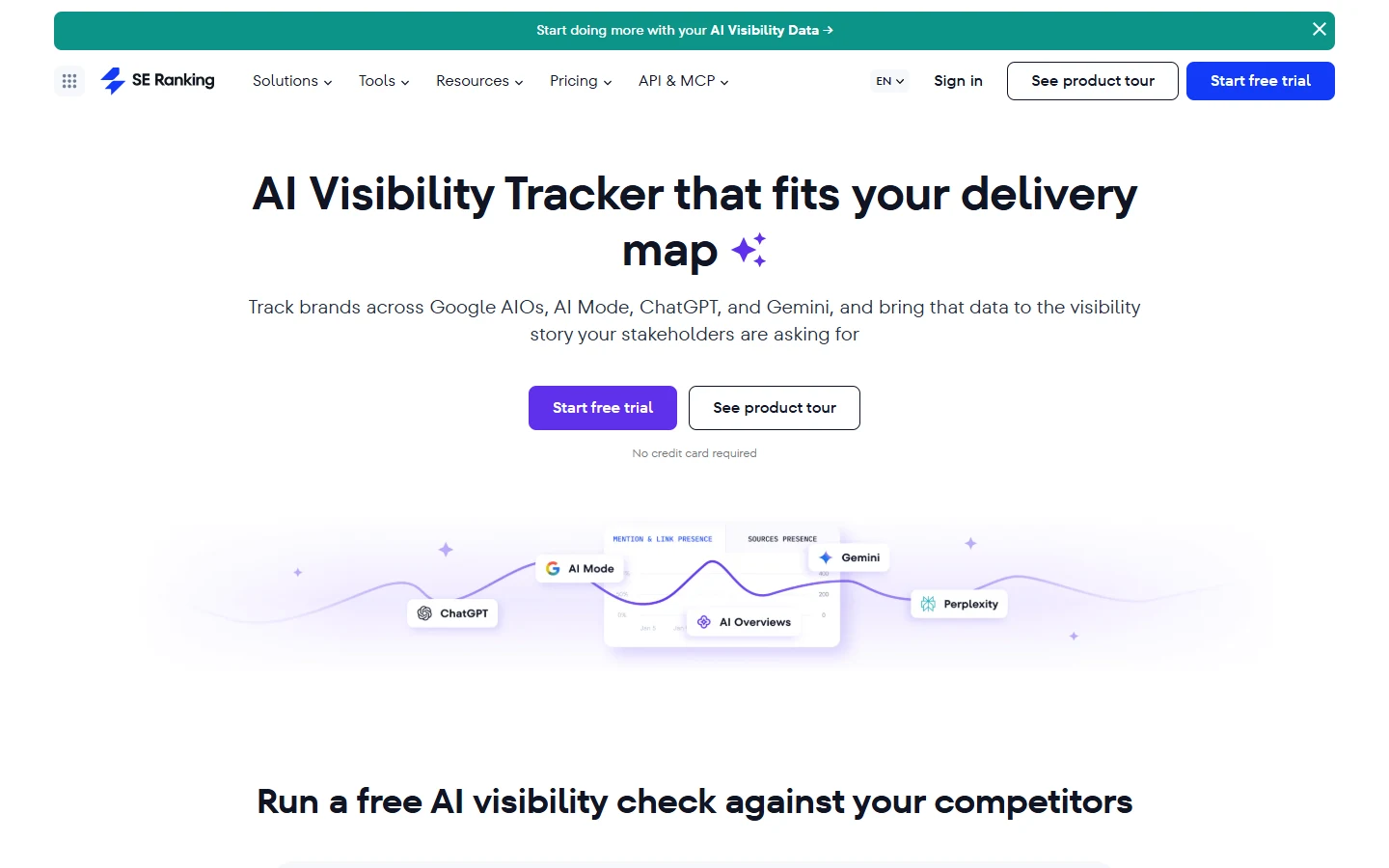
| Pricing | AI Results Tracker add-on ~$89/mo · SE Visible standalone from $189/mo (450 prompts) |
| Perplexity Fidelity | Tracked from the base plan alongside 4 other engines; counts unlinked brand mentions as well as clickable citations |
| Pros | Cheapest way to add Perplexity tracking onto an existing SEO subscription; counts mentions Perplexity makes without a link, not just citations |
| Cons | The standalone SE Visible product refreshes weekly, not daily, slower than several dedicated competitors |
| Best For | Agencies tracking Perplexity visibility across many client accounts at the lowest add-on price in this comparison |
Real, But With Real Caveats
Peec AI
Peec AI’s own pricing shows every self-serve plan (Starter, Pro, Advanced) tracking only 3 of 6 possible engines, chosen from ChatGPT, Google AI Mode, AI Overviews, Microsoft Copilot, Perplexity, and Gemini. Perplexity is available and commonly picked, but it isn’t a guaranteed default the way it is on the four tools above; adding a fourth engine costs extra on every tier.
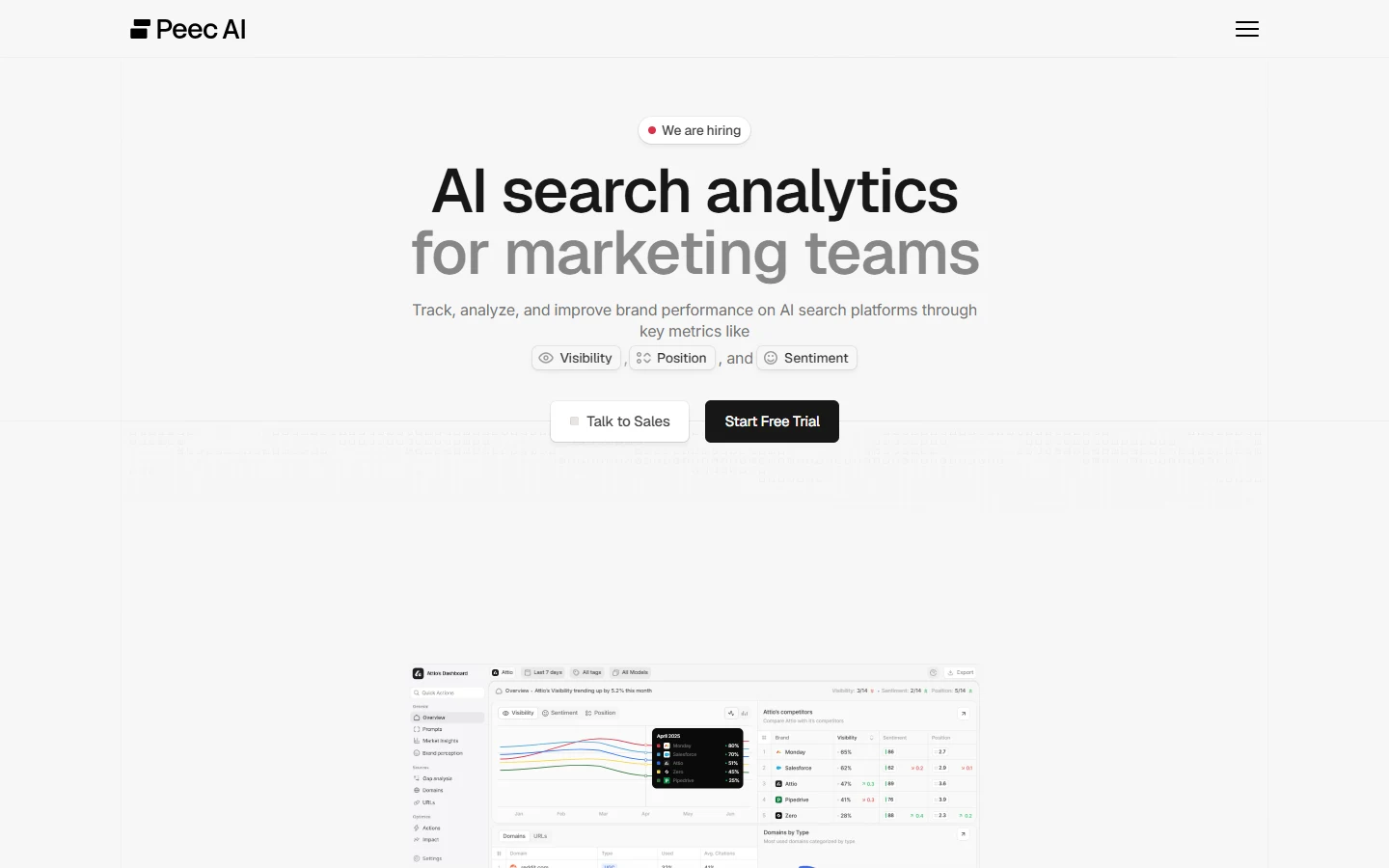
| Pricing | Starter ~€85/mo · Pro ~€205/mo · Advanced ~€425/mo (self-serve, monthly; lower on annual billing) |
| Perplexity Fidelity | Self-serve plans track only 3 of 6 possible engines; Perplexity has to be actively selected and competes with Gemini, Copilot, and AI Mode for a slot, with extra engines priced separately |
| Pros | Pairs Perplexity tracking, once selected, with specific content recommendations instead of a bare dashboard |
| Cons | Perplexity isn’t guaranteed unless you deliberately choose it over another engine on setup |
| Best For | A team that already knows it wants Perplexity as 1 of its 3 tracked engines, not a general-purpose default |
Ahrefs Brand Radar
Ahrefs’ own published methodology is unusually candid about how it treats Perplexity relative to Google’s own AI surfaces: Perplexity, ChatGPT, Gemini, and Copilot all refresh monthly on a 90-day reporting window, while Google AI Overviews and AI Mode refresh continuously. That’s not a flaw Ahrefs hides. It’s disclosed directly, which is more than most competitors say about their own per-engine coverage.
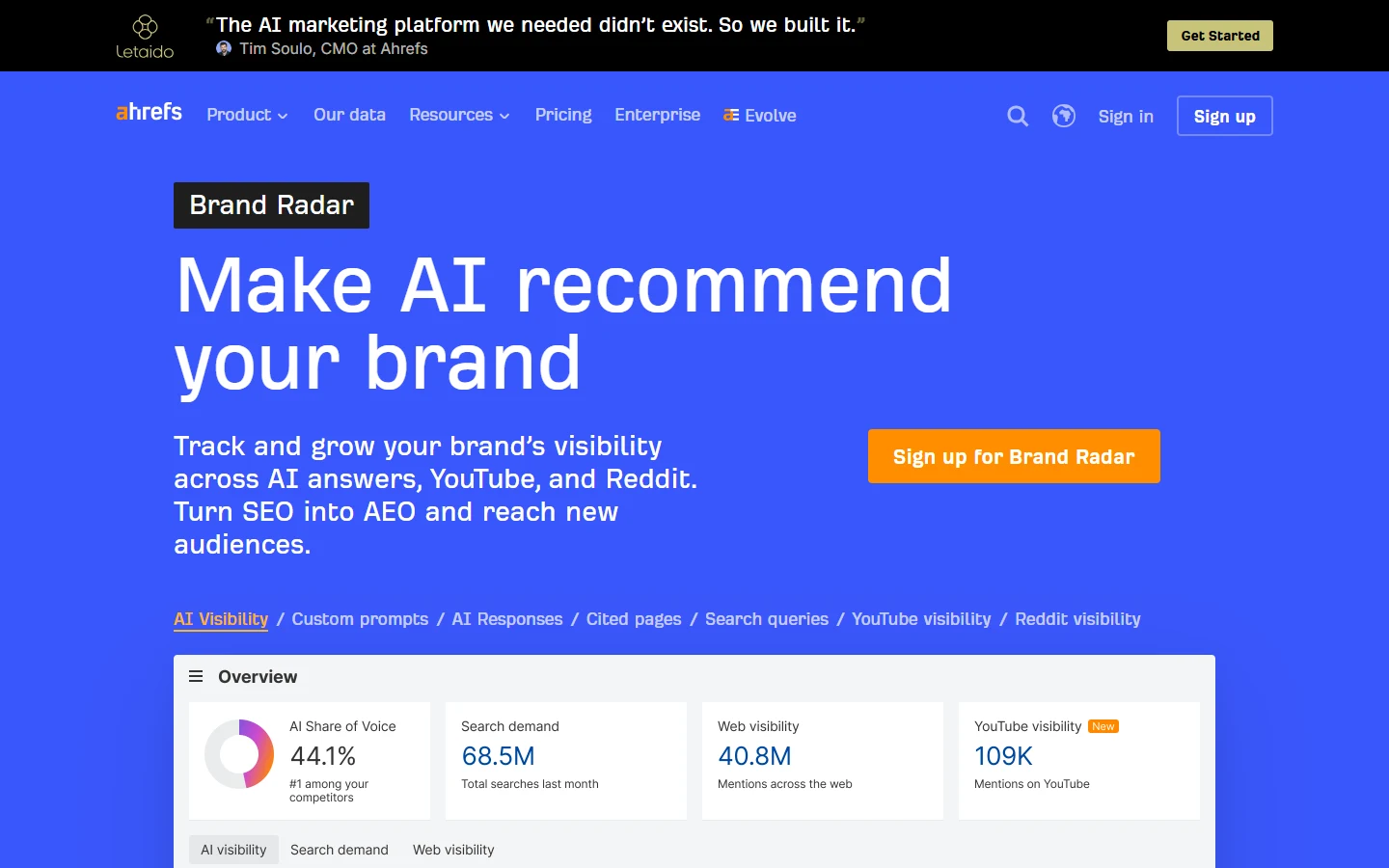
| Pricing | €179/mo (select platforms) · €654/mo (full access, 2,500 monthly custom prompt checks) |
| Perplexity Fidelity | Tracked and disclosed in detail, but refreshed monthly, the same cadence as ChatGPT, not the continuous refresh Google gives its own AI Overviews and AI Mode inside the same tool |
| Pros | The only tool here that publishes a real Perplexity query-volume figure (roughly 14.6 million monthly prompts) and states its own refresh limitations in writing |
| Cons | A monthly refresh for an engine whose whole design is live, per-query retrieval feels mismatched, even if Ahrefs is honest about it |
| Best For | Buyers who’d rather have a disclosed limitation than a vendor that hides one |
Perplexity as a Paid Upsell
Profound
Profound’s own pricing page is direct about this: the $99/month Starter plan is described as “ChatGPT tracking only,” and Perplexity doesn’t appear until the $399/month Growth tier, which adds it alongside Google AI Overviews. Enterprise pricing extends further to up to 9 engines, Perplexity included.
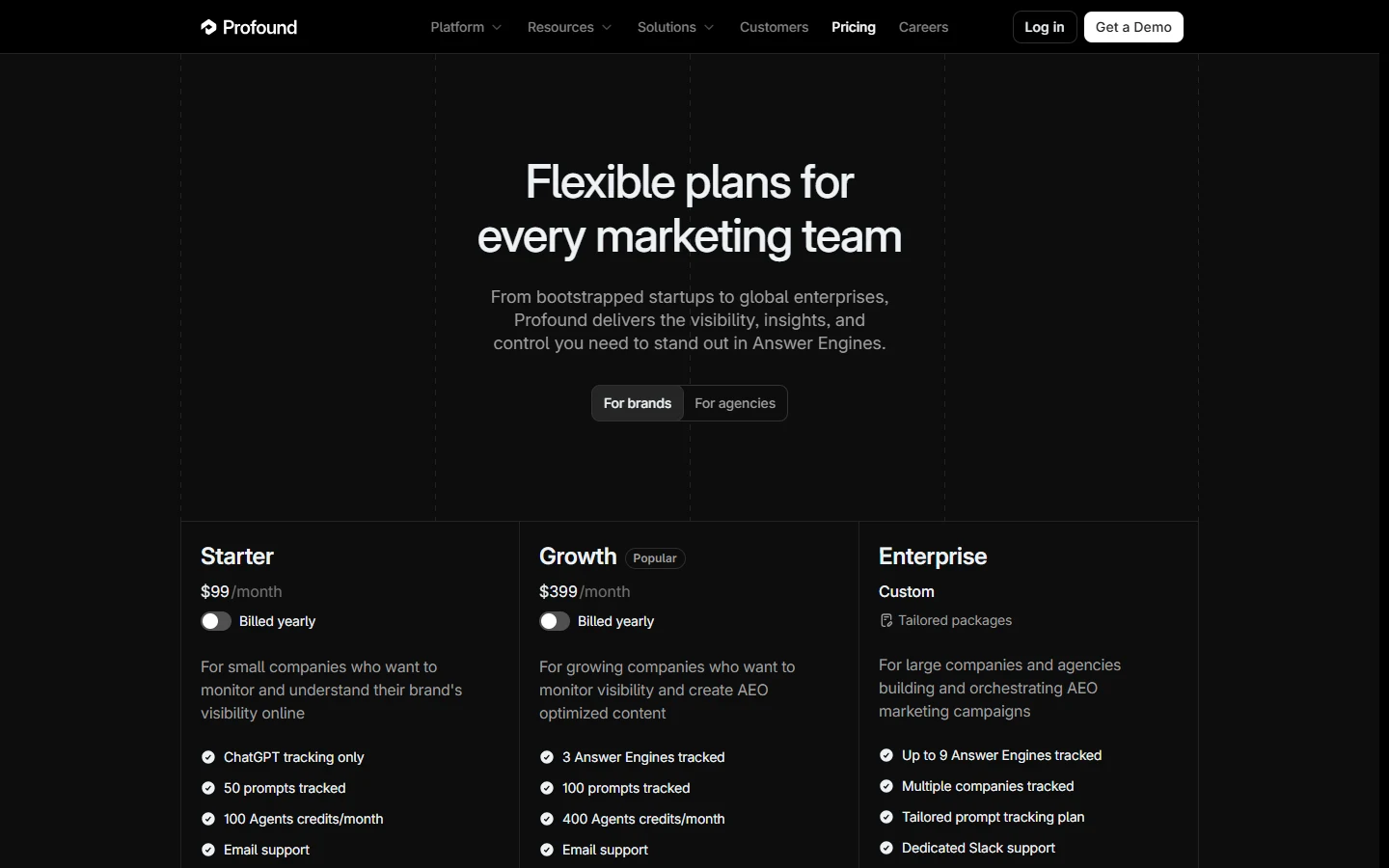
| Pricing | Starter $99/mo (ChatGPT only) · Growth $399/mo (adds Perplexity + AI Overviews) · Enterprise custom (up to 9 engines) |
| Perplexity Fidelity | Not available at all on the entry Starter tier; requires upgrading to Growth at $399/mo, a 4x price jump specifically to add Perplexity and AI Overviews |
| Pros | Once unlocked, the deepest prompt-level analytics of any tool in this comparison, with a disclosed 10-or-more-runs-per-prompt stability threshold in one published study |
| Cons | The genuinely useful, Perplexity-inclusive version of this product starts at $399/mo, not the $99/mo headline price |
| Best For | Enterprise buyers who need deep multi-engine analytics regardless of price and were budgeting for Growth or Enterprise anyway |
Common Mistakes When Evaluating a Perplexity Tracker
- Assuming “tracks Perplexity” on a features page means first-class coverage. Peec AI and Profound both technically track Perplexity, but one makes you choose it over another engine and the other locks it behind a 4x price jump.
- Treating a monthly Perplexity refresh the same as a monthly ChatGPT refresh. Because Perplexity retrieves live on every query, a slow refresh cadence is more likely to miss real, current movement than the same cadence would on a model that only sometimes searches live.
- Judging Perplexity visibility by ChatGPT-style keyword thinking. Perplexity’s heavier lean toward Reddit and fresh, real-time content means the pages that win ChatGPT citations aren’t automatically the ones that win Perplexity citations.
- Ignoring robots.txt and crawl access. Perplexity’s citation pipeline depends on being able to retrieve a page live; a page blocking Perplexity’s crawler won’t get cited no matter how well it’s written.
- Expecting a single tool to solve this alone. No platform has backend access to real Perplexity server logs, so every number here is a sampled estimate, not a direct count, regardless of which tool produced it.
If Perplexity’s citation behavior is new information for how you think about AI visibility generally, our full AI visibility tools comparison covers all of these platforms plus a few Perplexity doesn’t factor into as heavily, by budget and use case, and our methodology comparison goes deeper on query methods, confidence intervals, and why no independent benchmark of these tools’ accuracy exists yet. For the technical groundwork that affects whether any of these engines can extract facts from a page in the first place, robots.txt access, structure, freshness signals, our SEO services cover that directly as part of standard technical SEO.
Frequently Asked Questions
What does a Perplexity rank tracker actually measure?
It runs a set of realistic prompts against Perplexity on a schedule, then records two things: whether your brand or domain is mentioned in the generated answer, and which URLs Perplexity cited as sources. Since no vendor has access to Perplexity’s real server logs, every result is a sampled estimate built from repeated queries, not a direct count of real user sessions.
Is tracking Perplexity really different from tracking ChatGPT?
Yes, because the underlying products behave differently. Perplexity runs a live web search on every query with no exception, while ChatGPT only triggers a live search on a portion of queries and answers the rest from training data. A tracker built around ChatGPT’s on/off search behavior isn’t automatically measuring Perplexity’s always-on retrieval with the same rigor.
Which AI visibility tools track Perplexity for free?
AthenaHQ is the only tool in this comparison with Perplexity included on a genuinely free, permanent tier (Essential), not a time-limited trial. Most other tools require a paid plan to see any Perplexity data at all.
Why does Perplexity cite Reddit so often?
Independent citation research covering roughly 680 million citations found Reddit to be Perplexity’s single most-cited domain, consistent with a broader pattern of favoring community discussion and real-time, peer-to-peer information over the more encyclopedic, consensus-source pattern ChatGPT tends to favor, where Wikipedia leads.
Do general AI visibility tools track Perplexity as well as ChatGPT?
Not always. Otterly.AI, AthenaHQ, Semrush’s AI Visibility Toolkit, and SE Ranking’s AI Search Toolkit all treat Perplexity as a core engine from their entry tier. Peec AI makes Perplexity one of a limited number of selectable engines rather than a guaranteed default, Ahrefs Brand Radar refreshes it monthly instead of continuously, and Profound doesn’t include it at all below its $399/month Growth tier.
Does getting cited by Perplexity help with regular Google SEO too?
Not directly. Perplexity citations and Google organic rankings are measured by separate systems with different sourcing logic, so a citation in Perplexity doesn’t feed back into your Google ranking. What tends to help both is the same underlying groundwork: clear, well-structured, technically crawlable content with genuine primary sourcing, since that’s what makes a page easy for any retrieval system, human or AI, to trust and extract from.
How many sources does Perplexity actually cite per answer?
Independent analysis suggests Perplexity typically visits around ten pages per query during retrieval but only cites three to four of them in the final answer, which means a page can be crawled by Perplexity without ever appearing as a cited source. A tracker that only checks crawl activity, rather than the actual citation, is measuring the wrong signal.