Inactive
Simplifying IT
for a complex world.
Platform partnerships
- AWS
- Google Cloud
- Microsoft
- Salesforce
App store optimization
App store optimization is SEO for the App Store and Google Play: getting your app found in search and turning store visits into installs.
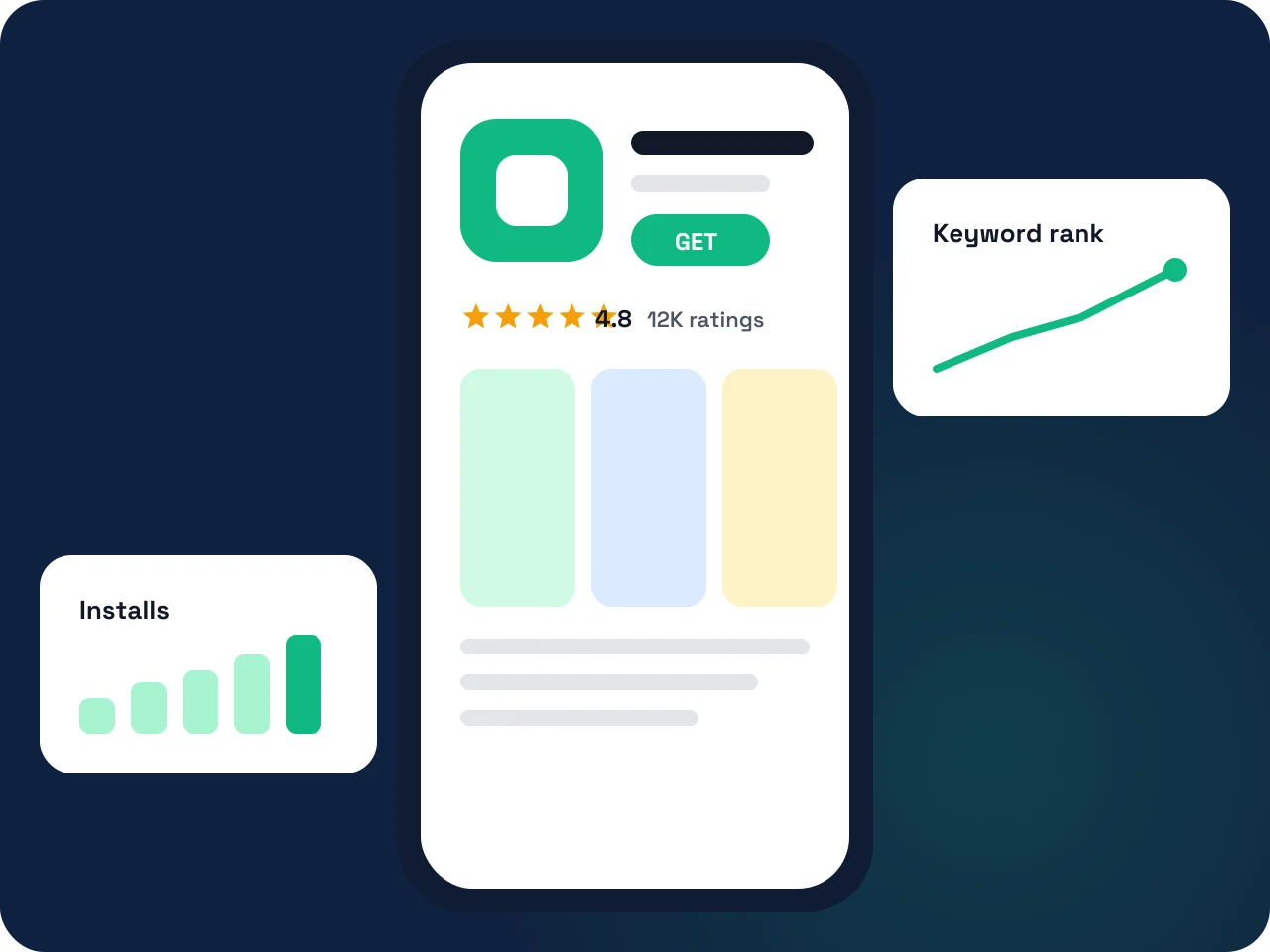
App Store Optimization (ASO) is the process of improving how an app is found and chosen in the Apple App Store and Google Play Store: optimizing the title, subtitle and description for what people actually search, and optimizing the icon, screenshots and preview video so the people who find the listing actually install it.
Ranking is only half the job. Getting into search results is the keyword and metadata side of ASO. Once someone lands on the listing, the icon, screenshots and preview video decide whether they tap install, which is a conversion problem, not a visibility one.
See how this plays out in our case studies, or read about our Dominate program if you want ongoing testing alongside SEO.
Most store listings are written once and never touched again.
Repeating words or using generic terms nobody searches.
Most people decide from the first two screenshots.
Ratings and recent reviews strongly affect installs.
For both stores.
What people usually want to know when they first look into ASO.
App store algorithms rank mostly on downloads, retention and ratings, not backlinks. Search queries inside the App Store and Google Play also tend to be shorter and more branded than typical web searches.
We treat ASO as its own discipline, built around how people search inside each store, not a copy of web SEO tactics.
A high keyword ranking means more people see your listing. It doesn’t mean they install it. That decision comes from the icon, the first two screenshots and, where it’s shown, the preview video.
We treat icon and screenshot work as conversion optimization, not decoration, and test variations instead of guessing which one performs better.
Apple’s Product Page Optimization and Google Play’s store listing experiments let you test different icons, screenshots and copy against real visitors before committing to one version.
Where there’s enough traffic to reach a reliable result, we use these built-in tools rather than swapping assets on a hunch.
Keyword behaviour, review expectations and even icon preferences vary by country. A single listing translated once isn’t localization, it’s a translation.
We prioritise markets by where your users or ad spend already are, not by translating into every language the store supports.
Ratings and recent review activity feed directly into ranking and into whether a visitor installs. Both stores weigh this more heavily than most teams expect.
We set up a routine for prompting reviews at the right moment, and for flagging the ones that need a reply.
The App Store and Google Play don’t rank listings the same way, and they don’t expose the same fields for keywords. A strategy built for one store doesn’t automatically carry over to the other.
We handle both stores separately: the keyword fields, the testing tools and the review mechanics each get their own plan.
Metadata fixes come first; icon and screenshot testing follows once there is enough traffic to trust the result.
1Week 1
We review your current title, subtitle, description, keywords, icon, screenshots and ratings against what’s actually searched and shown in each store.
You get: a clear list of what’s costing you visibility and what’s costing you installs.
2Weeks 2–3
Title, subtitle and description get rewritten for the keywords people search, within each store’s character limits and rules.
You get: an updated listing live in both stores.
3Ongoing
Where there’s enough traffic, we run Product Page Optimization or store listing experiments on icon, screenshots and copy instead of guessing which version wins.
You get: decisions backed by real visitor data, not opinions.
4Ongoing
You get plain reporting on keyword rank, impressions and install conversion rate, and we keep testing as the stores and your app change.
You get: a short report tied to installs, not vanity rank numbers.
ASO is easy to oversell with vague promises about downloads. These checks help you avoid that.
Written by Nadir Yaqoob, Founder of South Asia Digital · Last updated October 2026
We treat app store listings the same way we treat web pages: as something to test, not something to finish once. Icon and screenshot changes go through Apple’s Product Page Optimization or Google Play’s store listing experiments wherever there’s enough traffic to trust the result, and the reporting tracks installs, not just keyword rank. See examples of our work on the case studies page.
We are a Dubai-based agency and we work with clients worldwide. ASO work, keyword research, metadata, listing experiments and review management, is largely remote, so this applies equally wherever your users are.
Sources we draw on: Apple’s Product Page Optimization documentation · Google Play Console’s store listing experiments guide · Apple’s App Store search guidance.
This work is priced by scope, so we’ll give you a fixed quote after a 20-minute call. No hourly surprises.
Yes. Each store reads different fields for keywords, so the approach is different for each.
Metadata changes can show within a few weeks after the update is approved. Icon and screenshot testing takes longer, since each test needs enough installs before the result can be trusted.
No, we focus on organic ASO. We can point you to specialists for paid install campaigns if you need them alongside this.
We phase metadata changes and watch rank and conversion after each update, so we catch a problem before it costs you installs.
App store algorithms weigh downloads, retention and ratings heavily, not backlinks, and app store search queries tend to be shorter and more branded than web searches. It's a related discipline, not the same tactics applied to a different platform.
No. Ranking gets your listing seen. Whether someone installs after that depends mostly on the icon, screenshots and preview video, which is why we treat those as conversion work, not design polish.
Both let you test different icons, screenshots or copy against real visitors before committing to one version. They're built into each platform's own console, and we use them rather than swapping assets on a guess.
For a reliable result, yes. With lower traffic, we focus on fixing clear problems in the listing, keywords, metadata and reviews, instead of forcing a test that won't reach significance.
Yes, prioritized by where your users or ad spend already are. A single listing translated once isn't localization on its own, so we adjust keywords and visuals per market rather than just translating text.
There isn't a fixed price because it depends on how many markets are involved and whether creative design work is included. We give a fixed quote after a short call rather than billing by the hour.
Book a strategy call. Send us your URL beforehand and we’ll have already looked at it when we talk, so you get specifics, not a sales pitch.