

Entity mapping in SEO is the process of identifying the people, places, organisations, products and concepts connected to a topic, then documenting how they relate to each other so search engines and AI systems can understand your content as a set of real-world facts, not a string of keywords. The output is usually called an entity map: a structured list or diagram of entities, their attributes, and the relationships that link them.
If you have landed here after searching “what is entity mapping” or “entity mapping seo”, the short version is this: keyword-based SEO asks which words appear on a page. Entity-based SEO asks what the page is actually about, in terms Google’s Knowledge Graph and large language models already understand. Both matter. But as AI Overview, ChatGPT and Perplexity increasingly answer questions by assembling facts about entities rather than ranking ten blue links, entity mapping has become the part most sites get wrong.
This guide covers what an entity map is, how it differs from a topical map, the three-part model behind every entity (entity, attribute, value), a worked example you can copy, how to translate that map into schema markup, and how to check whether Google has genuinely recognised your entities instead of just hoping it has.
What Is Entity Mapping in SEO?
Entity mapping in SEO means breaking a subject down into its core entities and defining how those entities relate to one another, so that content, internal links and structured data can all reinforce the same underlying facts. An entity, in this context, is any distinct, nameable thing: a person, a brand, a product, a place, an event or an abstract concept. Google’s Knowledge Graph already stores millions of these as connected records, not as pages of text.
Where keyword research produces a list of search terms, entity mapping produces a list of things and the relationships between them. “Best CRM software” is a keyword. “Salesforce” is an entity, and it has attributes (founded 1999, headquartered in San Francisco, publicly traded) and relationships (competes with HubSpot, was founded by Marc Benioff, is classified as CRM software). A site that only optimises for the keyword talks about the topic. A site that maps the entity can state facts about it precisely, which is exactly what AI Overview and chat-based answers are built to extract.
What Is an Entity Map, Specifically?
An entity map is the actual document or diagram that records this analysis, distinct from the process of creating it. In practice it is usually a spreadsheet or table with one row per entity, columns for its attributes, and a separate column or diagram layer showing which other entities it connects to and how. Some teams keep it as a simple table; others render it as a node diagram, which makes the relationships easier to scan at a glance.
Either format works. What matters is that the map is specific enough to convert directly into content headings, internal links and schema properties later. A map that just lists ten related topics without defining the relationship between them is closer to a keyword cluster than a true entity map.
The Three Building Blocks: Entity, Attribute, Value
Every entity map is built on the same underlying structure, usually called the entity-attribute-value model, or EAV. An entity is the thing itself. An attribute is a property that describes it. A value is the specific fact that fills that property for this entity. This is the same logic Wikidata and Google’s Knowledge Graph use internally to store structured facts about real-world things.
| Entity | Attribute | Value |
|---|---|---|
| South Asia Digital | Type | SEO and digital marketing agency |
| South Asia Digital | Headquarters | Montana, United States |
| South Asia Digital | Core service | Search engine optimisation |
| Entity mapping | Defined as | A method for structuring topical content around real-world entities |
| Entity mapping | Related field | Semantic SEO |
| Schema.org | Used for | Marking up entities and their attributes in machine-readable form |
Once you have rows like these for every entity relevant to your topic, two things become possible. First, each attribute becomes a candidate heading or sentence in your content, because it is already phrased as a fact, not a vague theme. Second, each attribute maps cleanly onto a schema.org property, which is what lets Google and AI crawlers extract the same fact programmatically instead of inferring it from prose.
Why Entity-Based SEO Matters for AI Overview Visibility
AI Overview, ChatGPT and Perplexity generate answers by pulling verified facts about entities, then composing a response, instead of summarising whichever page ranks first. A page that clearly defines its primary entity, states its attributes plainly and links to related entities gives these systems something they can lift directly. A page that only repeats a keyword phrase gives them nothing extractable, even if it ranks well in traditional search.
This is also why entity-based SEO tends to reward depth over volume. A single, well-mapped page that clearly defines an entity and its three or four most important relationships will often out-perform five thin pages that each mention the keyword without ever stating a concrete fact. That kind of depth is exactly what separates pages that make it into Google AI Overview from pages that rank on page one but never get quoted.
Entity mapping is one part of a broader discipline some teams now call generative engine optimisation, or GEO: structuring a site so AI systems can cite it with confidence rather than simply crawl it. If that wider picture is what you are working towards, our comparison of GEO agencies looks at what the discipline covers beyond entity work alone.
How to Build an Entity Map for SEO
The process below produces a working entity map for a single topic in roughly the order most teams find practical. It does not require expensive tools to start; a spreadsheet is enough.
Step 1: Identify your primary entity

Decide what the page or site is fundamentally about, expressed as a named thing, not a keyword. For a business, this is usually the brand itself, or a specific service or product line. Getting this wrong (choosing a theme instead of a thing) undermines every step that follows.
Step 2: List supporting entities

List the people, organisations, tools, competitors, locations and concepts genuinely connected to the primary entity. Pull from your own content first, then check what real, ranking pages on the topic mention, since that reveals which supporting entities Google already associates with the subject.
Step 3: Define attributes for each entity

For every entity on the list, write down its factual properties: what it is, when it started, where it operates, what category it belongs to, what it is known for. Use the EAV table format shown above. Vague attributes (“popular”, “leading”) do not translate into schema or extractable facts; specific ones do.
Step 4: Map relationships between entities

Draw or list how each supporting entity connects back to the primary one. Use precise relationship verbs: competes with, is a type of, was founded by, is used for, is part of. Vague relationships (“is related to”) are harder to turn into either sentences or schema.
Step 5: Turn the map into content and internal links

Each entity with enough substance becomes its own page or section. Each defined relationship becomes a natural internal link between those pages, using anchor text that describes the relationship, not a generic phrase. This is what turns a list of pages into a cluster that reinforces a single, coherent set of facts.
Step 6: Add schema markup to confirm it

Structured data is how you state the map explicitly, instead of leaving Google to infer it from prose alone. The next section covers exactly how this works with a working example.
A Simple Entity Map Example
The diagram below shows a small entity map built around a single primary entity, with four supporting entities and the specific relationship connecting each one back to it. This is deliberately small; a real map for a full site will usually run to dozens of entities, but the structure does not change with scale.
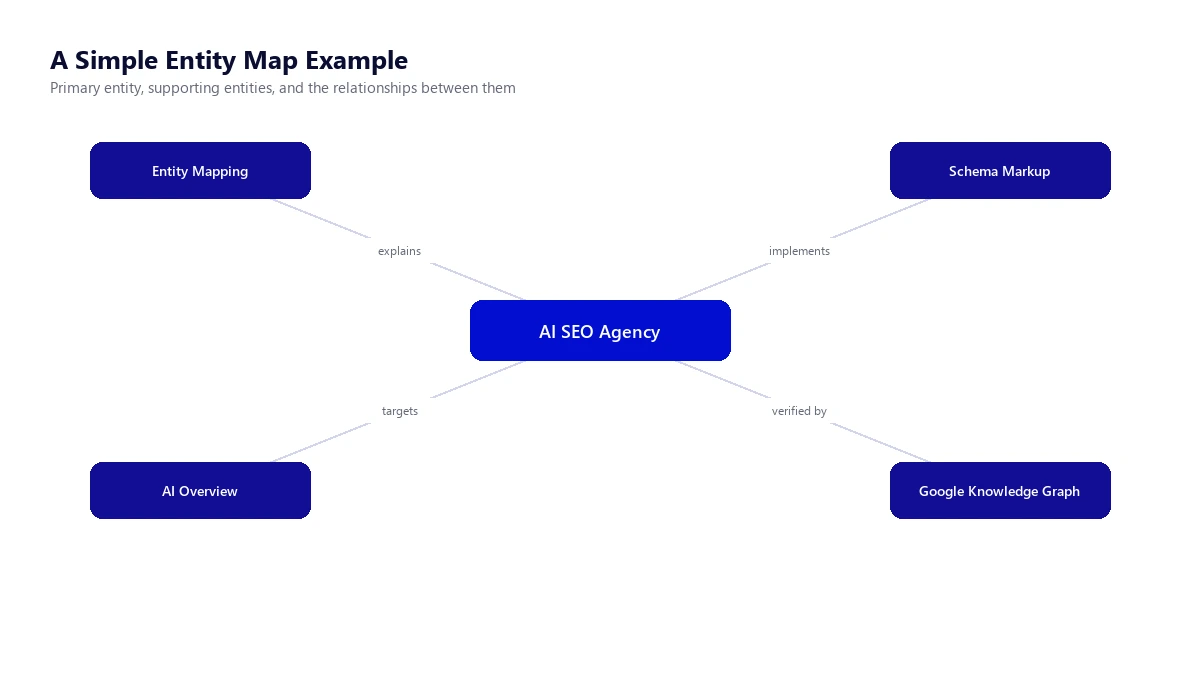
Read left to right, each line states a complete, checkable fact: the primary entity is explained by entity mapping, implements schema markup, targets AI Overview, and is verified by the Google Knowledge Graph. Every one of those four statements can be written as a sentence, linked internally, and marked up in schema, which is the entire point of doing the mapping exercise before writing a word of content.
How to Add Entity Markup with Schema.org
Once the map exists, translate it into structured data using schema.org’s about and mentions properties on your Article or WebPage markup. about declares the primary entity the page is fundamentally describing. mentions declares the supporting entities discussed but not central to the page. Both accept a sameAs reference to an external identifier, typically a Wikidata URI, which is what lets Google confirm your entity against its own Knowledge Graph rather than trusting your text alone.
{
  "@context": "https://schema.org",
  "@type": "Article",
  "headline": "What Is Entity Mapping in SEO?",
  "about": {
    "@type": "Thing",
    "name": "Entity mapping",
    "sameAs": "https://www.wikidata.org/wiki/Qxxxxxxx"
  },
  "mentions": [
    { "@type": "Thing", "name": "Schema.org" },
    { "@type": "Thing", "name": "Knowledge Graph" }
  ]
}
Treat the Wikidata reference as optional, not mandatory: use a real, existing Wikidata entry if one genuinely matches your entity, and omit sameAs entirely rather than link to a placeholder or unrelated ID. An incorrect entity reference is worse than none, because it actively tells Google the wrong thing.
How to Check If Google Has Recognised Your Entities
Publishing an entity map and adding schema is not proof that it has worked. Google’s own documentation on structured data is explicit that markup does not guarantee any particular treatment in search results, so it is worth confirming Google is reading your entities as intended, instead of leaving it to guesswork. Three free checks help with that.
- Google’s Rich Results Test. Paste your URL in and confirm your
Article,FAQPageor other schema is detected without errors. This checks that the markup is valid, not that the entity itself is recognised, but it is the first gate any broken schema has to pass. - Google Knowledge Graph Search API. A free public endpoint that lets you query whether a specific name already exists as a recognised entity in Google’s Knowledge Graph, and returns its confidence score if so. Useful for checking your brand or product name before you build content around the assumption that Google already knows what it is.
- Google Cloud Natural Language API. Run a page’s text through the entity analysis endpoint and it returns every entity the algorithm detected, along with a salience score between 0 and 1 showing how central each one is to the text. A primary entity scoring below roughly 0.05 salience suggests the page is not stating its main subject clearly enough, regardless of how the content reads to a human.
Running your own draft through the Natural Language API before publishing is the closest thing to a proofreading pass for entity clarity: if the tool cannot confidently identify your primary entity, an AI system trying to extract an answer from the page is likely to struggle in the same way. For checking a whole site rather than one draft at a time, a few AEO and GEO checker extensions can run a similar test directly in the browser.
Entity Mapping vs Traditional Keyword-Based SEO
| Keyword-based SEO | Entity-based SEO | |
|---|---|---|
| Starting point | Search terms and volume | Real-world entities and their relationships |
| Content structure | Pages built around a phrase | Pages built around a defined thing and its facts |
| Internal linking | Often exact-match anchor text | Anchors that describe the relationship between entities |
| Structured data | Optional, often generic | Central, using about, mentions and sameAs |
| Works well for | Traditional ten blue links | AI Overview, ChatGPT and Perplexity answers |
Neither approach replaces the other. A proper keyword research process still tells you what people are searching for right now. Entity mapping tells you what to say once you have their attention, and how to say it in a form AI systems can lift cleanly.
Common Mistakes That Break an Entity Map
- Treating themes as entities. “Digital marketing” is a theme. “South Asia Digital” is an entity. Build the map around nameable things, not broad subjects, or the attributes and relationships that follow will stay vague.
- Inconsistent naming across the site. If a brand or product is referred to by three slightly different names across different pages, Google has to work harder to confirm they are the same entity, which weakens every signal you have built.
- Schema that contradicts the visible page. Structured data should restate facts that already appear in the readable content, not introduce claims that exist only in the markup. Mismatches between what a page says and what its schema claims are a known trust signal Google checks for.
- Mapping without ever publishing the relationships. A spreadsheet full of entities and attributes that never becomes content or internal links has no SEO value on its own. The map is a planning tool, not the deliverable.
- Forcing a Wikidata link that does not exist. A fabricated or mismatched
sameAsreference is worse than omitting it: it tells Google something false about your entity instead of nothing at all.
Frequently Asked Questions
What is entity mapping in SEO?
Entity mapping in SEO is the process of identifying the entities relevant to a topic (people, places, organisations, products and concepts), defining their attributes, and documenting the relationships between them, so content and structured data can reinforce a consistent set of facts that search engines and AI systems can extract directly.
What is entity mapping?
Outside SEO specifically, entity mapping is the general practice of identifying distinct entities within a body of information and recording how they relate to one another. In SEO, that same practice is applied to a website’s content so the site’s structure mirrors the real-world relationships between the things it discusses.
What is the difference between entity mapping and a topical map?
A topical map organises content by subject and subtopic. An entity map goes a level deeper, defining the specific named things within those subjects and the factual relationships between them, which is what makes it translatable into schema markup and Knowledge Graph terms.
Do I need schema markup for entity-based SEO to work?
Schema markup is not strictly required, but it is the most direct way to confirm your entities to Google instead of relying on it to infer them from prose. Sites that skip schema can still benefit from clearer, entity-focused writing, but they are leaving a reliable signal unused.
How is entity SEO relevant to AI Overview specifically?
AI Overview assembles answers from verified facts about entities, not from summarising a single ranking page. Content that clearly states its primary entity and its attributes, backed by consistent structured data, gives AI Overview something concrete to extract and cite, which is why entity mapping has become closely tied to AI Overview visibility specifically.
If you would like this mapped out for your own site rather than worked through manually, our SEO services include entity and topical mapping as part of the initial strategy.
If AI visibility beyond Google is the more pressing problem, we cover that separately in why a well-ranking site can still be invisible in ChatGPT.