You type your product category into ChatGPT, half expecting to see your own name. Instead, it recommends two competitors and a tool you have never heard of. You rank on page one of Google for the same term. So why did the AI skip you entirely?
This is one of the most common questions we hear from SaaS founders and marketing leads right now, and it usually comes with a mix of confusion and frustration. You did the SEO work. You have the rankings to prove it. And yet ChatGPT, Perplexity, and Google’s AI Overview seem to be answering a different question than the one your site was built to win. It’s part of a much bigger shift in how AI is reshaping marketing strategy across the board. SaaS companies just tend to feel it first, because it’s their prospects doing the asking.
The good news is that this is diagnosable. There are a small number of specific, checkable reasons a SaaS site goes missing from AI answers, and most of them can be tested in a few minutes. This guide walks through what to check first, why AI visibility often has nothing to do with your Google rank, and what a realistic fix timeline looks like.
Google Rankings and AI Answers Are Not the Same Game
The instinct to assume “we rank well, so we should be cited” is understandable, but it misunderstands how these two systems work. They pull information through different mechanisms, and that difference explains most of the confusion.
Google AI Overview is generated at the moment someone searches. It draws heavily from pages that are already ranking well organically for that query. We’ve written a fuller walkthrough of how to get into Google AI Overview if you want to go deeper on that mechanism. The short version: your existing SEO performance genuinely matters, and strong rankings do raise your odds of being included.
ChatGPT and Perplexity work differently. ChatGPT blends what it learned during training with live web retrieval when it searches. Perplexity leans more heavily on live retrieval and citation. Both of them weigh signals that have little to do with your Google position: how often independent sources mention your brand, whether your product is registered as a recognisable “entity” through structured data, and whether your content gives a direct, extractable answer instead of a long buildup.
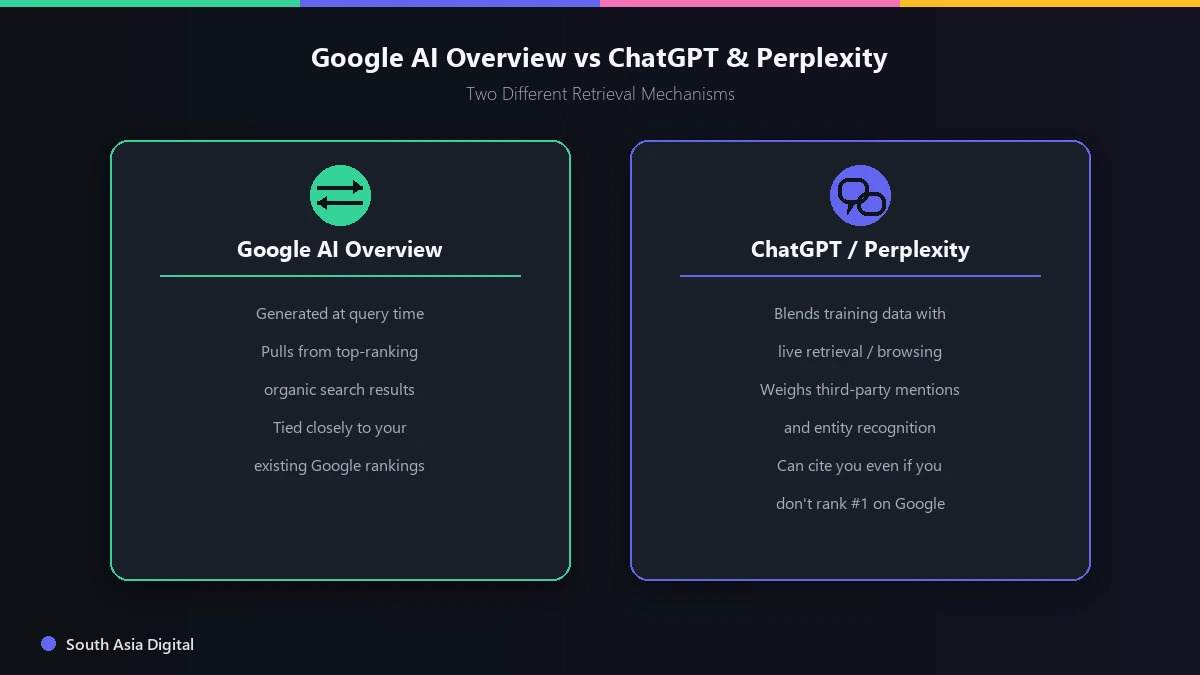
That is why it is entirely possible to rank in Google’s top three and still be invisible in ChatGPT — and, less intuitively, why a smaller competitor with no meaningful Google rankings can sometimes get cited ahead of you. Different game, different scoreboard.
A Quick Way to See Where You Actually Stand
Before changing anything, spend five minutes confirming the actual problem. Guessing wastes time on the wrong fix.
- Ask the AI directly. Open ChatGPT, Perplexity, and Gemini or Claude in separate tabs and ask the kind of question a prospect would ask — “what’s the best [your category] for [your use case]?” Note whether you appear, and where competitors show up instead.
- Check your indexed footprint. Search
site:yourdomain.com "your product name"on Google. A thin result count often means AI systems have little of your own content to draw from either. - Test crawler access directly. If you’re comfortable with a terminal, run a request as one of the AI bots and see what comes back:
curl -A "GPTBot" -I https://yourdomain.com
curl -A "PerplexityBot" -I https://yourdomain.com
A 200 OK response means the bot can reach the page. A blocked response, a redirect loop, or nothing at all is a strong early signal of the first problem below.
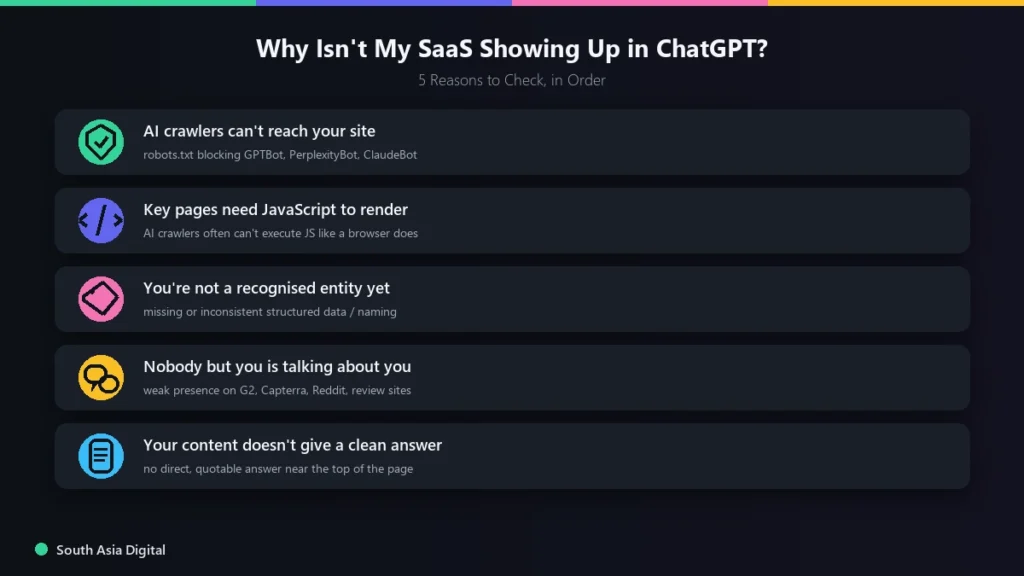
Five Reasons Your SaaS Might Be Invisible to AI Search
These are listed roughly in order of how often they turn out to be the actual cause, and how quickly each one can be fixed once identified.
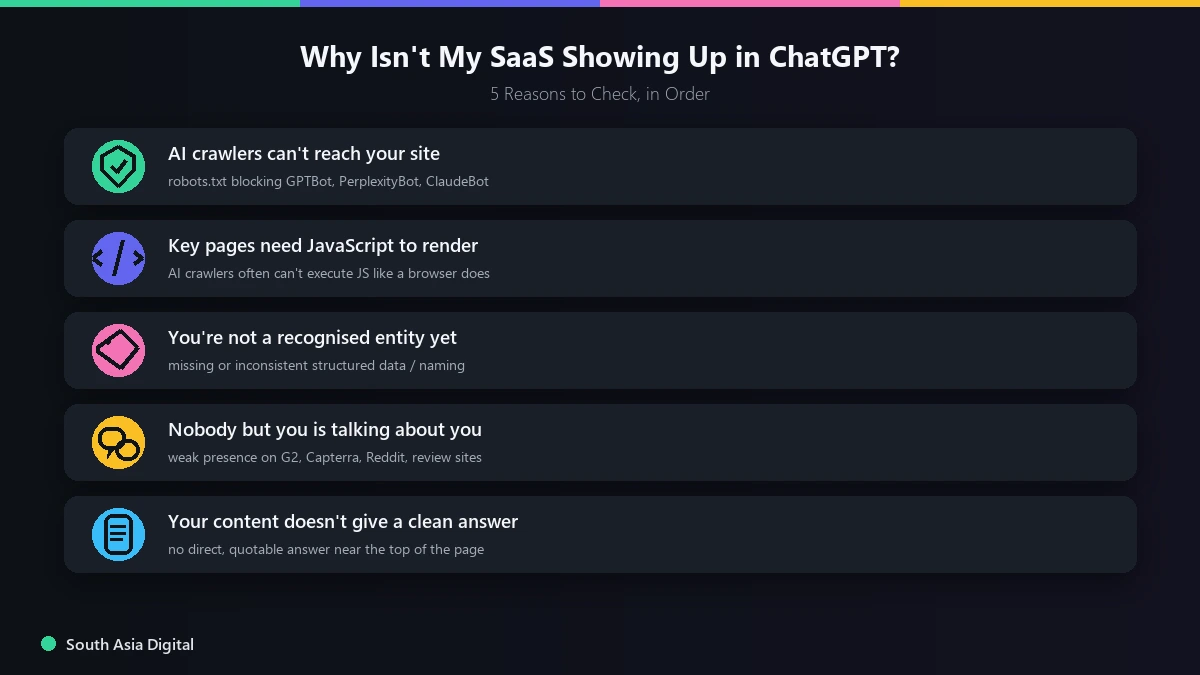
1. AI crawlers can’t reach your site
This is the single most common cause, and the easiest to fix once you know to look for it. Many robots.txt files were written years before AI crawlers existed, and some security plugins or CDN rules block unfamiliar user agents by default — sometimes without anyone realising it. If GPTBot, PerplexityBot, ClaudeBot, or OAI-SearchBot can’t fetch your pages, none of your content quality matters, because it never gets read in the first place.
2. Your key pages need JavaScript to render
If your pricing page, feature pages, or homepage rely on client-side JavaScript to load the real text, some AI crawlers will see a near-empty page. This is a common blind spot for SaaS sites built on modern JS frameworks, precisely because they tend to invest heavily in the frontend experience. Try loading a key page with JavaScript disabled, or check what a crawler sees using your browser’s “view page source” versus the rendered DOM. If the important content is missing from the raw source, that’s the issue.
3. You’re not a recognised “entity” yet
AI systems work better when they can confirm what you are, not just what you say about yourself. Without structured data — specifically SoftwareApplication or Organization schema — your product page reads as generic text rather than a clearly defined product with a name, category, and set of features. Inconsistent naming across your site, your app store listing, and your social profiles compounds this problem.
4. Nobody but you is talking about you
This is usually the slowest one to fix, and often the real reason a competitor gets cited and you don’t. AI models weigh independent, third-party mentions more heavily than anything on your own domain. We’ll walk through exactly where to focus this effort in the next section, because it deserves more than a passing mention.
5. Your content doesn’t give a clean, quotable answer
Even technically accessible, well-structured pages can be skipped if the actual answer to a likely question is buried three paragraphs into marketing copy. AI systems tend to favour content that states a direct answer plainly, near the top, in language close to how the question was asked, then supports it with detail afterward. None of this is unfamiliar advice, really: it’s the same clear-headings, direct-answers, logical-hierarchy thinking behind good on-page SEO, just applied with an AI reader in mind as well as a human one.
A Practical SoftwareApplication Schema Example
If reason 3 applies to you, here is a simplified but functional starting point. Adjust the fields to match your product; do not copy placeholder values into production.
{
  "@context": "https://schema.org",
  "@type": "SoftwareApplication",
  "name": "Your Product Name",
  "applicationCategory": "BusinessApplication",
  "operatingSystem": "Web",
  "description": "One or two sentences describing what the product actually does and who it's for.",
  "offers": {
    "@type": "Offer",
    "price": "0",
    "priceCurrency": "USD"
  },
  "aggregateRating": {
    "@type": "AggregateRating",
    "ratingValue": "4.6",
    "ratingCount": "128"
  }
}
Only include aggregateRating if you have genuine review data to back it. Schema built on numbers you can’t substantiate can do more harm than good if it’s ever checked against your real review profile.
Why Third-Party Mentions Matter More Than Most Teams Expect
It’s worth sitting with reason 4 a little longer, because it’s the one most SaaS teams underestimate. Your own website, no matter how well optimised, is a single, self-interested source. AI systems are effectively asking: “who else vouches for this?” A comparison article on a neutral blog, a detailed answer on a community forum, a cluster of recent G2 reviews — these carry weight precisely because you didn’t write them. That’s really a reputation management question as much as an SEO one, and it’s worth treating as an ongoing job, not a one-off cleanup before a launch.
Where to focus first
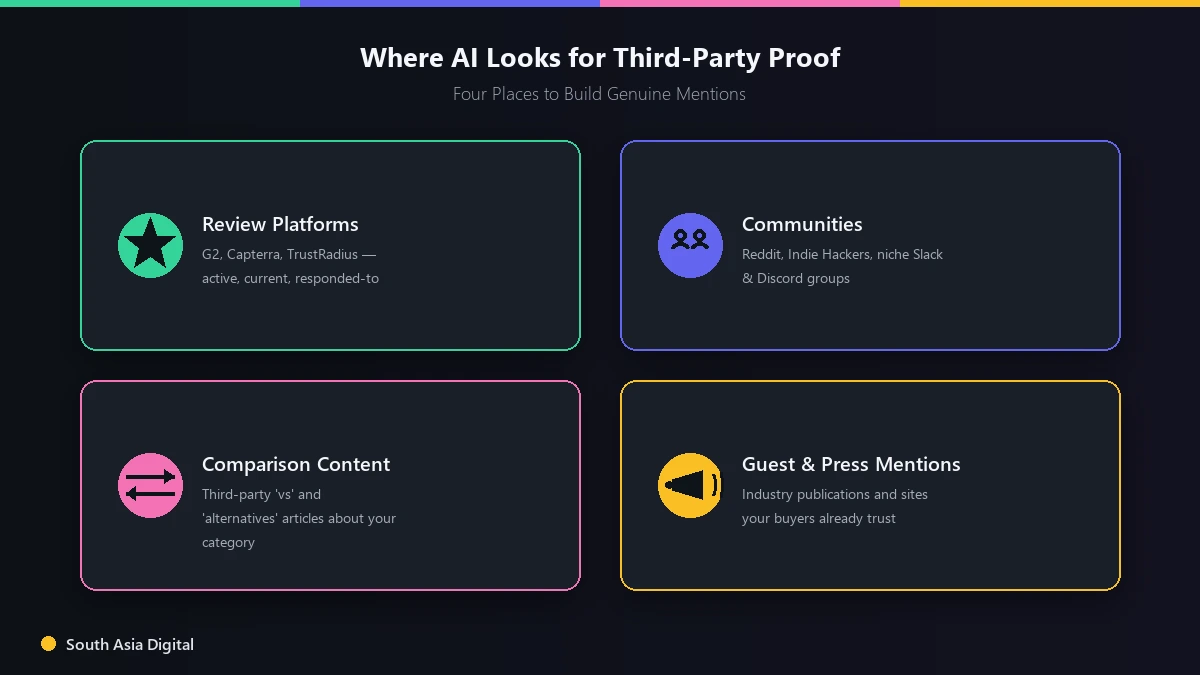
- Review platforms your buyers check. For B2B SaaS specifically, that usually means G2, Capterra, and TrustRadius. A handful of stale reviews from two years ago signals less than a steady, current stream, and a business that never responds to a review reads as absent, not just quiet.
- Communities where your category already gets discussed. Relevant subreddits, Indie Hackers, niche Slack or Discord groups, and industry-specific forums are places AI models increasingly draw on for candid, unprompted opinions. Being a known, helpful presence there (not a drive-by promoter) is what registers.
- Comparison and “alternatives” content other people write. Search for the “vs” and “alternatives to [competitor]” articles already being written about your category. If you’re mentioned inaccurately or missing entirely, that’s a specific, fixable gap, not a vague brand-awareness problem.
- Industry publications and guest content. A byline or feature on a site your buyers already trust does double duty: it’s a genuine third-party mention, and it’s usually a well-structured, citation-friendly piece of writing in its own right.
- Customer proof you can point to. Named case studies and specific, attributable results give AI systems, and human readers, something concrete to cite instead of generic claims about quality.
How to make each mention actually count
- Answer first, mention your product second. In forums and Q&A threads, a genuinely useful answer that happens to reference your product earns trust. A reply that’s obviously there to promote something gets ignored or removed, and it doesn’t build the signal you’re after.
- Keep your identity consistent everywhere. The same product name, category, and short description across your site, review profiles, social accounts, and directories makes it easier for AI systems to confidently connect the dots. Small inconsistencies add friction to entity recognition.
- Respond to reviews, especially critical ones. A thoughtful reply to a negative review often reads as more credible than a wall of five-star praise, because it shows there’s a real, accountable team behind the product.
- Don’t manufacture reviews or astroturf discussions. Beyond the ethical problem, platforms and AI systems are increasingly good at spotting patterns that look manufactured, and getting caught undermines the exact trust signal you’re trying to build.
- Track what’s actually moving the needle. Use the same AI-answer testing method described earlier on a recurring basis, and pay attention to which channels correlate with new mentions. Double down there instead of spreading effort evenly across every possible platform.
A Realistic Timeline for Fixing This
One thing that separates a useful diagnosis from a frustrating one is honesty about how long each fix takes. Don’t expect third-party authority problems to resolve on the same timeline as a robots.txt edit.
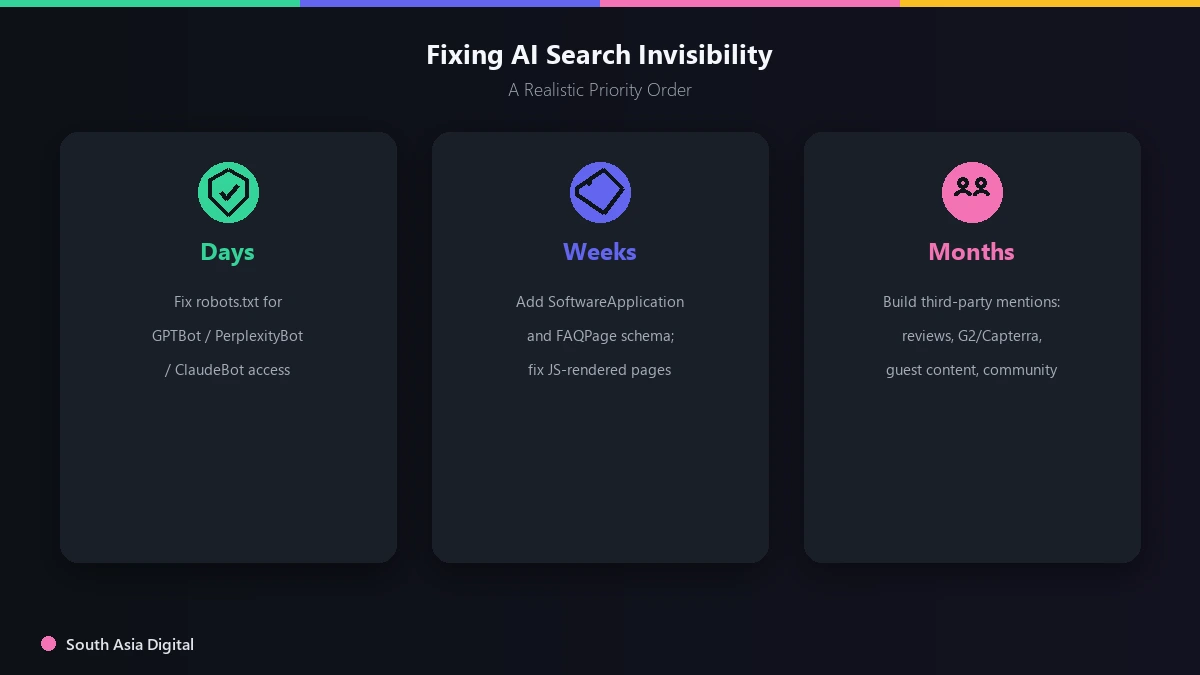
| Timeframe | What to fix | Why it’s ordered here |
|---|---|---|
| Days | robots.txt access for GPTBot, PerplexityBot, ClaudeBot and related crawlers | Zero value in any other fix if crawlers can’t reach the page at all |
| Weeks | SoftwareApplication and FAQPage schema, fixing JavaScript-rendered content, restructuring key pages for direct answers | Technical and on-page changes you control directly, no external dependency |
| Months | Building genuine third-party mentions — reviews, comparison content, community presence | Depends on other people and platforms acting, which can’t be rushed without looking manufactured |
Keeping Track of Whether It’s Working
Because AI answers are generated dynamically rather than fixed like a search ranking, tracking progress looks a little different from traditional SEO reporting. Rather than checking one ranking position, run the same set of realistic buyer questions across ChatGPT, Perplexity, and Google AI Overview on a regular schedule, and log whether you’re mentioned, in what position, and alongside which competitors. A handful of AEO and GEO checker extensions can speed up this kind of recurring check considerably, instead of testing every prompt by hand. Watching that pattern shift over a few weeks tells you far more than any single check ever will.
Frequently Asked Questions
Does ranking #1 on Google guarantee I’ll show up in ChatGPT?
No. Google AI Overview draws heavily from top-ranking pages, so a #1 ranking helps there. ChatGPT and Perplexity weigh different signals — training data, live retrieval, and third-party mentions — so a strong Google rank doesn’t carry over automatically.
How do I check if AI crawlers can access my site?
Check your robots.txt file for GPTBot, PerplexityBot, ClaudeBot, and OAI-SearchBot directives, and test directly with a request like curl -A "GPTBot" -I https://yourdomain.com to see the actual response your server returns to that crawler.
How long does it take to start showing up in AI answers after fixing these issues?
Technical fixes like robots.txt and schema can show movement within weeks. Building the third-party mentions that heavily influence ChatGPT and Perplexity citations is a slower process, typically playing out over several months rather than weeks.
Is it worth fixing this if my SaaS is early-stage with few reviews?
Yes: start with the technical fixes regardless of stage, since they cost little and remove barriers that would block you even after you build more third-party presence. Treat review and mention-building as an ongoing part of your marketing motion, not a one-time project.
If you’d rather compare options than tackle this alone, our rundown of the best AI SEO agencies for SaaS is a reasonable place to start. Or if you’d like it mapped specifically to your product, get in touch with our team for a look at where you stand across Google, ChatGPT, and Perplexity today.