

ChatGPT Ads Manager is OpenAI’s self-serve advertising platform, live at ads.openai.com since early 2026. We ran South Asia Digital through the signup flow ourselves, stopping before creating an advertiser account so nothing went live or got charged. This covers what we saw firsthand, how the setup treats a Shopify-style e-commerce business specifically, and why there’s no one-click Shopify connection yet despite how it gets marketed.
What do you need before you start?
- An existing OpenAI or ChatGPT account. No separate advertiser login gets created; the flow runs on the account you already sign into ChatGPT with.
- Your store’s live URL. The first screen reads it directly to auto-generate an ad preview.
- A product feed plan. There’s no native one-click Shopify connection yet. Decide now whether you’ll export and upload products manually via SFTP or use a third-party feed app, covered below.
- A daily budget ceiling in your own currency. OpenAI recommends one automatically; set your own number first rather than anchoring to theirs.
- Clarity on organic versus paid. A product can appear in ChatGPT’s organic shopping results and in paid feed ads at the same time, through two separate systems. Know which one you’re setting up.
- Clean product images and descriptions. Feed quality is reported to directly affect whether products get approved and how they perform, the same discipline a Google Shopping feed needs.
What is ChatGPT Ads Manager?
It’s OpenAI’s advertising platform, reached at ads.openai.com. The landing page frames it as a way to “reach people as they explore options, compare choices, and make decisions in ChatGPT.” Clicking “Start now” runs through your existing OpenAI account rather than creating a new login.
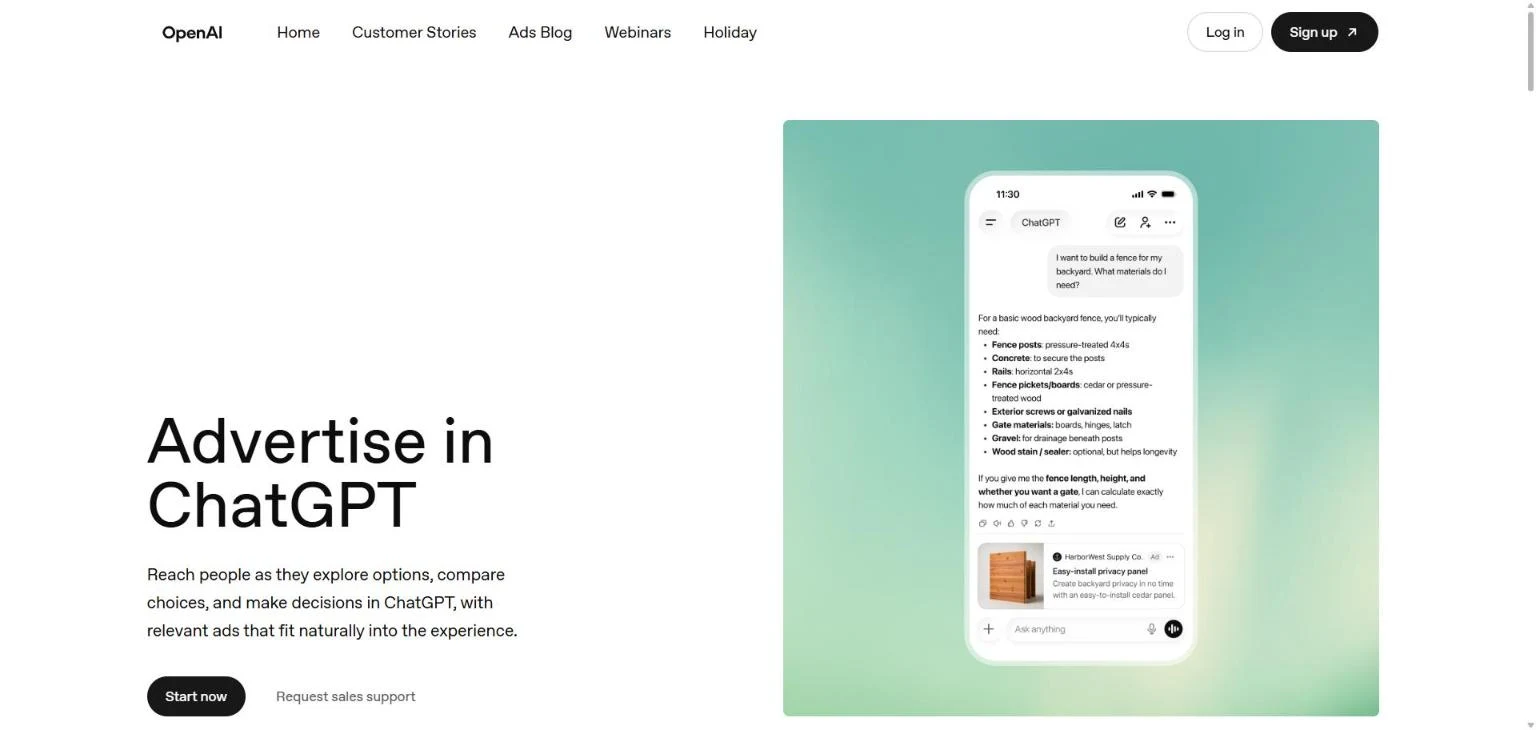
Our own screenshot of the ads.openai.com landing page.
How does the AI-generated ad preview read a store’s site?
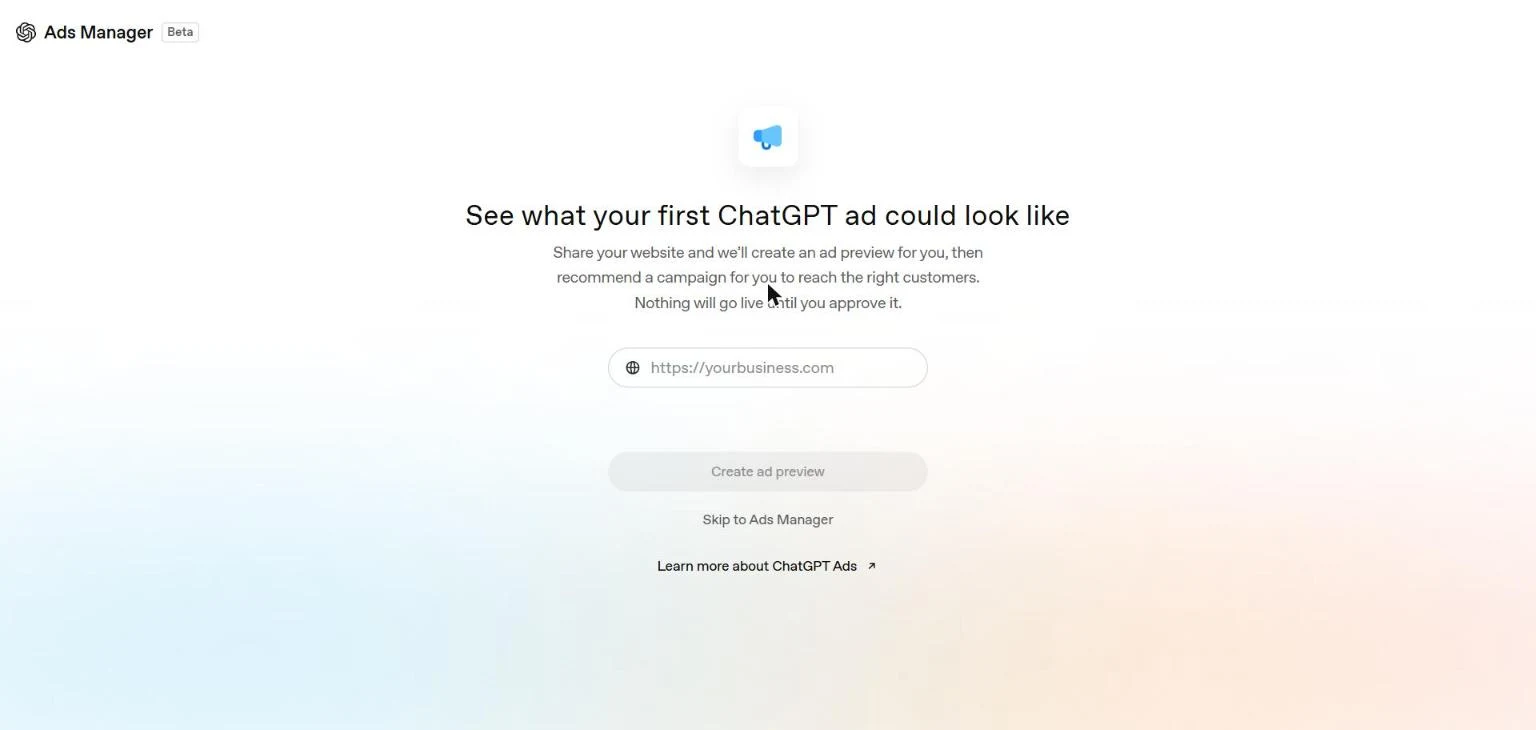
After signing in, the first step asks for a website URL: “Share your website and we’ll create an ad preview for you, then recommend a campaign for you to reach the right customers. Nothing will go live until you approve it.” We entered southasiadigital.com.
The result confirmed something worth knowing before you run this for a store: the tool reads actual site content and picks out distinct audience segments on its own. For our test site, it stated this directly: “We built this ad around ‘SaaS teams comparing SEO help for more signups and visibility’ and ‘Shopify brands looking to grow organic traffic and conversions,’ two themes that stood out across your website.” It then built the specific ad around the SaaS theme, but naming the Shopify-brand audience by itself shows the tool is reading for commerce intent, not just generic keywords.
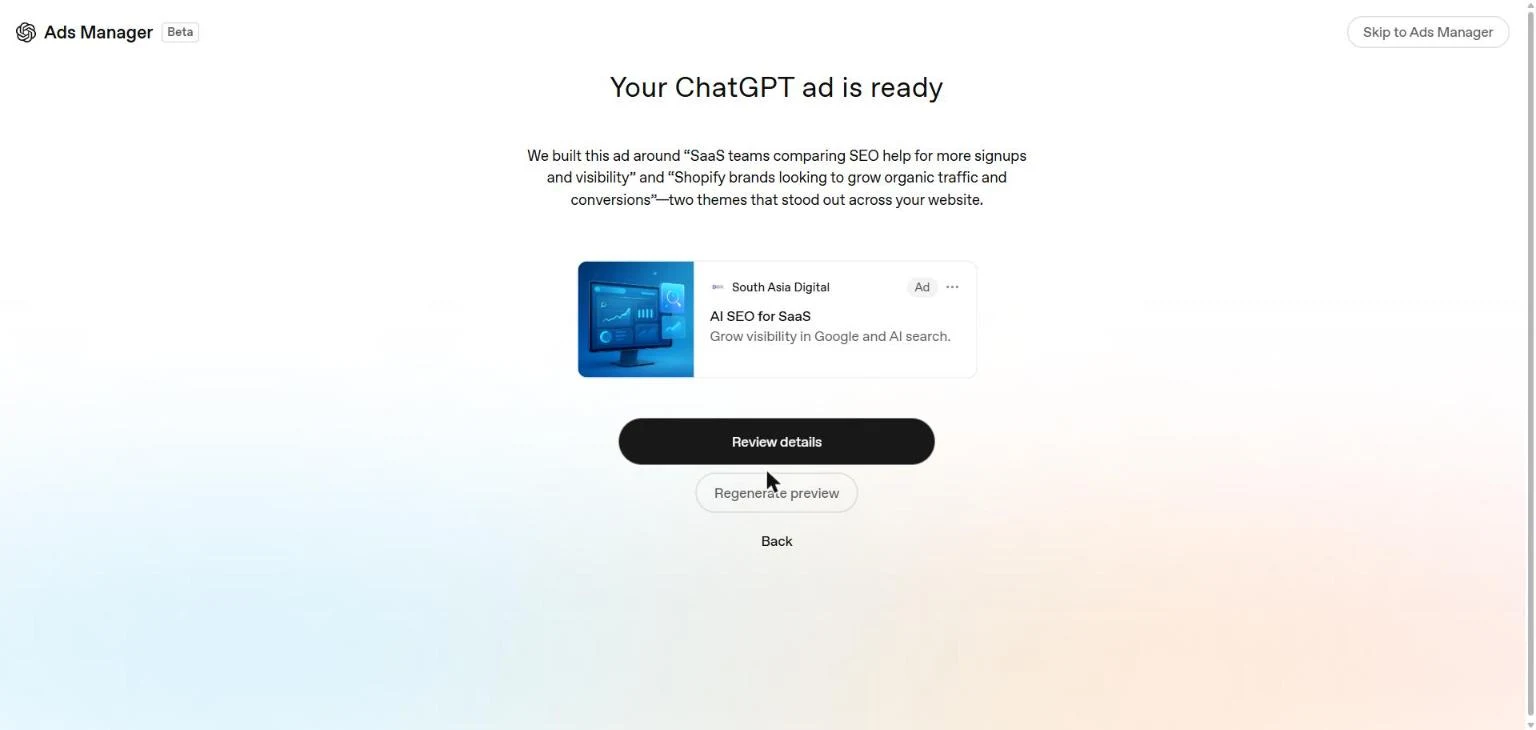
Our own test result. The tool’s own wording named “Shopify brands looking to grow organic traffic and conversions” as one of two audiences it detected.
For an actual Shopify store, the practical takeaway is the same one that applies to SaaS: whatever the tool generates reflects your site’s existing copy, not a neutral template. A store page full of generic product descriptions gets generic ad copy back. Clean up the source pages before running this, since the preview is a mirror, not an upgrade.
What does a recommended campaign include?
“Review details” showed a complete, specific setup rather than a vague summary: Objective: Clicks. Locations: Pakistan, pulled from the account’s own location. Destination URL: southasiadigital.com. Bid strategy: Autobid. Average daily budget: PKR 8,500, roughly $31 at November 2026 exchange rates. Creative enhancement: On.
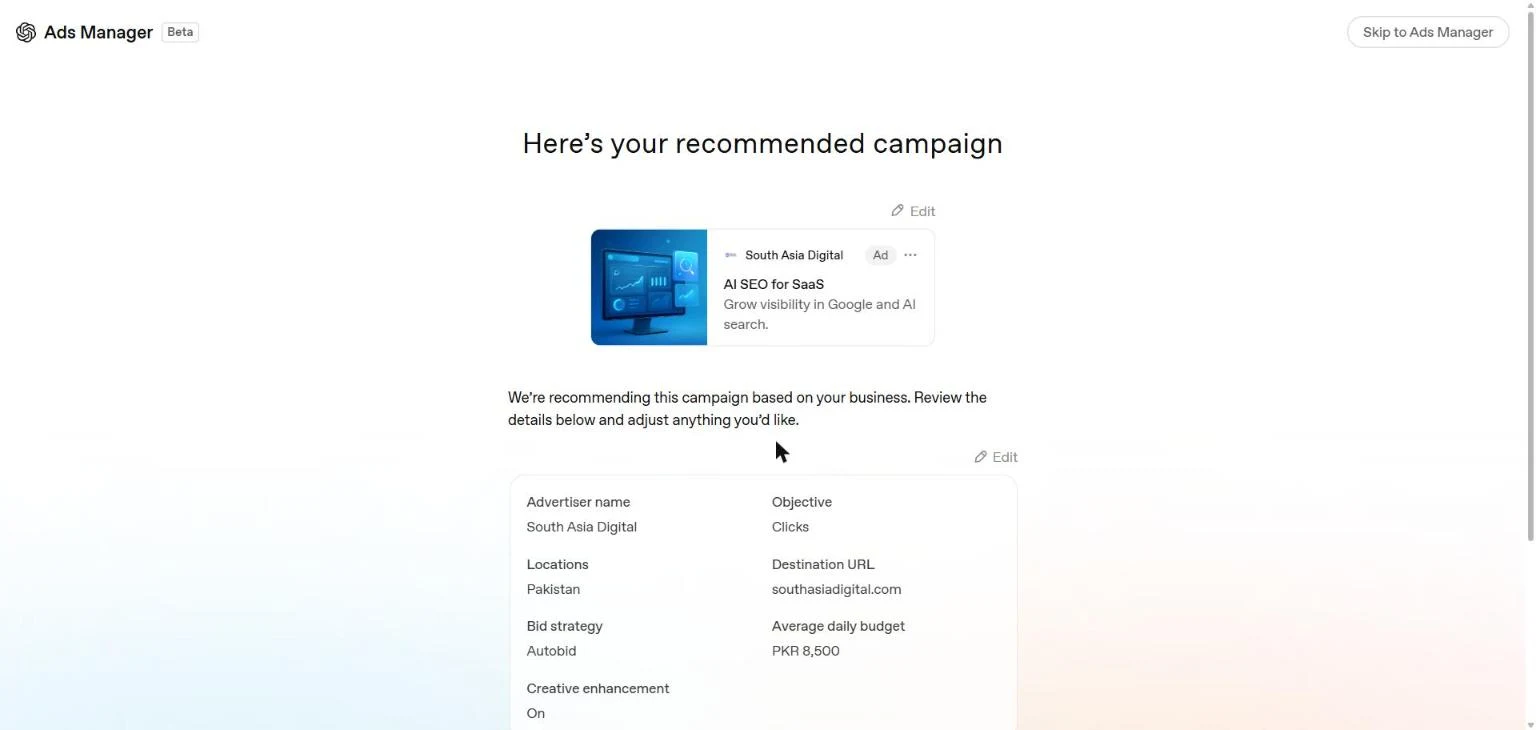
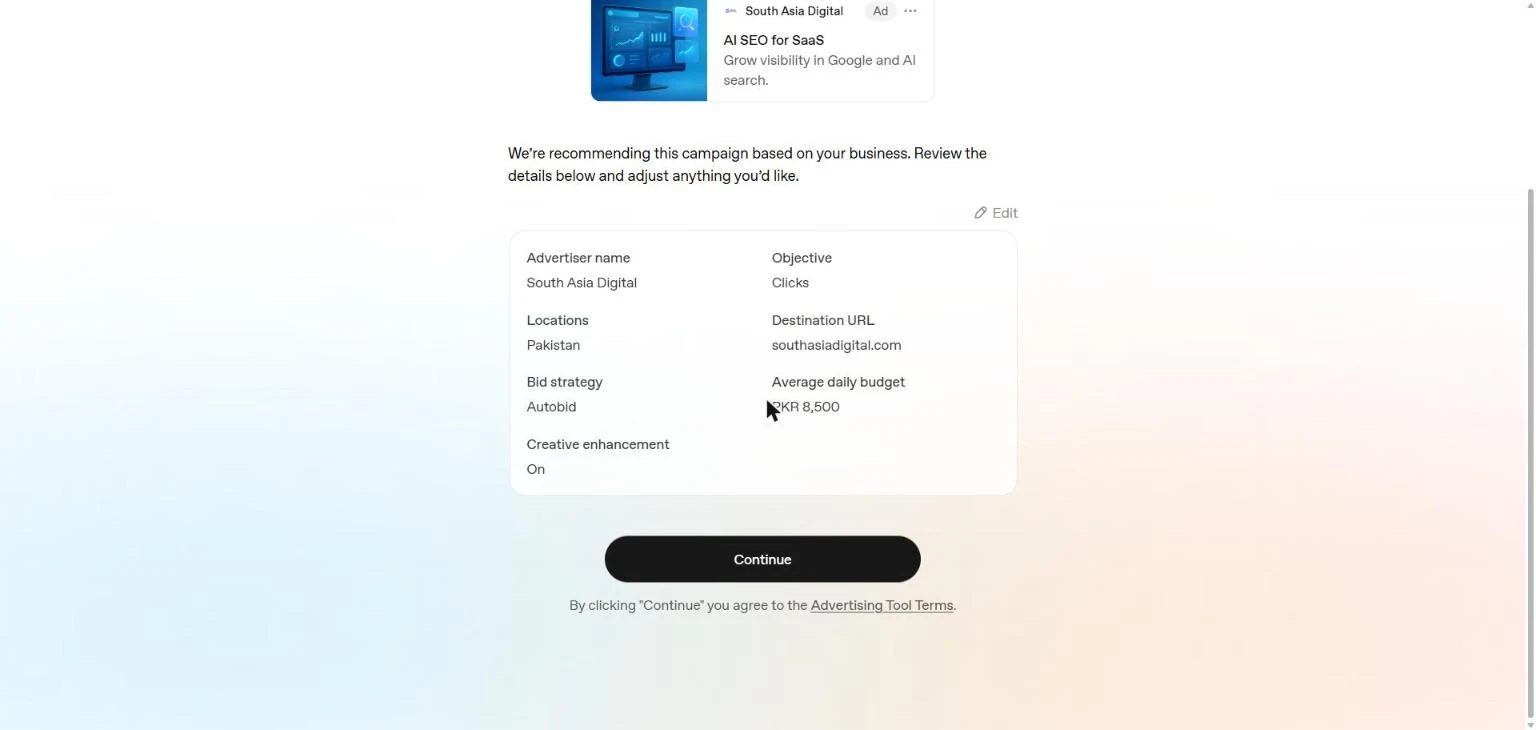
Our own test result: a recommended daily budget in local currency, generated from an actual account rather than a flat global default.
Vendor guides for e-commerce commonly describe click-through rates of 3% to 6% on ChatGPT product ads, but that figure comes from a single vendor’s reporting with no independent confirmation found. Treat it as a data point to test against, not a benchmark to plan around.
How do product feeds work for Shopify right now?
There’s no native, one-click Shopify-to-ChatGPT connection despite how some app listings describe it. Third-party reporting is consistent on this point: OpenAI currently requires product feeds to be uploaded through SFTP, which means a merchant exports product data from Shopify, reformats it to OpenAI’s feed specification, validates it, and uploads it on a recurring schedule rather than connecting the two platforms directly.
Two Shopify apps have been built to handle that gap. One, “Product Feed for ChatGPT Ads,” offers a free tier capped at 500 feed items with a paid Pro plan around $9.90 a month. Another, “ChatGPT Ads Feed Sync,” generates a separate feed per country using Shopify Markets pricing and translated titles, refreshing hourly and after product changes. Both exist specifically because the SFTP process isn’t something most merchants want to run by hand on a schedule.
Reporting also puts product-feed ads specifically at a later date than the general Ads Manager beta, around June 2026, after the broader self-serve platform had already opened. A store that signed up for Ads Manager early may have had access to the broader platform well before the feed-specific tooling matured.
Is ChatGPT Shopping the same thing as ChatGPT Ads?
No, and conflating them leads to budgeting mistakes. Organic appearance in ChatGPT’s shopping-style answers and paid product-feed ads are reported to be two separate systems. A product can show up in both at once, one through unpaid relevance and one through ad spend, and getting into the organic side doesn’t require an ads account or any budget at all.
That distinction matters for how a store should sequence its work. Getting product data structured well enough to be read accurately, named clearly, priced consistently, described without filler, pays off on the organic side before a single dollar goes toward ads, and the same clean feed then carries over directly into the paid side once that’s worth testing.
What should Shopify ad creative include?
Reported creative limits land in a similar range across sources: a headline around 16 to 24 characters, body copy recommended at 32 to 48 characters with a hard cap near 100, and a required square image. For a product ad specifically, that leaves no room for a generic lifestyle shot; the image needs to read clearly at a small size inside a conversation, not as a hero banner.
The same sourcing stresses feed quality over ad polish: optimized product descriptions and high-quality images are described as more decisive for approval and performance than the ad copy wrapped around them. A store with a clean, well-structured feed is reported to have an easier path through this than one relying on the ad itself to compensate for thin product data.
Common questions about ChatGPT Ads for Shopify stores
Can Shopify connect directly to ChatGPT Ads?
Not natively, as of this testing. Product feeds currently go through OpenAI via SFTP upload rather than a built-in Shopify integration. Third-party Shopify apps exist specifically to automate that export-and-upload process, since Shopify itself doesn’t push data to ChatGPT directly.
Do organic ChatGPT shopping results require an ads account?
No. Organic appearance and paid feed ads are reported to be separate systems, and a product can appear in ChatGPT’s organic shopping-style answers without any ad spend or advertiser account. Paid ads are a separate layer on top of that, not a requirement for organic visibility.
What’s the minimum daily budget for ChatGPT product ads?
There’s no fixed global figure. Guides commonly cite $25 to $50 a day, but our own test returned a recommended budget of roughly $31 at the account’s actual market rate, which suggests the number adjusts by location rather than following one flat rule everywhere.
Does ChatGPT Ads Manager generate ad copy automatically for a Shopify store?
Yes. Entering a store’s URL produces an AI-generated headline, description, and image based on the site’s actual content. In our own test, the tool explicitly identified a “Shopify brands” audience theme on the test site before generating the ad, confirming it reads for commerce-specific signals rather than generic keywords.
How is advertising for a SaaS product on ChatGPT different from advertising a Shopify store?
The targeting mechanics are shared, both use written context hints rather than keywords, but the creative and feed requirements diverge. A SaaS ad runs on written positioning alone, while a Shopify ad depends on structured product-feed data uploaded separately. How to create ChatGPT ads for SaaS covers the targeting side in more detail.
Written by Nadir Yaqoob, founder of South Asia Digital. Nadir has a software engineering background and runs the agency’s AI SEO and GEO work for SaaS and Shopify clients directly.