
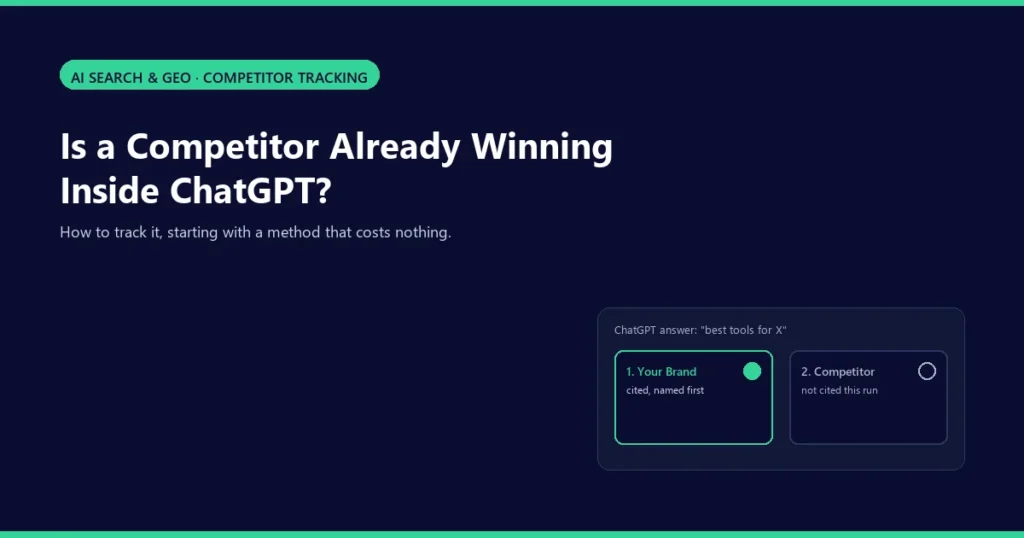
AI competitor visibility tracking means checking which brands ChatGPT, Perplexity, Google AI Mode, and AI Overviews recommend when someone asks a comparison or “best X” question in your category, then comparing how often you show up against how often your competitors do. It has nothing to do with your search rankings directly. A competitor can rank below you in Google and still be the brand AI keeps recommending, because citation and ranking are measured differently and pull from different signals.
That gap is worth taking seriously. A 75,000-brand Ahrefs study found branded web mentions correlate far more strongly with AI visibility (0.66-0.71) than backlinks do. The signal that has driven most of SEO for two decades barely moves this needle. If a competitor is building that kind of presence while you’re still optimizing for rankings alone, Search Console won’t show it. The only sign is usually indirect: a rising share of visitors who already seem decided before they talk to you.
How do AI visibility scores get calculated?
Most tools run a set of prompts, phrased the way a buyer would type them, against one or more AI engines on a schedule, then log three things for each result: whether your brand (or a competitor’s) was cited at all, where in the answer the citation appeared, and what tone surrounded it. A percentage score is built from how often and how prominently a brand shows up across that prompt set, not from a single check.
The detail most explanations skip is why a single prompt tells you almost nothing. Large language models sample from a probability distribution, so the same prompt run twice can return a different answer, with different brands cited, even with no change to your site in between. A score built from one run per week is mostly noise. A usable score comes from running the same prompt several times in a session and tracking the pattern across weeks, not the result of any one run.
Why do ChatGPT, Perplexity, and Google’s AI answers disagree about who to cite?
Because they’re pulling from different indexes and weighting different signals, even when they land on the same basic answer. Ahrefs compared Google’s AI Overviews and AI Mode directly, two products from the same company, answering the same questions, and found they cite the same URL only 13.7% of the time, even though their answers agree in substance about 86% of the time. SE Ranking ran a separate study and found similar separation: 10.7% URL overlap between the two.
If two Google products disagree that much about which pages to cite, ChatGPT and Perplexity, built on entirely different retrieval systems, are unlikely to agree any more closely. A separate Ahrefs study of 15,000 long-tail queries found AI assistant citations (across ChatGPT, Gemini, Copilot, and Perplexity) overlap with Google and Bing’s own top 10 rankings only about 11-12% of the time. Tracking your visibility on one platform and assuming it represents the others is close to tracking nothing.
Which competitors should you track?
Three to five, picked deliberately, not every company in your category. Split them into two groups: the direct competitors you lose deals to today, and one or two aspirational names, brands ranked above you that buyers already associate with the category, since AI engines tend to default to the names with the most existing mention volume. Tracking twenty competitors at once produces a spreadsheet nobody reads. Tracking five produces a list you can act on weekly.
One mistake shows up constantly: most people only prompt the AI with their own brand name (“how good is [my brand]”) and check the tone. That tells you almost nothing about competitive position. The prompts that matter are the ones a buyer types before they’ve picked a brand, the comparison and “best for” questions, since that’s where AI engines actively choose who to mention and who to leave out.
Does it matter where in the AI answer your brand gets mentioned?
Yes, position and sentiment both carry information a simple “cited: yes/no” count misses. A brand named first, with a specific reason attached (“X is best for teams that need Y”), is doing more competitive work than a brand buried in a list of five with no distinguishing detail. The same applies to tone: being cited alongside a caveat (“X is solid but lacks Y”) is a different outcome than being cited as the clear recommendation, even though both count as a “mention” in a basic tracker.
When you’re logging results manually, add a one-word sentiment tag to each citation, positive, neutral, or negative, and note whether your brand or the competitor’s was named first. Over several weeks this shows you something a raw mention count can’t: whether you’re gaining visibility or just gaining mentions that don’t move a buyer’s decision.
How do you track a competitor’s AI visibility manually, without paying for a tool?
Build a list of 15 to 25 prompts phrased the way a buyer in your category would type them, not your brand name, but the comparison and recommendation questions that come before someone picks a vendor: “best [category] for [use case],” “[competitor A] vs [competitor B],” “who should I use for [problem].” Pull these from your own sales calls, support tickets, or review-site Q&A sections, not guesswork.
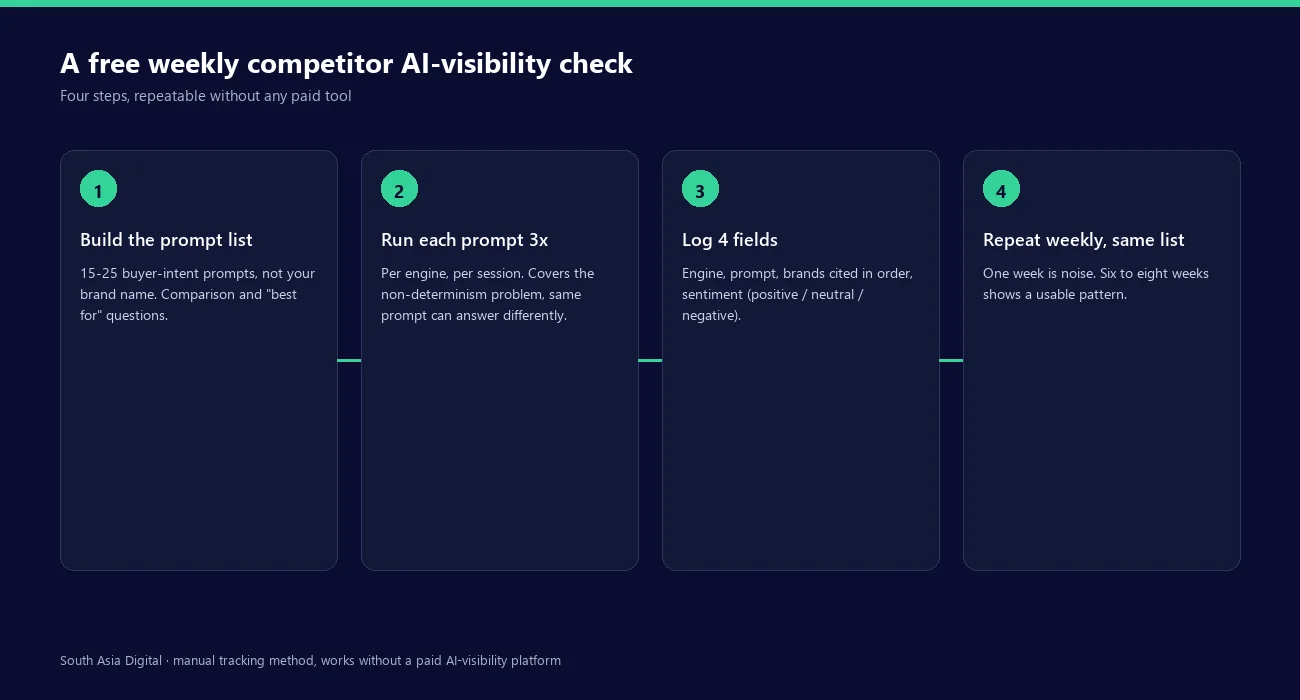
- Run each prompt three times per engine, per session. Covers the non-determinism problem above without needing a paid tool’s sampling infrastructure.
- Log four columns per run: engine, prompt, brands cited (in order), and whether your brand or the competitor’s appeared, with a link if one was given.
- Repeat weekly, same prompt list, same time of day. One week tells you almost nothing; six to eight weeks of the same list starts showing a usable pattern.
- Track the gap, not the absolute number. What matters is whether a named competitor is showing up on prompts you aren’t, and on which specific prompts, since that tells you exactly what content or presence to build next.
This gets you a usable, if manual, dataset. It breaks down once you’re tracking more than roughly 5-10 competitors across several engines: that volume of repeated manual prompting becomes a job in itself, not a weekly 30-minute task.
When does it make sense to pay for a tool instead of doing this manually?
Once the prompt list grows past what one person can run and log by hand each week, or once you need the same tracking across multiple engines at a consistent sampling rate rather than whenever you remember to run it. At that point a platform’s main value is the automation and the historical trend line, not the underlying data, which you could still collect by hand. We’ve compared the pricing and engine coverage of the main AI visibility tools (Otterly.AI, Profound, Peec AI, AthenaHQ, Scrunch AI, and the AI-tracking add-ons inside Semrush and Ahrefs) separately, since that comparison is its own piece of research and doesn’t need repeating here.
| Approach | Cost | Where it breaks down |
|---|---|---|
| Manual prompt tracking | Free | Past 5-10 competitors or 3+ engines tracked weekly, the logging time outgrows the value. |
| Single-engine free tiers (e.g. a free checker) | Free | Usually one engine, one-off snapshot, not a trend, so it misses the non-determinism problem above. |
| Paid AI visibility platform | $100-$500+/mo | Scales across engines and competitors, but the score still needs a human reading the trend, not just the dashboard number. |
What do you do with competitor AI-visibility data once you have it?
Sort your prompt list into three buckets: prompts where you’re cited and a named competitor isn’t, prompts where they’re cited and you aren’t, and prompts where neither of you shows up. The middle bucket is where to act first: it’s a direct map of which topics or comparisons to build content around next, aimed at being the citable, self-contained answer for that exact question.
Because branded mentions correlate with AI visibility more strongly than backlinks do, the highest-leverage move usually isn’t another blog post: it’s getting your brand discussed in the places AI engines weight heavily: Reddit threads, YouTube reviews and comparisons, and genuine third-party write-ups, not just owned content. A competitor that’s active in those spaces while you’re only publishing on your own blog will keep showing up more, even with a smaller content library than yours.
What are the most common mistakes when tracking competitor AI visibility?
- Checking once and treating it as the answer. One run of one prompt is a snapshot of that moment’s sampling, not your visibility.
- Only prompting with brand names. Buyer-intent, comparison, and “best for” prompts are where competitive position gets decided.
- Counting every mention as equal. A citation buried fourth in a list with no detail is worth far less than being named first with a specific reason attached.
- Tracking too many competitors to act on. A 20-row spreadsheet nobody reviews is worse than a 5-row one somebody uses weekly.
- Treating this as separate from your own brand visibility. Competitor gaps and your own visibility are two views of the same dataset, run the same prompt list for your own brand alongside the competitors you’re tracking, so you see both sides of every comparison prompt in one place.
How does competitor tracking fit with tracking your own brand’s AI visibility?
They should run on the same prompt list and the same schedule, not as two separate projects. The competitor view tells you where you’re losing ground and to whom. Your own brand’s trend tells you whether the content and mentions you’re building are moving the needle over time, independent of any one competitor. If you want a broader view of the tool landscape for the own-brand side of this, including what each platform tracks and costs: that’s covered in our AI visibility tools comparison.
Frequently asked questions about tracking competitor AI visibility
Is AI visibility the same as SEO visibility?
No. SEO visibility measures where your pages rank in Google’s search results. AI visibility measures whether and how often an AI engine cites or recommends your brand in its generated answers, a separate measurement that correlates only loosely with search rankings, around 11-12% citation overlap in one Ahrefs study.
How often should you check competitor AI visibility?
Weekly, using the same prompt list each time. Because AI answers vary between runs of the identical prompt, a single check tells you almost nothing, the pattern across several weeks is what shows a trend rather than noise.
Can you track AI visibility without paying for a tool?
Yes, manually, by running a fixed list of buyer-intent prompts across ChatGPT, Perplexity, and Google’s AI features on a weekly schedule and logging the citations by hand. It works well up to roughly 5-10 tracked competitors before the manual logging time outweighs the benefit.
Do AI engines show the same answer to everyone who asks?
No. Large language models sample from a probability distribution, so identical prompts can return different cited brands across separate runs, even seconds apart. That’s why a usable visibility score comes from repeated sampling over time, not a single query.
Do Google AI Overviews and AI Mode cite the same pages?
Rarely. Ahrefs found the two surfaces cite the identical URL only 13.7% of the time, even though their answers agree in substance about 86% of the time, so tracking one of Google’s AI surfaces doesn’t tell you your visibility on the other.
If you’d rather have this run as an ongoing audit than build the prompt list and spreadsheet yourself, that’s the exact competitor-gap mapping our Generative Engine Optimization service runs for clients: which prompts a named competitor owns, which ones are open, and what to build to close the gap. Get in touch if you want that done for you instead of tracked by hand.
Written by Nadir Yaqoob, founder of South Asia Digital. Nadir has a software engineering background and runs the agency’s AI SEO and GEO work for SaaS and Shopify clients directly.