
A client of ours runs a restaurant SaaS platform based in Australia, software that restaurants use to run part of their own operations. They came to us wanting two things at once: a brand new website built from scratch, and SEO. That’s a common combination, but the order they asked for it in is where this case study actually starts, because we didn’t treat “build the site” and “do the SEO” as two separate phases with a gap in between.
Most new sites go live, then wait. Technical SEO gets patched in after launch, brand signals build up slowly over months, and it’s normal for a brand new domain to sit in something like a sandbox for a while before Google starts sending it any real traffic. We built this site differently: the technical SEO work and the brand-entity work both started on day one of the build, not after it, specifically with an eye toward how Google’s AI Overviews and tools like ChatGPT decide what to cite. The site launched roughly two months ago, in early August 2026.
The result is the one thing about this engagement we didn’t fully expect to see this cleanly: real organic visibility showed up from essentially day one of launch, not after the usual multi-month wait, and it has kept climbing since. We’re not naming the client. This is real client work, and the numbers below are the real Search Console and Analytics figures from the engagement, not projections or invented case-study math.
Key Takeaways
- The ask: an Australia-based restaurant SaaS client wanted a new website built from scratch, plus SEO, roughly two months before this article was written.
- The difference: technical SEO (meta robots, llms.txt, robots.txt, Core Web Vitals, site structure) and brand-entity work both started on day one of the build, in parallel, not sequentially after launch.
- Why brand-entity work started early: getting cited by Google’s AI Overviews and by LLMs like ChatGPT depends partly on being a recognizable, well-signaled brand or entity, not only on-page keyword optimization.
- The standout result: real organic visibility appeared from essentially day one of launch instead of the typical months-long new-site delay, and it has kept climbing since.
- The real numbers: 2.6K clicks and 68.4K impressions in Search Console over the first roughly seven weeks live, at an average position of 7.9, a strong position for a brand-new site this early.
- Honest caveat: this is one client, over about two months, and the most recent few days show a normal dip from a mid-week peak, not a perfectly smooth line upward.
Why We Built AI Visibility Into the Site From Day One
The standard pattern for a new site is “build it, launch it, then start the SEO work.” We didn’t do that here, and it wasn’t a marketing flourish, it was a specific bet about how Google’s AI Overviews and LLM-based answer engines actually decide what to surface and cite.
Technical SEO from the first commit, not a post-launch cleanup pass
Before the site had real traffic to protect, we already had meta robots directives configured page by page, an llms.txt file in place describing the site to AI crawlers, and a robots.txt file written deliberately rather than left on a default template. Core Web Vitals, especially Largest Contentful Paint, were treated as a build requirement, not a post-launch fix list, because a slow first paint affects both how users experience the site and how confidently a crawler can index it. Site structure, how pages relate to each other, what sits under what category, how internal links connect a service page to the content that supports it, was planned before a single blog post was written, not patched together after the fact once a pile of loosely related pages already existed.
None of that is exotic on its own. What’s unusual is doing all of it before launch, on a domain with zero existing authority, rather than treating technical SEO as something you circle back to once the site “is doing well enough to justify the investment.”
Brand-entity work in parallel, not after the fact
The part of this that actually explains the result is the branding work. Traditional SEO leans heavily on matching keywords and building backlinks to individual pages. Getting cited inside an AI Overview or referenced by name in a ChatGPT answer works differently: these systems are trying to identify a real, coherent, trustworthy entity behind the content, not just find a page with the right words on it. A recognizable brand, consistent naming, a clear “who is this and what do they actually do” signal across the web, all of that feeds into whether an AI system treats a source as worth citing at all.
That’s the honest reasoning behind starting entity and brand-signal work at the same time as the technical build instead of waiting until “the SEO phase.” A site can have flawless on-page optimization and still be invisible to an AI Overview if the underlying brand entity isn’t clearly established. We wanted both tracks moving from day one so neither one was the bottleneck holding the other back once the site actually launched.
The Result: Real Visibility From Day One
The most defensible number here is the average position. Over the three-month Search Console window from August 9 to September 23, 2026, which captures essentially the entire live history of the site, total clicks reached 2.6K, total impressions reached 68.4K, average CTR sat at 3.8%, and average position was 7.9. Both clicks and impressions climb from near zero right at the start of that window, which is exactly when the site actually went live, not some point months into the account’s history.
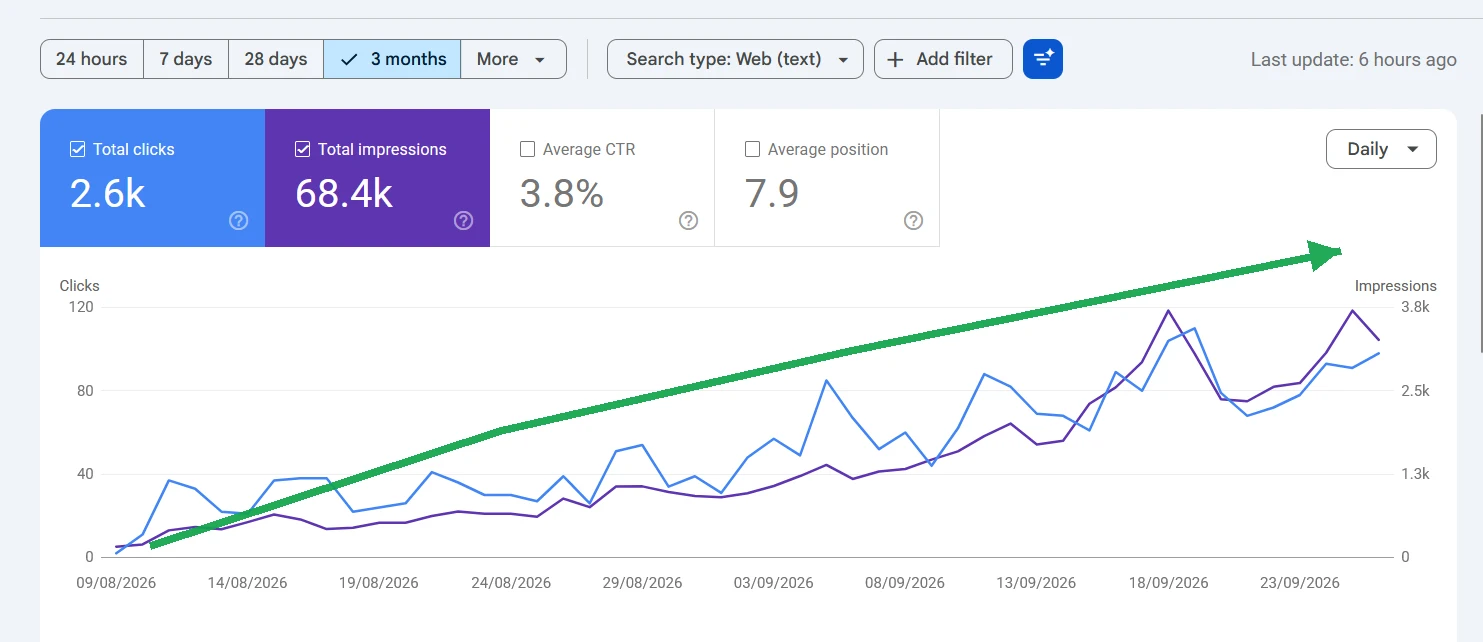
An average position of 7.9 for a domain in its first seven weeks of real visibility is genuinely strong. New sites typically spend that early period scattered across page two and three of results while Google works out how much to trust them, if they’re visible at all. Landing close to the bottom of page one on average, this early, is consistent with the bet we made: that pre-built technical SEO and early brand-entity signals shorten the usual trust-building runway rather than eliminating it.
The launch-to-now story, in one chart
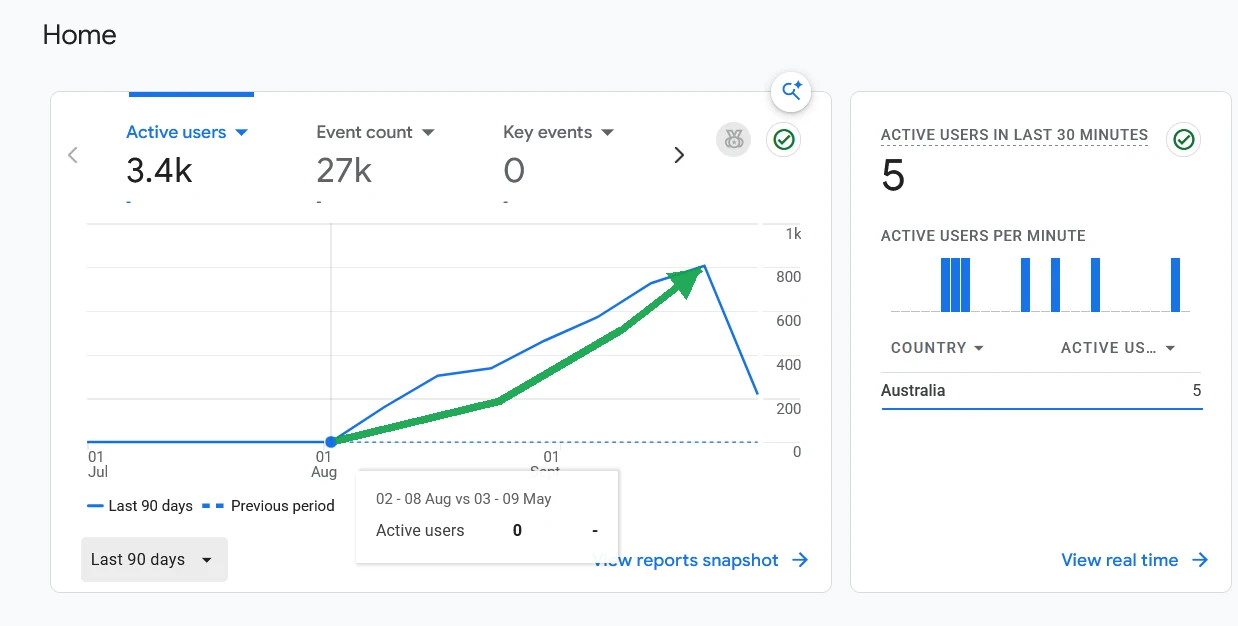
The clearest way to see the “day one” claim is the site’s 90-day Google Analytics view, covering roughly July 1 through September 29, 2026. The line is flat at literally zero from July 1 through around August 1, because the site simply didn’t exist yet in any public sense. Then it climbs continuously and steeply from that point onward, active users reaching 3.4K and event count reaching 27K over the full 90 days. That flat-then-climbing shape lines up almost exactly with the real build and launch timing described above, not a gradual ramp that started weeks before or after the site actually went live.
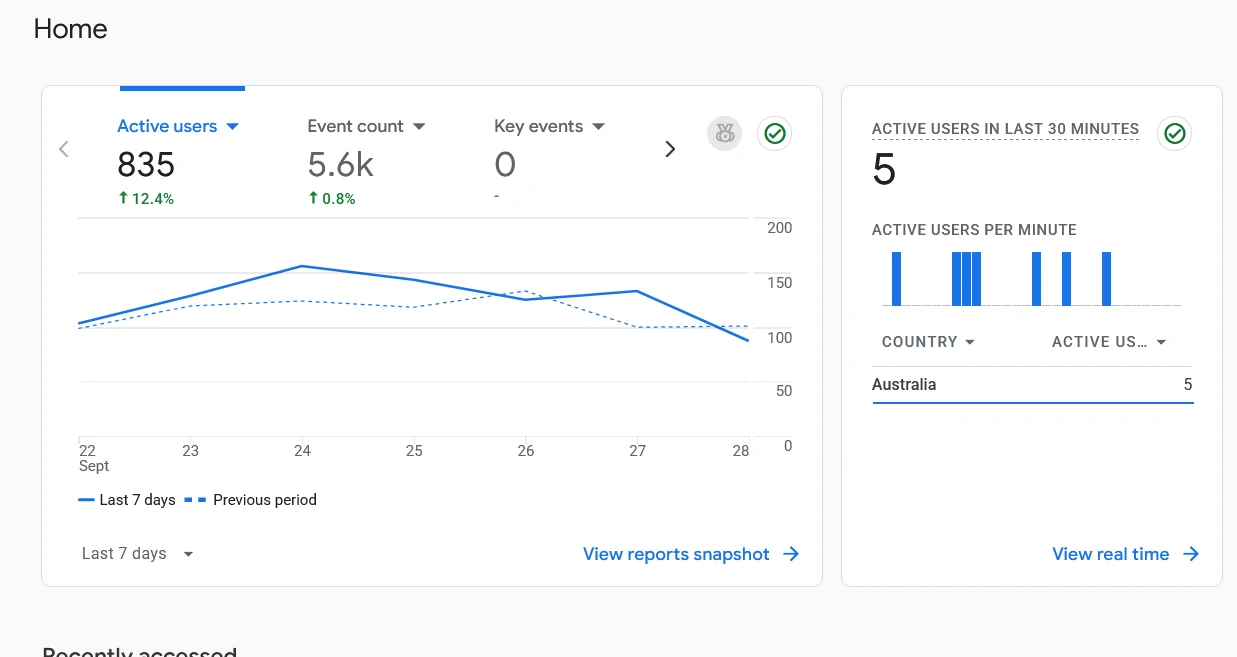
Over just the most recent 7 days (September 22 to 28, 2026), active users reached 835, up 12.4% week over week, with event count at 5.6K, up 0.8%, and Australia as the primary market, which matches the client’s own target audience. It’s worth being honest about the shape of that most recent week rather than only showing the flattering long-range chart: daily active users peaked mid-week around September 24 and dipped somewhat over the last few days of the window shown. That’s normal week-to-week variation for a young site with a small enough audience that day-to-day swings still show up clearly, not a hidden decline we’re leaving out of the numbers above.
| Metric | Real Figure |
|---|---|
| GSC total clicks, 3 months (Aug 9 to Sep 23, 2026) | 2.6K |
| GSC total impressions, 3 months | 68.4K |
| GSC average CTR, 3 months | 3.8% |
| GSC average position, 3 months | 7.9 |
| GA4 active users, last 7 days | 835 (+12.4% week over week) |
| GA4 event count, last 7 days | 5.6K (+0.8%) |
| GA4 active users / events, 90 days | 3.4K active users, 27K events, climbing from zero starting around Aug 1 |
This kind of pre-launch technical and brand-entity groundwork is the same category of work covered under our SEO services and AI SEO services, applied here from the very start of a build rather than retrofitted onto an existing site.
What This Doesn’t Prove
This is one client’s early result, not a guaranteed outcome, and we want to be upfront about the limits of what two months of data can actually show.
- Two months is still early. Seven weeks of real Search Console history is genuinely promising, but it’s a young site’s early trajectory, not a settled, multi-year track record. Early momentum can slow, plateau, or accelerate further, and we won’t know which for a while yet.
- The work was bundled together. The technical SEO and the brand-entity work happened in parallel as one engagement, so we can’t cleanly isolate exactly how much of the day-one visibility came from which piece individually. What we can say is both pieces were real, deliberate parts of the same build, not one dominant fix with the other as an afterthought.
- The most recent week dipped, and that’s normal. Active users peaked mid-week and pulled back over the last few days of the 7-day window shown above. We’re showing that honestly rather than only showing the flattering long-range charts, because a young site with a smaller daily audience will naturally show more visible day-to-day variation than an established one.
- This is genuine, disclosed South Asia Digital client work. We built this site and did this SEO and brand work ourselves, for a real paying client, and we’re the ones publishing this case study. We think the approach and the early numbers are worth sharing honestly, but that vendor relationship is part of the context you should weigh this against, not something we’re hiding.
If you want to see how this same AI-visibility thinking applies outside a brand-new build, on a site that already existed, we’ve also written about how to get into Google’s AI Overviews for SEO more generally.
Building a New Site and Want AI Visibility Built In From Day One?
This is the exact technical SEO and brand-entity approach behind the results above, built into your site from the start instead of bolted on after launch.
Frequently Asked Questions
What does “building AI Overview visibility in from day one” actually mean?
It means the technical SEO fundamentals, meta robots configuration, an llms.txt file, a deliberately written robots.txt, Core Web Vitals performance, and planned site structure, were all in place before or at launch rather than added afterward, and that brand-entity work (making the business a clear, recognizable, well-signaled entity) started on the same timeline instead of waiting until “the SEO phase” after the site was already live.
Why does branding matter for getting cited by AI Overviews or ChatGPT, not just for looking professional?
AI Overviews and LLM-based answer engines are trying to identify a real, coherent, trustworthy source behind a piece of content, not just match keywords on a page. A recognizable brand with consistent naming and clear signals about who the business actually is feeds directly into whether these systems treat a source as citation-worthy. On-page keyword optimization alone doesn’t establish that kind of entity trust by itself.
Is an average position of 7.9 actually good for a brand-new site?
Yes, notably so. New domains typically spend their early months scattered across page two and three of results, or not visible at all, while Google works out how much to trust them. An average position of 7.9 across the first roughly seven weeks of real visibility is a strong early signal, though it’s still an early number from a short window, not a settled long-term ranking.
Why show the recent dip in the 7-day chart instead of only the flattering long-range numbers?
Because it’s real, and hiding it would misrepresent the data. Active users peaked mid-week around September 24 and pulled back somewhat over the following few days. A young site with a smaller daily audience will show more visible day-to-day swings than an established one, and a single week of movement, up or down, isn’t the same as a trend reversal.
Does building SEO in from day one always produce results this fast?
Not automatically. This is one client’s real result over about two months, not a guaranteed outcome for every new site. The approach, technical SEO and brand-entity work started in parallel from the build stage, is the same for any client we’d apply it to, but competitive niche, domain history, market, and execution quality all still affect how quickly visibility shows up.
Is this South Asia Digital’s own product being reviewed here?
No. The client is a separate, real, paying client of ours, an Australia-based restaurant SaaS platform, not a South Asia Digital product. We built their site and handled their SEO and brand-entity work, and we’re disclosing that vendor relationship plainly rather than presenting this as an independent, unaffiliated review.