A client has just told you they want AEO. Or GEO. Or AIO, depending on which newsletter they read last week. They’re not entirely sure what the acronym stands for, but they’ve seen a competitor mentioned in a ChatGPT answer and now they want the same thing, starting this month.
If you’ve been doing SEO for a while, your first instinct is probably the right one: a site that’s genuinely good, fast, well-structured and trusted tends to show up in AI answers too, because the underlying signals overlap more than the marketing around “GEO” admits. But that instinct isn’t the whole answer, and a client paying you for this work deserves more than “keep doing what we were already doing.” There’s a real, if narrower, body of practice that’s different: what to actually check first, what counts as progress, and how often to look again.
This is that practical version. It’s built from our own research into how working agencies are actually approaching this exact client request right now, not just the vendor pitch version, organized around the parts that hold up under scrutiny: baseline prompt-set construction, the citation-versus-mention distinction, a realistic re-testing cadence, and what genuinely differs from normal SEO versus what’s just relabeled.
Key Takeaways
- Before touching anything, build a baseline: 20-30 real buyer questions run through ChatGPT, Perplexity and AI Overviews, logged by whether the client is named and which URL gets cited. Without this, you have no way to prove the work did anything.
- Citation and mention are different signals and need separate tracking: a citation is a specific page getting used as a named source, a mention is just the brand being named with no link attached.
- Re-test the same prompt list monthly, not once. Individual AI answers vary run to run; the trend across a fixed list over several months is what actually means something.
- What’s genuinely different from normal SEO is narrower than most pitches suggest: content structured to answer in the first sentence, consistent entity details across your site and third-party pages, and a presence on the directories/distributors/reviews sites a model actually cites, not a brand-new discipline.
- No agency controls what ChatGPT, Gemini or Perplexity decide to cite. Set that expectation with the client on day one, honestly, before the first report goes out.
Why We Built This Now
Every old and new agency seems to be working out how to actually start AEO/GEO work right now, not because the discipline reinvented SEO overnight, but because Google, and now ChatGPT, Perplexity and the rest, keeps changing how AI-generated answers surface content, and clients notice the shift faster than most agencies can build a repeatable process around it. Our research for this guide included reviewing the live, current debate happening across the SEO industry about exactly this problem, agencies and freelancers working through the same client request we’re describing here, alongside our own client work. What follows is our own synthesis and recommendation set, built from the parts of that practice that actually hold up, not a transcript of anyone else’s opinion.
Why “Just Keep Doing Good SEO” Isn’t a Complete Answer
The skeptic’s case is worth taking seriously before building a sales pitch around AEO/GEO as something entirely new: if all of SEO really were GEO, visibility would already be showing up everywhere, and that’s a claim worth checking rather than assuming. Our recommendation: figure out how much traffic AI chatbots actually refer to the client before spending a budget chasing visibility in a channel that might be 2% of total traffic.
Looked at from other angles, the conclusion lands in roughly the same place. Most of what’s being sold as AEO/GEO work is the same schema and trust work already done for technical, engineer-facing clients, so don’t let the alphabet soup suggest it’s a new discipline. Good SEO fundamentals still do most of the heavy lifting for AI visibility, with one real distinction worth calling out: content structure for extraction, not just relevance, is what’s actually different.
That’s the honest starting position for this engagement: AEO/GEO isn’t a parallel discipline you’re bolting on, it’s an extra layer of measurement and a handful of real structural changes, sitting on top of SEO work you were probably already doing. The rest of this guide is about which layer is genuinely new and how to prove it’s working.
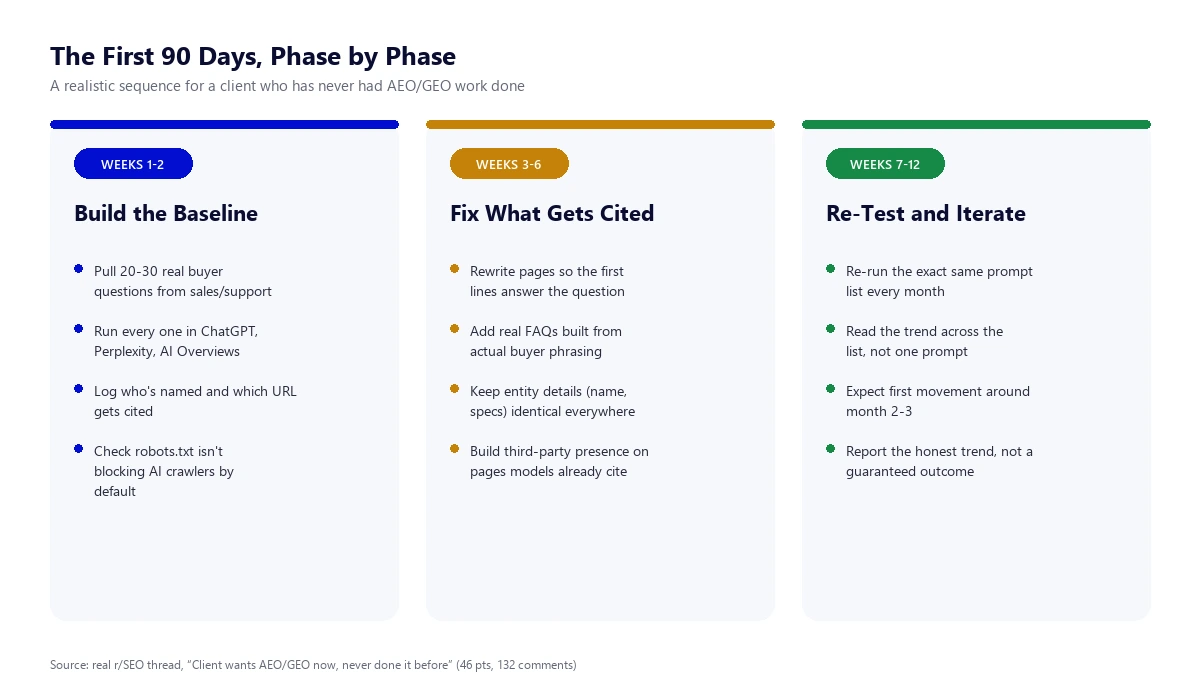
Weeks 1-2: Build Your Baseline Prompt Set
Before you change a single page, you need to know where the client already stands. Build the baseline first: write 20-30 questions the client’s buyers would actually type (comparisons, “best X for Y,” the spec questions engineers ask), run them in ChatGPT, Perplexity and AI Overviews, and log whether the client shows up, whether it’s linked, and which URL gets cited. Rerun the same list monthly, since answers vary run to run and a single snapshot means nothing. Note the specific framing: not “does the client rank,” but “is the client named, and is a specific URL cited.”
Where do the actual questions come from? Not a keyword tool. Sit with the client’s sales team and pull 30 questions buyers actually ask: “what’s the lead time for X,” “X vs Y for [application],” “suppliers of X that ship to [region],” “best [component] for [spec].” That’s a 30-minute conversation with whoever actually talks to buyers, not a Semrush export. Forums, Q&A platforms, and “people also ask”-style sources are useful supplementary signal for how real people phrase questions, good for filling gaps once the sales-team list is built, not a substitute for it.
Run every question through at least ChatGPT (with search on), Perplexity, and Google AI Overviews or AI Mode. For each one, log three things: was the brand named at all, was a specific URL cited, and which URL exactly. That log doubles as your content priority list: the pages that already get cited (even if not the client’s) tell you exactly what kind of page format and source type the model is pulling from for this query space.
What You’re Actually Measuring: Citation vs. Mention
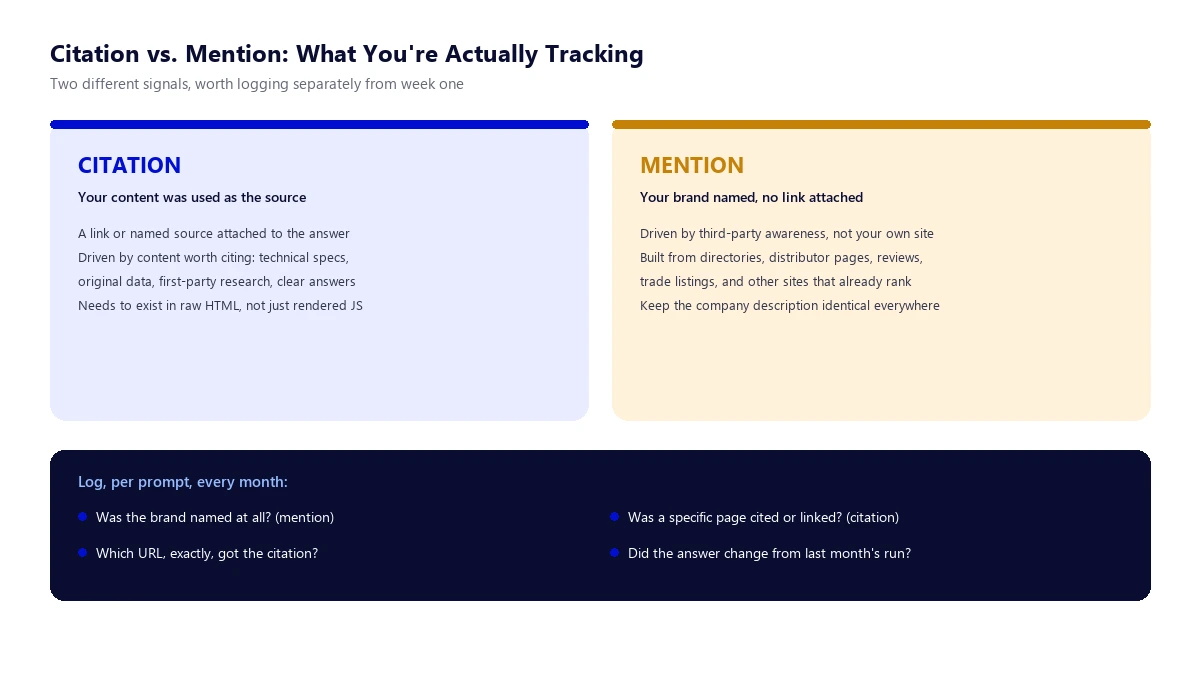
This is the single most useful framing for setting up a tracking sheet that a client can actually read: visibility splits into citations (your content used as a source for the answer) and mentions (your brand named within the answer, with no link attached). They’re driven by different things and need different fixes.
Citations are earned by content worth citing: technical information, unique product information and data, original research, first-party data, and anything else that adds real value on the topic, not just on a blog but everywhere across the site. For technical B2B content specifically, pages that answer one question in their first two sentences and carry quotable specifics (specs, tolerances, standards) tend to get cited, while long pages that bury the answer get skipped even when they rank.
Mentions work differently, and are often earned entirely outside the client’s own site. For a mention, AI systems need to already be aware of the brand, which is driven primarily by presence on third-party websites (quantity matters here, the same way old-school link building did), and plausibly by entity management as well. The practical version of that: keep the same company name, the same product names, and the same wording for specs identical across the client’s site, the distributor pages, and the trade directories. If a product goes by three different names across those pages, nothing accumulates.
Weeks 3-6: Fix the Pages a Model Would Actually Cite
Here’s the clearest version of what the “fix” phase actually involves, specific to a B2B manufacturing client but generalizable to most industrial and technical niches: fix the pages the engines would cite if they could. For a manufacturer that’s spec sheets, application guides and comparison pages. Rewrite each so the first paragraph answers the question outright, every spec is a number not an adjective, and each H2 section makes sense on its own. Add a short FAQ at the bottom of product pages, built from real buyer questions, with 2-3 sentence answers.
It’s worth checking what already works before guessing: look at which competitors are actually getting cited in ChatGPT, Perplexity and AI Overviews, then crawl those sites and examine the specific content, structure, schema, entities and authority signals the models appear to be pulling from. Do this before you rewrite a single page, since the content type that earns a citation genuinely varies by industry (comparison tables for software, spec sheets for manufacturing, ingredient breakdowns for consumer health).
Run this in parallel, not after: third-party presence. Industry directories, distributor pages, trade association listings, and the “top suppliers of X” articles that already rank are what the engines cite for supplier questions far more often than the manufacturer’s own site. Make sure the company description is identical everywhere. For most B2B and industrial clients, this is the part that genuinely differs from a typical on-site SEO scope, and the part most generalist pitches skip entirely because it isn’t billable as “content” in the usual sense.
One structural checklist worth treating as near-consensus best practice across agencies doing this work well: a direct-answer opening instead of building up to the point, real FAQ sections built from actual buyer phrasing rather than invented questions, comparison tables and clear definition-style paragraphs over narrative prose, and specifics (numbers, tolerances, named standards) over vague adjectives. Our own guide to earning AI Overview inclusion covers the same structural pattern in more depth if you want a reference while rewriting pages.
Check the Boring Stuff First: Can AI Crawlers Even Reach You
A failure mode that’s easy to miss and genuinely common: the client is invisible to AI search not because the content is wrong, but because a bot is blocked. Check the robots.txt and CDN bot rules on day one; it’s common for manufacturers to block OAI-SearchBot and PerplexityBot by accident through a default “block AI” toggle. Check the boring stuff first more generally too: can the AI crawlers actually reach the important pages, and is there any referral traffic from them? Server logs and GA4 can tell you a lot before you pay for another GEO tool. If they can’t crawl the pages, the rest of the optimization matters less.
One more technical wrinkle worth checking before assuming the gap is a content problem: ChatGPT’s web results largely pull from Bing’s index at search time, and an Ahrefs analysis found that only about 12% of the URLs ChatGPT cites also rank in Google’s top 10 for the same query. The practical, checkable fix: set up Bing Webmaster Tools (free, imports straight from GSC) and check whether the spec pages are even indexed there. That’s the gap most manufacturers have and nobody looks for. AI Overviews are a different story, those run on Google’s own index so existing SEO carries over. A page that ranks fine in Google but was never indexed by Bing can be structurally perfect and still never get cited by ChatGPT.
A genuinely free diagnostic worth running before any paid tool: both Google Search Console and Bing Webmaster Tools can show whether AI systems already cite a site, which is worth knowing before optimizing for it. In GSC, check the Performance tab; Bing Webmaster Tools has a separate tab labeled “AI Search performance.” Check both before recommending a monitoring subscription the client may not need yet.
Weeks 7-12: Re-Test on a Cadence, Not Once
A single prompt run proves nothing, because AI answers vary between identical queries run minutes apart. The fix is a fixed cadence against a fixed prompt list: run 15-20 real buyer-phrased questions your engineers would actually type, across ChatGPT and Perplexity, and log which source gets cited, at least monthly (weekly if you’re tracking by hand and want a tighter signal, since there’s no reliable off-the-shelf analytics for this yet). Read the trend across the whole list, not any single prompt; answers wobble between runs even for the same query.
On realistic timelines, here’s the guidance we give clients directly: re-run your prompt set monthly. Expect the first real mentions around month two to three, usually on long-tail application questions before broader category questions. That’s a genuinely useful line to put in a proposal, specific enough to be checkable, honest enough that nobody’s surprised in month one when nothing has visibly moved yet.
Tools Worth Paying For (And When Manual Beats Them)
Opinion in the industry splits fairly evenly between “do it by hand first” and “just pay for a tool,” and both positions have a real point buried in them. The by-hand case: tools exist (Profound, Otterly.AI) but they’re more useful once you already know what pattern you’re looking for. The counter-case: just pay for one of the AI analytics tools (Peec, Mentionflow, Promptwatch). They’ll run about $90/month, and most clients will be fine paying for that rather than an agency spending hours doing it manually.
Both are reasonable depending on scale. For a single client with a 20-30 prompt list, manual tracking in a spreadsheet costs nothing and forces you to actually read every answer, which is useful early on while you’re still learning what the client’s buyers ask and how the engines answer. Once you’re running this across multiple clients, or the prompt list grows past what’s practical to check by hand every month, a dedicated tool earns its subscription. We’ve covered the current landscape in more depth, including real verified pricing, in our AI visibility monitoring tools roundup, and for a free first spot-check before committing to a paid tool, our AEO/GEO checker extensions guide covers lighter options that work for a quick baseline read.
Setting Honest Client Expectations
The most important non-technical advice applies to nearly every one of these engagements: manage client expectations and don’t let them get too carried away with the shiny new “GEO” label. Use the client’s excitement for AI search as a vehicle for getting the usual SEO work implemented sooner, with more buy-in. That’s a genuinely useful reframe: the client’s enthusiasm for GEO can fund technical SEO work that was already overdue.
No agency controls what ChatGPT, Gemini or Perplexity decide to cite on any given day, the same way no SEO agency has ever controlled Google’s algorithm. Say that plainly, in writing, before the first invoice goes out. What you can commit to is the process: a real baseline, specific fixes tied to what the baseline showed, a fixed re-testing cadence, and an honest report of the trend, up or down, every month. A client who understands that from day one is far less likely to churn after month one shows no visible movement, which the month-two-to-three timeline above suggests is the normal pattern, not a failure.
A Real-World Pattern: Why Months of Google Work Can Tell You Almost Nothing About ChatGPT
This pattern is worth calling out directly, since it’s genuinely instructive and shows up often. An agency runs three months of solid Google-focused SEO work (technical fixes, schema, E-E-A-T content) and starts moving the needle in Google, but as the Bing-indexing point above shows, that work alone says very little about ChatGPT visibility specifically, because ChatGPT’s web results draw heavily from a different index. The lesson generalizes: strong Google rankings are a good sign, not proof, that the same pages are visible to AI search. Verify it directly with the baseline prompt set rather than assuming one implies the other.
Want This Playbook Run for You Instead?
This is genuinely the process we run with our own AI-SEO clients: baseline prompt set, honest measurement, monthly re-testing, no guaranteed outcomes. If you’d rather hand the first 90 days off than run it yourself, we’re set up for exactly that.
We’re not pretending this article is written from the outside looking in. South Asia Digital runs dedicated AI-SEO services and generative engine optimization services built around the same process described above, not a different, more impressive-sounding one reserved for paying clients. If you’re an agency or freelancer reading this to run the work yourself, everything above is the real thing, use it. If you’d rather this was somebody else’s problem for a quarter, that’s a genuinely fine reason to talk to us too.
Frequently Asked Questions
What’s the very first thing to do when a client asks for AEO/GEO work?
Build a baseline before changing anything. Pull 20-30 real buyer questions (from the client’s own sales or support team, not a keyword tool), run each one through ChatGPT, Perplexity and Google AI Overviews, and log whether the client is named and which URL gets cited. Without this baseline, there’s no way to later prove the work changed anything.
What’s the real difference between a citation and a mention in AI search?
A citation is a specific page being used and named as the source behind an AI-generated answer. A mention is the brand being named in the answer with no page or link attached. Citations are earned mainly by on-site content worth citing (technical specs, original data, clear answers); mentions are driven more by third-party presence, directories, distributor listings, and review sites that models pull brand awareness from.
How often should AEO/GEO visibility actually be re-tested?
Monthly, using the exact same prompt list each time. Individual AI answers vary meaningfully between runs even for the same query, so a single snapshot is close to meaningless. A fixed list re-run on a fixed monthly cadence lets you read the trend across the whole list instead of chasing noise in any one answer.
What genuinely differs from normal SEO, versus what’s just relabeled?
The genuinely new parts are narrower than most pitches suggest: structuring pages to answer a question directly in the first sentence rather than building up to it, keeping entity details (brand name, product names, specs) identical across your own site and every third-party listing, and deliberately building presence on the directories and distributor pages that models already cite for your category. Technical SEO, schema, and E-E-A-T content work is the same underlying work either way.
Can you guarantee a client will show up in ChatGPT or AI Overviews?
No, and any agency that promises this should be a red flag. No agency controls what ChatGPT, Gemini or Perplexity decide to cite on a given query, the same way no SEO agency has ever controlled Google’s core algorithm. What’s realistic to commit to is the process: a real baseline, specific fixes, a fixed monthly re-test, and an honest report of the trend.
Why might a site rank well in Google but still not show up in ChatGPT answers?
ChatGPT’s web results draw heavily on Bing’s index at search time, not Google’s, and a site that’s never been checked in Bing Webmaster Tools can have pages that rank fine in Google but were never properly indexed by Bing. Checking Bing indexation is a five-minute diagnostic worth doing before assuming a content problem. Google AI Overviews are different and do run on Google’s own index, so existing SEO carries over more directly there.
Are there free tools to check if AI already cites a client’s site?
Yes. Google Search Console has an AI Search performance view under the Performance tab, and Bing Webmaster Tools has a separate AI Search performance tab, both free and worth checking before recommending a paid monitoring subscription. Manually running a baseline prompt list through ChatGPT and Perplexity by hand is also free and arguably more instructive early in an engagement.
When does a paid AI visibility tracking tool actually make sense?
Once a prompt list grows too large to check by hand every month, or once the work is running across multiple clients at once, a dedicated tracking tool earns its subscription. Early on, for a single client with a 20-30 prompt baseline, manual tracking in a spreadsheet is free and forces a closer read of what the AI answers actually say.
Should robots.txt be checked before starting any content work?
Yes, on day one. It’s a common, easy-to-miss failure mode for a site to be accidentally blocking AI crawlers like OAI-SearchBot or PerplexityBot through a blanket “block AI” toggle, often added without realizing it also blocks the bots that could cite the site. If crawlers can’t reach the pages, no amount of content rewriting will fix visibility.
How soon should a client expect to see results?
Based on consistent patterns across real AEO/GEO engagements, expect the first visible mentions around month two to three of consistent monthly re-testing, typically showing up first on long-tail, specific questions before broader category questions. Setting this timeline honestly at the start of an engagement avoids a difficult conversation when month one shows no visible movement, which is the normal pattern, not a failure.
Is South Asia Digital an AEO/GEO agency?
Yes, we run dedicated AI-SEO and generative engine optimization services built around the same baseline-and-re-test process described in this article. The point of this guide is to give you the real process either way, whether you run it yourself or decide to hand it off to us.