The best social media analytics tool depends on what you actually need to measure.
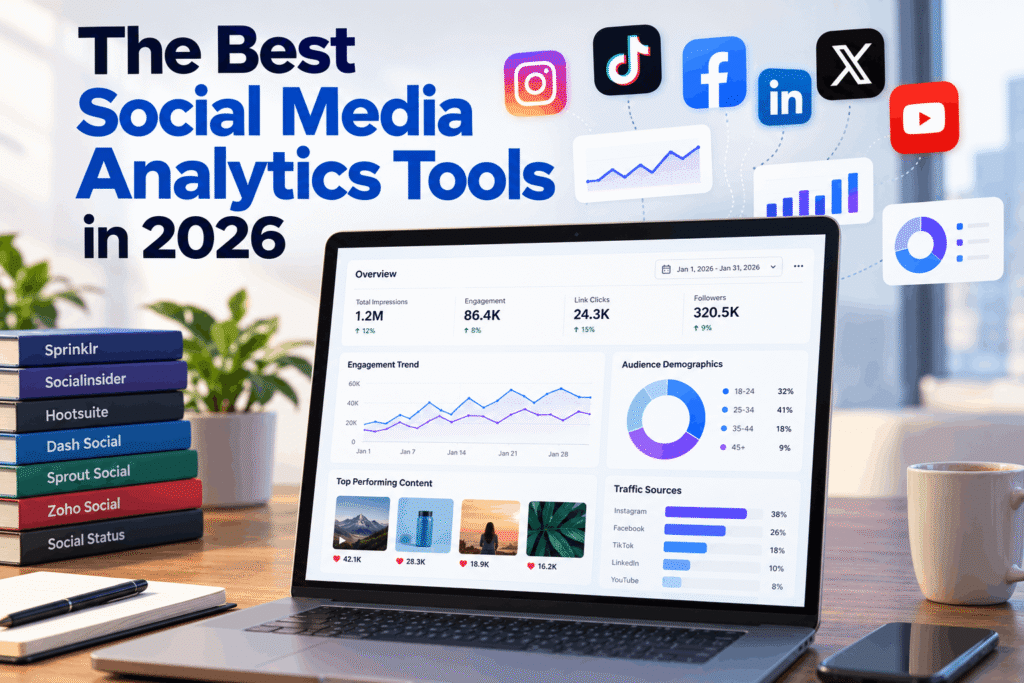
Sprinklr is built for enterprises that need social intelligence across multiple channels. Socialinsider is particularly useful for competitor benchmarking, while Hootsuite works well for teams that want analytics, publishing, and social media management in one platform. Dash Social is better suited to visual and creator-led brands, and Social Status makes reporting easier for agencies managing multiple clients.
The important part is not collecting more social media data. It is turning that data into decisions about what to publish, where to invest, which campaigns are working, and what should change.
This guide compares seven social media analytics tools worth considering in 2026.
What Are Social Media Analytics Tools?
Social media analytics tools collect, organise, and report data from platforms such as Facebook, Instagram, LinkedIn, TikTok, YouTube, X, and other social networks.
Instead of manually checking likes, comments, shares, impressions, clicks, follower growth, and conversions on every platform, marketers can view this information from a central dashboard.
Good social analytics software can help businesses understand:
- Which posts generate the most engagement
- Which platforms contribute the most traffic
- How audiences respond to different content formats
- Whether follower growth is translating into business results
- How competitors perform on social media
- What people are saying about a brand or industry
- Which creators and influencers generate meaningful engagement
- How paid and organic social campaigns compare
Analytics should also connect with the wider marketing strategy. South Asia Digital, for example, describes data and analytics as part of its broader approach to digital marketing services, alongside SEO, PPC, content, social media, and conversion optimisation.
Best Social Media Analytics Tools at a Glance
| Tool | Best for | Standout capability |
|---|---|---|
| Sprinklr Social | Large enterprises | Social intelligence and customer data |
| Socialinsider | Competitive analysis | Competitor and industry benchmarking |
| Hootsuite | Social media management | Analytics, publishing and management |
| Dash Social | Visual and creator-led brands | Content and creator analytics |
| Sprout Social | Listening and analytics | Social listening and reporting |
| Zoho Social | Zoho users | Reporting with Zoho ecosystem integration |
| Social Status | Agencies | Automated client reporting |
1. Sprinklr Social – Best for Enterprise Social Intelligence
Sprinklr Social is designed for large organisations that need more than basic engagement reports.
Its strength is combining social media management, listening, customer conversations, competitive intelligence, and analytics within a wider customer experience platform.
That makes it useful for enterprise teams that want to understand not only how individual posts perform but also how customers talk about their brand, products, competitors, and industry.
Key features
- Cross-channel social analytics
- Social listening
- Sentiment analysis
- Audience intelligence
- Competitive intelligence
- Campaign analytics
- Content performance reporting
- Custom dashboards
- AI-assisted insights
Good for: Enterprises with multiple social channels, markets, brands, or customer service teams.
Potential drawback: The platform may offer more functionality and complexity than a small company actually needs.
2. Socialinsider – Best for Competitive Benchmarking
Socialinsider focuses heavily on social media analytics and competitive benchmarking.
Rather than looking only at your own historical performance, it helps marketers compare engagement rates, posting frequency, content formats, campaign performance, and other metrics against competitors.
This can be valuable when your own analytics tell you that engagement has fallen but do not explain whether the decline is specific to your brand or reflects a wider shift within the industry.
Key features
- Cross-platform analytics
- Competitor benchmarking
- Industry benchmarks
- Content performance analysis
- Campaign analytics
- Social media reporting
- Competitive analysis
Good for: Marketing teams, agencies, and brands that regularly compare their performance with competitors.
Potential drawback: Businesses mainly looking for publishing, customer support, or broader social media management may need additional tools.
3. Hootsuite – Best for Analytics and Social Media Management
Hootsuite combines analytics with everyday social media management.
Teams can plan content, publish posts, monitor conversations, collaborate internally, and analyse social performance without moving between several separate platforms.
Its analytics features help marketers identify which posts, networks, and campaigns are generating engagement so they can adjust future content accordingly.
For businesses already investing heavily in social channels, analytics should be connected to a wider social media marketing strategy rather than treated as a separate reporting exercise.
Key features
- Social media analytics
- Cross-network reporting
- Post-level analytics
- Social listening
- Publishing and scheduling
- Campaign reporting
- Team collaboration
Good for: Businesses and agencies that want social media management and reporting within the same platform.
Potential drawback: Companies requiring highly specialised competitive analytics may prefer a dedicated analytics platform.
4. Dash Social – Best for Visual and Creator-Led Brands
Dash Social is particularly relevant for brands where visual content, short-form video, creators, and audience retention play a major role.
Instead of focusing entirely on follower counts or basic engagement, teams can examine how specific pieces of content perform and whether views translate into meaningful audience interaction.
That can be useful for ecommerce, fashion, beauty, food, lifestyle, media, and other businesses where visual content influences product discovery.
Key features
- Cross-channel analytics
- Content performance reporting
- Competitive benchmarking
- Creator analytics
- Influencer performance tracking
- Social listening
- ROI analysis
- Content retention insights
Good for: Visual-first and creator-led brands that publish large volumes of social content.
Potential drawback: Businesses with relatively simple social media programmes may not need its creator-focused capabilities.
5. Sprout Social – Best for Analytics and Social Listening
Sprout Social combines social media reporting with listening and engagement tools.
Marketing teams can analyse clicks, impressions, audience growth, engagement, content performance, and campaign activity while also monitoring conversations around their brand and industry.
The combination is useful because performance metrics explain what happened, while social listening can provide more context around why audiences reacted in a certain way.
Key features
- Cross-channel analytics
- Social reporting
- Content analytics
- Campaign reporting
- Audience insights
- Social listening
- Sentiment analysis
- Competitive analysis
Good for: Marketing teams that want reporting and social listening within one platform.
Potential drawback: Teams that only need simple monthly reports may not use enough of the platform to justify a broader social management suite.
6. Zoho Social – Best for Businesses Using the Zoho Ecosystem
Zoho Social combines publishing, monitoring, collaboration, and social media reporting.
It becomes particularly useful for businesses already using other Zoho products because social media activity can sit within a wider business software ecosystem.
Marketers can review individual post performance, audience engagement, publishing activity, and broader account-level trends.
Key features
- Social performance reports
- Post analytics
- Engagement tracking
- Custom reports
- Scheduled reporting
- Publishing and scheduling
- Team collaboration
- Integration with other Zoho products
Good for: Small and medium-sized businesses already using Zoho applications.
Potential drawback: The ecosystem advantage is less important if your company does not use other Zoho products.
7. Social Status – Best for Automated Agency Reporting
Social Status is focused heavily on analytics and reporting rather than trying to become an all-in-one social media management suite.
It allows agencies and marketing teams to analyse organic posts, paid campaigns, competitors, and influencer activity and then turn the data into client-facing reports.
That can save significant time for agencies that otherwise export information from several social platforms every week or month.
Key features
- Organic social analytics
- Paid social analytics
- Competitor analytics
- Influencer analytics
- Cross-channel reporting
- Automated reports
Good for: Agencies, consultants, and in-house teams that produce recurring social media reports.
Potential drawback: Businesses wanting extensive publishing, inbox management, or customer engagement functionality may need another platform alongside it.
How to Choose a Social Media Analytics Tool
There is no need to choose the platform with the longest feature list. Start with the questions your team actually needs the data to answer.
Choose based on your main objective
If competitive benchmarking is the priority, a platform such as Socialinsider may make more sense.
If your organisation manages a large number of customer conversations and social channels, Sprinklr may be more appropriate.
If your team wants publishing, scheduling, engagement, and analytics together, Hootsuite or Sprout Social may be easier to manage.
Agencies producing regular client reports may prefer a reporting-focused platform such as Social Status.
Check which social networks are supported
Not every analytics platform provides the same level of data for every social network.
Before subscribing, check whether the tool supports all the channels that matter to your organisation and whether it can report on the metrics you actually use.
Look beyond follower growth
Follower count alone does not tell you whether social media is contributing to the business.
More useful measures may include:
- Engagement rate
- Website clicks
- Leads
- Sales
- Assisted conversions
- Cost per acquisition
- Video completion
- Audience retention
- Campaign ROI
For ecommerce companies in particular, social data should ideally connect with broader traffic and conversion activity. ecommerce marketing services also emphasise combining social media activity with SEO, paid advertising, content, and conversion optimisation rather than evaluating each channel in isolation.
Consider reporting requirements
A small in-house team may only need a simple monthly dashboard.
An agency handling 20 clients may need scheduled white-label reports, multiple workspaces, competitor tracking, and account-level permissions.
The best tool therefore depends as much on how the information will be used as on what data it collects.
Social Media Analytics vs Social Listening
The two terms are often used together, but they solve slightly different problems.
Social media analytics primarily measures the performance of your own accounts, content, and campaigns.
Social listening monitors wider conversations involving your brand, competitors, products, industry, topics, or keywords.
For example, analytics might show that engagement on a campaign fell by 20%. Social listening could help identify whether customer sentiment changed or whether a wider discussion affected audience behaviour.
Businesses running paid campaigns can also combine these insights with the principles covered in South Asia Digital’s guide to the advantages of social media advertising to understand whether stronger reach is producing meaningful engagement and business outcomes.
Do You Need a Dedicated Social Analytics Platform?
Not every company does.
Most major social networks already provide native analytics. For a business operating only one or two channels, those dashboards may provide enough information.
Dedicated social analytics tools become more useful when you need to:
- Compare several social networks
- Track multiple brands
- Monitor competitors
- Create recurring client reports
- Measure influencer campaigns
- Analyse paid and organic performance together
- Conduct social listening
- Compare performance against industry benchmarks
- Give multiple team members access to the same reporting environment
As marketing operations become more complex, analytics platforms can also work alongside marketing automation software to connect audience behaviour with wider campaigns and customer journeys.
Final Thoughts
The best social media analytics tool in 2026 is the one that answers the questions your marketing team actually needs to solve.
Sprinklr is designed for enterprise-level social intelligence. Socialinsider puts more emphasis on competitive benchmarking. Hootsuite combines analytics with day-to-day social management, while Dash Social is suited to visual and creator-led brands. Sprout Social combines analytics with listening, Zoho Social makes sense for companies already using the Zoho ecosystem, and Social Status is particularly useful for automated agency reporting.
Before choosing a platform, identify the social networks you need to measure, the reports your team uses, the level of competitor analysis required, and how closely social activity needs to connect with traffic, leads, and revenue.
Social media analytics is most valuable when it leads to a decision: what content to produce next, which campaigns to stop, where to invest more budget, and how social media contributes to the wider business.