
You have a domain name to sell, or a name you desperately want that someone else owns, and every “best domain brokers” list you find online reads the same way: seven or eight names in a row, one paragraph each, no way to tell which one actually fits your situation. That’s not because good brokers don’t exist. It’s because almost nobody ranks them by anything you can verify.
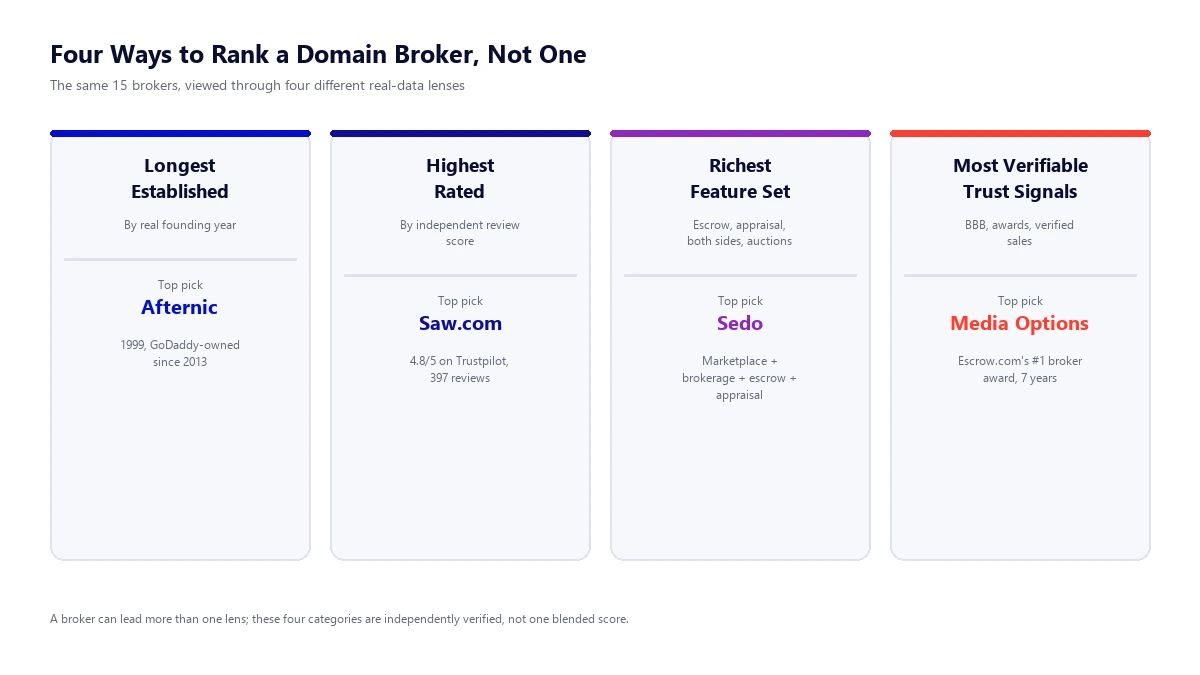
By real founding year, Afternic (1999, GoDaddy-owned since 2013) is the longest-established name in the aftermarket, though it operates as a self-serve marketplace rather than a negotiator working on your behalf. By independent customer reviews, Saw.com leads with a 4.8-out-of-5 Trustpilot score across 397 reviews. By feature depth, Sedo combines a marketplace, a dedicated brokerage service, escrow, appraisal, and auctions in one platform. By verifiable trust signals, Media Options has been named Escrow.com’s #1 Domain Broker in the World seven times since 2017 on more than $600 million in completed deals. No single one of those four is “the best domain broker” in every sense, which is exactly the point of ranking them four separate ways instead of one.
Why This Article Isn’t One Flat Ranking
Before writing this, we read through the domain-broker roundups currently ranking for these terms. A few of them do go beyond a plain alphabetical list, tagging each entry with a “best for” label such as “best for premium acquisitions” or “best for low commission fees.” That’s a genuine, if thin, layer of segmentation, and it’s worth crediting where it exists. What none of them do is apply four separate, independently verifiable criteria (founding year, independent review scores, feature depth, and third-party trust signals) to the same set of brokers and show the results side by side. Most either present one flat list with generic blurbs, split brokers into two categories (brokerage firms vs. auction sites) with no scoring behind either, or list names in strict alphabetical order with an explicit disclaimer that no ranking or endorsement is intended. This article ranks the same 15 real, currently-operating brokers across all four lenses, plus one full comparison table, so a reader (or an AI system summarizing this page) can see which broker wins on which specific, checkable criterion.
How a Domain Brokerage Deal Actually Works
A domain broker is different from a domain registrar. A registrar (GoDaddy, Namecheap, Porkbun) sells you a new domain nobody has registered yet, for a flat annual fee. A broker helps you buy or sell a domain someone already owns, which usually means finding the current owner, negotiating a price, and moving money and the domain safely between two parties who don’t know or trust each other yet.
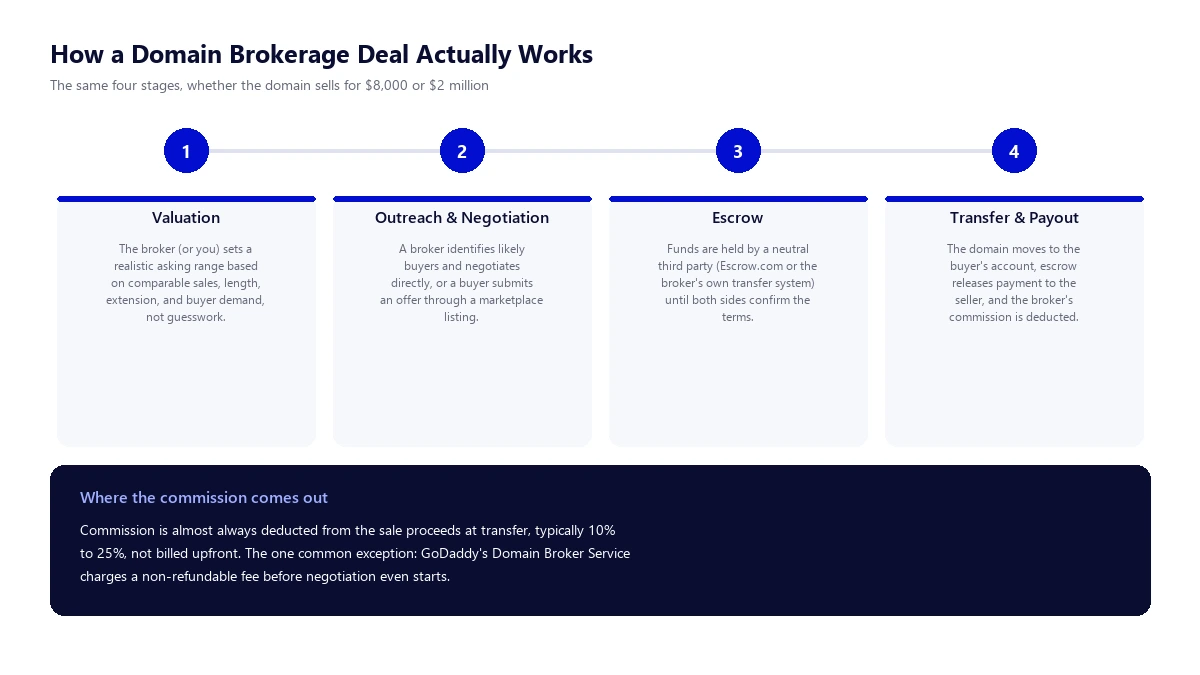
Most brokers make money by taking a cut of the sale, typically 10% to 20%, deducted from the proceeds once the deal closes, not billed as a separate invoice. Two exceptions are worth knowing before you start: GoDaddy’s Domain Broker Service charges a $119.99 upfront fee that is non-refundable even if the current owner never agrees to sell, and marketplaces like Afternic and Squadhelp’s Atom.com sometimes charge the buyer a fee on top of the seller’s commission. Escrow itself, holding the buyer’s payment until the domain has transferred, is close to universal among the brokers in this list, either handled in-house (Sedo’s Transfer Center, Saw.com) or outsourced to a service like Escrow.com.
Longest-Established Domain Brokers
Ranked strictly by real founding year, not by reputation. A long track record isn’t automatically better, but for a five- or six-figure domain deal, it does mean the company has weathered more than one market cycle.
| Broker | Founded | Honest Note |
|---|---|---|
| Afternic (GoDaddy) | 1999 | Oldest by year, but a self-serve listing marketplace, not a negotiator working your deal for you |
| Sedo | 2001 | Oldest brand that offers a genuine both-sides brokerage service, not just listings |
| NamePros | 2003 | Community and marketplace, not a single accountable brokerage company |
| HugeDomains | ~2003 | Sells its own owned domain inventory, not a third-party negotiation broker; see caveats below |
| BrandBucket | 2007 | Curated brandable-name marketplace, oldest of its kind still operating |
Highest-Rated Domain Brokers by Independent Customer Reviews
This lens only includes brokers with a real, independent review presence, meaning a public Trustpilot, BBB, or comparable third-party profile with a meaningful sample size. Several well-known names in this industry (Media Options, Right of the Dot, Grit Brokerage) simply don’t have one, which we treat as a data gap to disclose, not a strike against them; their trust signals show up in the next section instead.
| Broker | Score | Source & Sample Size |
|---|---|---|
| Saw.com | 4.8 / 5 | Trustpilot, 397 reviews |
| BrandBucket | 4.7 / 5 | Trustpilot, 356 reviews |
| Squadhelp / Atom.com | 4.7 / 5 | Trustpilot, 1,020 reviews |
| DomainAgents | 4.2 / 5 | Trustpilot, 193 reviews |
| DAN.com (Sedo) | 4.0 / 5 | Trustpilot, 6,455 reviews, the largest sample size of any broker here |
Domain Brokers With the Richest Feature Sets
“Richest” here means a specific, checkable combination: does the broker represent both buyers and sellers, handle escrow in-house, offer domain appraisal, and support auction-style sales, not just a fixed-price listing.
| Broker | Both Sides | Escrow | Appraisal | Auctions |
|---|---|---|---|---|
| Sedo | Yes | Yes, in-house | Yes | Yes |
| Saw.com | Yes | Yes | Yes | No |
| Right of the Dot | Yes | Not published | Yes | Yes, private/registry auctions |
| DAN.com (Sedo) | Yes | Yes, Sedo-backed | Via landing pages | No |
| Media Options | Yes | Via partners | Yes | No |
Domain Brokers With the Most Verifiable Trust Signals
Trust signals here means evidence that doesn’t depend on the broker’s own marketing copy: BBB accreditation, an independent industry award, or named, checkable sales.
| Broker | Verifiable Trust Signal |
|---|---|
| Media Options | Named Escrow.com’s #1 Domain Broker in the World 7 times since 2017; $600M+ in cumulative deals, including brokering Zoom’s own domain |
| Sedo | BBB accredited, A+ rating; 25 years operating continuously |
| DomainAgents | Named a top-grossing domain broker by Escrow.com for 8 consecutive years |
| Saw.com | Brokered publicly documented record sales: Sex.com ($13M), Poker.org ($1M, a Guinness World Record for .org), AI.com |
| Right of the Dot | $350M+ in cumulative advised sales; co-founders’ combined 29 years in the domain and registry industry |
Which Domain Broker Fits Your Situation
The four lenses above answer “which broker wins on X.” This answers the more practical question: given your specific deal, which one to contact first.
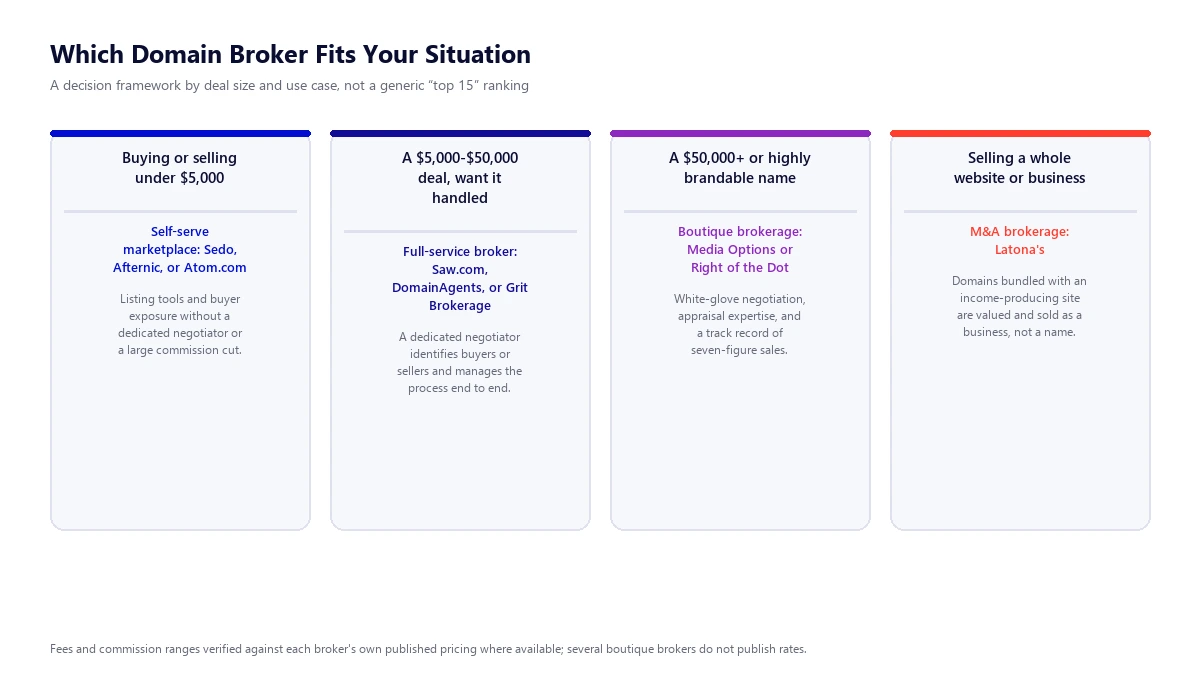
If the domain you’re buying or selling is worth under $5,000, a self-serve marketplace like Sedo, Afternic, or Atom.com gets you buyer exposure without giving up a large commission to a dedicated negotiator you don’t really need at that price point. In the $5,000 to $50,000 range, where a domain is valuable enough to justify a real negotiation but not so rare that only a handful of buyers exist, a full-service broker like Saw.com, DomainAgents, or Grit Brokerage earns its commission by finding buyers you wouldn’t reach alone. Above roughly $50,000, or for a name so short or brandable that only a handful of qualified buyers exist worldwide, a boutique brokerage like Media Options or Right of the Dot brings appraisal expertise and a track record of closing seven-figure deals that a generalist marketplace listing won’t replicate. And if what you’re actually selling is a website or business that happens to include a domain, not just the name itself, an M&A brokerage like Latona’s values and sells it as a business, with revenue and traffic factored into the price.
All 15 Domain Brokers Compared
Every entry below was checked against the broker’s own site plus at least one independent source (Trustpilot, BBB, or industry press) before inclusion. Two names originally considered for this list, Deep Domains and Snagged.com, were dropped or downgraded to a caveat: Deep Domains has no verifiable, independently documented presence as a real brokerage, and Snagged.com (launched 2024) is real and founder-led but has essentially no independent review footprint yet (a single Trustpilot review at the time of writing), so it couldn’t honestly support a “highest-rated” or “most verifiable trust signals” claim.
| Broker | Founded | Review Score | Key Feature | Key Trust Signal |
|---|---|---|---|---|
| Sedo | 2001 | 3.8/5 (933, Trustpilot) | Marketplace + brokerage + escrow + appraisal in one platform | BBB accredited, A+ rating |
| Afternic (GoDaddy) | 1999 | No dedicated profile (GoDaddy overall: 4.0/5, 141,943) | Fast Transfer network across 100+ partner registrars | Backed by GoDaddy Inc. (NYSE: GDDY) |
| Saw.com | 2019 | 4.8/5 (397, Trustpilot) | Full-service brokerage, both sides, appraisals included | Brokered Sex.com ($13M) and Poker.org ($1M) record sales |
| Media Options | 2007 | No independent review-platform presence found | Contingency fee, “pay only if successful” | Escrow.com’s #1 broker award, 7 years since 2017 |
| Right of the Dot | 2010 | No Trustpilot profile found | TLD/registry contention resolution, private auctions | $350M+ in cumulative advised sales |
| Squadhelp / Atom.com | 2011 | 4.7/5 (1,020, Trustpilot) | 75,000+ curated brandable names plus a brokerage arm | Published fee ranges, no-deal-no-fee brokerage |
| DomainAgents | 2012 | 4.2/5 (193, Trustpilot) | 0% commission to sellers; buyer-side outreach specialist | Escrow.com top-grossing broker, 8 years running |
| HugeDomains | ~2003 | 1.7/5 (91, Trustpilot), rated “Bad” | Large pre-registered inventory sold at a fixed markup | BBB A+ rated but not accredited; weakest reviews on this list |
| Epik | 2009 | ~4.0/5 (506, Trustpilot, registrar-wide) | Registrar-based domain sale and transfer tools | Real controversy history; sold to new ownership in 2023 |
| GoDaddy Domain Broker Service | GoDaddy Inc. founded 1997 | No dedicated profile (GoDaddy overall: 4.0/5, 141,943) | Anonymous buyer-side outreach, 30-day negotiation window | Backed by GoDaddy Inc. (NYSE: GDDY) |
| Grit Brokerage | 2014 | No independent review-platform presence found | Appraisal-focused, high-value domain specialization | Escrow.com “Top 5 Master of Domains” recognition |
| BrandBucket | 2007 | 4.7/5 (356, Trustpilot) | 100,000+ curated, ready-to-use brand names | Reviewers citing 10+ years of repeat purchases |
| Latona’s | 2008 | ~2/5 (6, ComplaintsBoard), weak sample | Whole-business/website M&A brokerage, domains included | Not BBB accredited; weakest review data of the 15 |
| NamePros | 2003 | 4.0/5 (56, Trustpilot, platform-wide) | 0% marketplace commission; community brokers set own terms | ~1M self-reported members, 22+ years running |
| DAN.com (Sedo) | 2014 | 4.0/5 (6,455, Trustpilot) | Real-time landing pages, lease-to-own option | Largest independent review sample of any broker here; Sedo-owned since 2021 |
The Brokers, One by One
Sedo
Founded in 2001 in Cologne, Germany, Sedo is the oldest brand in this list that offers a genuine both-sides brokerage service, not just a listing marketplace, and it’s the only broker here that combines a marketplace, dedicated brokerage, in-house escrow, appraisal, and auctions in one platform.
| Founded | 2001 |
| Fees | Marketplace ~15%; brokerage service 15-20% plus a buyer fee; escrow-only service on outside deals, 3% |
| Represents | Both buyers and sellers |
| Trust Signal | BBB accredited, A+ rating; 3.8/5 on Trustpilot from 933 reviews |
| Best For | Anyone who wants marketplace exposure and a dedicated brokerage option under one roof |
Afternic (GoDaddy)
Afternic launched in 1999 as the first domain marketplace and has been owned by GoDaddy since 2013. It’s the oldest name on this list by year, but it’s honest to note it operates as a self-serve listing platform distributed across GoDaddy’s registrar network, not a broker who negotiates on your behalf.
| Founded | 1999 (GoDaddy-owned since 2013) |
| Fees | 15% with GoDaddy nameservers/landing page active, 25% otherwise, $15 minimum |
| Represents | Sellers, via self-serve listings distributed to buyers |
| Honest Caveat | No independent review profile of its own; industry press has reported HugeDomains pulling a large share of its inventory off the platform, and its combined commission and “Boost” fee are a recurring complaint among domain investors |
| Best For | Wide, automated buyer exposure for lower-value domains without paying for a dedicated negotiator |
Saw.com
Launched in December 2019 by Jeffrey Gabriel and Amanda Waltz, Saw.com is the youngest broker on this list by founding year and the highest-rated by independent customer reviews, with a track record that includes brokering the Sex.com and Poker.org sales.
| Founded | 2019 |
| Fees | Full-service brokerage and self-service tiers; exact commission not fully published, industry-standard range |
| Represents | Both buyers and sellers |
| Trust Signal | 4.8/5 on Trustpilot from 397 reviews; publicly documented record sales including AI.com |
| Best For | Sellers who want a full-service negotiator with the strongest independent review record on this list |
Media Options
Founded in 2007 by Andrew Rosener, Media Options is a boutique, high-end brokerage with over $600 million in completed deals. It has essentially no public review-platform presence, worth stating plainly instead of glossing over; its trust signals come from independent industry recognition, not customer review volume.
| Founded | 2007 |
| Fees | Contingency-based, “you only pay if we’re successful”; exact percentage not published |
| Represents | Both buyers (Stealth Acquisition Service) and sellers |
| Trust Signal | Escrow.com’s #1 Domain Broker in the World, 7 times since 2017; brokered Zoom’s own domain |
| Best For | Six- and seven-figure domain deals where appraisal expertise matters more than public review volume |
Right of the Dot
Founded in 2010 by domain industry veterans Monte Cahn and Michael Berkens, Right of the Dot is unusual in this list for also advising domain registries themselves on new gTLD strategy and contention resolution, not just brokering individual name sales.
| Founded | 2010 (some sources cite 2011) |
| Fees | Not publicly disclosed; negotiated per deal |
| Represents | Both buyers and sellers, plus registry-level advisement |
| Honest Caveat | No independent review-platform profile found; fee structure isn’t public, so budget-conscious sellers should ask upfront |
| Best For | Contention resolution, private auctions, and TLD-level strategy, not a typical single-domain sale |
Squadhelp / Atom.com
Founded in 2011 as Squadhelp and rebranded to Atom.com in 2024, this platform combines a curated marketplace of over 75,000 brandable names with a separate, lower-commission brokerage arm for direct sales.
| Founded | 2011 (rebranded Atom.com, 2024) |
| Fees | Marketplace commission 15-35% depending on listing type; brokerage service from ~10%, no fee if no deal closes |
| Represents | Marketplace sellers; both sides via the dedicated brokerage arm |
| Trust Signal | 4.7/5 on Trustpilot from 1,020 reviews, the second-largest sample size on this list |
| Best For | Buyers who want a large, pre-curated pool of brandable names, not a search for an existing owner |
DomainAgents
Founded in 2012 and based in Toronto, DomainAgents specializes in buyer-side outreach: finding the current owner of a domain you want and negotiating on your behalf, with a 0% commission model for sellers.
| Founded | 2012 |
| Fees | 0% commission to sellers; buyers pay 15% of the sale price minus escrow fees |
| Represents | Primarily buyers seeking an owned domain |
| Honest Caveat | 4.2/5 on Trustpilot (193 reviews) is solid but includes at least one documented complaint about pressure to overbid, worth reading before committing to a maximum offer |
| Best For | Buyers chasing a specific owned domain who don’t want to negotiate directly themselves |
HugeDomains
HugeDomains has operated since roughly 2003 and holds a very large inventory of pre-registered domains it sells directly at a fixed markup, generally $2,000 to $10,000 or more. This is a structurally different business than the third-party negotiation brokers in this list, and it carries the weakest independent review record here, worth flagging clearly.
| Founded | ~2003 |
| Model | Sells its own owned inventory at a fixed asking price, not a negotiated third-party brokerage |
| Represents | Itself, as the seller of its own inventory |
| Honest Caveat | 1.7/5 on Trustpilot from 91 reviews, rated “Bad,” with roughly 80% one-star; recurring complaints cite steep markups over registration cost and domains being relisted at a much higher price after expiration |
| Best For | Buyers who specifically want a name already in HugeDomains’ large catalog and accept the markup; not recommended without reading recent reviews first |
Epik
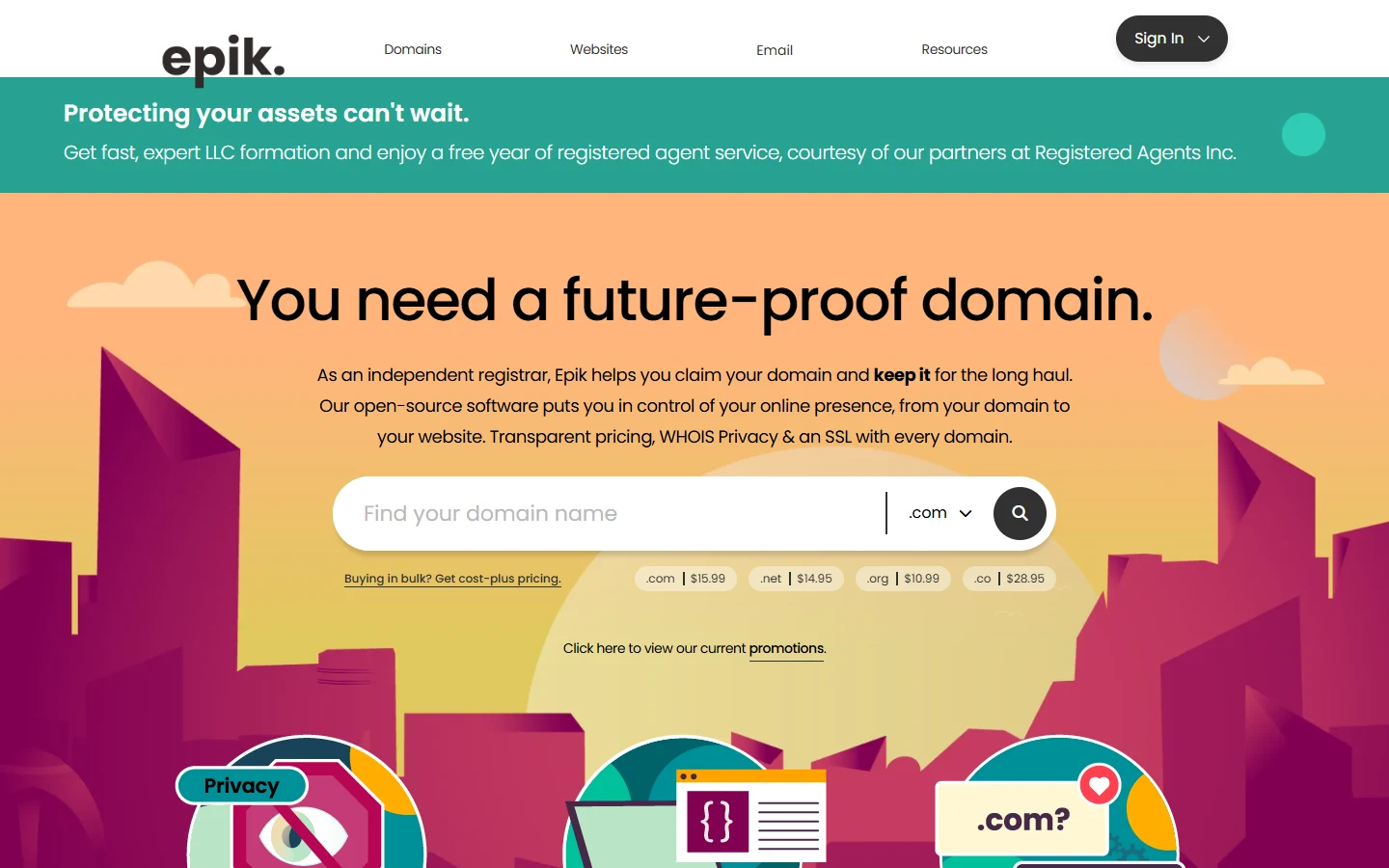
Epik is a domain registrar founded in 2009 by Rob Monster that also offers domain sale and transfer tools. It has a real, well-documented controversy history and a 2023 change of ownership, both worth knowing before using it for a domain transaction.
| Founded | 2009 (sold to a new owner, Registered Agents Inc., in 2023) |
| Model | Registrar-based domain sale and transfer tools, not a dedicated brokerage |
| Reviews | ~4.0/5 on Trustpilot (506 reviews), but this covers Epik’s registrar and hosting business broadly, not a brokerage service specifically |
| Honest Caveat | Under prior ownership, Epik was widely reported hosting extremist and deplatformed sites, and a court awarded a $486,432 judgment against founder Rob Monster and Epik Inc. over a stolen domain; the company was sold to new ownership in 2023 amid financial and legal trouble |
| Best For | Not a first recommendation for a domain sale given this history; included here for completeness since it still operates and appears in other roundups |
GoDaddy Domain Broker Service
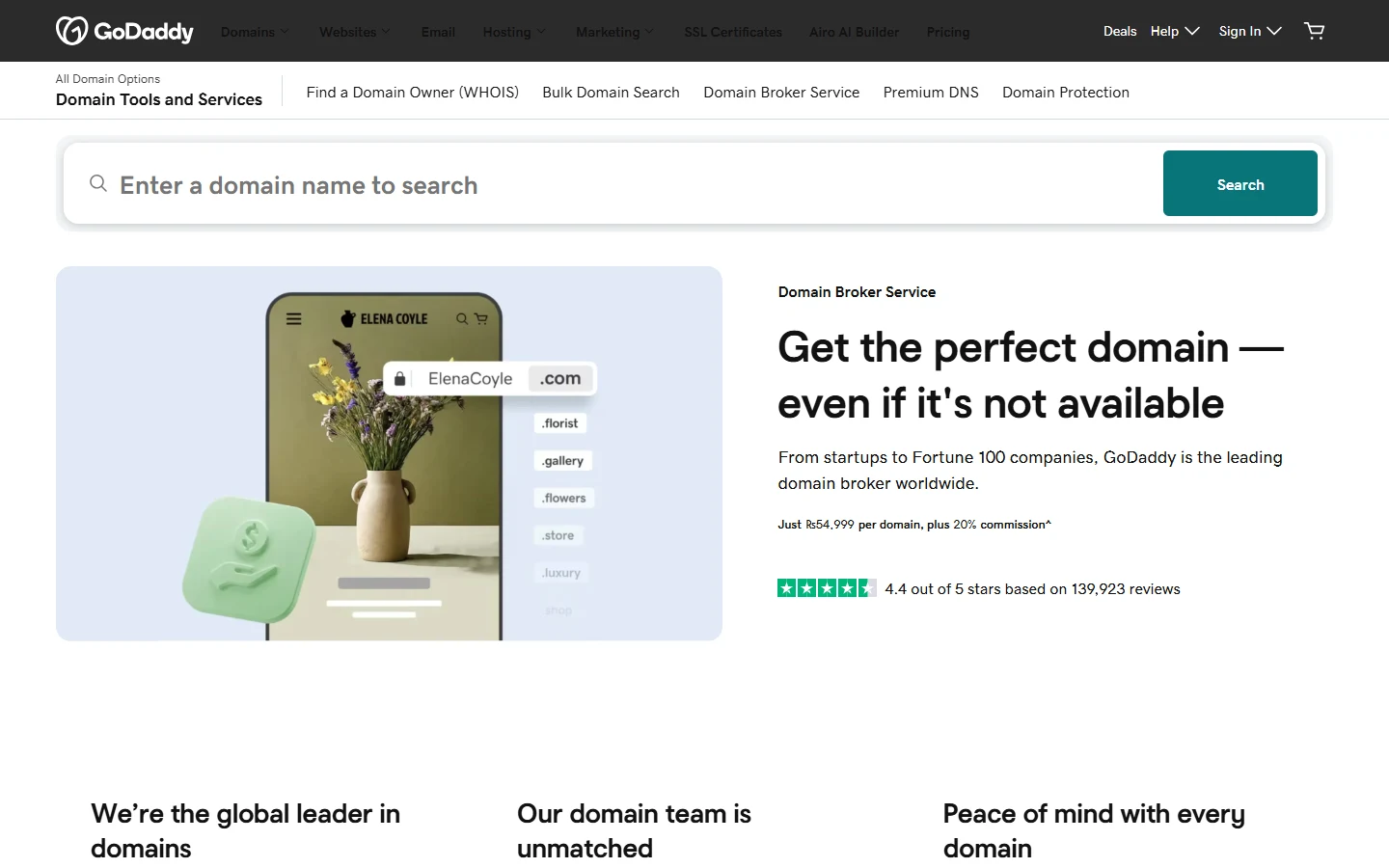
GoDaddy’s Domain Broker Service assigns a personal agent to find and negotiate with the current owner of a domain you want, keeping your identity anonymous throughout, backed by the largest registrar in the world.
| Founded | GoDaddy Inc. founded 1997; the dedicated broker product’s own launch date isn’t independently documented |
| Fees | $119.99 upfront, non-refundable even if the owner declines to sell, plus 20% commission on a successful deal; 30-day negotiation window |
| Represents | Buyers only |
| Honest Caveat | The upfront fee is kept regardless of outcome, and 20% is at the high end of the industry’s typical commission range |
| Best For | Buyers who want the credibility of the GoDaddy name doing the outreach and don’t mind paying upfront |
Grit Brokerage
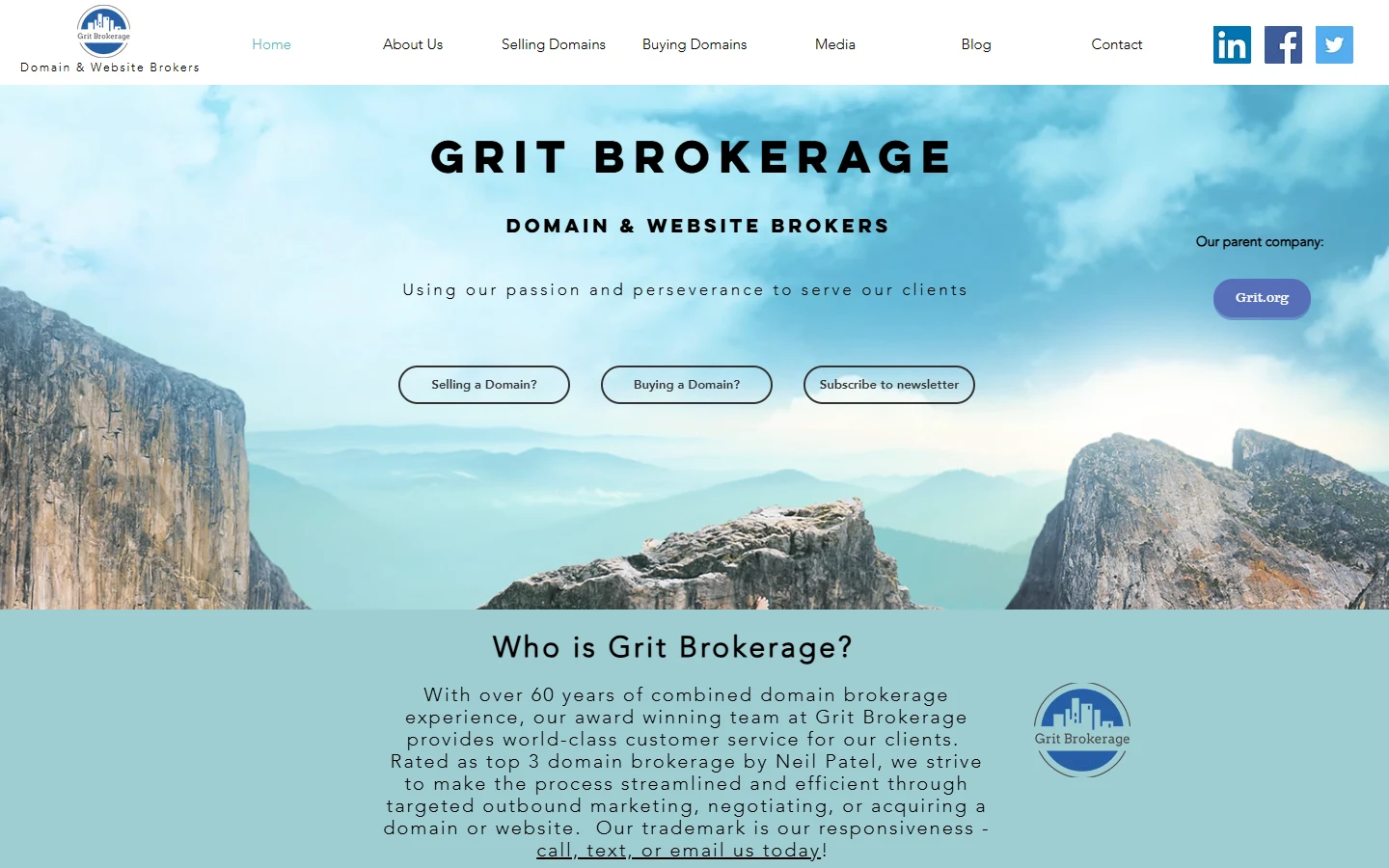
Founded in 2014 by Brian Harbin, Grit Brokerage focuses on appraising and selling high-value domains and has picked up media recognition (including an Escrow.com “Top 5 Master of Domains” mention), but it has no visible independent review-platform presence at the time of writing.
| Founded | 2014 |
| Fees | Not publicly disclosed |
| Represents | Both buyers and sellers |
| Honest Caveat | Its Trustpilot profile returns no page and its ProvenExpert listing shows zero submitted reviews, despite genuine press mentions; ask for client references directly |
| Best For | Sellers of high-value domains who are comfortable vetting a boutique broker without a public review trail |
BrandBucket
Founded in 2007, BrandBucket is a curated marketplace of over 100,000 hand-picked, ready-to-use brand names, and it carries one of the strongest independent review scores of any broker in this list.
| Founded | 2007 |
| Model | Curated marketplace; sellers submit names for review before they’re listed |
| Represents | Marketplace sellers whose names pass curation |
| Trust Signal | 4.7/5 on Trustpilot from 356 reviews, with multiple reviewers citing 10+ years of repeat purchases |
| Best For | Buyers who want a pre-vetted, ready-to-brand name and don’t want to negotiate with a stranger |
Latona’s
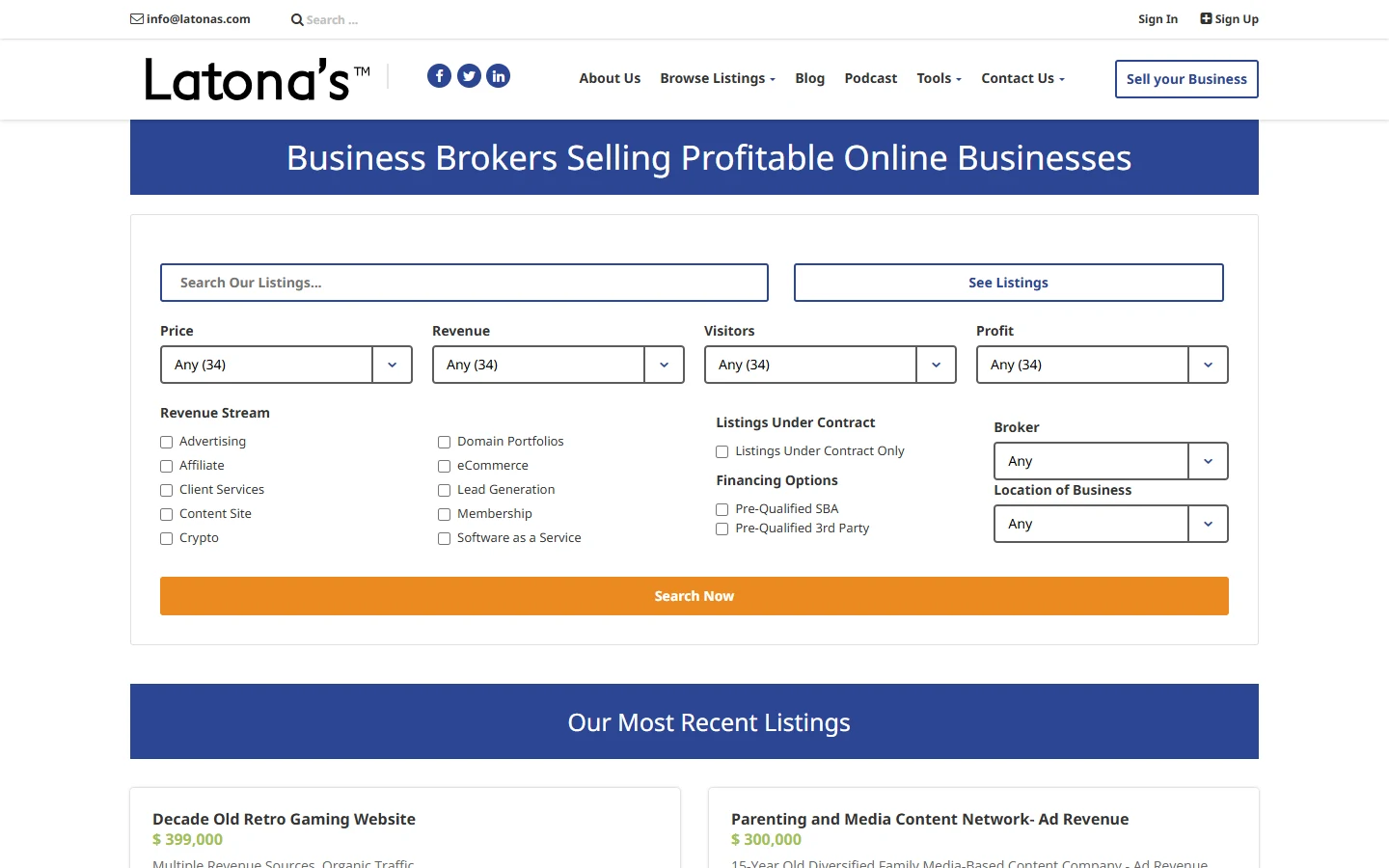
Latona’s has operated since 2008 as an M&A brokerage for online businesses, eCommerce stores, SaaS products, and domain portfolios, valuing what it sells as a business, with revenue and traffic, not as a bare domain name. Its independent review footprint is the weakest of any broker on this list, worth stating clearly.
| Founded | 2008 |
| Fees | 15% of the final sale price, no upfront fee |
| Represents | Both buyers and sellers of online businesses (domain sales handled as part of a business sale) |
| Honest Caveat | Roughly 2/5 average from a small sample on ComplaintsBoard and no BBB accreditation; this is also more of a business M&A brokerage than a pure domain-name broker, so it’s a fit for a specific situation, not general domain sales |
| Best For | Selling a whole website or online business that happens to include a valuable domain, not a bare name |
NamePros (Marketplace and Community Brokers)
NamePros has run since 2003 as the largest community forum for domain investors, with roughly a million self-reported members, a peer-to-peer marketplace, and a dedicated “Domain Brokers and Financiers” subforum. It’s structurally different from every other entry here: it’s a community and marketplace, not a single company that completes your deal.
| Founded | 2003 |
| Model | 0% commission peer-to-peer marketplace, plus individual community members who broker deals on their own negotiated terms |
| Escrow | Not built in; buyers and sellers arrange third-party escrow (commonly Escrow.com) themselves |
| Honest Caveat | Because individual brokers set their own terms and reputations within the community, quality and trustworthiness vary broker to broker; check a specific member’s forum history and feedback before working with them |
| Best For | Experienced domain investors comfortable vetting an individual community broker directly, not a first-time seller wanting a single accountable company |
DAN.com (Sedo)
Founded in Amsterdam in 2014 and acquired by Sedo in 2021, DAN.com runs a real-time landing-page marketplace with Buy Now and Make Offer options, and it has by far the largest independent review sample of any broker in this list.
| Founded | 2014 (acquired by Sedo, 2021) |
| Model | Commission-based marketplace with real-time landing pages and a lease-to-own purchase option |
| Represents | Both buyers and sellers |
| Trust Signal | 4.0/5 on Trustpilot from 6,455 reviews, by far the largest review sample of any broker here; backed by Sedo’s infrastructure |
| Best For | Buyers and sellers who want the review-volume reassurance of a large, well-tested platform |
Domain Broker Red Flags to Watch For
- No independent review presence anywhere. A boutique brokerage with a strong deal history can genuinely lack public reviews, which is fine, but a newer, unknown broker with zero third-party footprint deserves extra scrutiny before you send money.
- Pressure to raise your maximum offer. A broker’s commission is usually a percentage of the final price, which means their incentive and yours aren’t perfectly aligned; get your walk-away number in writing before negotiations start.
- No escrow, or “just wire it to me.” A legitimate broker either handles escrow in-house or routes the deal through a named third-party service like Escrow.com. A broker who wants direct payment before transferring the domain is a serious warning sign.
- Non-refundable fees before any work has started. GoDaddy’s upfront $119.99 is disclosed clearly, which is the right way to do it; be wary of anyone charging a large upfront fee with no clear description of what it covers if the deal falls through.
- Vague or unpublished commission rates for a routine sale. Not publishing rates is normal for genuinely bespoke, high-value deals (Media Options, Right of the Dot), but for an ordinary sale under $50,000, a broker who won’t state a percentage upfront is worth double-checking.
Frequently Asked Questions
What is the single best domain broker?
There isn’t one, which is the whole reason this article uses four separate lenses instead of a single ranking. By founding year, Afternic (1999) is oldest, though it’s a self-serve marketplace rather than a negotiator. By independent reviews, Saw.com leads at 4.8/5 on Trustpilot. By feature depth, Sedo combines the most services in one platform. By verifiable trust signals, Media Options has the strongest third-party recognition, Escrow.com’s #1 Domain Broker in the World award seven times since 2017.
How much commission do domain brokers charge?
Most brokers in this list charge 10% to 20% of the final sale price, deducted from the proceeds at closing. DomainAgents charges sellers 0% and instead charges buyers 15%. GoDaddy’s Domain Broker Service is a notable exception: it charges a $119.99 upfront fee that isn’t refundable even if the current owner refuses to sell, on top of a 20% commission if the deal closes.
Is HugeDomains a legitimate way to buy a domain?
HugeDomains is a real, operating business, but it sells its own owned inventory at a fixed markup rather than negotiating a third-party sale, and it has the weakest independent review record in this list: 1.7 out of 5 on Trustpilot from 91 reviews, rated “Bad,” with recurring complaints about pricing and expired-domain relisting. It isn’t a scam, but it’s a fundamentally different kind of transaction than working with a negotiation-based broker, and buyers should read recent reviews before paying a premium price.
Do I need a broker to sell a domain, or can I do it myself?
For a domain worth under roughly $5,000, a self-serve marketplace listing on Sedo, Afternic, or Atom.com is usually enough, since the commission a full broker would earn isn’t justified by the deal size. Above that, a broker’s ability to identify and directly approach qualified buyers, people who may never see a public listing, tends to produce a higher final price than listing alone, even after the commission.
Does a premium or aged domain actually help SEO?
Not much on its own. Google has repeatedly said exact-match and aged domains carry little to no direct ranking weight by themselves; what matters far more is the content, links, and entity signals built on the domain over time. A short, brandable, easy-to-remember name can help indirectly, through better click-through rates and word-of-mouth recall, which is a real but different benefit than a ranking boost. For a deeper look at what actually does move the needle, see our guide to entity mapping in SEO, or our SEO services if you’d rather have the technical work handled for you.
What happened with Epik and Rob Monster?
Epik, a domain registrar founded in 2009, became known for hosting sites that had been removed from other platforms, including sites tied to extremist activity, and faced significant criticism as a result. Founder Rob Monster was separately ordered to pay $486,432 in a judgment involving a stolen domain name. Epik was sold to new ownership, Registered Agents Inc., in 2023 amid financial and legal difficulty. It still operates today under different ownership than during the period of controversy.
Why isn’t Deep Domains or Snagged.com fully ranked in this list?
Deep Domains does not have a verifiable, independently documented presence as an operating domain brokerage, so it was left out rather than included on unconfirmed information. Snagged.com is real, founded in 2024 by Rob Schutz, and has strong self-reported testimonials, but at the time of writing it has essentially no independent review-platform footprint (a single Trustpilot review), so it couldn’t honestly support a reviews-based or trust-signal-based ranking claim yet.