
You type a competitor’s brand name into the Google Ads keyword planner, half-expecting a warning message to pop up and tell you this isn’t allowed. Nothing happens. The keyword gets accepted, the campaign goes live, and now you’re waiting for the cease-and-desist letter that never quite arrives, or wondering if it will. Meanwhile a colleague swears their last agency got a client suspended for doing exactly this.
Here’s the direct answer: yes, you can bid on a competitor’s brand name as a keyword in Google Ads. Google’s own trademark policy states plainly that it will not restrict the use of trademarks as keywords. What Google will restrict is using that trademark in your ad text if you’re a direct competitor, and enforcement runs on a complaint filed by the trademark owner, not an automatic block. Whether it’s legally safe on top of being policy-compliant is a separate question, and the honest answer depends on which country your ads run in, since the US and the EU/UK apply genuinely different legal tests to the same practice.
This guide covers what Google’s policy actually says, how the US and EU/UK legal standards differ (with the real case law, not vague references to “recent rulings”), a formula-based way to decide whether bidding on a rival’s brand is worth it for your business, what to do when a competitor bids on yours, and the real mechanics of filing a Google trademark complaint. One quick note before we start: this is general PPC guidance based on publicly available policy and case law, not legal advice for your specific campaign. If real money or a real legal threat is on the table, talk to a trademark attorney, not a marketing agency.
The Short Answer
- Bidding on the keyword: allowed by Google policy, and US courts have consistently held it isn’t infringement on its own.
- Using the trademark in your ad text: restricted for direct competitors, with a few narrow exceptions.
- Enforcement: complaint-driven and advertiser-specific, not an automatic scan that blocks the term for everyone.
- Legal risk: lower and fairly settled in the US, meaningfully higher and more fact-dependent in the EU and UK.
- Economics: usually a worse Quality Score and higher CPC than bidding on your own brand, which is why the decision should run through a real cost calculation, not a gut call.
What Google’s Policy Really Says
Most articles on this topic paraphrase Google’s trademark policy secondhand. It’s worth reading the actual language, because the distinction it draws is the one everything else in this guide builds on.
Keywords vs. ad text: the core distinction
Google’s policy is explicit that it “will not investigate or restrict trademarks as keywords,” including in your display URL. Separately, it states it will restrict “using trademarks in an ad from a direct competitor” and any “ads that use the trademark in a confusing, deceptive, or misleading way.” That’s the whole rule in two sentences: buy the keyword freely, be careful what the ad itself says.
The exceptions to the ad-text restriction
Google carves out specific situations where using a trademark in ad text is still allowed, even for a competitor:
- Reseller pages: your landing page is “primarily dedicated to selling or clearly facilitating the sale of” the trademarked product, with actual purchase options and pricing shown, not just a mention of it.
- Informational sites: your landing page provides genuine “informative details about products or services corresponding to the trademark,” such as a comparison page or an index of results, rather than a competing sales pitch.
- Descriptive use: you’re using the term “descriptively in its ordinary meaning,” not as a brand reference at all.
- Component or compatible parts: you sell components, replacement parts, or compatible products for the trademarked item and say so accurately.
In every case, Google requires that “the ad and landing page must be clear as to whether the advertiser is a reseller or informational site,” so vague hedging doesn’t qualify. You either clearly disclose the relationship or you don’t get the exception.
How enforcement really works
This is the part that surprises people: Google doesn’t run an automated scanner that yanks every ad mentioning a trademark. Enforcement is complaint-driven. A trademark owner (or someone authorized to act for them) submits a complaint against a specific advertiser’s use of their mark in ad text, and Google only accepts complaints “against specific advertisers identified on the basis of their URL(s), within the countries and industries in which trademark owners have demonstrated trademark rights.” If it’s approved, the restriction applies to that advertiser’s domain going forward, not to every advertiser who has ever mentioned the term. Nobody else bidding on the same keyword is affected by someone else’s complaint.
Is It Legal? US vs EU/UK
Google’s policy tells you what Google itself will enforce on its own platform. It says nothing about whether a competitor can successfully sue you for trademark infringement, and that answer changes depending on which country’s courts you’d end up in. This is the gap almost every other article on this topic glosses over, and it’s the one place where “just follow the platform rules” isn’t the whole story.
United States: the “likelihood of confusion” standard
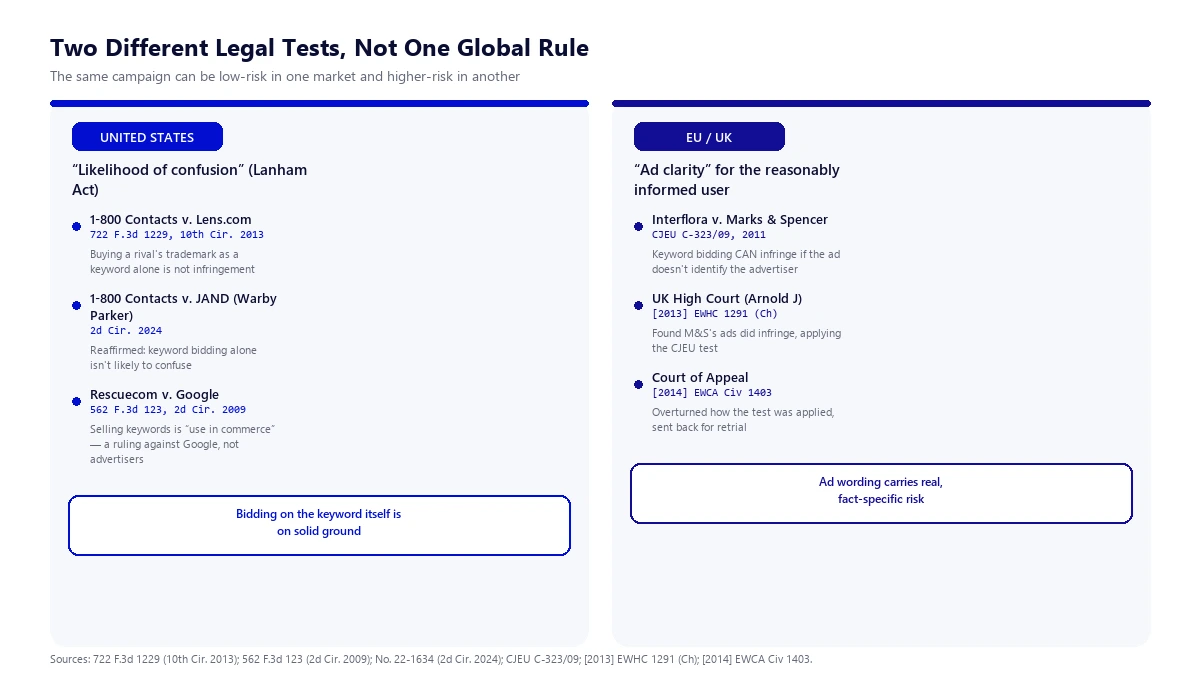
US trademark law under the Lanham Act asks whether an ad creates a likelihood of confusion among consumers, and buying a keyword by itself has repeatedly failed to clear that bar. In 1-800 Contacts, Inc. v. Lens.com, Inc., 722 F.3d 1229 (10th Cir. 2013), the Tenth Circuit rejected 1-800 Contacts’ infringement claim against a competitor that bid on its trademark as a keyword, finding the confusion evidence too thin to support the claim. More recently, in 1-800 Contacts, Inc. v. JAND, Inc. (Warby Parker), the Second Circuit affirmed on October 8, 2024 that the mere act of buying a competitor’s trademark as a keyword in an ad auction, without using the mark in the ad text itself, does not create a likelihood of confusion sufficient to state a claim.
The other frequently cited case, Rescuecom Corp. v. Google Inc., 562 F.3d 123 (2d Cir. 2009), gets misquoted often enough that it’s worth being precise about it. That case was Rescuecom suing Google, not a competitor, over Google’s practice of selling trademarked terms as keywords through its own Keyword Suggestion Tool. The Second Circuit held that this practice counted as “use in commerce” under the Lanham Act, which was enough to let the case proceed past a motion to dismiss. It did not rule that Google, or any advertiser, infringed the mark; it just cleared a procedural hurdle. It’s a case about definitions, not a finding of liability, and treating it as proof that keyword bidding is illegal misreads it.
Put together, US case law is fairly consistent: bidding on the keyword is not, by itself, trademark infringement. What still matters is what your ad text and landing page say.
EU/UK: the “ad clarity” standard
The European standard asks a different question, and it’s a meaningfully lower bar for a trademark owner to clear. In Interflora, Inc. v. Marks & Spencer plc, Case C-323/09 (CJEU, 22 September 2011), the Court of Justice of the European Union held that a trademark’s origin function is harmed if an ad does not let “a reasonably well-informed and reasonably observant internet user” easily tell whether the advertised goods come from the trademark owner or from an unconnected third party. That’s an ad-clarity test, not a marketplace-confusion test: it turns on whether the ad itself discloses who’s behind it, not on how many real customers got confused.
Applying that standard, the UK High Court (Arnold J) ruled on 21 May 2013, in [2013] EWHC 1291 (Ch), that Marks & Spencer’s use of “Interflora” as a Google Ads keyword did infringe, because M&S’s ads gave no indication that M&S Flowers wasn’t part of the Interflora network. M&S appealed, and on 5 November 2014 the Court of Appeal, in [2014] EWCA Civ 1403, found that Arnold J had misapplied parts of the CJEU test and sent the infringement question back for retrial. That’s a genuinely different outcome than “M&S lost,” and it’s worth stating accurately: the case shows how fact-sensitive and appeal-prone this standard is in practice, not a single clean verdict either side can point to.
The practical takeaway isn’t which side eventually won. It’s that the EU/UK test can find infringement based purely on how an ad reads, even when no US court applying the confusion standard would reach the same conclusion on similar facts.
Why this matters if you run ads in multiple regions
An ad that’s defensible in the US (“keyword only, clean ad copy, no trademark in the headline”) can still be risky in the UK or EU if the ad doesn’t make the advertiser’s identity obvious at a glance. If you run the same competitor-conquesting campaign across US and European markets, treat them as two separate risk assessments, not one global policy. At minimum, keep the trademark out of headlines and descriptions everywhere, and in EU/UK markets specifically, make sure your brand name and domain are visible enough in the ad that a quick reader isn’t left guessing who’s selling to them.
Should You Actually Do It? A Real Decision Framework
Being legally and policy-compliant doesn’t mean bidding on a competitor’s brand is a good idea for your budget. Most articles on this topic quote specific CPC multiples or Quality Score ranges as if they’re universal, and none of them cite a source, a sample size, or a methodology for those numbers. We’re not going to repeat unsourced statistics here. What follows is a framework you can run with your own numbers instead.
The Quality Score and CPC tradeoff, honestly framed
Competitor-brand terms tend to score lower on Quality Score than your own brand terms, for a straightforward reason: your landing page and ad copy are, almost by definition, less relevant to someone searching for a different company’s name than they would be to someone searching for yours. Lower Quality Score generally pushes CPC higher for the same ad position. That directional relationship is well established. The specific multiple you’ll pay varies by industry, competitor, and how well you’ve built the landing page experience, which is exactly why a single number repeated across every blog post on this topic should make you skeptical, not confident.
How to calculate your own allowable CPC
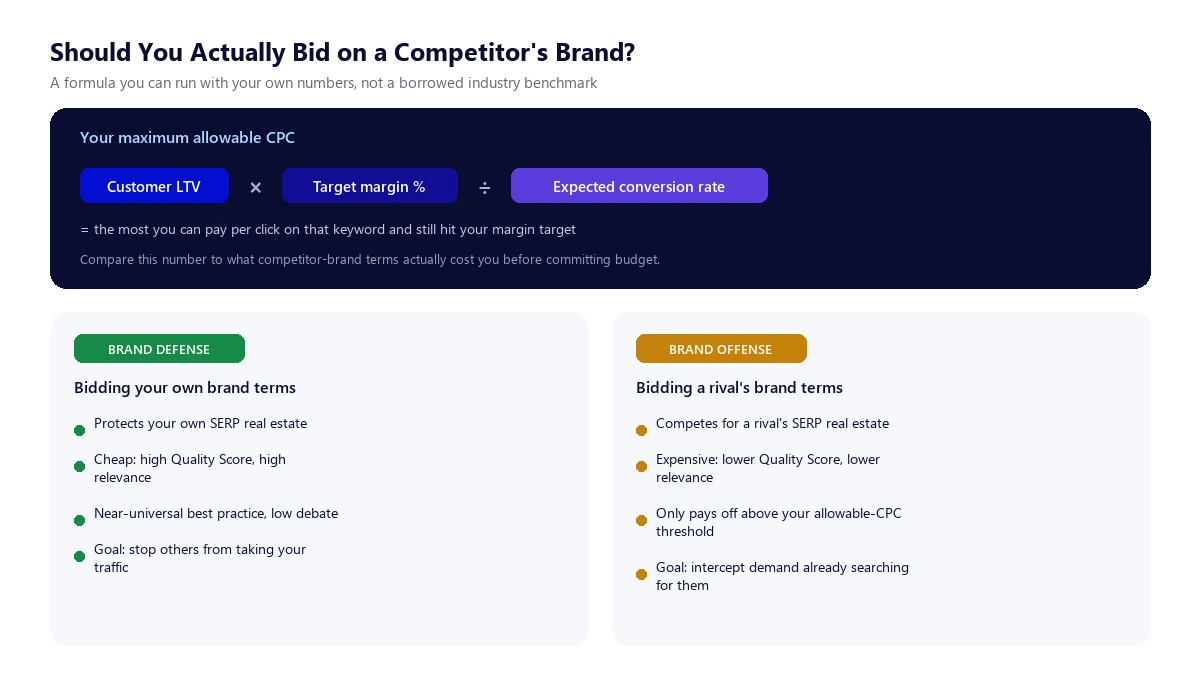
Instead of asking “is competitor bidding worth it” as a yes-or-no question, calculate the actual number where it stops being worth it for your business: multiply your average customer lifetime value by your target margin, then divide by the conversion rate you realistically expect from that traffic (which is usually lower than your branded-search conversion rate, since these visitors weren’t searching for you). The result is your maximum allowable cost per click. If competitor-brand terms are pricing below that number in Auction Insights or your own account data, they’re worth testing. If they’re pricing above it, you’re paying to lose money on volume, no matter how good the click-through rate looks in a dashboard.
Brand defense vs. brand offense
These get lumped together constantly, and they’re different strategies with different economics. Brand defense, bidding on your own brand terms to control your SERP real estate, is cheap, scores well on Quality Score almost by default, and is close to universal best practice; skipping it just hands that space to whoever else wants it, competitor or not. Brand offense, bidding on a rival’s brand terms, is the expensive, lower-Quality-Score version, and it only makes sense once you’ve run the allowable-CPC math above and confirmed the numbers work for your margins. Treat them as two separate line items in your strategy, not one “competitor bidding” bucket.
What Happens When a Competitor Bids on YOUR Brand
The same practice works both directions. If it’s legal for you to bid on a rival’s brand, it’s legal for them to bid on yours, subject to the same ad-text restrictions. Here’s how to handle it without overreacting or underreacting.
How to detect it
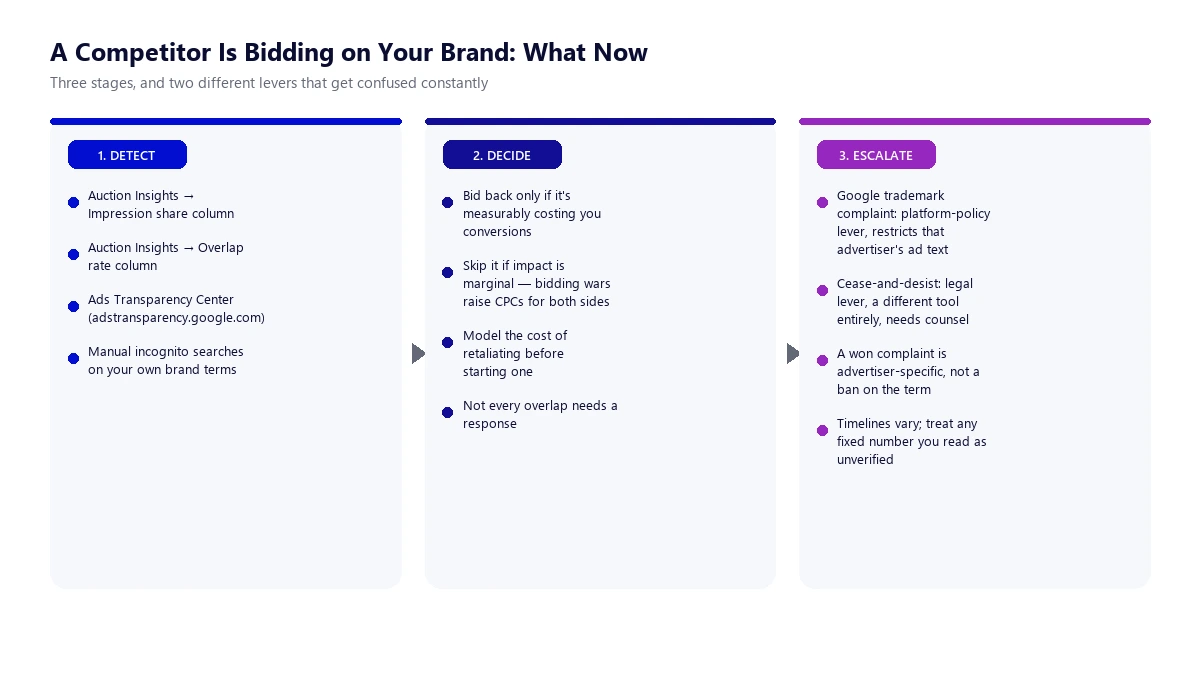
Don’t rely on guesswork or the occasional incognito search. In Google Ads, open the Auction Insights report for your branded campaigns and check two columns specifically: impression share, which tells you how often your ads showed when they were eligible to, and overlap rate, which tells you how often a specific competitor’s ad appeared alongside yours in the same auction. A rising overlap rate on your own brand terms is the clearest signal something changed. Separately, Google’s Ads Transparency Center lets you search any advertiser by name or domain and see their actual live and recent ad creatives across Search, Shopping, and Display, no login required, which is a faster way to confirm what a specific competitor’s ad copy says than repeatedly searching your own brand and hoping to catch it.
The retaliation decision gate
Most advice here just says “bid back,” treating it as automatic. It isn’t. Bidding back raises CPCs for both of you with no guarantee either side comes out ahead, since you’re now both competing on a keyword neither of you owns outright. Before retaliating, check whether the overlap is costing you measurable conversions, not just impressions. If your own brand impression share is still high and the overlap is occasional, it’s often cheaper to leave it and focus budget elsewhere. If it’s persistent and your conversion data shows real leakage, that’s when bidding back, or escalating through the channels below, earns its cost.
Running a brand-defense campaign correctly
Whether or not you retaliate, make sure your own branded campaign is structured to win the auction on your own name by default: dedicated ad groups for brand terms, tightly matched ad copy, and a landing page experience built specifically for people who already know who you are. This keeps your Quality Score high and your defensive CPC low, so that even if a competitor shows up in the same auction occasionally, you’re not paying an inflated price to hold ground you should own anyway.
How to Report Trademark Misuse to Google (Step by Step)
If a competitor’s ad text itself, not just the keyword, is using your trademark in a way that violates the policy above, here’s what filing a complaint involves.
What you need before filing
You need to hold, or be authorized to represent, the actual registered trademark, in the specific country where the offending ad ran. Google’s process is scoped by country and by industry class, matching how trademark rights themselves work, so a mark registered in the US doesn’t automatically give you standing to complain about an ad that only ran in a market where you hold no rights. Screenshot the actual ad in question, including the exact wording and the advertiser’s URL, before you file.
The actual submission process
The correct entry point is Google’s trademark complaint process, reached through the Ads trademark policy page rather than a general contact form. You submit the specific advertiser’s identifying details (their URL), the trademark registration information, and the country and industry the rights apply to. Google reviews it against the policy language covered earlier in this guide, checking whether the flagged use falls under one of the reseller, informational, descriptive, or component-parts exceptions before deciding.
What a successful complaint does, and doesn’t, fix
This is the detail most competing articles get vague about. A successful complaint restricts that specific advertiser from using your trademark in ad text going forward, tied to their domain. It is not a blanket ban on the keyword for every advertiser who might bid on it, and it doesn’t stop other, unrelated advertisers from bidding on the same term the next day. If multiple competitors are misusing your mark in ad text, each one needs its own complaint.
Realistic timeline expectations
Turnaround time is genuinely inconsistent across accounts and reports, and we’re not going to hand you a specific number of business days as if it’s guaranteed, since we can’t verify one that holds up consistently. Build in slack for a review process that can take anywhere from several business days to a few weeks, and don’t treat a fast resolution on one complaint as a promise for the next one.
Beyond Google’s Policy: When to Involve a Lawyer
A Google trademark complaint is a platform-policy lever. It changes what Google will allow in an ad, nothing more. A cease-and-desist letter, or an actual infringement suit, is a legal lever, aimed at a court or a direct legal threat, and it’s a different tool with different requirements and consequences. Filing a Google complaint doesn’t require a lawyer and doesn’t preserve or waive any legal claim you might have. Sending a cease-and-desist, or deciding whether to sue over a competitor’s keyword strategy, is exactly the point where you want a trademark attorney reviewing the specific ads, the market you’re in, and, per the section above, which country’s standard actually applies to the campaign in question. This guide can tell you what the policy says and what the case law has held in general; it can’t tell you whether your particular situation is worth litigating, and neither can any other marketing blog.
If you’re weighing whether to run a competitor-bidding campaign, defend your own brand terms, or just want a PPC account structured so this doesn’t become a guessing game, our team runs Google Ads campaigns for clients who’d rather have someone watching Auction Insights and Quality Score than finding out about an overlap problem three months late.
Frequently Asked Questions
Can I legally bid on a competitor’s brand name as a keyword in Google Ads?
Yes. Google’s policy explicitly allows trademarks to be used as keywords, and US courts, including the Tenth and Second Circuits, have consistently held that buying a competitor’s trademark as a keyword alone is not trademark infringement. The restriction applies to what your ad text says, not to the keyword purchase itself.
Can I put a competitor’s brand name in my ad headline or text?
Generally no, if you’re a direct competitor. Google restricts using a trademark in ad text unless you qualify for a specific exception, such as being a genuine reseller with purchase options on your landing page, an informational or comparison site, using the term descriptively rather than as a brand reference, or selling compatible components. Every exception requires the ad and landing page to clearly disclose the relationship.
Is bidding on competitor trademarks the same in the EU/UK as it is in the US?
No. The US applies a likelihood-of-confusion standard that has generally favored advertisers in keyword-bidding cases. The EU and UK apply an ad-clarity standard from Interflora v. Marks & Spencer (CJEU C-323/09), asking whether a reasonably observant user can tell from the ad itself who’s actually advertising. That’s a lower bar for a trademark owner to clear, and it makes ad wording, not just the keyword purchase, a real point of legal exposure in those markets.
What happens if I get a Google trademark complaint filed against me?
Google reviews the complaint against its trademark policy and, if it’s upheld, restricts your account from using that specific trademark in ad text tied to your domain going forward. It doesn’t automatically ban you from bidding on the keyword itself, and it isn’t a court judgment. It’s a platform-policy restriction, separate from any legal action the trademark owner might also choose to pursue.
Can a competitor stop me from bidding on their brand name?
Not through Google’s policy alone, since Google won’t restrict keyword bidding regardless of who files a complaint. They could pursue legal action against you directly, but based on the US case law covered above, a claim based purely on keyword bidding (with clean ad text that doesn’t reference their trademark) has a weak track record of succeeding in US courts. The calculus is different in the EU/UK given the ad-clarity standard.
What can I do if a competitor is bidding on MY brand name?
First confirm it’s actually happening and how often, using Auction Insights’ overlap rate column and the Ads Transparency Center, rather than relying on occasional manual searches. If their ad text uses your trademark improperly, file a Google trademark complaint. If it’s just keyword bidding with clean ad copy, decide whether to run a defensive bidding campaign based on whether you’re measurably losing conversions, not on principle alone, since bidding wars raise costs for both sides.
Does bidding on competitor keywords hurt my Quality Score?
Generally yes, relative to your own brand terms, because your ad and landing page are inherently less relevant to someone who searched for a different company’s name. This typically pushes your CPC higher for the same ad position. The exact size of that effect varies by account and industry, which is why it belongs in a real cost calculation rather than a fixed rule of thumb.
How do I report a competitor for misusing my trademark in their Google Ads?
File a complaint through Google’s trademark policy process, not a general support form. You’ll need to demonstrate you hold or represent the registered trademark in the country where the ad ran, identify the specific advertiser by URL, and show the ad text itself violates the policy. A successful complaint restricts that advertiser specifically; it doesn’t remove the keyword for everyone else who might bid on it.
Is it worth bidding on competitor brand keywords, or does it usually lose money?
It depends entirely on your numbers, not on a generic industry rule. Calculate your maximum allowable CPC as customer lifetime value multiplied by your target margin, divided by the expected conversion rate on that traffic, then compare it to what competitor-brand terms are actually costing you. Above that threshold it’s a losing bet regardless of click-through rate; below it, it can be a legitimate acquisition channel worth testing.