Ranking #1 with a low click-through rate usually means one of three things: you’re ranking for the wrong query (often a competitor’s brand name), your title and meta description don’t match what the searcher actually wants, or an AI Overview, featured snippet, or ad block is sitting above your result and taking the click before anyone scrolls to you. Fixing it starts with figuring out which of the three is actually happening, because the fix is different for each one.
Position #1 also doesn’t mean what it used to. Independent studies published in 2025 found real, measurable drops in position-1 click-through rate as AI Overviews have spread across more searches, not a small dip, a significant one. That’s covered in detail further down, with the numbers and sources, not just the claim.
A Real Example, With the Numbers
A SaaS founder in the QR code space recently posted their Search Console data after 28 days: 44,749 impressions, 229 clicks, a 0.51% click-through rate, average position 9.9. Their homepage sat at a healthy 13% CTR. Everything else was the problem, and their worst-performing page got 6,128 impressions a month at position 7 for a grand total of 6 clicks, a 0.10% CTR.
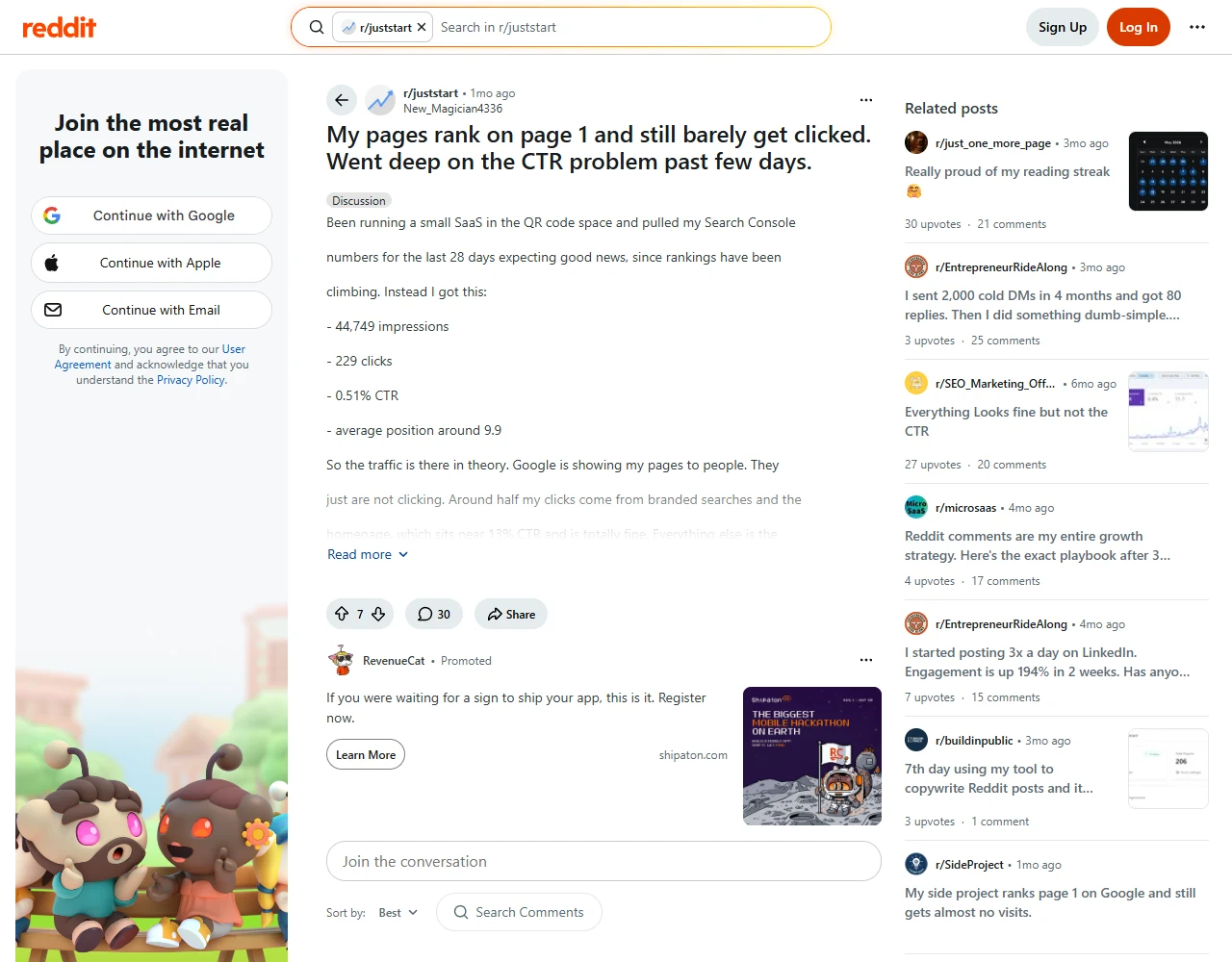
Source: r/juststart on Reddit, the actual thread this example is drawn from.
Digging into it, they found the real cause: they ranked position 6 for a competitor’s exact brand name. Someone searching a competitor’s brand name is looking for that specific company, not an alternative, so no amount of title rewriting fixes that click-through rate. The impressions are real. The intent match isn’t.
The replies to that post disagreed on what to fix first, and that disagreement is worth sitting with rather than smoothing over, because both sides have a real point.
Is It the Title, or Is It the Position?
One camp says fix the title first: a title and meta rewrite deploys today, and Search Console shows whether CTR moved within two weeks. Climbing from position 7 to position 5 can take months of link building with no guarantee it happens at all.
The other camp says the position is the real bottleneck below position 5, and no title rewrite overcomes being below the fold, especially with an AI Overview sitting above the results. Click-through rate is not linear across positions; it falls off a cliff after the top three or four results, and a page at position 9.9 is competing for a fraction of the clicks a page at position 2 gets regardless of how good its title is.
Both are right, just about different pages. If you’re already in the top 3 to 5 and CTR is still weak, the title and meta are genuinely the lever to pull. If you’re sitting at position 7 to 10, the honest answer is that you have a ranking problem wearing a CTR problem’s clothes, and no snippet rewrite fixes that on its own.
Why Position #1 Gets Fewer Clicks Than It Used To
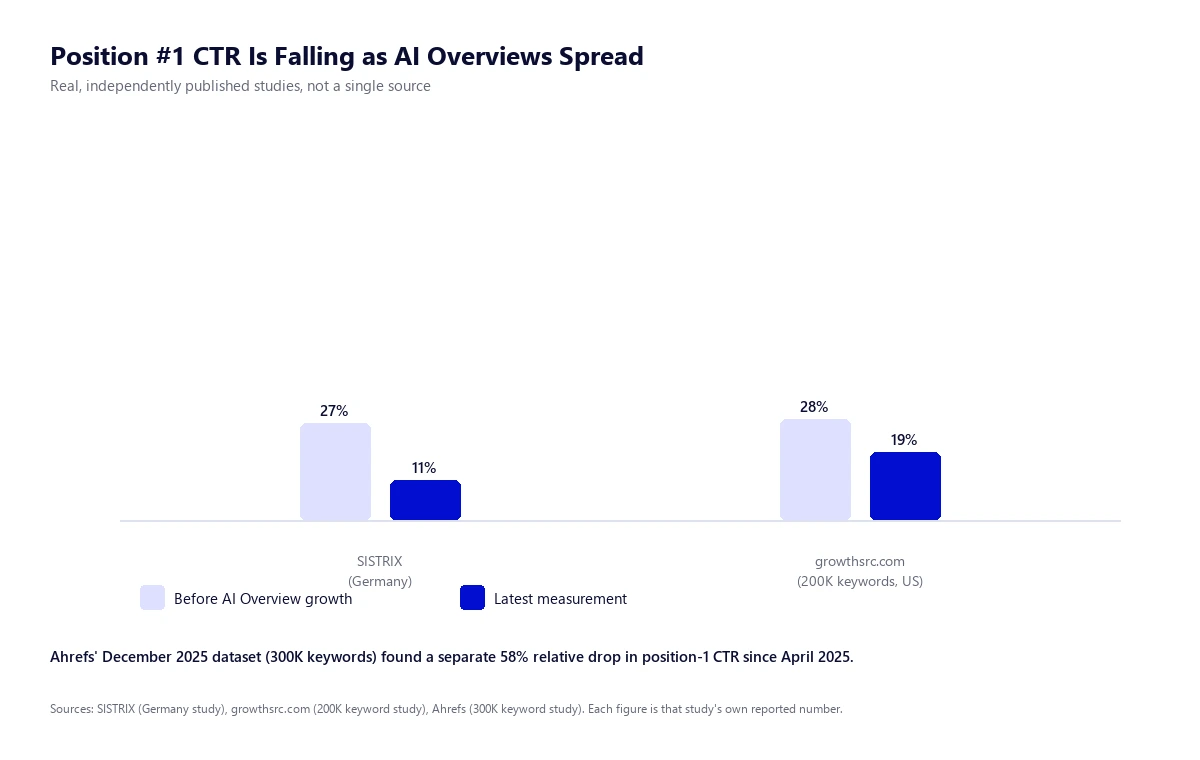
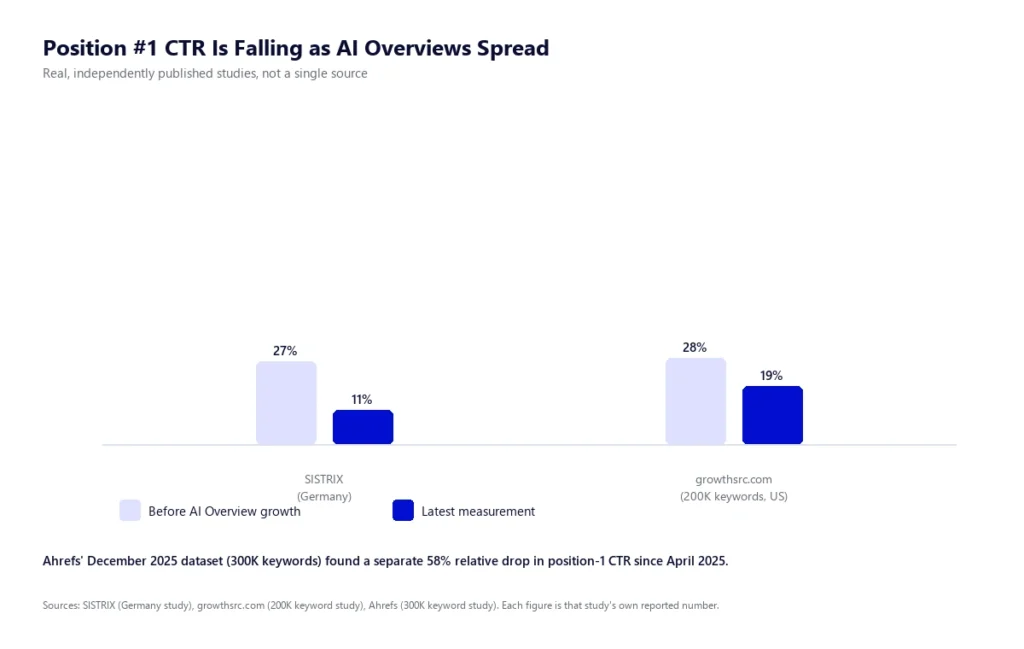
This isn’t a single study’s claim. SISTRIX found position-1 CTR in Germany fell from 27% to 11% as AI Overviews rolled out, a 59% relative decline. A separate 200,000-keyword study from growthsrc.com found US position-1 CTR fell from 28% to 19%, a 32% decline. Ahrefs’ December 2025 dataset, covering 300,000 keywords, found a 58% relative drop in position-1 CTR since April 2025 alone, and Advanced Web Ranking’s tracking shows AI Overviews grew from 18.55% of search results in Q3 2024 to 49.92%, essentially half of all searches, by Q4 2025.
The practical takeaway: being told you rank #1 by a rank tracker and being the first thing a searcher sees are increasingly two different things. Check what’s rendering above your result for your target queries before assuming the ranking itself is fine and the title is the only problem.
What to Check, in Order
1. Are you ranking for the right query?
Pull your Search Console queries for the page and check what it’s getting impressions for. A page ranking for a competitor’s brand name, a tangential term, or a query with mismatched intent will show high impressions and a CTR that never recovers no matter what you change on the page, because the people seeing it were never going to click it.
2. Do your visible headings match what people are actually typing?
It’s not just the title tag. Rewriting the meta title while leaving the on-page H1 and H2 as whatever the page was originally named leaves a mismatch between what Google shows in the snippet and what a searcher reads once they land. Match the visible headings to the query language showing up in Search Console, not the internal name you gave the page when you wrote it.
3. What’s rendering above you on the SERP?
An AI Overview, a featured snippet, or a People Also Ask block can answer the query before anyone reaches the organic results at all. Search your own target terms and look at what’s sitting above your listing. If it’s an AI Overview, competing on title alone won’t fix it; the fix is either winning the featured snippet or accepting that this particular query has a lower ceiling than it used to.
4. Is your position as good as your tracker says?
Average position in Search Console is exactly that, an average. A page bouncing between position 4 and position 14 across different queries can show an average position of 9 while never ranking anywhere a real person scrolls to. Check position by individual query, not just the page-level average, before deciding the ranking is fine and the click is the only problem.
5. Were the impressions ever real to begin with?
Until September 2025, anyone could request 100 results per page from Google using a URL parameter called num=100, and most rank-tracking tools used exactly that to check where a site sat far down the results. Every one of those automated checks logged as a real impression in Search Console, even at position 87, even though no human ever saw it. When Google disabled that parameter, an analysis of 319 properties by Search Engine Land found 87.7% lost impressions and 77.6% lost unique ranking terms, while clicks stayed flat and average position often improved. The impressions weren’t wrong exactly, they just weren’t people.
This is exactly the kind of thing that shows up as an unsolved question in Google’s own support forums. One thread from February 2025, before the fix, has the original poster ranking #1 for a term, title and meta already good, no featured snippet or AI summary in the way, and still getting 200-plus weekly impressions with zero clicks. The recommended answer was to optimise the title and meta further. A second commenter pushed back, correctly, that the title and meta were already fine and couldn’t realistically explain a number that low, and the thread ends without a real answer.
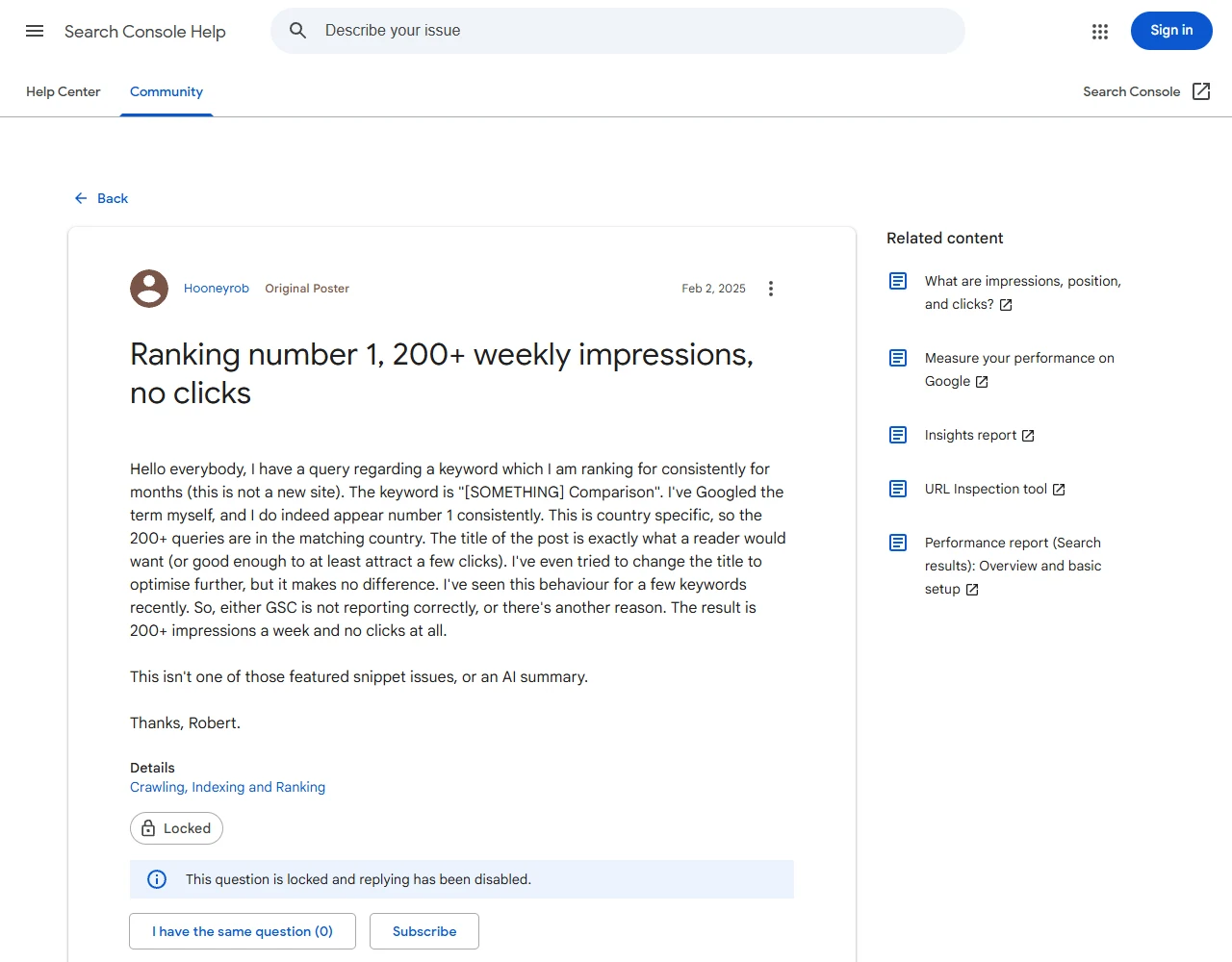
Source: Google Search Central Community, a thread Google’s own product experts couldn’t fully resolve at the time.
If your data looks like that, and especially if you’re looking at anything from before September 2025, bot-inflated impressions are a genuinely plausible explanation the thread never landed on. It’s less of a live issue now that Google has closed that specific gap, but it’s worth ruling out before you assume a real person saw your listing and chose not to click it.
Quick Diagnostic: Match the Symptom to the Fix
| Symptom | Likely Cause | What to Do |
|---|---|---|
| High impressions, position 2-9, CTR near zero everywhere | Ranking for the wrong query, often a competitor’s brand name | Check the actual queries in Search Console before touching the title |
| Ranking top 3-5, still low CTR | Title and meta don’t match search intent | Rewrite title and meta to match real query language; check GSC in 2 weeks |
| Average position looks fine, CTR is still near zero | The average is masking a wide swing in real per-query position | Check position by individual query, not the page-level average |
| Title, meta, and ranking all look fine, CTR is still low | An AI Overview, featured snippet, or PAA block sits above your result | Search the term yourself; if AI Overview answers it, a better title won’t fix it |
| Nothing above explains it, especially in pre-Sept 2025 data | Impressions inflated by rank-tracking bots via the old num=100 parameter | Compare against post-Sept 2025 data before trusting the older numbers |
How to Fix It, By Cause
There’s no single fix that works across all five causes above. What worked for the original Reddit poster, and what’s realistic more generally, depends on which one you’re dealing with.
Wrong query (competitor brand terms)
No title rewrite fixes this, since the searcher never intended to click you. The realistic options are to reframe the page around a genuinely different angle rather than the competitor’s name itself, or to accept those impressions as unconvertible and stop investing further effort there. In the Reddit thread, the poster’s own plan was to cut or reframe the “vs competitor” pages that were only pulling curiosity impressions, rather than trying to rescue them with a better title.
Title or meta mismatch
Rewrite the title tag and the visible H1 and H2 together, not just the meta, matching the exact query language showing in Search Console rather than the term the page was originally written around. Redeploy, then give it roughly two weeks before checking again, that’s the window multiple people in the thread cited before a title change shows up clearly in the data.
A SERP feature sitting above you
Two realistic options: structure the page to try to win the featured snippet itself, with a clear, direct answer near the top of the section Google is already pulling from, or accept that this particular query now has a lower ceiling and put the effort into queries where you’re not competing with an AI Overview at all. Not every query is worth continuing to chase once an AI Overview owns it.
The position itself is the problem
This is the slow one. There’s no shortcut from position 8 to position 3 that skips real authority signals, internal linking, and content depth built up over months, not weeks. A title rewrite is still worth doing here, since it costs little, but treat it as a small test alongside the real work, not the whole fix.
Bot-inflated impressions
There’s nothing to recover here except your read of the data. Compare only post-September-2025 figures going forward, and don’t spend time chasing a CTR problem that was a measurement artifact from the num=100 parameter.
Checking whether it worked
Compare like periods, not seven days after a change against ninety days before it. Give title and meta changes roughly two weeks minimum before judging them. And re-check what’s rendering on the SERP itself, since AI Overview presence on a given query can change independently of anything you did to the page.
What Doesn’t Reliably Work
Loading a title with urgency words or vague superlatives to force a click tends to help less than it looks like it should, and can hurt if the page doesn’t deliver on the promise, since Google does account for post-click behaviour over time. A title that’s honest about what the page delivers and specific about the query tends to hold up better than one optimised purely to look clickable.
Frequently Asked Questions
Why is my CTR low even though I rank #1?
Usually one of three causes: the page ranks for the wrong query (including competitor brand terms that were never going to convert), the title and meta description don’t match search intent, or an AI Overview, featured snippet, or ad block is displayed above the organic result and capturing the click first.
Should I rewrite my title or try to improve my ranking position first?
If you’re already ranking in the top 3 to 5 positions, rewrite the title and meta description first, since it deploys immediately and Search Console shows results within about two weeks. If you’re ranking position 7 or lower, the position itself is usually the bigger factor, since click-through rate drops sharply below the top few results regardless of title quality.
How much has AI Overview reduced click-through rates?
Independent studies show real declines: SISTRIX found German position-1 CTR fell from 27% to 11%, a US-focused 200,000-keyword study from growthsrc.com found a drop from 28% to 19%, and Ahrefs’ December 2025 dataset found a further 58% relative decline in position-1 CTR since April 2025 alone.
Can ranking for a competitor’s brand name hurt my click-through rate?
Yes. Ranking for a competitor’s exact brand name generates impressions, since Google is showing your page to people, but those searchers are looking for the competitor specifically and are unlikely to click an alternative, which produces high impressions with a consistently low CTR that no title change will meaningfully fix.
Could my impressions be inflated by bots rather than real people?
Yes, particularly in data from before September 2025. Google’s num=100 URL parameter let rank-tracking tools check positions far down the results page, and each check counted as a real impression in Search Console. When Google disabled it, an analysis of 319 properties found 87.7% lost impressions while clicks stayed flat, meaning much of that impression volume was never real people.
If working through this properly, page by page, is more than you want to take on yourself, it’s exactly the kind of diagnostic work our SEO services cover as part of an ongoing engagement, not just new content.