Most Shopify SEO agencies pitch the same slide deck. Technical audit, keyword research, content calendar, link building, monthly report. It reads fine until you notice it’s the identical slide deck they’d show a supplement brand, a furniture retailer, and a B2B wholesale distributor, three businesses with almost nothing in common except the platform they happen to run on.
That’s usually where the wasted quarter comes from. Not a bad agency exactly, just a generic one applying a generic playbook to a store that needed something more specific: a fashion brand whose seasonal collections get deleted every year instead of kept live, a supplements store that needs expert-reviewed content to survive Google’s health-content scrutiny, a Shopify Plus wholesale account whose entire catalog sits behind a login wall that search engines can’t see at all.
This isn’t a ranked list of agencies. There’s no way to fairly rank “the best Shopify SEO agency” without either fabricating case studies or reviewing companies we’ve never worked with, and neither is something we’re willing to do. What follows instead is what actually matters when you’re the one hiring: how Shopify SEO priorities genuinely shift by niche, the technical questions that separate a real Shopify specialist from a generalist who’s worked on “ecommerce sites,” what pricing models actually look like with real sourced figures, and the red flags specific to this platform.
Key Takeaways
- “Shopify SEO agency” isn’t one job. A fashion store, a supplements brand, and a Shopify Plus B2B wholesaler need meaningfully different priorities, not the same audit template with a different logo on it.
- Ask for a client in your specific niche, not just “ecommerce experience.” A generalist who’s only worked on apparel stores will miss the YMYL content requirements a supplements brand needs.
- Real 2026 pricing data (Ahrefs, 439 providers surveyed): average retainer is $3,209/month, average one-off project is $9,507, and 78.2% of providers bill on a monthly retainer.
- Test technical competency with a live question: ask how they’d handle Shopify’s product/collection URL duplication, and whether they’d still recommend rel=next/rel=prev pagination tags. Google stopped using that signal in March 2019, so a confident “yes” is a real red flag.
- Reporting that only shows rankings and impressions, with no link to revenue or Shopify order data, is a sign the agency is measuring what’s easy to show, not what you hired them to move.
Why “Shopify SEO Agency” Isn’t One Job
Shopify gives every store the same technical foundation: automatic canonical tags, an auto-generated sitemap, SSL by default, and base product schema baked into most themes. That part really is close to commoditized, which is exactly why it shouldn’t be the main thing an agency sells you on. What Shopify doesn’t standardize is everything downstream of the platform: what your customers actually search for, what kind of content earns trust in your specific category, how your catalog is structured, and whether your pricing model is even visible to search engines in the first place.
A fashion brand’s biggest SEO problem is rarely the same as a supplements brand’s biggest SEO problem, even though both run on identical Shopify infrastructure. One is fighting duplicate content from color and size variants. The other is fighting Google’s scrutiny of health-adjacent claims. An agency that hands both of them the same 90-day roadmap hasn’t diagnosed either business, it’s run a template.
How Shopify SEO Priorities Actually Shift by Niche
Before you evaluate any agency’s pitch, it helps to know what your own store’s real priority list should look like. Here’s how it genuinely differs across the store types we see most often on Shopify.
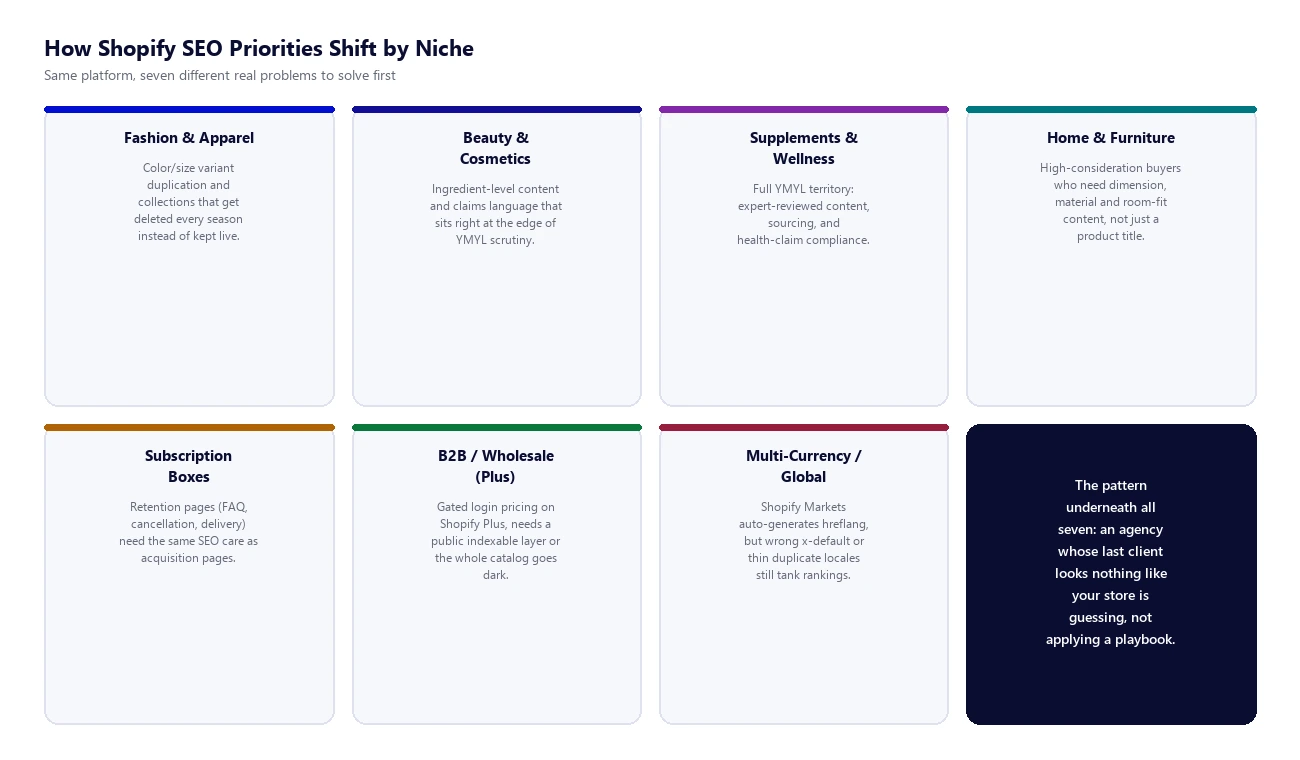
| Niche | Top SEO Priority | Question to Ask the Agency |
|---|---|---|
| Fashion and Apparel | Keep seasonal collection URLs live year-round instead of deleting them | “How do you handle out-of-season collections?” |
| Beauty and Cosmetics | Defensible, ingredient-level content near the YMYL boundary | “How do you handle ingredient and safety claims?” |
| Supplements and Wellness | Full YMYL compliance: credentialed reviewers, sourced health claims | “Who reviews and credentials your health content?” |
| Home and Furniture | Structured spec data plus genuine buying-guide content | “How do you get product specs into machine-readable content?” |
| Subscription Boxes | Retention pages (cancellation, delivery, fit guides) get real SEO investment | “Do you optimize account pages, or just acquisition pages?” |
| B2B / Shopify Plus Wholesale | A public, indexable catalog layer above the gated pricing wall | “Have you built a public layer for a gated B2B catalog before?” |
| Multi-Currency / International | Validating Shopify Markets hreflang after every configuration change | “How do you validate hreflang after a Markets change?” |
Fashion and Apparel
Fashion stores generate more duplicate content than almost any other Shopify vertical. A single dress in 6 colors and 8 sizes can spin off dozens of near-identical variant URLs, on top of Shopify’s own product-and-collection URL duplication. The bigger, less-discussed mistake is what happens at the end of a season: most apparel brands delete or unpublish seasonal collection pages once the season ends, which throws away every backlink, every click-through-rate signal, and every crawl history that page built up. The better pattern is to keep seasonal collection URLs live year-round and simply update what’s inside them each year, so a “summer dresses” page keeps compounding instead of restarting from zero every spring. Ask a candidate agency directly how they handle out-of-season collections. “We unpublish them” is a real answer you’ll hear, and it’s the wrong one.
Beauty and Cosmetics
Beauty sits in an uncomfortable middle zone. It’s not automatically classified as Your Money or Your Life content the way supplements are, but ingredient claims, skin-safety language, and before-and-after style content sit close enough to that line that sloppy wording can still draw scrutiny. The SEO work that actually matters here is ingredient-level content (real explanations of what an ingredient does and why it’s included, not just a marketing adjective), plus careful, defensible language around what a product claims to do. An agency that’s only ever written generic “shop our new collection” copy for beauty clients hasn’t dealt with this at all.
Supplements and Wellness
This is the one niche on this list that’s unambiguously YMYL. Google’s own guidance on Your Money or Your Life content states plainly that its systems give extra weight to Experience, Expertise, Authoritativeness and Trustworthiness signals on pages that could affect a reader’s health, and nutrition and supplement advice falls squarely in that category. In practice that means content genuinely written or reviewed by someone with relevant credentials, visible author information, sourcing for any health claim, and backlinks from sources that actually carry authority in health, government or academic spaces rather than generic guest posts. If an agency’s supplements case study is just a keyword-stuffed product description with no reviewer credited anywhere, that’s not a YMYL-competent shop.
Home and Furniture
Furniture and home goods are high-consideration purchases with long research cycles. Shoppers want dimensions, materials, care instructions and room-fit guidance before they’ll commit to a $1,200 sofa, not just a product title and a price. The SEO opportunity here leans heavily on genuinely useful buying-guide and room-style content that a category page alone can’t carry, plus getting the actual product specification data (dimensions, weight, material composition) into structured, machine-readable content rather than buried in a PDF spec sheet nobody indexes.
Subscription Boxes
Subscription commerce runs on retention, and that changes which pages deserve real SEO investment. Delivery schedule pages, cancellation policy pages, and size or fit guides aren’t just support content, they’re pages that reduce churn and returns, which makes them worth the same on-page care as an acquisition-focused landing page. An agency that only optimizes the homepage and the “subscribe now” page and treats the account-management pages as an afterthought is missing where a subscription business actually loses and keeps customers.
B2B and Wholesale on Shopify Plus
This is the niche most likely to get quietly wrecked by a well-meaning but inexperienced agency. Shopify Plus B2B stores commonly gate entire collections and exact pricing behind a company-account login, which is reasonable for the business but catastrophic for SEO if nobody thinks it through: if your whole catalog sits behind a login wall, search engines can’t read it, and a competitor with even a thin, publicly visible catalog will outrank you for every commercial query by default. The fix isn’t to remove the gate, it’s to build a public-facing layer: indexable product and category pages with full specifications and descriptions, with only the exact net pricing and checkout flow kept behind login. Ask specifically whether an agency has handled a gated B2B catalog before, because “we’ve done ecommerce SEO” doesn’t tell you they’ve dealt with this particular problem.
Multi-Currency and International Stores
Shopify Markets automatically generates hreflang tags once you set up multiple country or language markets, which sounds like the problem is solved. It isn’t, automatically generated doesn’t mean correctly generated. Common real failure points include a missing or wrong x-default tag, hreflang pointing at a market page that doesn’t actually exist yet, and thin, machine-translated locale pages that read as duplicate content rather than genuinely localized content. A competent agency validates hreflang output after every Markets configuration change, via Search Console’s International Targeting data or a crawl, rather than trusting that Shopify’s automation got it right and moving on.
The Technical Competency Checklist Specific to Shopify
General SEO knowledge doesn’t automatically transfer to Shopify’s specific architecture. Here’s what to verify before you sign anything.
- Theme and Liquid access. Real technical fixes, like correcting internal links that point to the collection-nested product URL instead of the canonical one, require editing theme Liquid code, not just a settings toggle. Ask who does that work and whether it’s included or billed separately.
- App conflicts. Multiple installed apps (reviews, upsells, SEO apps) can each inject their own JSON-LD, producing duplicate or conflicting Product schema that suppresses rich results entirely. A competent agency audits which app owns which schema and disables the duplicates rather than letting them stack.
- Collection and pagination handling. Each paginated collection page should carry its own self-referencing canonical tag and stay independently indexable. Canonicalizing every paginated page back to page one, a genuinely common mistake, tells Google those pages aren’t worth indexing at all. And if anyone recommends rel=next/rel=prev tags as a current fix, that’s outdated by more than six years, Google confirmed in March 2019 it no longer uses them as a signal.
- JSON-LD schema depth. A purchasable product page needs an
Offer, not anAggregateOffer, with price and currency set. Variants need a sharedProductGroupwith aproductGroupID. Star ratings need a realAggregateRatingbuilt from verifiable customer reviews. If an agency can’t explain this distinction unprompted, they haven’t implemented merchant listing schema before. - Canonicalization quirks. Shopify generates a working URL for every product both at
/products/handleand nested inside every collection it appears in at/collections/x/products/handle. The canonical tag already points to the short version; the actual fix is auditing theme Liquid so internal links (related products, breadcrumbs, “recently viewed”) point to the canonical URL too, instead of contradicting your own canonical signal. Our own Shopify SEO checklist covers this pattern and the rest of what’s genuinely still your job even after you hire someone, worth reading either way so you know what to expect from whoever you bring on. - App-bloat awareness. Every installed app adds script weight that can hurt Core Web Vitals. A useful, low-effort test before you even get on a call: run a free Shopify app detector against a competitor’s storefront or your own, and ask the agency what they’d flag from the results.
Questions to Ask Before You Sign
Blackbelt Commerce’s guide to evaluating a Shopify SEO expert frames this well: ask questions specific enough that a real specialist answers easily and a generalist exposes themselves quickly. Adapted for a niche-specific hire, here’s what’s worth asking directly on the call, not just in a proposal document.
- “Which of your current, live clients are in my specific niche, not just ‘ecommerce’?” A real answer names a store and a specific problem they solved for it. A vague answer names an industry category.
- “Walk me through how you’d handle [the niche-specific issue from the section above that applies to your store].” A fashion brand should ask about seasonal collections. A B2B wholesaler should ask about gated pricing. A supplements brand should ask how they source and credential health-content reviewers.
- “How do you decide which keyword each page owns, when a collection page and its own product pages could both plausibly target the same term?” This is a real, common Shopify architecture problem, and a specialist will have a clear system for it.
- “What does month one look like, deliverable by deliverable?” Not a strategy summary, a specific list of what gets done and by when.
- “Does your reporting connect to revenue or order data, or does it stop at rankings and impressions?” Growing impressions means very little if the traffic isn’t converting into orders.
- “How do you think about AI Overviews and AI-driven search alongside traditional rankings?” This isn’t a gimmick question in 2026, and an agency with no answer at all is behind on where search is heading. Our own guide to earning AI Overview inclusion covers what that involves if you want a baseline before the call.
- “Who specifically does the day-to-day work, and how many other accounts do they manage?” A senior strategist pitching the deal and a junior account manager doing the actual work is common; just know which one you’re getting.
Red Flags That Are Specific to Shopify Agencies
- Ranking guarantees. No agency controls Google’s algorithm. A guaranteed position is either a coincidence waiting to be claimed as a win, or a sign they don’t understand how search works at all.
- No mention of theme or Liquid work at all. If technical fixes never come up in the pitch, they’re likely not planning to touch anything below the surface, which caps what they can fix on Shopify at all.
- Reporting that’s all rankings, no revenue. Impressions and position tracking are inputs, not outcomes. If a proposal’s sample report has no line connecting to orders or revenue, ask why before you sign.
- Contract terms that lock in ownership. Watch for automatic renewal with no real notice period, lock-in terms beyond six months with no performance checkpoints, and clauses where content or backlinks built during the engagement revert to the agency if you leave.
- A portfolio with zero stores in a remotely adjacent niche. General ecommerce experience is a start, not a substitute for having solved your specific category’s problem before.
- Outdated technical advice presented confidently. The rel=next/rel=prev example above is a real, checkable test. If it comes up unprompted as current best practice, treat the rest of the pitch with more scrutiny too.
What SEO Pricing Actually Looks Like
Pricing varies enormously by store size and scope, but real sourced data is more useful than a guess. Ahrefs’ most recent published survey of 439 SEO service providers found three distinct pricing models in active use, each suited to a different kind of engagement.
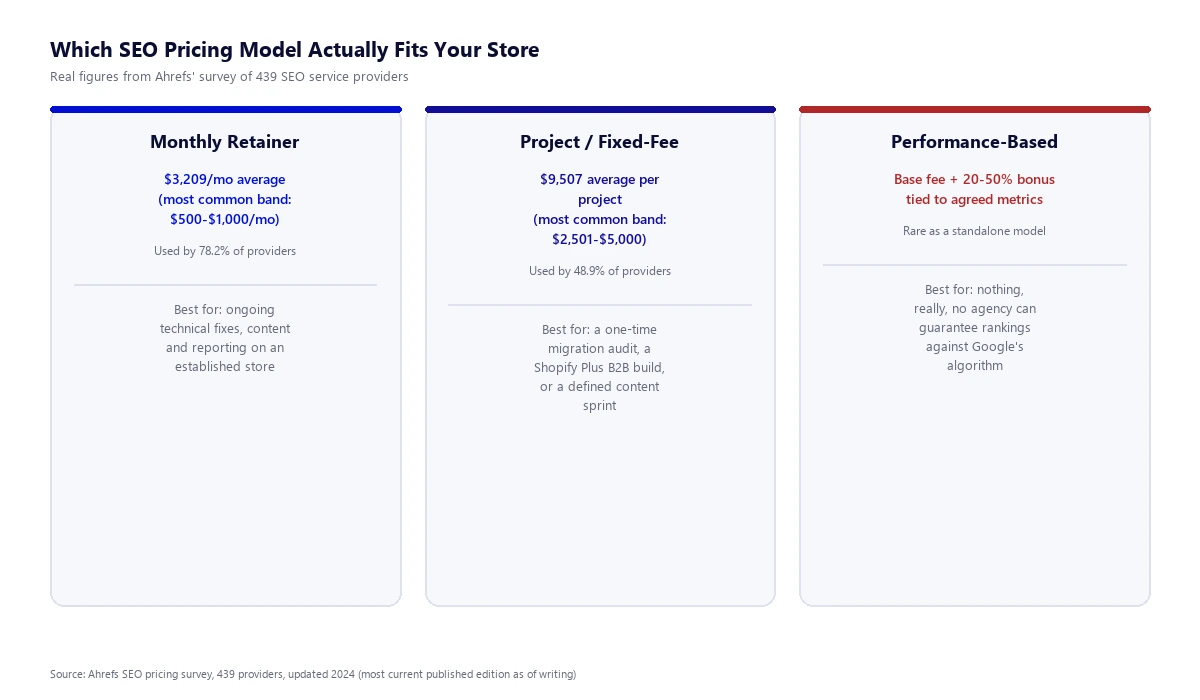
A monthly retainer suits an established store that needs ongoing technical maintenance, content production and reporting, the majority of Shopify SEO engagements fall into this category. A project or fixed fee suits a defined, bounded piece of work: a full technical migration audit, building out the public-facing layer for a gated B2B catalog, or a scoped content sprint with a clear start and end. Performance-based pricing is worth treating with real skepticism as a standalone model. It’s rare for a legitimate reason: no agency can honestly guarantee a specific ranking outcome against an algorithm neither party controls, so a “pure performance” pitch is either underpriced elsewhere to compensate, or built around metrics vague enough to always claim success.
How Do You Verify an SEO Agency’s Case Studies?
A polished case study PDF proves an agency can design a PDF. What actually verifies competence is checking the underlying claim yourself. Ask for the actual store URL, not just a logo and a screenshot, so you can look at the live site’s structure, content depth and technical setup directly. Ask what specifically changed and when, and cross-reference that timeline loosely against what a tool like Search Console’s own historical data (which they should be willing to show a redacted version of) or a third-party traffic estimator suggests, rather than accepting a bar chart with unlabeled axes. And ask for a result tied to revenue or order volume, not just a traffic or ranking increase; a 40% traffic jump on a page that converts at a fraction of a percent isn’t the win it’s presented as.
Evaluate three to five agencies side by side rather than one at a time. It’s the only way to notice that one candidate’s “case study” is a generic traffic screenshot while another’s includes a specific, checkable before-and-after with a real URL attached. For a sense of what that standard looks like in practice, our own writeup of a 2026 Google spam-update recovery names the real site, the dated timeline and the actual before-and-after data, rather than an unlabeled chart. It’s a general SEO recovery case, not a Shopify-specific one, but it’s the same transparency standard worth holding any agency to.
What Good Reporting and Communication Should Look Like
A Shopify-specific report should connect technical and content work back to store performance, not just search visibility in isolation. That means Search Console data alongside Shopify’s own analytics or Google Analytics revenue data in the same report, not two disconnected dashboards you have to reconcile yourself. It also means a named point of contact who can explain what changed and why in plain language, not just a monthly PDF that lands in your inbox with no call attached. And it means honesty about timeline: real Shopify SEO work, especially anything touching content or authority building, typically takes a few months before results are visible in aggregate, and an agency that promises fast, dramatic movement on a competitive term is setting an expectation they can’t control.
How South Asia Digital Approaches Shopify SEO
We’re not going to pretend this article exists in a vacuum. South Asia Digital runs Shopify SEO services covering the same technical ground this article describes: theme and Liquid-level fixes, product and collection schema, canonicalization audits, and content built around AI Overview and traditional search visibility together rather than treating them as separate projects. We’d rather you use the framework above to evaluate us the same way you’d evaluate anyone else, ask about our niche-specific client work, ask what month one actually looks like, ask how reporting ties back to revenue, than take a single self-description at face value. If that evaluation leads somewhere else, that’s a genuinely fine outcome; the point of this article was to help you ask better questions, not to funnel you toward one answer.
Frequently Asked Questions
Do I need an agency with specific Shopify experience, or is general ecommerce SEO experience enough?
General ecommerce experience is a reasonable starting filter, but Shopify has specific architecture quirks, like the product and collection URL duplication pattern and theme-level Liquid dependencies, that a Magento or WooCommerce specialist hasn’t necessarily dealt with. Ask directly which platform their recent, live client work is actually on.
How much does Shopify SEO cost?
Based on Ahrefs’ survey of 439 SEO service providers, the average monthly retainer is $3,209, though the most common band sits between $500 and $1,000 a month, and the average one-off project fee is $9,507. Actual cost depends heavily on store size, catalog complexity and how much technical work is needed upfront.
Should I pick a retainer, a project fee, or performance-based pricing?
A retainer suits ongoing work on an established store. A project fee suits a bounded task like a technical migration or a gated B2B catalog build-out. Performance-based pricing is worth real skepticism as a standalone model since no legitimate agency can guarantee a specific ranking outcome.
What Shopify-specific technical questions should I ask before hiring?
Ask how they handle the product and collection URL duplication pattern, whether they audit for conflicting app-generated JSON-LD schema, how they set canonical tags on paginated collection pages, and whether they validate hreflang output if you run multiple Shopify Markets. A confident but outdated answer, like recommending rel=next/rel=prev tags, is a real red flag.
Is a niche-specific portfolio actually necessary?
It matters more than general ecommerce experience does. A fashion-focused agency may never have dealt with YMYL content requirements a supplements brand needs, and an agency that’s only worked with direct-to-consumer stores may not know how to build a public-facing content layer around a gated B2B catalog. Ask for a live client in your specific category, not just the same broad industry.
What are the biggest red flags when hiring a Shopify SEO agency?
Ranking guarantees, reporting that never connects to revenue or order data, contract terms with automatic renewal or content/backlink ownership reverting to the agency on cancellation, and confidently wrong technical advice, like still recommending rel=next/rel=prev pagination tags six years after Google stopped using them.
Do I need to give an SEO agency access to my theme code?
For real technical fixes, generally yes. Correcting internal links that point to non-canonical product URLs, fixing schema conflicts, or adjusting pagination canonicals all require editing theme Liquid, not just store settings. An agency that never asks for this kind of access is likely limited to on-page and content work only.
How is SEO different for a Shopify Plus B2B or wholesale store?
Shopify Plus B2B stores often gate entire collections and pricing behind a company-account login, which search engines can’t read. The fix is building a public-facing layer of indexable product and category pages with full specifications, keeping only exact net pricing and checkout behind the login, so the catalog isn’t invisible to search entirely.
Does Shopify handle canonical tags and duplicate content automatically?
Partially. Shopify’s canonical tag on a product page does correctly point to the short /products/handle URL. What it doesn’t fix automatically is a theme’s internal links (related products, breadcrumbs, “recently viewed”) pointing to the collection-nested duplicate version instead, which still needs a manual Liquid-level audit.
How long does it take to see results from Shopify SEO?
Real, sustainable results typically take a few months to show up in aggregate, longer for competitive terms or content-heavy niches like supplements that require building genuine authority. An agency promising fast, dramatic movement on a competitive term is setting an expectation outside their actual control.
What should a Shopify SEO agency’s reporting actually include?
Search visibility data connected to Shopify’s own order or revenue data, not rankings and impressions in isolation, plus a named point of contact who can explain what changed and why. A report with no link back to actual business outcomes is measuring what’s easy to show rather than what you hired them to move.
Is South Asia Digital a Shopify SEO agency?
Yes, we run dedicated Shopify SEO services covering technical, content and AI-search work, but the point of this article is to help you build your own evaluation criteria first, and apply the same questions to us that you’d apply to anyone else.