
Your rankings haven’t moved. Your traffic has.
Open Search Console right now and you’ll probably see the same chart: impressions flat, position barely shifting, clicks sliding down anyway. That’s not a glitch, and it’s not only happening to you. It’s also not the industry-wide collapse the scariest headlines describe.
Google search traffic is declining in 2026. Just not evenly, and not for the single reason most people blame first: AI Overviews get the headlines, but they’re one of several causes stacking on top of each other, and some of those causes are fixable. One proof point: a client of ours grew signups 12x over three months during this exact window, by rebuilding what was losing traffic, not by walking away from search.
The short version
- The decline is happening, but unevenly: publishers and informational content are getting hit hardest, mid-sized commercial sites often see smaller drops, and some of the largest and smallest sites are still growing.
- AI Overviews (Google’s AI-written answer box above the results) and chatbots are absorbing clicks, not eliminating demand: people are still asking the same questions, just increasingly inside an AI answer box or a chat window instead of a results page.
- Click-through rate is falling faster than traffic itself: rankings can hold steady while clicks drop, because the click that used to happen at position one sometimes happens inside the AI Overview instead.
- Some of this you can fix in 90 days. Some of it you can’t. Intent mismatch and AI-citability problems are fixable. A smaller overall pool of clicks at the top of the funnel isn’t.
Is Google search traffic declining?
Depends which slice of the web you measure. Search Engine Land reported in March 2026 that 73% of B2B websites saw significant traffic losses between 2024 and 2025, averaging a 34% year-over-year decline. Similarweb’s own report on generative AI’s impact on publishers, covered by Alta Journal in March 2026, found news publisher traffic down 26% in the 12 months after Google rolled out AI Overviews, with some individual publications losing as much as 97% of specific traffic streams. Separately, Chartbeat data shared by Axios and reported by 9to5Google found Google referral traffic to publishers down 34% over the prior year, with Discover referrals down 15%, and the drop steeper for smaller sites.
That’s one side of it. Here’s the other: Graphite CEO Ethan Smith’s analysis of Similarweb data across more than 40,000 of the largest US sites, reported by Search Engine Land in early 2026 and validated against first-party Search Console and Analytics data at a median correlation of 0.86, found aggregate organic traffic down only about 2.5% year over year, not 25%. The decline concentrated in the top 100 to 10,000 sites by size, while the largest sites and plenty of smaller ones kept growing.
Both figures are true at once, because they’re measuring different things. The sites getting cited in the loudest “search is dying” posts tend to be exactly the informational publishers and B2B content sites AI Overviews absorb most aggressively. Commercial and niche sites with content that already matches buyer intent often don’t see the same hit. So before you panic about your own traffic, check which kind of content you’re publishing before asking whether search overall is declining.
Gartner’s often-cited forecast, published in February 2024 by analyst Alan Antin, predicted traditional search engine query volume, not traffic or revenue, would fall 25% by 2026 as AI chatbots and virtual agents took over a share of queries. That’s a market-level forecast across Google, Bing, and similar engines, not a per-site prediction. Whether it lands exactly on 25% matters less than the direction it called correctly, two years in advance.
Why are click-through rates dropping even when rankings haven’t moved?
Because the click is moving, not disappearing. Seer Interactive’s analysis of 5.47 million queries across 53 brands found that organic click-through rate on brand-cited pages inside AI Overviews fell from 2.52% in September 2025 to 0.76% in November, a roughly 61% drop in two months. Seer itself couldn’t fully explain the November collapse from its own data, which is more honest than most agencies manage.
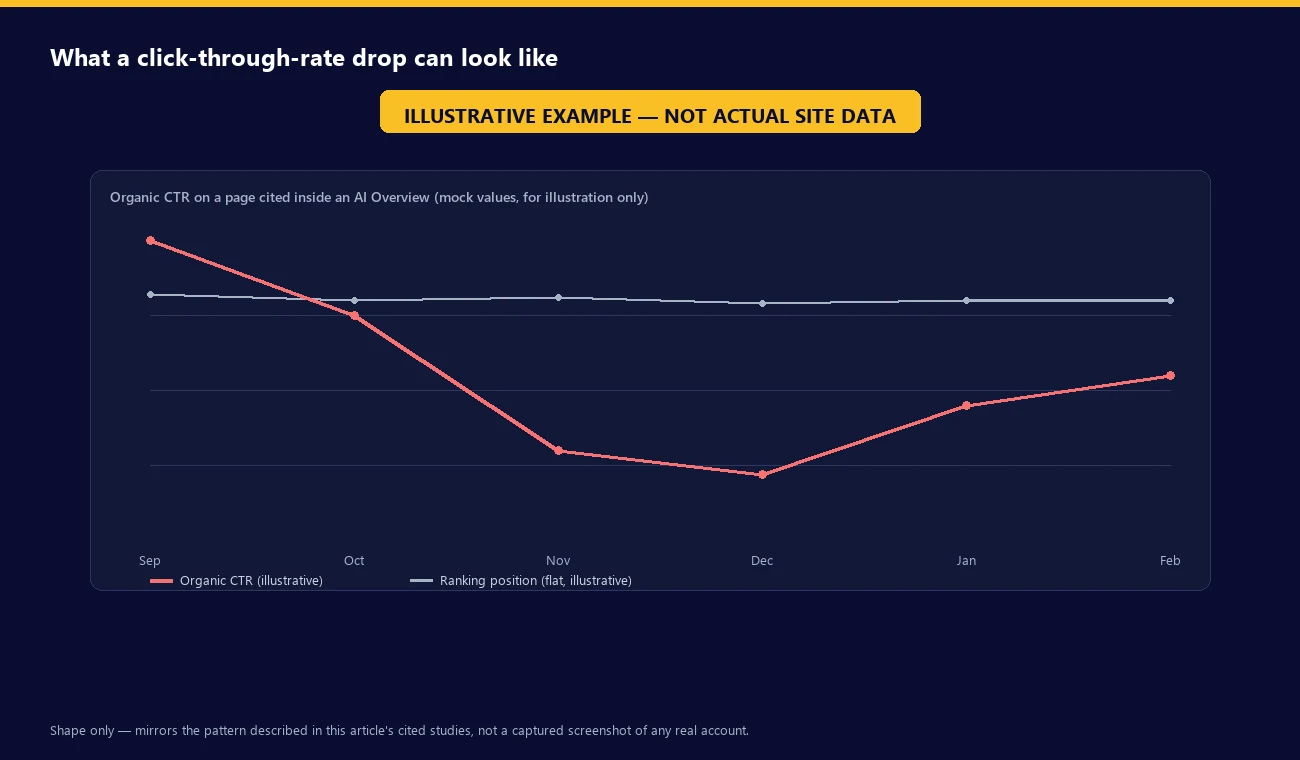
An illustrative example of the shape this kind of CTR decline tends to take. Not a screenshot of any real account.
Here’s the part most “AI killed SEO” posts leave out: Seer’s own 2026 follow-up found organic CTR on AI Overview result pages rebounded from 1.3% in December 2025 to 2.4% in February 2026. Seer calls that a leveling off, not a recovery, and warns against forecasting a trend from two months of data. We agree. Don’t plan your content strategy around a rebound that might just be noise, and don’t plan it around a permanent collapse either.
In Germany, SISTRIX data from March 2026 showed position-one organic CTR collapse from 27% to 11% on affected queries. Paid search isn’t immune: Seer Interactive found paid CTR dropped to 9.87% on queries with an AI Overview present, against 21.27% on the same queries without one. Google still handles roughly nine in ten search-engine referrals worldwide, according to StatCounter’s 2026 tracking; it hasn’t stopped being the biggest channel so much as changed what winning a ranking pays out.
Why are my click-through rates collapsing even though our rankings haven’t moved?
Your position in Google’s results and your chance of getting a click used to be the same number. They’re not anymore. When an AI Overview appears above the results, it can answer the query directly, cite two or three sources inline, and push the ranked list below the fold. Your page can sit at position one, exactly where it always did, and still see fewer clicks, because the click that used to land on it now sometimes lands on the AI Overview’s citation link instead, or doesn’t happen at all because the answer already satisfied the searcher. Tracking rank alone is no longer enough. Tracking whether you’re the cited source inside the AI Overview matters just as much, and most rank trackers still don’t show you that.
What’s causing the decline?
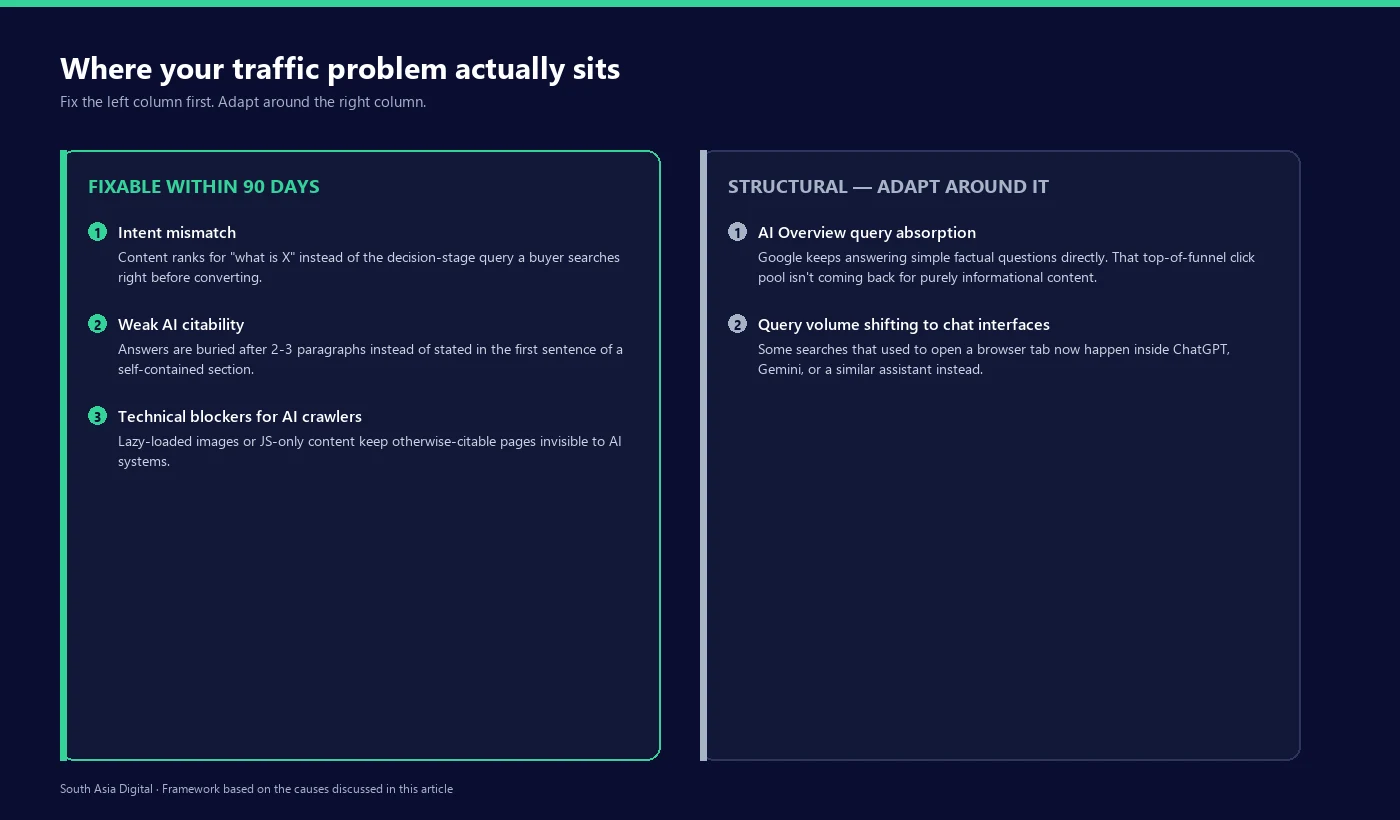
Five mechanisms are driving this, and they split cleanly into what’s in your control and what isn’t.
What you can fix within 90 days
- Intent mismatch in existing content. Ranking for “what is a chatbot” doesn’t convert the same reader who’s ready to install one. Rebuild the content around the decision your reader is making, not the general topic, and you recover traffic AI Overviews would otherwise absorb at the informational stage.
- Weak AI citability. If your page isn’t structured as a self-contained, quotable answer, an AI Overview or chatbot is less likely to cite it, even when you rank well. Short sections with a direct answer stated in the first sentence, not built up to over three paragraphs, fix this without a rewrite of your whole site.
- Technical blockers for AI crawlers. Lazy-loaded images, JavaScript-only content, and blocked crawler access keep AI systems from reading content that’s otherwise good enough to cite. Check this before you touch a word of copy; it’s often the cheapest fix on the list.
What’s structural, and you just have to adapt around it
- AI Overview query absorption at the informational layer. Google is going to keep answering simple factual questions directly. That pool of top-of-funnel clicks isn’t coming back for purely informational content, no matter how well you optimize it.
- Query volume shifting to chat interfaces. Some share of searches that used to open a browser tab now happen inside ChatGPT, Gemini, or a similar assistant instead. That’s a platform-level shift, not something your SEO work alone reverses.
Why does it feel like we’re publishing more content than ever but getting less traction?
Because volume and intent-matching aren’t the same lever, and only one of them still works. Publishing more posts just increases the surface area for AI Overviews and chatbots to absorb at the informational stage, without necessarily increasing the number of readers who convert. We saw this directly with a Shopify AI chatbot app client: most of its content was general how-to material ranking for people learning what a chatbot is, not store owners comparing specific apps and ready to install one. Replacing that mix with comparison and use-case content, not more content, grew monthly signups from roughly 100 to roughly 1,200 over three months. The full case study is here. More output without a matching intent fix just gives AI systems more pages to summarize instead of click through to.
What works right now
Fix the two things in your control before worrying about the two you can’t change.
- Rebuild your losing informational pages into decision-stage pages. Don’t delete the “what is X” content; it still serves top-of-funnel search. Build the comparison and use-case pages next to it, the way the Shopify case study above did, and let the new pages carry the conversion weight the old ones can’t anymore.
- Put the answer in the first sentence, every section. If a reader, or an AI system, has to read three paragraphs to find your actual recommendation, you’ve already lost the citation to a competitor who didn’t make them wait.
- Check whether AI crawlers can even see your content before you rewrite anything. A page blocked by lazy-loading or client-side rendering can’t be cited no matter how well it answers the question.
- Track citations, not just rank. If you don’t know whether you’re the source an AI Overview quotes on your target queries, you’re flying blind on the metric that now decides whether a top-three ranking pays off.
We rebuilt a declining hyperlocal publication’s SEO around exactly this approach and got it appearing in Google’s AI Overviews for queries it had never been cited on before. That’s the opposite of what most of the publisher traffic data earlier in this article shows happening industry-wide. The sitewide trend doesn’t have to be your sentence.
If you’re trying to work out where your own content sits on the fixable-versus-structural split, that’s the specific audit our Generative Engine Optimization service runs: which pages are losing clicks to AI Overviews you could be cited in, and which are losing clicks to a shift no page-level fix reverses.
If your traffic is declining, try this first
Before changing anything, find out which bucket your drop falls into. Run through this in order; each step takes an afternoon, not a redesign.
- Pull your top 20 pages by lost traffic in Search Console. Sort by clicks, compare year over year, and note which ones answer a broad “what is” question versus a decision-stage question.
- Check if those pages still rank. If position hasn’t moved but clicks dropped, the problem is CTR and AI Overview absorption, not a ranking loss. Different fix, same page.
- Open three of those pages and time how long it takes to reach the actual answer. If it’s longer than one short paragraph, that’s a citability problem you can fix without touching the ranking.
- Check whether AI crawlers can read the page at all (lazy-loaded images, JS-only content, and blocked crawler access all hide otherwise-good content). This is usually the cheapest fix on the list.
- Sort the rest into fixable versus structural using the breakdown earlier in this article, and work the fixable pile first.
| Cause | Fixable in 90 days? | What to do |
|---|---|---|
| Intent mismatch | Yes | Rebuild informational pages into comparison or use-case pages aimed at the decision-stage reader. |
| Weak AI citability | Yes | Put the direct answer in the first sentence of each section instead of building up to it. |
| Technical blockers for AI crawlers | Yes | Fix lazy-loading and JS-only rendering on pages worth citing. |
| AI Overview query absorption | No | Accept the smaller top-of-funnel click pool; shift investment toward decision-stage content. |
| Query shift to chat interfaces | No | Track whether you’re the cited source inside those assistants instead of chasing rank alone. |
If you’d rather have someone audit this against your own Search Console data instead of doing it by hand, that’s exactly what our Generative Engine Optimization service does, and you can reach us directly here if you want a second set of eyes on it.
Common questions about the 2026 search traffic decline
Is Google search traffic declining in 2026?
Yes, but unevenly. Publisher and informational B2B sites show the steepest losses, in some studies over 30% year over year, while a broader analysis across 40,000+ large US sites found aggregate decline closer to 2.5%. Both are accurate measurements of different slices of the web.
Is Google search dying?
No. Google still handles roughly nine in ten search-engine referrals worldwide. What’s changing is how many answers it gives directly inside the results page instead of sending a click elsewhere, which shrinks the click pool for some content types without eliminating search as a channel.
Why is my organic traffic dropping in 2026?
The most common cause is content that ranks for informational, early-stage queries AI Overviews now answer directly. Check whether your top traffic pages answer broad “what is” or “how does X work” questions rather than decision-stage questions a buyer asks right before converting. That mismatch is usually fixable without losing the ranking itself.
Is Google sending less traffic than before?
For many sites, yes, specifically on queries where an AI Overview now appears. Pages cited inside the AI Overview tend to hold up better than pages that rank well but aren’t cited, which absorb most of the loss on that same query. Even that gap narrowed slightly in early 2026, though Seer Interactive itself calls it too soon to count as a recovery.
Your rankings probably haven’t moved much. Your traffic has, because the click that used to land on your page increasingly lands on an AI Overview instead. Intent mismatch and weak AI-citability are worth fixing this week. The shrinking pool of purely informational clicks won’t budge no matter how much more you read about it, so put the next hour into the first two instead.
That covers why the clicks left. If you want to know where that attention actually goes once it leaves, and what to do about each destination, we break that down separately here.
Written by Nadir Yaqoob, founder of South Asia Digital. Nadir has a software engineering background and runs the agency’s AI SEO and GEO work for SaaS and Shopify clients directly.