A client of ours runs a hyperlocal publication in Singapore, covering a single, narrow slice of the city rather than the country as a whole: food and dining, lifestyle, things to do, local services, accommodation, and real estate in that one area. When we picked up the site, it was already sliding. Traffic had been falling for months, and Search Console told a specific, unflattering story: real impressions, real presence in search results, and almost no clicks.
That combination, being shown but not chosen, usually points to something more specific than “the site needs more content.” We audited it, found a handful of concrete problems, fixed them, and rebuilt the site around its actual niche. The recovery shows up clearly in Search Console, and so does something we did not expect to see this cleanly: the site started appearing, then growing, inside Google’s “Generative AI features” report, the AI Overview visibility metric that had sat at zero before this work began.
We’re not naming the client or linking to the site. This is real client work, not a hypothetical, and we’re sharing the real Search Console numbers and dates below, but the client’s identity isn’t ours to publish. Everything else in this article is accurate to what actually happened.
Key Takeaways
- The starting problem: a hyperlocal Singapore publication with real Search Console impressions but almost no clicks, already in decline before we started.
- The decline, dated: the site’s clicks dropped off from around February 2026 and stayed low through roughly the end of May 2026, after an earlier peak in January 2026.
- What the audit found: inconsistent publishing quality, a category of content that had nothing to do with the site’s actual subject, and a visual design that didn’t match what the client wanted the site to look and feel like.
- What we did: rebuilt the site, removed the off-topic content, did on-page SEO written for both classic ranking and how AI systems read and extract answers, and built out topical authority inside the site’s real niche.
- The result: 2.74K clicks and 256K impressions over the most recent 6 months, both trending upward and climbing more steeply from around July and August 2026 onward.
- The standout number: the site’s Google AI Overview impressions, tracked in Search Console’s Generative AI features report, went from flat and near zero for months to a sharp, sustained climb starting in late August 2026.
The Starting Problem: Real Impressions, Almost No Clicks
Before any of the work described below, the client’s own Search Console data showed a pattern we see fairly often on declining sites but that’s still worth stating plainly: Google was showing the site’s pages in search results, and searchers weren’t clicking on them. Impressions without clicks isn’t automatically a content problem or automatically a technical problem, it can be either, or both, or something about how the results themselves are presented. Figuring out which one it actually was is what the audit below was for.
The longer-range clicks chart makes the decline itself easy to see. The site had a real earlier peak around January 2026, then clicks fell off and stayed low for roughly the following three and a half months, from around early-to-mid February 2026 through late May 2026, before recovery started to show up.
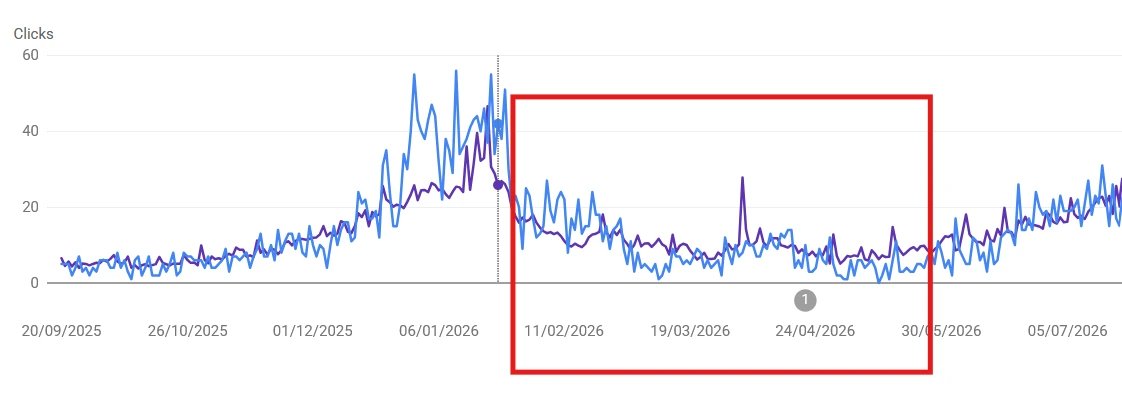
This is the honest starting point of the engagement: not a healthy site that needed a small tune-up, but one that had already been losing ground for months by the time we started working on it.
What the Audit Found
Three problems came out of the audit, none of them exotic, all of them concrete enough to act on directly.
Inconsistent publishing and content quality
Content on the site varied a lot in depth and quality from post to post. Some pieces were genuinely useful, specific, and well put together. Others read as thin or rushed, the kind of gap that’s easy to accumulate over time as a small publication tries to keep a regular publishing schedule going without a consistent editorial standard behind it.
Content that had nothing to do with the site’s actual subject
One holdover from an earlier, less focused version of the site was a whole content category that didn’t belong there at all. It read like it had wandered in from a completely different kind of website, sitting in the same category list as the food reviews and neighbourhood guides, with no real connection to a hyperlocal food, lifestyle, and local-services publication. It’s exactly the kind of irrelevant, off-topic content that dilutes a site’s actual subject-matter focus in the eyes of both readers and search engines, and it had clearly never been cleaned up after whatever earlier direction the site had once tried.
A visual presentation that didn’t match what the client wanted
The site’s theme and overall visual design didn’t reflect what the client actually wanted the publication to look like. It wasn’t broken, exactly, just generic and a little dated, and it didn’t do the content any favors. Combined with the inconsistent content quality, the overall impression on landing on the site was unpolished rather than like a publication with a clear identity.
What We Actually Did
The fix wasn’t one single change. It was four pieces of work done together, because none of them would have done much on their own.
- Rebuilt the site. New theme and visual design matching what the client actually wanted the publication to present as, replacing the generic, unpolished look the audit flagged.
- Removed the irrelevant content. The off-topic category and the content under it came off the site entirely, so the site’s actual subject matter, food and dining, lifestyle, things to do, local services, accommodation, and real estate in its one covered area, was no longer diluted by content that didn’t belong.
- Did on-page SEO built for both audiences. Classic keyword and ranking-factor SEO, but also structure, clarity, and directness written with how AI systems read and extract content in mind, not just how a human skims a page or how a classic crawler indexes one.
- Built topical authority inside the real niche. Instead of scattered content across unrelated categories, the site’s coverage was organized and expanded around what it actually is: a genuinely narrow, hyperlocal publication, with the depth of coverage that a search engine, or an AI system summarizing search results, can recognize as a real, focused authority on that one area rather than a generic local blog.
This kind of engagement, on-page SEO combined with a content strategy built around a site’s real topical focus, is the same category of work covered under our SEO services and content marketing services, not a one-off trick specific to this client.
The Result: Recovery, and a New Kind of Visibility
Over the most recent 6 months, the site logged 2.74K total clicks and 256K total impressions, a 1.1% average CTR, and an average position of 29.1. Both clicks and impressions trend upward across that window, and the climb gets noticeably steeper from around July and August 2026 onward, well after the rebuild and content work described above had been done.
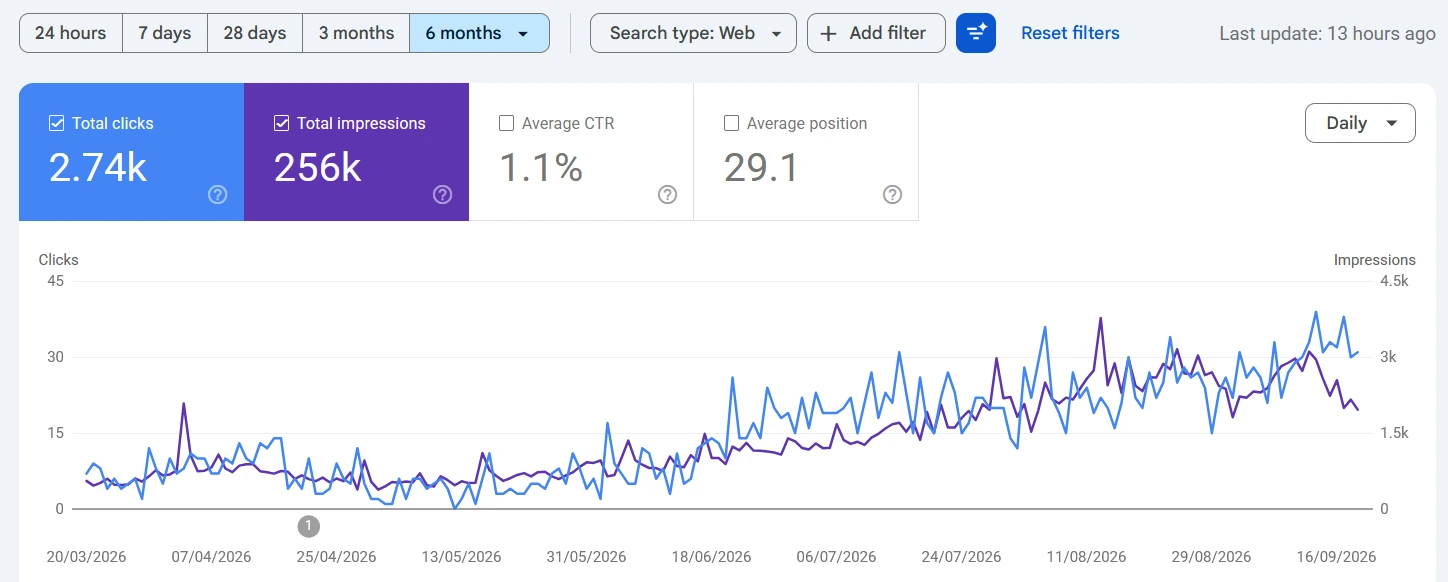
Average position across the full window is 29.1, which is worth reading honestly rather than glossing over: that figure still carries the weight of the earlier, weaker months in the same window, not just the improved recent ones. The trend line is what matters here, not a single blended average.
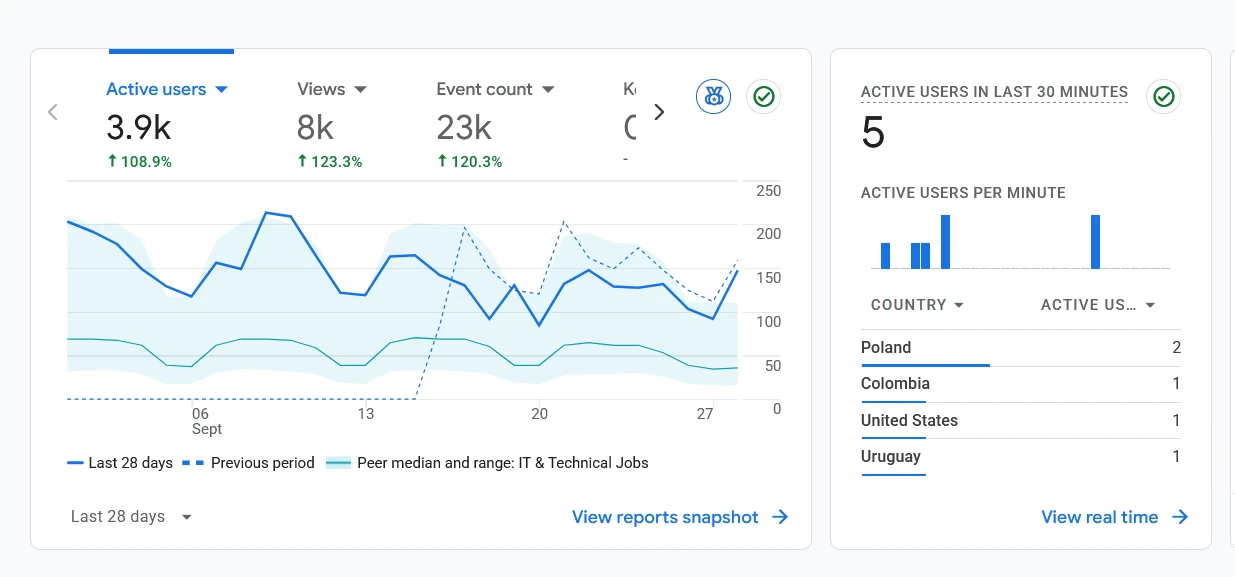
Search Console shows what’s happening in search results; Google Analytics shows what actually happens once someone lands on the site, and it’s worth checking both rather than treating search data alone as proof. Over the most recent 28 days, the site’s own analytics show active users up 108.9% and page views up 123.3% against the prior 28-day period, real visits from a second, independent data source, not just an impressions count from search.
The standout: appearing in Google’s AI Overviews
The result we didn’t fully expect to see this clearly is in Search Console’s “Generative AI features” report, the metric that tracks how often a site’s pages get surfaced inside Google’s AI Overviews. Over the most recent 12 months, that report shows 3.46K total impressions. For most of the period shown, roughly May through mid-August 2026, the trend line sits low and flat, generally under 20 impressions a day with a few small spikes into the 60-90 range. Then, starting in late August 2026, it climbs sharply and keeps climbing into September, passing 150 impressions a day by the time this article was written.
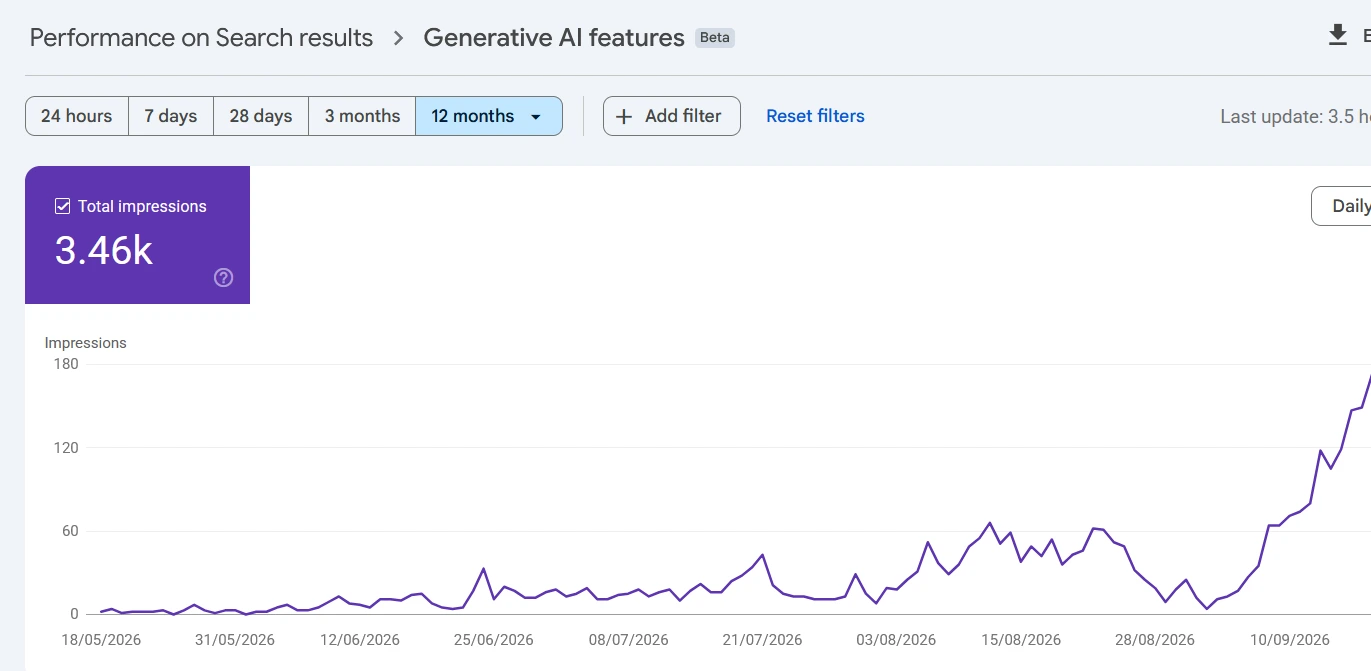
That timing lines up with the on-page work described above, content and structure written for how AI systems read and extract answers, plus the topical authority built up inside the site’s real niche, becoming visible in Google’s own AI Overview surfacing data roughly a few weeks to a couple of months after that work was done. We can’t prove a single, isolated cause and effect the way a controlled experiment would, Google doesn’t publish that kind of per-site attribution, but the shape and timing of the curve is real, and it’s a genuinely different kind of visibility than a rise in classic blue-link rankings.
| Signal | What the Data Shows |
|---|---|
| Organic clicks, 6 months | 2.74K total, trending upward, steeper climb from around July 2026 |
| Organic impressions, 6 months | 256K total, same accelerating pattern as clicks |
| Average position, 6 months | 29.1, still reflecting the earlier, weaker months in the same window |
| AI Overview impressions, 12 months | 3.46K total; flat and low through mid-August 2026, then a sharp, sustained climb from late August 2026 |
What This Doesn’t Prove
This is one client’s real result, not a guaranteed outcome, and we want to be upfront about the limits of what the data above actually shows.
- The work was bundled together. The rebuild, the content pruning, and the SEO work all happened as one engagement over a similar period, so we can’t cleanly isolate exactly how much of the recovery came from which piece. What we can say is that all four pieces were real, necessary fixes for the problems the audit actually found, not busywork.
- Average position is still soft. An average position of 29.1 across the full 6-month window means the site, taken as a whole, still isn’t ranking near the top of results for most of its queries. The trend is genuinely positive; it isn’t a finished story yet.
- AI Overview visibility is early and can move. A few weeks of sharp growth in a Beta report is a real, promising signal, not a settled, durable outcome. Google can and does change how AI Overviews source and surface content, and this kind of visibility should be watched over months, not declared a permanent win after one strong stretch.
- This is one niche, one market, one site. A very narrow, geographically specific publication is a particular kind of site. What worked here, cutting scope back to a genuine niche and building depth inside it, won’t automatically transfer word-for-word to a broad, general-interest site or a different industry.
We’re also intentionally not naming the client, linking to the site, or giving details specific enough to identify it, at the client’s request. That’s a deliberate limit on this write-up, not an oversight. If you want to see a different real recovery story from our client work, with a different set of problems entirely, we’ve also written up how we recovered a job board site hit by a Google spam update.
Frequently Asked Questions
How long did this recovery take?
Based on the real Search Console data, the site’s decline ran from roughly February through May 2026. The rebuild, content pruning, and SEO work happened in the months after that, and the recovery becomes clearly visible in the clicks and impressions data from around July and August 2026 onward, with the AI Overview visibility gain showing up a little later still, starting in late August 2026.
Does this approach work for any declining site?
Not automatically. This case involved a specific set of real problems, inconsistent content quality, off-topic content diluting the site’s actual subject, and a mismatched visual presentation, on a site with a genuinely narrow, well-defined niche to rebuild around. A different declining site with different root causes, a manual action, a technical crawling problem, a genuinely broad and unfocused subject area with no clear niche to narrow into, would need a different diagnosis and a different fix, not this same playbook applied by default.
What is topical authority, and why did it matter here?
Topical authority is the idea that a site which covers one subject area in real depth, consistently and without unrelated distractions, is more likely to be recognized by search engines, and increasingly by AI systems summarizing search results, as a genuine, trustworthy source on that subject than a site that covers many unrelated things thinly. For this client, that meant removing the off-topic category entirely and concentrating coverage inside the site’s actual hyperlocal niche, rather than trying to be a slightly-better generic local blog.
Why does AI Overview visibility matter separately from regular search rankings?
Google’s AI Overviews summarize and cite sources directly inside the search results page, sometimes reducing the need for a searcher to click through to any individual result at all. A site can be improving in classic rankings while having zero presence in AI Overviews, or vice versa, because the two systems don’t necessarily select and weight sources identically. Tracking both, which is what Search Console’s Generative AI features report is for, gives a fuller picture than watching classic position and clicks alone, which is part of why this client’s move from zero to growing AI Overview impressions is treated as a distinct, additional result here rather than folded into the general ranking recovery.
What does on-page SEO “built for how AI systems read content” actually mean in practice?
In practice, it means writing and structuring pages so the actual answer to a reader’s question is clear, direct, and easy to extract, using real headings that match real questions, concrete specifics instead of vague filler, and a logical structure an automated system can parse cleanly, rather than writing purely to satisfy a classic keyword-density checklist. It’s not a separate, exotic technique from good content writing; it’s closer to writing genuinely clear, well-organized content and not burying the useful part of the answer under padding.
Why was removing content part of the fix, instead of just adding more?
Because the problem wasn’t a shortage of content, it was a lack of focus. A content category with nothing to do with the site’s actual subject doesn’t just sit there neutrally; it dilutes what the site is actually about, both for a human visitor trying to figure out what the publication covers and for a search engine trying to establish what topic the site has real authority on. Removing it was a precondition for the topical-authority work to mean anything, not an optional cleanup step done alongside it.