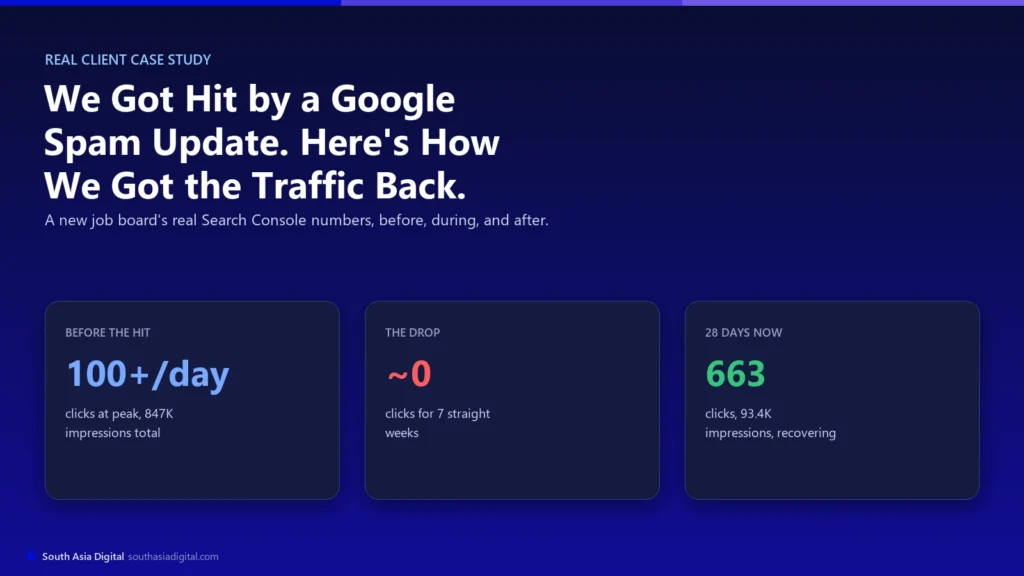
A job board client’s traffic disappeared almost overnight. The site had been getting steady, growing clicks from Google for months. Then, right after a Google spam update in mid-2026, that traffic dropped to almost nothing, and stayed there for about seven weeks.
We found four real problems causing it, fixed all four, and the traffic came back. This article walks through exactly what we found, what we changed, and why the recovery took as long as it did.
This is a real case from our own client work, not a hypothetical. The site is a job-posting platform we’ve worked with since launch. It grew into a genuine traffic source over its first few months, then got hit hard enough that the client assumed the project had failed. We’re sharing the full story below, including the parts where the client pushed back on our advice, because most “we got hit by a spam update” posts skip that part.
Key Takeaways
- What got hit: a new job board site, roughly four months into genuine organic growth, dropped to near-zero clicks starting July 1, 2026.
- What we found: auto-approved comment spam getting indexed, user profile fields being used to inject backlinks that also got indexed, unedited theme-default images with generic alt text, and duplicate job-listing pages from broken canonicals.
- What the client resisted: replacing the dummy theme images, more than any other fix, in favor of cosmetic theme tweaks.
- The real update timeline: the drop lines up with the June 2026 spam update (June 24-26), not the August 2026 spam update the client remembered, though the recovery becoming visible does line up with the August update’s rollout. Both are covered below.
- Where it stands now: visibility has recovered to roughly its pre-hit range, though average position is still a bit softer than it was during the growth run, and it’s early to call this a full, durable recovery.
The Situation: A New Job Board’s First Real Growth Run
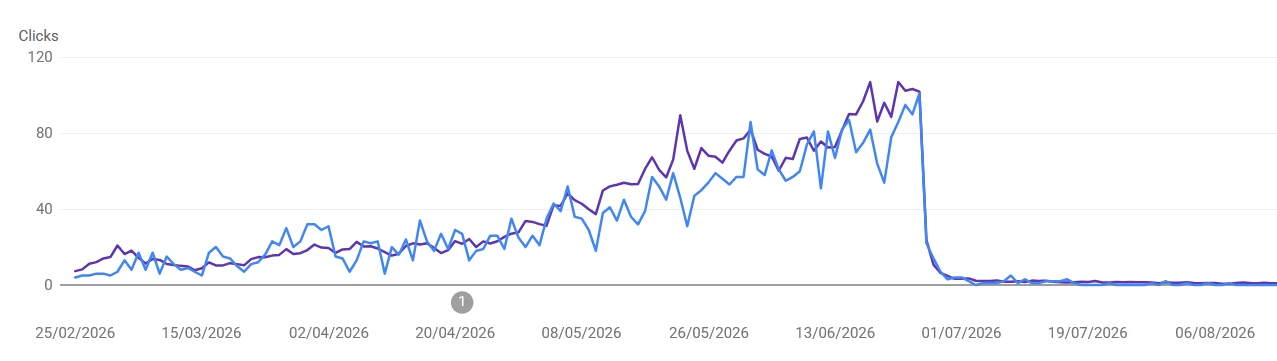
The client came to us with a newly launched job-posting site and one goal: get it ranking. There was no existing organic traffic to protect, no legacy penalty to dig out of, just a new domain that needed the standard technical and content groundwork done properly from the start. Over the following months, it worked. Search Console’s Performance report for the roughly four months from February through the end of June 2026 shows 4.99k total clicks and 847k total impressions, a 0.6% average CTR, and an average position of 8.8. By the later weeks of that run, daily numbers were regularly topping 100 clicks and 10,000 impressions a day, real, growing organic visibility for a brand-new site in a competitive vertical.
The Update the Client Called “August 2026” (And What the Dates Actually Show)
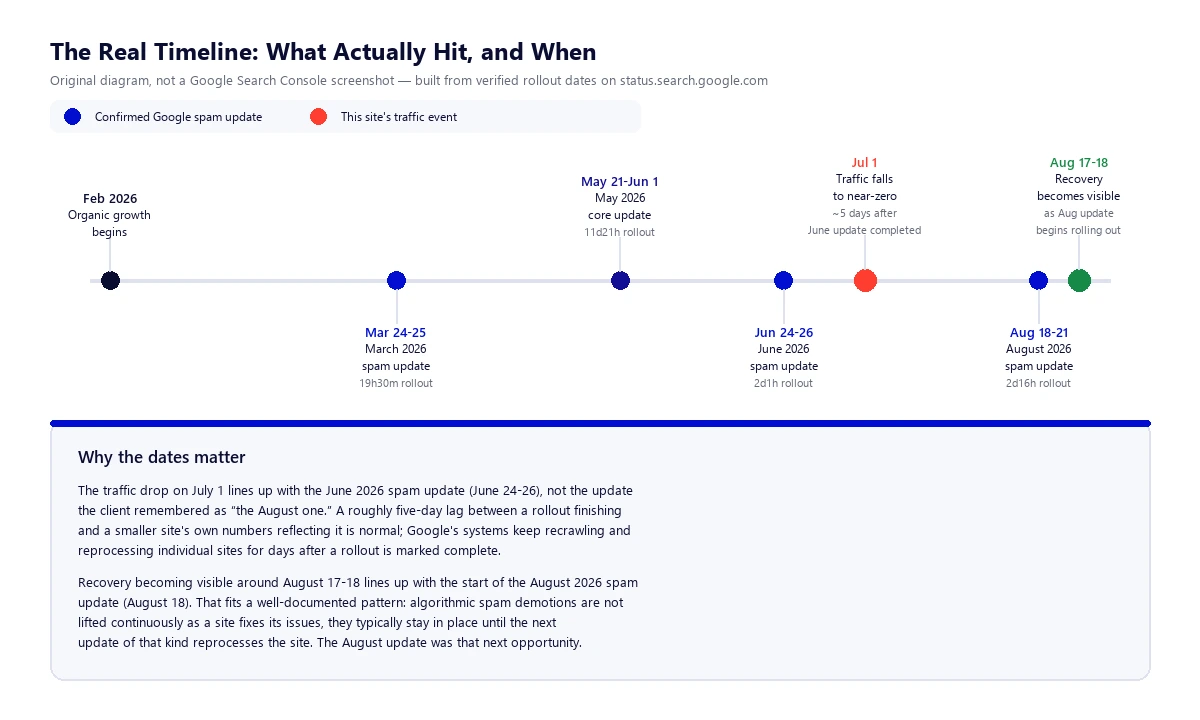
Before writing any of this up, we went back to Google’s own Search Status Dashboard and Search Central announcements to verify the timeline instead of repeating what the client remembered. Google ran three named spam updates in 2026 before this article was written: the March 2026 spam update (March 24-25, a short 19.5-hour rollout), the June 2026 spam update (June 24-26, roughly two days), and the August 2026 spam update (August 18-21, roughly two days and sixteen hours). None of the three shipped with a dedicated policy-name blog post, the kind Google used for the 2024 site reputation abuse update; these were logged as one-line entries on the status dashboard and a short post on Google’s Search Central account, described as standard spam updates enforcing existing policy globally, across all languages, not introducing a new rule.
| Update | Rollout Dates (Pacific) | Duration | Relevance to This Site |
|---|---|---|---|
| March 2026 spam update | March 24-25, 2026 | 19h 30m | Too early; the site’s traffic kept growing after this one |
| May 2026 core update | May 21 – June 1, 2026 | 11d 21h | Not a spam update; also too early to explain a July 1 drop |
| June 2026 spam update | June 24-26, 2026 | 2d 1h | The most likely real cause. Completed 5 days before the July 1 drop |
| August 2026 spam update | August 18-21, 2026 | 2d 16h | Likely tied to recovery, not the original hit. Started the same week visibility returned |
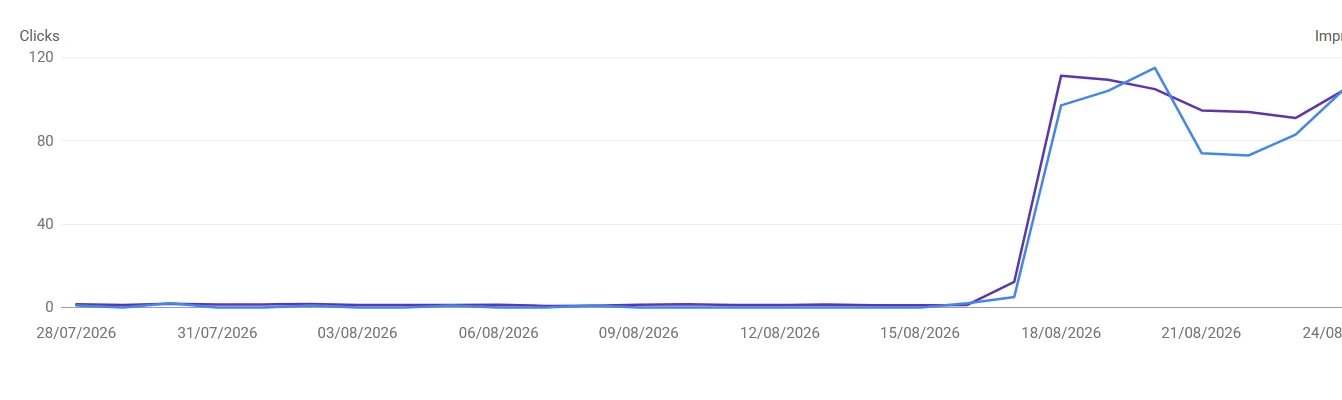
The client’s traffic fell to near-zero starting July 1, 2026, based on real Search Console data. That date sits five days after the June 2026 spam update finished rolling out on June 26, not after the August update, which hadn’t happened yet. A short lag between a rollout finishing and an individual smaller site’s own numbers reflecting it is normal; Google’s systems keep recrawling and reprocessing pages for days after a rollout is marked “complete” on the dashboard. So the honest read of the evidence is that the June 2026 spam update, not August, is what hit this site. We’re flagging this plainly instead of forcing the client’s own “the August update” framing to fit, since the dates don’t support it.
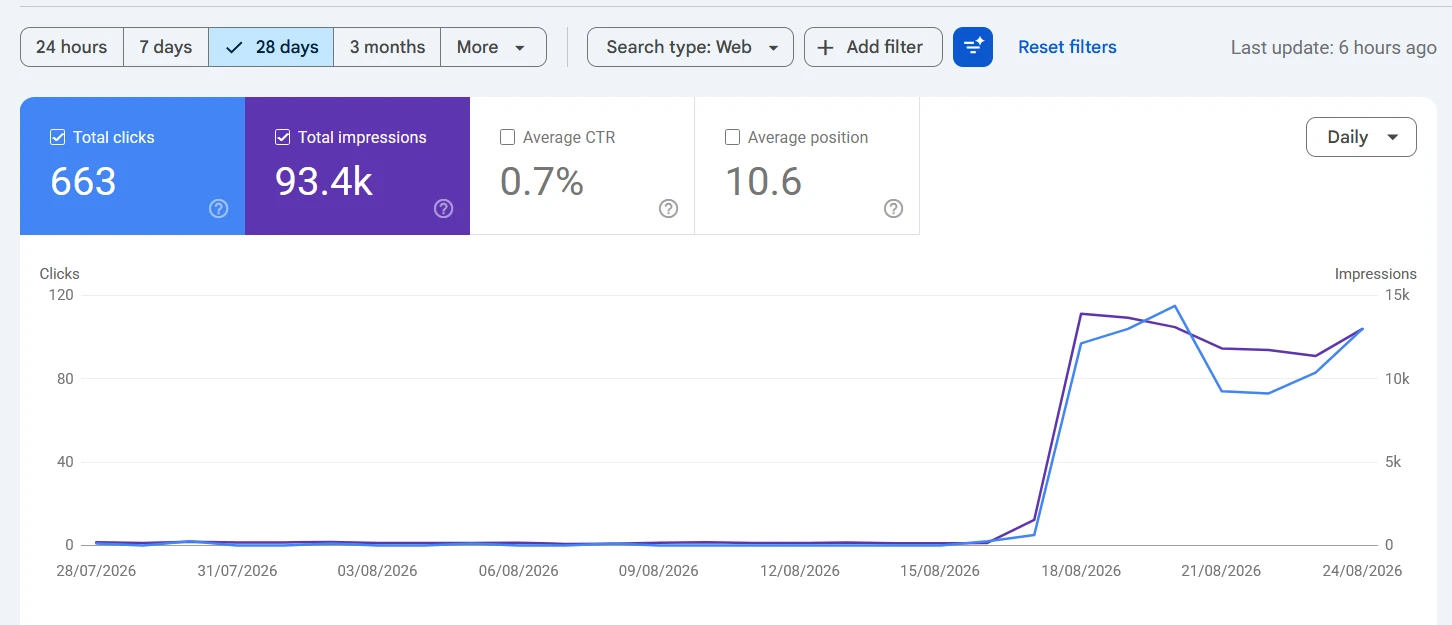
The recovery timing tells a different, equally interesting story. Visibility started coming back around August 17-18, 2026, which lines up almost exactly with the August 2026 spam update’s start on August 18. That’s not a coincidence we can prove with certainty, Google doesn’t publish per-site cause and effect, but it matches a well-documented pattern in how algorithmic spam demotions work: fixing the underlying issue doesn’t lift the demotion immediately, because Google’s spam classifiers aren’t re-scoring every page continuously. A site typically has to wait for the next update of the same kind to roll through and reprocess it. We finished the technical fixes described below in the weeks after the June update; the August update was the next opportunity for Google’s systems to reflect that.
The Hit
There was no manual action notice in Search Console, no email from Google, just clicks and impressions falling off a cliff starting July 1 and staying near zero for weeks. That absence of a manual action notice is itself informative: it pointed us toward an algorithmic spam update, not a human reviewer flagging the site by hand, which shaped how we approached the audit (more on that distinction in the FAQ below). For a site that had spent months building real organic visibility, the sudden silence looked, from the client’s side, like the project had simply failed.
The Friction: Cosmetic Fixes Over Technical Ones
This part is worth being honest about instead of smoothing over. Once the audit findings below were in hand, the client’s initial response wasn’t to prioritize the fixes with clear spam-policy exposure. It was to keep pushing for cosmetic theme changes, header colors, a homepage banner redesign, small layout tweaks, while treating the image replacement and profile-link changes as lower priority, optional, or something to revisit “later.” The dummy theme images were the single most resisted change: the client didn’t want to touch them, partly because sourcing and approving new photography felt like more work than a color swap, and partly because the risk wasn’t visible or intuitive to a non-technical site owner in the way a homepage redesign is.
This is a common, understandable dynamic, not a criticism of this specific client. Cosmetic changes are easy to evaluate by eye and feel like progress. A canonical tag or a comment-moderation setting produces no visible change at all until something goes wrong, and by the time it does, the connection between “we never got around to that” and “the site is now getting almost no traffic” isn’t obvious. Part of the actual work in a case like this is making that connection concrete enough that a client will act on it, which is what the audit findings below were used for internally, not just as a diagnostic list but as the argument for why the unglamorous fixes had to come first.
The Audit: Four Real Spam-Policy Risks
Each of these was verified against Google’s current spam policies for web search, not assumed from general SEO folklore, since the point of an audit like this is diagnosing what a spam system would flag, not what merely looks untidy.
1. Auto-approved comments were indexing spam and adult-content links
The site’s comment section was set to auto-approve, meaning any submitted comment went live immediately with no review. Spam and pornography-linked comments had been accumulating for weeks, and a portion of them were indexed by Google. Google’s spam policies define a specific category for exactly this, user-generated spam, described as spammy content added to a site by users through a channel intended for legitimate user content, with comment spam on blogs named as a direct example. An indexed page full of unmoderated adult and spam comments is not a cosmetic embarrassment, it’s the literal pattern that policy exists to catch, sitting on a domain Google was actively evaluating during a spam update.
2. User sign-up profiles were being used to inject backlinks
Job boards with open registration have a structural feature most other site types don’t: a public profile page for every user who signs up, and this one let new accounts add links into their public profile fields. New sign-ups, many clearly automated and not genuine job seekers, were using that field to plant backlinks, and a meaningful number of those profile pages, links included, were getting crawled and indexed. This falls under the same user-generated spam umbrella as the comments, closely related to what Google’s own policy documentation describes as forum comments with optimized links in the post or signature, just on a profile field instead of a comment box. The mechanism is identical: a channel meant for legitimate user content, exploited at scale, indexed, and now working against the site’s own spam risk instead of for user experience.
3. Theme-default images the client wouldn’t approve replacing
A large share of the site’s imagery was unedited demo content shipped with the WordPress theme, generic stock-style photos with filenames like placeholder-1.jpg, missing or auto-generated alt text, and no unique titles. On its own, this is an accessibility and image-SEO problem: alt text exists to describe an image to users who can’t see it and to give search engines something concrete to index, and a missing or generic value fails both jobs. At scale, it’s also a signal problem: the same theme, with the same unedited demo images and the same default alt text, is running on an unknown number of other sites that never customized it either. A page built on entirely templated, unedited assets looks less like a unique property to a search engine’s automated systems and more like one instance of a mass-produced template, which is adjacent to the kind of scaled, undifferentiated content that spam systems are increasingly built to discount, even when, as here, the business behind it is completely legitimate and the intent was never manipulative.
4. Duplicate listing pages from broken canonical tags
Job boards generate duplicate and near-duplicate URLs almost by design: the same listings reachable through filter combinations, sort orders, pagination, and location or category crossovers, plus expired postings left live. This site’s canonical tags weren’t consistently pointing at the correct target page, so Google was indexing multiple near-identical URLs for what was functionally the same set of listings, splitting ranking signals across pages competing with each other instead of consolidating them onto one. This is standard technical SEO, not spam-specific, but it compounds a spam-update hit: a site already under scrutiny gains nothing from also presenting search engines with a confusing, duplicated URL structure to sort through.
The Fix, Mapped to Each Finding
Every fix below maps directly to one of the four findings above. None of them required removing a feature the site genuinely needed; all of them were about controlling exposure and indexability, not ripping functionality out.
| Finding | Why It’s a Spam-Policy Risk | The Fix |
|---|---|---|
| Auto-approved spam/adult comments, indexed | Textbook user-generated spam, an unmoderated channel exploited at scale and left crawlable | Switched to manual moderation; disabled/nofollowed links inside the comment field so future comments can’t inject followed links even before review |
| Profile fields used to inject backlinks, indexed | Same user-generated spam pattern as forum-signature link spam, on a public profile page instead | Kept profile customization (a job board plausibly needs some), but nofollowed outbound profile links and noindexed low-value profile pages instead of removing the field entirely |
| Theme-default images, generic/missing alt text | Accessibility failure plus a template-uniqueness signal shared with every other unedited install of the same theme | Replaced the highest-visibility images and rewrote alt text, titles, and filenames on the rest to be unique and descriptive, once the client agreed to prioritize it |
| Duplicate listing pages, broken canonicals | Filter, pagination, and location/category combinations splitting ranking signals across near-identical URLs | Corrected and consolidated canonical tags onto the real target listing pages; noindexed low-demand facet combinations instead of trying to canonicalize every one |
What Else We Checked, Beyond What the Client Raised
The four issues above were what the audit surfaced first, but a spam-update recovery is a good moment to check a few adjacent things that don’t always make it onto a client’s own radar. These aren’t padding; each one is a genuine, verifiable risk specific to a job board that we’d check on any site in this situation.
- XML sitemap hygiene. We audited the sitemap to confirm it only listed canonical, indexable, currently-live URLs, not the duplicate filter/sort URLs the canonical fix was already handling separately. A sitemap that still lists pages you’ve just noindexed sends Google a contradictory signal at the exact moment you want your fixes read cleanly.
- Expired job listings left indexed. Job boards accumulate postings that have expired but whose pages are still live and returning thin, outdated content, a classic soft-404 risk: a page that returns a normal 200 status but effectively has nothing left to offer a searcher. We checked for expired listings still indexed and made sure they either redirect to a live, related listing or return a proper 404/410 instead of sitting indexed as dead weight.
- Internal linking to the real canonical pages. Once the canonical consolidation was in place, we checked that internal links across the site pointed at the canonical listing URLs directly, instead of at the filtered or paginated variants, so link equity flows to the pages meant to rank instead of diluting across duplicates.
- Monitoring Search Console’s Removals and Manual Actions reports through the recovery window. Since there was no manual action here, this was about confirming that stayed true, and about using the Removals tool to request temporary removal of the worst indexed spam-comment and profile-link pages while the underlying fixes took effect, instead of waiting on natural recrawl timing alone.
The Recovery
Over the most recent 28 days as of a screenshot taken around August 24, 2026, the site logged 663 clicks and 93.4k impressions, a 0.7% CTR, and an average position of 10.6. Read carefully, that’s a real recovery, not a full one yet. The 28-day window still contains roughly three weeks of near-zero days from before visibility returned around August 17-18, which drags the period average down; the more meaningful signal is the shape of the curve in the final third of that window, not the 28-day total by itself. Average position at 10.6 is also still a little softer than the 8.8 the site held during its original growth run, so we’re treating this as visibility returning to roughly its pre-hit range, not a confirmed, fully durable recovery. It’s early, and we’re continuing to monitor it instead of declaring victory.
What This Means If Your Site Gets Hit Too
A few takeaways apply beyond this specific job board. First, verify the actual update timeline before you act on one, the name a site owner remembers is often approximate, and the real cause can be a different update entirely, sitting a few weeks off from where you’d assume. Second, open user-generated content, comments, profiles, forums, is worth auditing on its own even outside a crisis, since auto-approval settings are an easy default to leave on and a direct match for a named Google spam policy. Third, the boring technical fixes, canonical tags, alt text, moderation settings, are usually the ones with real spam-policy exposure, while the visible cosmetic changes a client naturally wants to prioritize usually aren’t; part of the job is making that distinction concrete enough to act on. And fourth, if you do get hit, fixing the cause doesn’t guarantee an immediate bounce back; based on how these updates run, it can genuinely take until the next update of the same kind before the recovery shows up in your own numbers.
This kind of audit, going through comments, user-generated fields, image metadata, and canonical structure against Google’s current spam policies instead of guesswork, is the same technical work our SEO services cover. If a spam-policy fix reveals broader structural gaps, our entity mapping framework covers the deeper technical foundation, and ongoing checks like the ones described in the recovery section above are typically the kind of work covered under an SEO monthly retainer, not a one-time project.
Frequently Asked Questions
How long does it take to recover from a Google spam update?
There’s no fixed timeline, and Google doesn’t guarantee one. Because spam classifiers aren’t continuously re-scoring every page, a site that fixes the underlying issue often doesn’t see that reflected until the next update of the same kind rolls through. In this case, the fixes were made in the weeks after the June 2026 spam update, and visibility didn’t return until the August 2026 spam update began rolling out roughly seven weeks later.
Do I need to disavow links after a spam update?
Usually not. Google’s own guidance reserves the disavow tool for sites with an active manual action for unnatural links, or strong, evidence-based reason to expect one, and most low-quality or irrelevant backlinks are simply ignored by Google’s ranking systems without needing disavowal. If your Search Console Manual Actions report is clean, as it was on this site, the higher-value move is auditing and fixing on-site spam signals rather than reaching for the disavow tool.
Should I disable comments entirely, or just moderate them?
Moderate them, in most cases, rather than removing the feature outright. Auto-approval is what turns a comment section into a genuine user-generated spam vector; switching to manual approval and disabling or nofollowing links inside the comment field removes the risk while keeping the engagement value comments can provide.
What counts as user-generated spam under Google’s policies?
Google defines user-generated spam as spammy content added to a site by users through a channel meant for legitimate user content, and names comment spam on blogs and spammy forum posts as direct examples. A job board’s public profile fields fit the same pattern when they’re exploited to inject backlinks, closely related to what Google’s link spam guidance separately flags as optimized links placed in forum comments or signatures.
Can duplicate content from filters and pagination on a job board actually cause ranking problems?
Yes, though it’s a standard technical SEO issue rather than a spam-policy violation on its own. Filter combinations, sort orders, pagination, and location or category crossovers are a very common way job boards generate large numbers of near-duplicate URLs, which splits ranking signals across competing pages instead of consolidating them. Correcting canonical tags and noindexing low-demand facet combinations addresses it directly.
How do I know if a spam update, a core update, or a manual action hit my site?
Check Search Console’s Security and Manual Actions report first. A manual action shows up there with a specific reason and a notification from Google; an algorithmic spam or core update produces no notification at all, which is itself a useful signal. A spam update tends to affect specific pages or sections that match a known policy, while a core update tends to re-rank more broadly across a site’s whole topical footprint, so the shape of the drop, one section versus the whole site, is also worth checking against the confirmed rollout dates on Google’s Search Status Dashboard.
What should I check in Search Console while waiting for recovery?
Beyond the Performance report, watch the Manual Actions report to confirm one hasn’t been added, the Removals tool if you need indexed spam pages taken down faster than natural recrawl would manage, and the Page Indexing report for signs that Google is recrawling and re-evaluating the pages you’ve fixed. A rising number of pages moving out of exclusion categories is often the earliest sign of recovery, ahead of clicks and impressions turning up.