Your follower count has been stuck at the same number for weeks, a competitor with worse content has fifty thousand followers and three likes a post, and a follower-growth site is one tab away promising a thousand new followers for nine dollars. Or maybe you already paid, watched the count jump overnight, then watched it quietly slide back down two weeks later while wondering what else that payment touched.
Here is the direct answer: buying Instagram followers goes against Instagram’s own Terms of Use, most of what gets delivered for a low price is inactive bot accounts instead of real people, and the real risk is not just wasted money. It is reach suppression, follower purges, and account penalties that hurt the account you were trying to grow in the first place. Some services look more legitimate than others, but “safer-looking” is not the same as compliant, and the underlying violation stays the same no matter how the followers are delivered.
This guide covers what Instagram’s policy says, what happened when a real company bought followers and reported the results, the legal precedent that makes selling fake engagement a genuine liability and not just a platform-rules problem, the different types of services in this market and the red flags worth checking for, and what to do instead if the goal is a bigger, more valuable audience, not just a bigger number.
Is It Safe to Buy Instagram Followers? What Instagram’s Own Rules Actually Say
Most articles on this topic mention that buying followers is “against the rules” without quoting what the rules say or linking to where they say it. Since that language is the whole basis for the risk, it is worth reading directly instead of taking someone else’s paraphrase.
The exact policy language
Instagram’s Terms of Use are explicit about trading in accounts and account activity. The current terms state that you cannot sell, license, or purchase any account or data obtained from Instagram or its services, and that this includes attempts to buy, sell, or transfer any aspect of your account, including your username. You can read the full Instagram Terms of Use directly.
Separately, Meta’s Community Standards address the engagement itself. Under its spam policy, Meta prohibits attempting to or successfully selling, buying, or exchanging for engagement such as likes, shares, views, follows, and clicks. That line covers the follower-selling transaction on both sides, the seller offering it and the buyer paying for it, published on Meta’s own Transparency Center spam policy page, not a third party’s summary of it.
How Instagram detects it
This is not enforced by someone manually reporting an account. Meta has stated publicly, in its own “Reducing Inauthentic Activity on Instagram” messaging, that it built machine-learning systems specifically to identify accounts using third-party services that generate inauthentic likes, follows, and comments, and that using such a service violates both the Community Guidelines and the Terms of Use regardless of whether a human ever flags it. The detection is described as deliberate and ongoing, built for this exact pattern, not a side effect of some other system catching it by accident.
What happens when you get caught
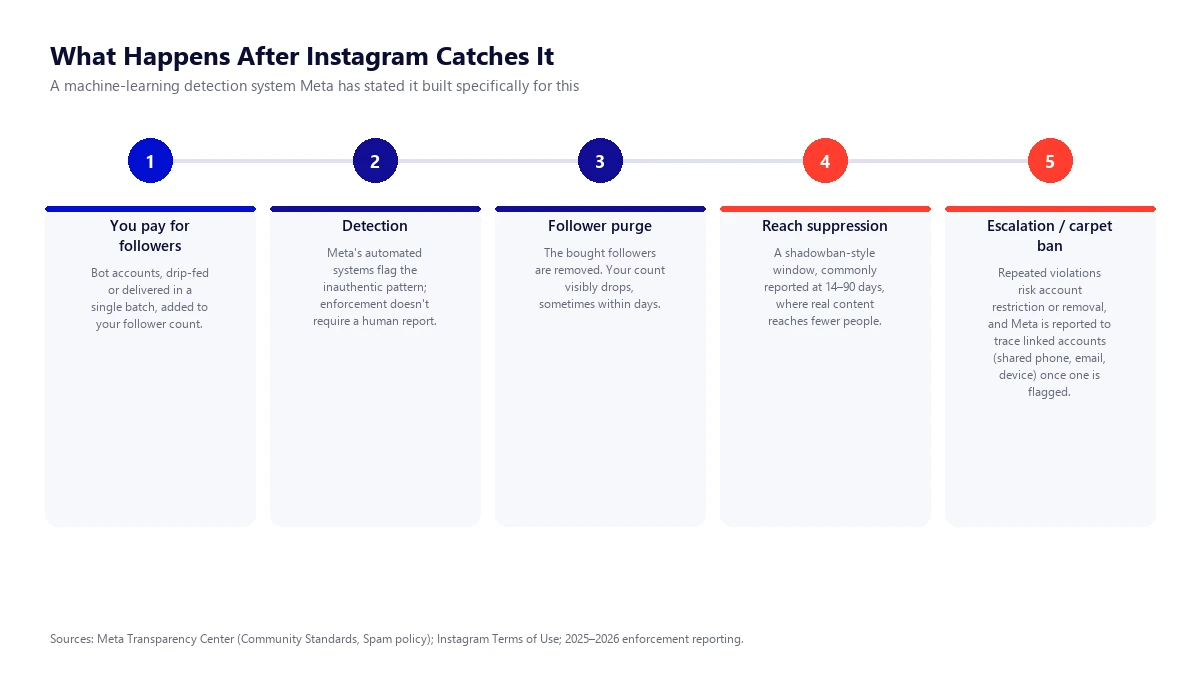
The consequence people picture is an instant permanent ban, and that is not usually the first thing that happens. The more commonly reported sequence starts with Meta simply removing the purchased followers, which is why bought counts often visibly drop days or weeks after delivery. That is frequently followed by a reach-suppression window, a shadowban-style period commonly reported between 14 and 90 days, where genuine content reaches fewer of your real followers than it normally would. Repeated or escalating violations are what tend to bring account restriction or removal, and Meta is reported to trace connected accounts sharing a phone number, email, or device once one is flagged, which matters most for agencies or businesses managing several linked profiles, since one flagged account can put the others at risk too.
Does Buying Instagram Followers Actually Work? A Real Experiment’s Results
Vendor “reviews” of follower-buying services are mostly written by people with a financial interest in the answer being yes. A cleaner data point comes from Hootsuite, a marketing company with no follower-selling business to protect, which ran its own paid experiment and published exactly what it got.
What Hootsuite bought, what it cost, and what showed up
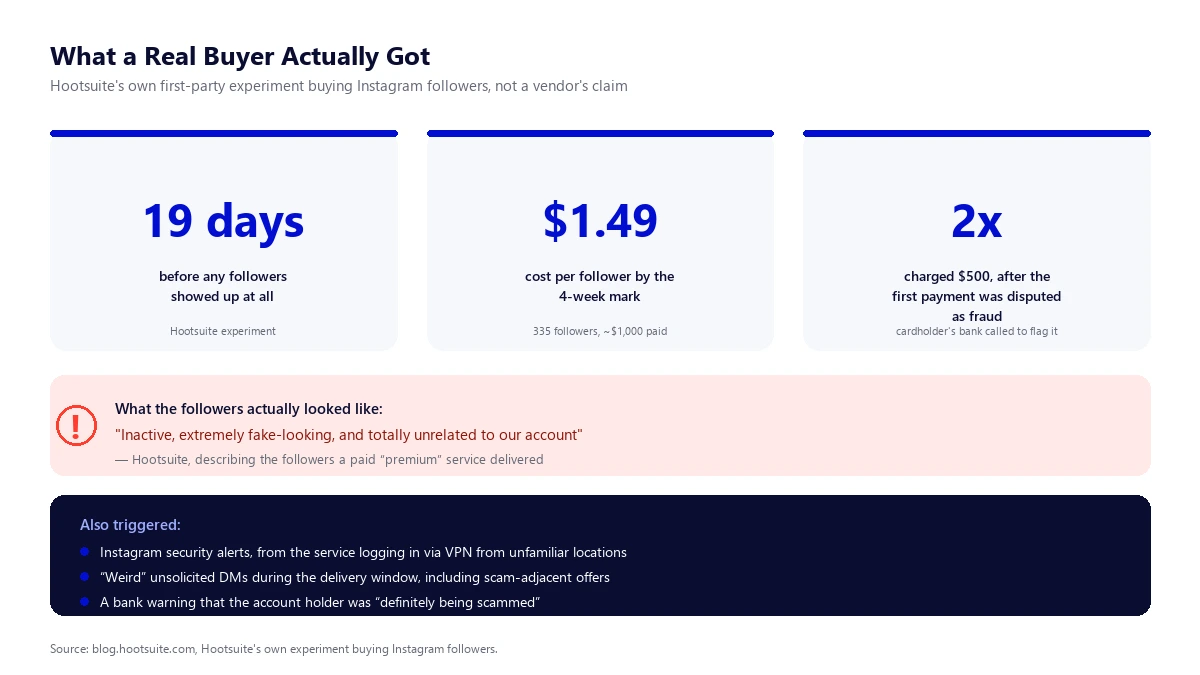
Hootsuite paid a growth-management-style service called Social Boost, not a bargain bot farm, expecting a premium result. It took 19 days before any followers appeared at all. By the four-week mark, 335 followers had arrived against roughly $1,000 paid, working out to about $1.49 per follower. Hootsuite described what showed up as inactive, extremely fake-looking, and totally unrelated to the account, a striking result from a service explicitly marketed as higher-quality than the cheapest options in this space.
The payment-security angle
The part most “best sites” articles never mention is what happens to your card and your account credentials during the purchase itself. Hootsuite’s card was declined and its bank called repeatedly over fraud concerns before the first payment went through, and the service then claimed the initial payment had not gone through at all, requiring a second charge of the same amount. Separately, Instagram’s own security systems sent alerts because the service was logging into the account through a VPN from unfamiliar locations, and the bank ultimately told Hootsuite it was, in its own words, definitely being scammed. That combination, security alerts on the platform side and fraud flags on the payment side, is a direct product of handing account access and payment details to a service with no accountability if something goes wrong.
What real complaint patterns show
Beyond the one detailed experiment, review threads for follower-selling sites on Trustpilot show a recurring pattern, not isolated bad luck: orders paid for and never delivered, with support denying the order ever existed; followers that arrive and then drop off within days or weeks, sometimes thousands at once; and repeated characterizations of specific vendors as scams by paying customers, not just disgruntled competitors. None of that is unique to one operator. It is the shape of the category, worth knowing before treating any individual site’s polished landing page or star rating as proof of reliability.
The Real Cost of a “Cheap” Follower
What you are paying for versus what happens after
A bought follower is not a stable asset. It is a number that decays, delivered by accounts that do not view your content, do not buy anything you sell, and do not tell Instagram’s algorithm your posts are worth showing to anyone else. Real engagement rate, the metric that determines organic reach and whether brands take an account seriously, gets diluted instead of helped, since the denominator grows while genuine interaction does not. The money buys a screenshot-friendly number for a short window, not growth.
The follower count moves. Nothing that matters to the business does.
Most bought followers are inactive or automated accounts, which means they are structurally incapable of doing any of the three things a follower is actually worth to a business: becoming a customer, sharing the content with real people who might become one, or interacting in a way Instagram’s ranking systems reward with reach. Hootsuite’s own experiment is the clearest evidence of this, with real numbers instead of a hypothetical. The $1,000 it paid bought 335 followers described as inactive, extremely fake-looking, and totally unrelated to the account. Of those 335, the count of resulting comments, saves, shares, DMs, or purchases was zero. Not low. Zero. The money moved a number on a profile page and changed nothing else about the business.
Run the arithmetic on why that also actively hurts the account instead of just failing to help it. Take an account with 1,000 real followers and a healthy-for-2026 4% engagement rate, meaning about 40 people genuinely like, comment, save, or share a given post. Add 5,000 bought followers on top and the follower count jumps to 6,000, but the 40 real engagements do not grow with it, since bot and inactive accounts do not open the app, let alone tap anything. The same post’s engagement rate now reads under 0.7%, not because the content got worse, but because the denominator got padded with accounts that were never going to interact. For context, Instagram’s platform-wide average engagement rate across analysed posts sits around 0.45% in 2026, per Social Insider’s benchmark data across 35 million posts, itself down roughly 24% year over year, so padding the follower count pushes an account’s real rate toward that weak baseline, not away from it.
That matters because engagement rate is not just a vanity metric brands eyeball before a partnership. Instagram’s own head of Instagram has confirmed the platform’s ranking systems weigh signals like watch time, saves, shares to DMs, and meaningful comments most heavily, with likes now the weakest signal of the group, and score every post per user and per surface using them. A bot account cannot generate a genuine version of any of those signals. It cannot watch a Reel, save a post, or send it to a friend, because there is no person behind it to do so. So the practical effect of buying followers is not neutral. It is a double cost: the money spent produces zero leads, zero sales, and zero brand awareness among real people, while the resulting diluted engagement rate can lower how much reach Instagram gives future posts to the real audience that was already there.
Case study: the legal precedent that fake engagement is not just a platform-rules problem
The clearest evidence that this is more than a terms-of-service technicality is Devumi, a company the Federal Trade Commission settled with in October 2019 for selling what it called fake indicators of social media influence, including fake followers, subscribers, and views. It is worth being precise about which platforms were named in that case: Devumi’s FTC complaint centered on Twitter, YouTube, LinkedIn, Pinterest, Vine, and SoundCloud, filling more than 58,000 orders for fake Twitter followers alone, not Instagram specifically. Devumi and its CEO settled for $2.5 million.
What makes the case relevant here is what it established, not which app it happened to target. It was the FTC’s first-ever enforcement action against a company for selling fake social media influence, built on a legal theory, that manufacturing fake engagement is a deceptive and unfair business practice, that would apply just as directly to a company selling fake Instagram followers today. The FTC’s authority under Section 5 of the FTC Act is not platform-specific. A New York Attorney General settlement covering the same underlying conduct was separately described as the first law-enforcement finding that selling fake social media engagement is illegal outright, not merely against one platform’s house rules. Meta has also pursued its own legal action on this front, filing a US lawsuit in 2019 against a New Zealand-based operation selling fake followers, which shows the platform itself treats sellers, not just buyers, as a legal target.
The Landscape: Bot Farms, Drip-Feed Panels, and “Targeted” Services
Not every follower-selling service works the same way, and the differences matter for how quickly a problem shows up, even though none of them make the underlying activity compliant.
Instant bulk bot delivery
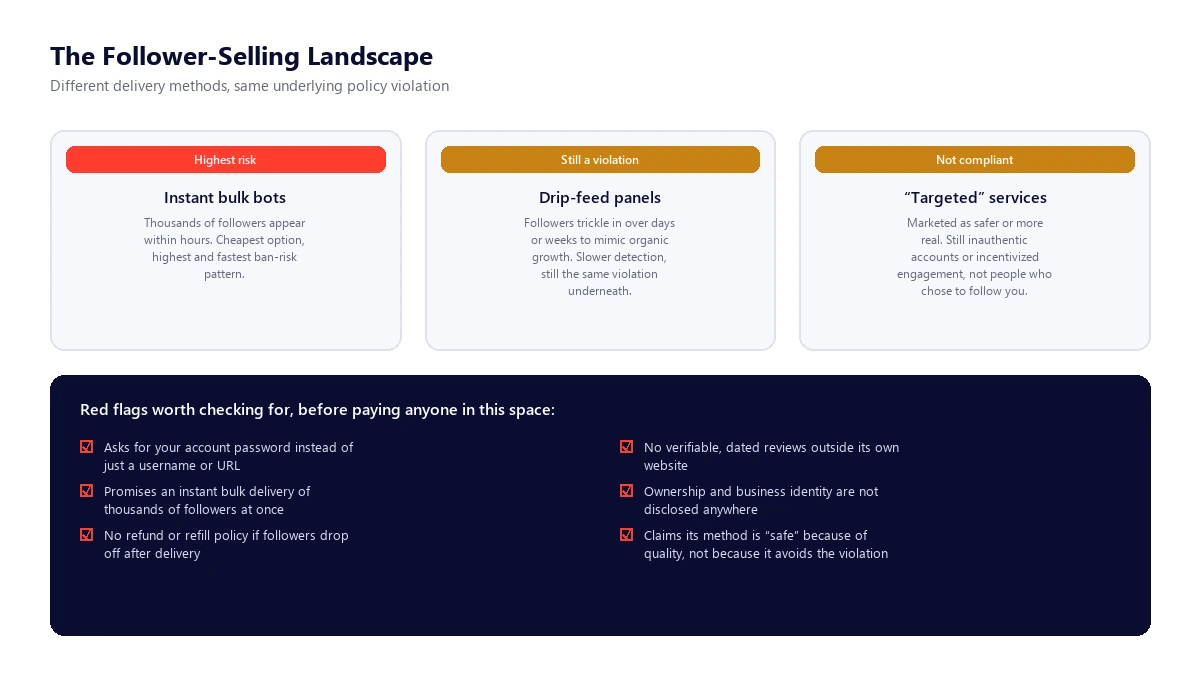
The cheapest and fastest option: thousands of followers appear within hours from a batch of bot or dead accounts. It is also the pattern Instagram’s detection systems are best tuned to catch, since a sudden, large, unnatural spike in followers with no matching engagement is one of the clearest inauthentic-activity signals there is.
Drip-feed panels
These deliver the same bought followers more gradually, over days or weeks, specifically to look more like organic growth and slip past pattern-based detection for longer. Slower detection is not the same as no violation. It is still purchased engagement from inauthentic accounts, still covered by the same spam policy language quoted earlier, just harder to catch quickly.
“Real” or targeted engagement services
Some services market themselves as safer because they claim to use real or targeted accounts, not bots, sometimes explicitly contrasting themselves against the sites they compete with. That framing, that safety depends on the quality of the provider and not on the category of activity itself, is misleading. The Terms of Use prohibition and the spam policy do not carve out an exception for engagement that happens to come from higher-quality fake or incentivized accounts. It is still purchased engagement from people who did not choose to follow you, which is exactly what the policy addresses.
Red flags worth checking for
If someone is still going to research this space despite the risks above, a few signals are worth treating as disqualifying, not just cautionary: a request for your account password instead of just a profile URL or username, a promise of thousands of followers delivered instantly, no refund or refill policy if the followers disappear, no dated, verifiable reviews outside the vendor’s own site, no disclosed ownership or business identity behind the service, and any claim that its particular method is safe because of quality instead of because it avoids the underlying violation. Vendor “review” sites that rank providers while quietly being run by one of the providers they rank are common enough in this space that the review itself should not be trusted at face value.
5 Real Services That Sell Instagram Followers, and What You Actually Get
Most “best sites to buy Instagram followers” lists online are written or paid for by the vendors they rank, which is part of why this guide has avoided naming any until now. But the question of what actually exists in this market, and what buyers actually report getting, is a fair one to answer honestly. The five services below are genuinely operating as of 2026, cross-checked against independent Trustpilot listings, Scamadviser, and multiple third-party reviewer sources, not the vendors’ own marketing pages or an affiliate roundup. Naming them here is not an endorsement. It is what this market actually looks like once the reviews are checked instead of the landing page.
| Service | Claimed Price | Delivery Speed | Real Engagement? | Main Red Flag |
|---|---|---|---|---|
| Twicsy | Roughly $15-$30 per 1,000 (tiered “high-quality” vs. “active” pricing) | Claimed instant to a few hours | No, reviewers report bot-quality accounts | Trustpilot reviews describe followers dropping by roughly 50% within days, some citing hundreds lost per day |
| Media Mister | From about $2 for the smallest package, roughly $20 per 1,000 | Gradual, about 1-10 days | No, quality reported as inconsistent | Roughly 2-star average on current Trustpilot reviews; followers reported dropping off daily around the 60-day mark |
| Famoid | Roughly $30 per 1,000 (from about $2.95-$3.95 per 100) | Gradual, drip-feed delivery | No, testers report zero-activity “ghost” accounts | Flagged on Trustpilot for suspicious/likely-fake review activity, on top of the delivered-account quality complaints |
| Buzzoid | Roughly $25-$35 per 1,000 (from $0.49 per 100) | Claimed instant, within minutes | No, independent 30-day retention testing found only around a third remained | 2.0/5 Trustpilot rating across 99 reviews, about 70% of them one-star |
| InstaFollowers.co | Wide range depending on tier, roughly $20-$450 per 1,000 | Claimed instant | No, and multiple reports of orders never arriving at all | Scamadviser flags a very low trust score; Trustpilot reviews describe unfulfilled orders and support denying the order existed |
Twicsy
Pros: one of the longer-operating names in this space, in business since 2012, and it only asks for a public username, not your account password. Packages run from small to bulk, with a choice between “high-quality” and “active” follower tiers. Cons: current Trustpilot reviews describe followers dropping by roughly half within days of delivery, with one recurring reviewer line calling it “basically a scam” when refill or refund requests go unanswered. Whatever tier is chosen, the followers are still not people who chose to follow the account.
Media Mister
Pros: a genuinely operating business, not a fly-by-night storefront, running since 2012 across 30-plus platforms, with a stated refund and refill policy and gradual delivery designed to look less like a sudden spike. Cons: an average around 2 stars on current Trustpilot reviews, with a recurring complaint pattern of followers dropping off at a steady daily rate roughly two months after delivery, then being replaced with repeated “top-ups” instead of a real fix.
Famoid
Pros: one of the more established names in this market, offering around 15 different package sizes plus marketed refill and refund guarantees and a stated “24/7” support team. Cons: flagged on Trustpilot for suspicious review activity, with a number of reviews investigated or removed as likely fake, and independent testers report followers that have zero posts, zero followers of their own, and zero activity, which is exactly the bot-account pattern Instagram’s detection systems are built to catch.
Buzzoid
Pros: the cheapest headline price point of the five, an instant-delivery promise, and a stated 30-day money-back guarantee. Cons: a 2.0-out-of-5 Trustpilot rating from 99 reviews, about 70% of them one star, and independent 30-day retention testing found only around a third of delivered followers were still on the account a month later. One reviewer described paying $59 for 10,000 followers that were gone within three days.
InstaFollowers.co
Pros: a wide range of tiered packages, from cheap bot-style delivery up to a pricier “real” follower tier, with same-day claimed delivery. Cons: the most serious complaint pattern of the five. Scamadviser’s automated check flags the site as high scam risk, and Trustpilot reviews describe orders paid for and never delivered, support denying the order ever existed, and one buyer reporting the loss of half of “real” followers within a single day of delivery.
The pattern across all five, and effectively every other vendor in this category, is the same one covered earlier in this guide: fast or instant delivery, a recurring complaint thread describing bot-quality or fast-disappearing followers, and support that is hard to reach once something goes wrong. None of that makes one of the five “the safe pick.” It is the reason the category itself, not any single provider’s execution, is the actual problem, and why every account above still carries the same Terms of Use and spam-policy violation covered at the start of this guide.
What Works Instead of Buying Followers
Organic growth fundamentals
The unglamorous version of growth still works because it produces the thing bought followers cannot fake: people who genuinely engage. That means a consistent content and posting strategy built around what a specific audience wants to see, using Reels and other formats the algorithm is favoring for reach right now, showing up in your niche’s comments and DMs instead of treating the account as a broadcast-only channel, and using hashtags, collaborations, and cross-posting to reach people who are likely to care, not just anyone. None of this produces an overnight number. It produces followers who show up in your engagement rate, your reach, and eventually your sales, the entire point a bought follower cannot deliver on.
When paid growth makes sense
Paid growth is not inherently the problem; the fake-engagement business model is. Legitimate paid social advertising and genuine influencer or creator partnerships put real budget behind reaching real people who choose to follow, click, or buy, and Instagram’s own ad platform reports that activity transparently instead of hiding it behind a third-party login. It costs more per follower than a bot-farm invoice, and it buys exposure to real people instead of a number.
If the goal is measurable growth, not just a bigger number
This is the kind of work our team does for clients directly, building content and organic growth strategy around an audience that converts, not a follower count that looks good in a screenshot and does nothing for the business behind it. If an account has already taken damage from a bought-followers mistake and a rebuild is part of a bigger cleanup, our reputation management services cover that kind of recovery too, and if the account in question is one you are considering walking away from entirely instead of rebuilding, our guide on how to delete an Instagram account permanently covers what that involves and what can and cannot be undone.
Frequently Asked Questions
Is it safe to buy Instagram followers?
No. It violates Instagram’s Terms of Use and Meta’s spam policy on buying or selling engagement, and Meta has stated it built machine-learning detection specifically to catch it. The realistic outcomes are a follower purge, a reach-suppression window, and escalating penalties for repeat violations, on top of the payment and login-security risk of handing account access to a third-party service.
Can you get banned for buying Instagram followers?
A permanent ban is not usually the first consequence. The more commonly reported sequence is Instagram removing the bought followers, followed by a shadowban-style reach-suppression window commonly reported between 14 and 90 days. Full account restriction or removal tends to follow repeated or escalating violations, and linked accounts sharing a phone, email, or device can be affected once one account is flagged.
Does buying Instagram followers actually work to grow an account?
Not in any way that matters for reach or revenue. In Hootsuite’s own experiment, a premium-priced service took 19 days to deliver anything and produced followers described as inactive, extremely fake-looking, and totally unrelated to the account, with no engagement value at all. The follower count moves; the audience does not.
What happens to bought followers over time? Do they stay?
Often not. Trustpilot complaint patterns across multiple follower-selling sites show followers dropping off within days or weeks of delivery, sometimes thousands at once, on top of Instagram’s own periodic purges of accounts it identifies as fake or inauthentic.
Is it illegal to buy Instagram followers, or just against Instagram’s rules?
Buying followers for personal use is primarily a platform-rules violation, not a crime on the buyer’s side. Selling fake engagement is a different story: the FTC settled its first-ever case against a fake-engagement seller, Devumi, for $2.5 million in 2019, over platforms named in that case other than Instagram, but on a legal theory that applies to any platform. A separate New York Attorney General settlement over the same conduct was described as the first law-enforcement finding that selling fake social media engagement is illegal, not just against a platform’s terms.
What is the difference between bot followers and “real” or targeted followers?
Bot followers are inactive or automated accounts delivered instantly or via drip-feed. Services marketed as real or targeted claim to use higher-quality or more relevant accounts, but the underlying transaction, paying for followers who did not choose to follow you, is still the exact activity Instagram’s spam policy prohibits. Better-looking followers are not compliant followers.
Will buying followers hurt my engagement rate or reach?
Yes. Engagement rate is calculated against your follower count, and bought followers almost never engage, so the rate drops even while the follower number rises. A lower engagement rate can also affect how much organic reach Instagram gives future posts, and that is before accounting for any reach-suppression penalty triggered by detection.
What should I check before paying for any Instagram growth service?
Treat these as disqualifying: a request for your account password instead of just a username or profile link, a promise of thousands of followers delivered instantly, no refund or refill policy, no dated and verifiable reviews outside the vendor’s own website, no disclosed business identity, and any claim that the method is safe because of provider quality instead of because it avoids buying engagement in the first place.
What are some real sites that sell Instagram followers, and is any of them actually safe?
Twicsy, Media Mister, Famoid, Buzzoid, and InstaFollowers.co are five services genuinely operating in this market as of 2026, verified against independent Trustpilot listings and reviewer sources, not their own marketing. None of them qualify as safe. Each carries current, real complaints of bot-quality or fast-disappearing followers, and buying from any of them still violates Instagram’s Terms of Use and Meta’s spam policy covered earlier in this guide. A longer operating history or a slightly higher star rating changes the complaint pattern, not the underlying violation.
What actually works instead of buying followers?
Consistent content built around what a specific audience wants, genuine engagement in comments and DMs, formats like Reels that Instagram is favoring for reach right now, and, when budget allows, legitimate paid social advertising or real creator partnerships that put money behind reaching real people instead of paying for a fake number.
Can Instagram tell the difference between bought followers and organic growth?
Generally, yes. Meta has stated it built machine-learning detection specifically to identify accounts using third-party services for inauthentic likes, follows, and comments, looking at patterns like sudden unnatural spikes in followers with no matching engagement, difficult for a bought-followers transaction to disguise indefinitely, even with a slower drip-feed delivery.
If growing an Instagram audience the sustainable way is the real goal, not just the number, get in touch with our team and we will walk through what a real content and growth strategy looks like for your account.