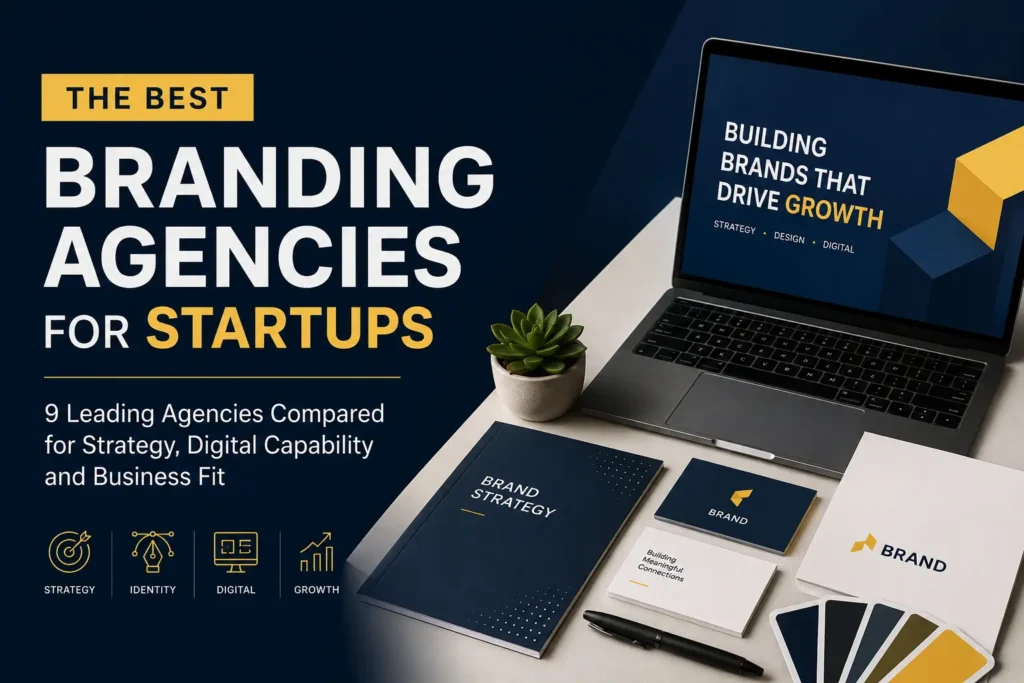
The best branding agencies for startups and digital-first brands in 2026 include The Branx, C42D, Red Antler, Ramotion, Clay, Motto, Ragged Edge, Koto and Superside.
The right choice depends on what your business needs. The Branx and C42D are particularly relevant to technology startups, Red Antler is a strong option for consumer-facing brands, Ramotion and Clay connect branding with digital product design, while Motto, Ragged Edge and Koto suit companies preparing for a more substantial repositioning or rebrand.
This guide compares each agency by strategic focus, ideal client, core capabilities and potential limitations. It is designed to help you build a realistic shortlist rather than declare one agency universally better than every other option.
Branding agencies compared
| Branding agency | Best for | Core strengths | Most suitable business stage |
|---|---|---|---|
| The Branx | AI, SaaS and technology startups | Positioning, brand identity and startup websites | Early-stage to growth-stage |
| C42D | Venture-backed and growth-stage companies | Brand strategy, messaging, identity and web design | Funded startups and scale-ups |
| Red Antler | Consumer and founder-led brands | Pre-launch branding, naming, identity and campaigns | Pre-launch to established |
| Ramotion | SaaS and product-led technology companies | Branding, product design, UI/UX and websites | Startup to enterprise |
| Clay | Digital products requiring brand and UX alignment | Brand identity, digital products and experience design | Growth-stage and established |
| Motto | Leadership-led repositioning and transformation | Business strategy, positioning, culture and identity | Scale-up to enterprise |
| Ragged Edge | Challenger brands seeking strong differentiation | Strategy, verbal identity and distinctive design systems | Growth-stage and established |
| Koto | Ambitious global and digital-first brands | Strategy, branding, digital design and campaigns | Funded scale-up to enterprise |
| Superside | Businesses needing ongoing creative capacity | Brand systems, campaigns and subscription-based production | Scale-up and enterprise |
How we selected these branding agencies
This is not a ranking based on which agency has the most attractive website or the largest client logos.
The agencies were assessed using publicly available service information, portfolios, case studies and positioning statements reviewed in July 2026. South Asia Digital has not worked directly with every agency included, so this should be treated as an independently researched shortlist rather than a hands-on review.
The evaluation focused on seven areas.
Startup and digital-business experience
We looked for agencies with visible experience working with startups, SaaS companies, technology platforms, ecommerce businesses or other digital-first organisations.
Strategic capabilities
Strong branding should begin with the business problem. We prioritised agencies that offer positioning, research, messaging, naming or brand strategy rather than presenting branding as logo design alone.
Brand and digital alignment
A digital-first brand must work across its website, product interface, search presence, campaigns, social content, sales materials and customer experience.
This is particularly important as buyers increasingly discover companies through search engines and AI-generated answers. A strong identity may earn attention, but it also needs supporting content and a clear AI search visibility strategy to become discoverable.
Evidence of relevant work
We looked for published projects or case studies that demonstrate experience with the types of businesses the agency claims to serve.
Ability to support growth
Startup brands change quickly. The agency should be able to build a system that remains usable as the company adds products, markets, team members and marketing channels.
Clear specialisation
An agency with a clear strength is often more useful than one claiming to be the best option for every industry and project type.
Buyer suitability
The final assessment considered who would benefit most from each agency and when a different type of partner may be more practical.
Do you need a branding agency yet?
Not every startup needs a full branding agency immediately. The right level of support depends on how far the business has progressed, how clearly it understands its market and what problem the branding project needs to solve.

| Your situation | What you probably need | Recommended partner |
|---|---|---|
| Product is not yet validated | Basic positioning and a lightweight identity | Senior freelancer or small studio |
| Product is validated but difficult to explain | Positioning, messaging and website strategy | Startup branding agency |
| Preparing for seed or Series A fundraising | Credibility, messaging, identity and investor materials | Startup-specialist agency |
| Marketing and product feel disconnected | Brand system, website and product design | Brand and UX agency |
| Entering a new category or market | Research, positioning and category strategy | Strategy-led branding agency |
| Existing identity cannot support growth | Rebrand, design system and implementation planning | Growth-stage branding agency |
| Core brand is already strong | Campaigns and ongoing creative production | Creative subscription or production partner |
The best branding agencies for startups and digital-first brands
1. The Branx — Best for AI, SaaS and technology startups
Best for: Technology startups that need positioning, identity and a website from one specialist partner.
The Branx is focused specifically on startup branding, particularly for AI, SaaS and technology companies. Its services include brand strategy, visual identity, messaging, websites, motion graphics and other launch materials.
That specialisation is useful for founders selling products that are difficult to explain. A technology startup usually needs more than an attractive logo. It needs a clear market position, a credible identity and language that helps customers, investors and potential employees quickly understand the product.
The Branx says it has developed brands for more than 120 technology startups across markets including the United States, Canada, the United Kingdom and Europe. Its portfolio is therefore more relevant to early-stage and growth-stage technology companies than that of a general creative agency.
Core services:
- Brand strategy and positioning
- Visual identity
- Messaging
- Startup website design
- Motion graphics
- Brand guidelines
- Launch materials
Potential limitation:
The Branx’s technology focus may be less suitable for traditional consumer products, hospitality businesses or companies seeking a large-scale corporate transformation.
Verdict:
A strong starting point for AI, SaaS and technology founders who want their positioning, identity and website developed as one connected system.
2. C42D — Best for venture-backed and growth-stage startups
Best for: Funded startups that need to build credibility before fundraising, expansion or a major growth phase.
C42D is a New York branding agency focused on startups and growth-stage companies. It highlights experience in AI, health technology, financial technology and SaaS—categories where trust and clarity are particularly important.
Its work covers strategy, purpose, positioning, personality, messaging, identity and website development. This makes it suitable for companies whose challenge is not simply visual inconsistency but a lack of clarity about how they should present themselves to customers, investors and the market.
C42D’s positioning is especially relevant to companies moving beyond their earliest stage. At that point, a basic identity assembled for launch may no longer represent the product, team or commercial direction. The agency’s combination of strategic and digital services can help bring those elements back together.
Core services:
- Brand strategy
- Market positioning
- Messaging
- Visual identity
- Naming
- Website strategy and design
- Brand guidelines
Potential limitation:
A very early-stage, bootstrapped company may not need a complete agency-led branding programme before it has validated its audience and business model.
Verdict:
A relevant choice for venture-backed startups and scale-ups preparing to raise capital, enter a more competitive market or replace an identity they have outgrown.
3. Red Antler — Best for consumer and founder-led brands
Best for: Consumer startups preparing to launch, reposition or build stronger cultural relevance.
Red Antler is widely associated with founder-led and consumer-facing businesses. Its work spans branding, naming, advertising, packaging, pre-launch strategy and digital experiences.
The agency maintains a dedicated pre-launch capability that works directly with founders developing new businesses. That makes it particularly relevant when the company name, positioning, identity, packaging and launch story must be created together rather than handled as separate projects.
Its published work covers consumer technology, food and beverage, beauty, healthcare, finance, retail, transportation and business-to-business brands. This range gives it an advantage for companies whose brand must live across physical products, packaging, websites, advertising and retail environments.
Core services:
- Brand strategy
- Naming
- Visual identity
- Packaging
- Pre-launch branding
- Advertising
- Digital experiences
Potential limitation:
Its consumer-brand strength may be more than a technical B2B startup needs if the main challenge is simplifying a complex software product for a narrow professional audience.
Verdict:
A strong option for ambitious consumer businesses that need to create a brand people can recognise and connect with across multiple touchpoints.
4. Ramotion — Best for SaaS and product-led technology brands
Best for: SaaS and technology companies that need their brand, product and website to feel connected.
Ramotion works across branding, websites, digital products and UI/UX design. This combination is particularly relevant to product-led businesses, where the brand experience does not end on the marketing website.
A SaaS company can have a polished visual identity but still feel inconsistent if its dashboard, onboarding flow, documentation, product screens and sales materials appear to belong to different businesses. Ramotion’s product-design capabilities make it better suited to addressing that problem than an agency focused only on external communications.
Its official positioning covers startups, SaaS companies and established technology businesses. The agency presents its work as an intersection of brand strategy, digital product experience and technology rather than treating those areas independently.
Core services:
- Brand strategy
- Visual identity
- SaaS branding
- Product design
- UI/UX
- Design systems
- Website design and development
- Motion design
Potential limitation:
A company that needs primarily organisational strategy, internal culture work or enterprise brand architecture may require a more specialised transformation consultancy.
Verdict:
One of the stronger options for SaaS and product-led businesses that need consistency from market positioning through to the product interface.
5. Clay — Best for aligning brand and digital product experience
Best for: Digital-first businesses undertaking a major brand, website or product experience redesign.
Clay describes itself as a global branding and UX design agency. Its services combine brand identity, digital products, websites, research, product strategy, user experience and development.
This makes Clay particularly relevant when the branding problem cannot be separated from the digital experience. A financial platform, ecommerce product, mobile application or software company may need to improve how the business is positioned while also redesigning the customer journey.
Clay’s approach centres on creating digital brand identities that remain consistent across websites, interfaces and customer touchpoints. That is more comprehensive than commissioning an identity and then asking a separate product team to interpret it later.
Core services:
- Brand strategy
- Digital brand identity
- UI/UX design
- Product strategy
- Design systems
- Website design
- Product development
- Usability testing
Potential limitation:
Clay may be more suitable for well-funded companies with a meaningful digital product or experience challenge than for a small startup requiring a simple identity package.
Verdict:
A suitable choice when brand perception, website usability and digital product experience all need to be improved together.
6. Motto — Best for leadership-led repositioning
Best for: Founders and executive teams navigating growth, reinvention or a strategic change in direction.
Motto is a strategic branding agency working with technology, culture and innovation companies. Its positioning places significant emphasis on leadership alignment, organisational culture, category definition and business strategy.
This is important when a branding project involves more than the marketing department. During a substantial repositioning, executives may disagree about the company’s future, value proposition, audience or competitive category. A new identity cannot resolve those differences unless the strategic questions are addressed first.
Motto’s services cover business strategy, brand positioning, category definition, brand identity and transformation. It works with founders, chief executives and leadership teams at important stages of business growth and reinvention.
Core services:
- Business and brand strategy
- Brand positioning
- Category definition
- Leadership alignment
- Organisational culture
- Messaging
- Brand identity
- Rebranding
Potential limitation:
A startup that already has clear positioning and mainly needs production support, social assets or a quick website refresh may not require this level of strategic engagement.
Verdict:
A strong option when the real challenge is aligning leadership and clarifying the company’s direction before changing how the brand looks.
7. Ragged Edge — Best for challenger brands
Best for: Companies that need to look, sound and behave clearly different from established competitors.
Ragged Edge positions itself as a global branding agency for businesses that refuse to settle for average. Its work tends to suit challenger brands seeking a more distinctive market presence rather than a safe visual refresh.
This can be valuable in crowded categories where every competitor uses similar language, typography, website layouts and colour palettes. A challenger brand needs more than visual novelty. It needs a point of view that can shape its messaging, identity, product presentation and campaigns.
Ragged Edge works across brand strategy, design and verbal identity, with an emphasis on building brands that perform in the real world rather than exist only in presentation decks. Its published partnerships include companies undergoing launches, repositioning and broader growth initiatives.
Core services:
- Brand strategy
- Positioning
- Visual identity
- Verbal identity
- Campaign development
- Packaging
- Brand implementation
Potential limitation:
Its bold approach may not suit businesses operating in conservative or highly regulated categories that require a more restrained identity.
Verdict:
A compelling choice for growth-stage and established challenger brands that need stronger differentiation rather than minor cosmetic improvements.
8. Koto — Best for ambitious global brand systems
Best for: Well-funded digital-first companies that need a sophisticated brand capable of working across markets and channels.
Koto is an international creative agency offering strategy, branding, digital design and marketing. Its portfolio includes technology, entertainment, finance, gaming and consumer brands.
The agency’s strength is its ability to create contemporary brand systems with enough flexibility to function across websites, products, campaigns, motion, social media and international markets.
This matters for businesses that have moved beyond a single product and a small marketing team. As the number of channels and stakeholders grows, the brand system must provide freedom without allowing every department to interpret it differently.
Koto describes its work around four business-critical areas and presents itself as an ongoing strategic brand partner rather than only a design supplier.
Core services:
- Brand strategy
- Visual identity
- Digital design
- Campaigns
- Brand systems
- Motion and typography
- Ongoing brand partnership
Potential limitation:
Koto is more likely to suit ambitious and well-funded businesses than bootstrapped startups looking for a small initial identity.
Verdict:
A strong premium option for businesses that need an internationally usable identity with a high level of craft and digital flexibility.
9. Superside — Best for ongoing creative production
Best for: Scale-ups and enterprise marketing teams that need regular branded creative work without continually hiring freelancers.
Superside operates differently from a traditional project-based branding agency. It offers creative services through a subscription model, giving companies access to a dedicated team and a range of design capabilities.
Its branding services cover strategy, identity systems and brand development, while its wider offering includes advertising, social media, presentations, video, illustration, web design and campaign production.
This model can work well after the core brand direction is established. Growing marketing teams often struggle to produce enough campaign assets, sales materials, landing pages, social content and presentations while keeping everything consistent.
Superside’s subscription model is designed to provide ongoing capacity rather than complete one isolated project and leave.
Core services:
- Brand strategy
- Brand identity systems
- Campaign creative
- Social media assets
- Presentation design
- Video and motion
- Web design
- Ongoing creative production
Potential limitation:
The model may not be the most natural choice for an early-stage founder seeking an intimate, one-off strategy and identity engagement. It is better suited to companies with recurring creative demand.
Verdict:
A practical option for scale-ups and larger marketing teams that need consistent creative output across many channels.
Which branding agency is right for your business?
There is no universally best branding agency. The most suitable option depends on your business stage, customer, product and immediate problem.
Best for an early-stage technology startup
Start with The Branx when you need positioning, visual identity and a website from a team that regularly works with technology founders.
Consider C42D when the startup is already funded and needs to establish greater credibility before the next stage of growth.
Best for a SaaS or product-led business
Consider Ramotion when the brand must work consistently across the marketing website and software product.
Choose Clay when the project also involves substantial UX, product or digital-experience work.
Best for a consumer startup
Red Antler is particularly relevant to founder-led consumer brands preparing for launch, packaging, retail or broader marketing campaigns.
Best for a major strategic repositioning
Consider Motto when leadership alignment, organisational culture or category definition is part of the problem.
Best for a challenger brand
Ragged Edge is a strong candidate when the company needs a bolder and more differentiated market position.
Best for an international scale-up
Koto is better suited to well-funded businesses that need a flexible, sophisticated identity across multiple markets and channels.
Best for ongoing creative work
Superside is worth considering when the main issue is creative capacity and brand consistency after the strategic foundation has already been established.
What does a startup branding agency do?
A startup branding agency helps a new or growing company define how it should be understood, remembered and presented.
Depending on the scope, the work may include:
- Customer and competitor research
- Brand positioning
- Category definition
- Company or product naming
- Value proposition development
- Messaging and tone of voice
- Visual identity
- Logo design
- Typography and colour systems
- Brand guidelines
- Website strategy and design
- Product design
- Packaging
- Campaign concepts
- Launch support
A complete branding engagement should connect strategic decisions with practical implementation.
For example, messaging should not remain inside a strategy document. It should shape the website, sales presentation, onboarding emails and content marketing programme.
Similarly, a visual identity should be usable across actual product and campaign requirements rather than only look impressive in portfolio mock-ups.
When should a startup hire a branding agency?
A startup does not always need a full branding agency at the beginning.
During the earliest validation stage, a simple identity and clear message may be enough. Spending heavily on a rigid brand system before understanding the customer can create unnecessary work later.
Hiring an agency becomes more reasonable when:
- Customers do not understand the product
- The company is preparing for a public launch
- The startup is entering a crowded category
- The business is raising or has recently raised funding
- Different teams describe the company differently
- The current identity appears less credible than the product
- The company is expanding into new markets
- The website no longer reflects the business
- A merger, acquisition or strategic change has occurred
- The existing brand cannot support new products
A rebrand should solve a recognised business problem. It should not be commissioned simply because the founders have become bored with the logo.
How much does a branding agency cost?
Branding costs vary significantly according to the agency, scope, company size and number of deliverables.
Clutch’s July 2026 pricing guide reports that most branding projects reviewed on its platform fall between $10,000 and $49,999, while branding agencies commonly charge around $100 to $149 per hour. These figures are broad market benchmarks rather than fixed prices for the agencies listed above.
A branding proposal becomes more expensive when it includes:
- Extensive customer research
- Multiple stakeholder interviews
- Naming and trademark work
- Brand architecture
- Messaging and verbal identity
- Packaging
- Website design and development
- Product interface design
- Photography or video
- International rollout
- Training and implementation support
Do not compare proposals using the final price alone. One proposal may cover only a logo and short style guide, while another includes research, positioning, messaging, identity, website design and rollout support.
Ask each agency to define exactly what is included, what is excluded and what happens when the scope changes.
How to choose a branding agency
Define the business problem first
Do not begin by asking agencies for a new logo.
Clarify what is no longer working. The problem might be weak differentiation, inconsistent messaging, low trust, an outdated identity, confusing product positioning or a brand that cannot support expansion.
The clearer the problem, the easier it becomes to judge whether an agency’s proposal addresses it.
Review relevant case studies
Look for work involving a similar business stage or challenge.
An agency does not need experience with an identical product, but it should demonstrate that it understands the type of problem you are facing.
A visually impressive restaurant identity does not automatically prove that the agency can position a complex enterprise software platform.
Examine the thinking, not only the visuals
Strong case studies should explain:
- The original problem
- The research conducted
- The strategic decision
- Why the creative direction was selected
- How the brand was implemented
- What changed after launch
Be cautious when a portfolio shows polished mock-ups but provides no business context.
Meet the actual project team
The people presenting the proposal may not be the people doing the work.
Ask who will lead the strategy, write the messaging, develop the identity and manage the project. Find out how much access you will have to senior team members.
Understand the process
A credible process should explain how the agency moves from research to strategy, creative development and implementation.
Avoid agencies that cannot explain how they will reach decisions or that promise to begin by presenting logo concepts.
Check how the brand will be implemented
The final result must work beyond the launch presentation.
Ask how the identity will be used across:
- Website pages
- Product interfaces
- Sales materials
- Social media
- Advertising
- Packaging
- Recruitment
- Internal communications
For digital-first brands, this should also include discoverability, website structure and the technical SEO foundation required to ensure the redesigned site remains accessible to search engines.

Review ownership and licensing terms
Confirm who owns:
- Final logo files
- Fonts
- Photography
- Illustrations
- Templates
- Website designs
- Source files
- Custom code
- Unused creative concepts
Do not assume that paying for a project automatically gives the business unrestricted ownership of every asset.
Consider post-launch support
Some agencies complete the guidelines and hand over the project. Others provide rollout, training, campaign development or ongoing creative support.
Choose the model that matches your internal resources.
Branding agency or freelance designer?
A freelance designer can be a practical choice when:
- The scope is narrow
- The positioning is already clear
- You mainly need visual execution
- The budget is limited
- One senior specialist can handle the work
A branding agency is usually more appropriate when:
- Research is required
- Positioning is unclear
- Several stakeholders are involved
- Naming or messaging is included
- Multiple creative disciplines are needed
- The brand must work across many channels
- The project carries significant commercial risk
The difference is not simply that an agency has more people. The main advantage is access to strategy, writing, design, research, project management and implementation capabilities within one engagement.
Branding agency or digital marketing agency?
A branding agency defines how the business should be positioned, presented and remembered.
A digital marketing agency focuses on reaching audiences and generating results through channels such as search, paid advertising, social media, content and email.
A company may need both, but they solve different problems.
Choose a branding agency when the issue is:
- Unclear positioning
- Weak differentiation
- Inconsistent messaging
- An outdated identity
- A new company or product launch
- A substantial rebrand
Choose a digital marketing services partner when the brand foundation is clear but the business needs more visibility, traffic, leads or sales.
For online retailers, brand decisions should also connect with the wider ecommerce marketing strategy, including acquisition, conversion, retention and customer experience.
How to Score and Compare Branding Agencies
| Factor | Weight |
|---|---|
| Understanding of the business problem | 20% |
| Positioning and strategic depth | 15% |
| Relevant startup-stage experience | 15% |
| Quality of comparable case studies | 15% |
| Brand and digital implementation ability | 10% |
| Access to the senior delivery team | 10% |
| Scope and pricing transparency | 10% |
| Ownership and licensing terms | 5% |
Questions to ask a branding agency
Before signing a proposal, ask:
- What business problem do you believe we need to solve?
- How will you research our customers and competitors?
- Who will work directly on the project?
- What experience do you have with businesses at our stage?
- What deliverables are included?
- How many strategic and creative stages are planned?
- How will decisions be presented and approved?
- How many revision rounds are included?
- What is not included in the proposal?
- Who owns the final files and intellectual property?
- Will you help implement the brand after approval?
- How will the identity work across our website and product?
- What information and time will you need from our team?
- How do you handle disagreements between stakeholders?
- How should the success of the project be evaluated?
The agency’s answers should be clear before the project begins. A vague proposal usually leads to a vague scope.
Red flags when hiring a branding agency
Be cautious when an agency:
- Talks only about logos and colours
- Cannot explain its research process
- Uses the same visual style for every client
- Makes unverified growth or revenue promises
- Will not identify the delivery team
- Provides unclear deliverables
- Avoids discussing intellectual-property ownership
- Recommends trends without connecting them to the strategy
- Cannot show relevant project experience
- Promises unlimited revisions without a defined process
- Provides no implementation plan
- Pressures you to sign before answering questions
Also examine the agency’s own reputation. Client reviews, leadership visibility, published work and consistent public information can reveal potential concerns before an agreement is signed.
For high-stakes projects, broader online reputation management principles can also be applied during agency due diligence: check what independent sources say, not only what appears on the company’s own website.
Final verdict
The Branx is one of the clearest options for AI, SaaS and technology startups, while C42D is well suited to venture-backed companies preparing for their next growth stage.
Red Antler stands out for consumer and founder-led brands. Ramotion and Clay are stronger choices when branding must connect with a SaaS product or wider digital experience.
Motto is more suitable for leadership-led repositioning, while Ragged Edge and Koto serve businesses seeking a distinctive, high-impact brand system. Superside offers a different model for companies that need continuous creative output after the strategic foundation is established.
The best agency is not necessarily the most famous or the most visually adventurous. It is the one that understands the business problem, has evidence of solving similar challenges and can build a brand your team is capable of using after the project ends.
Frequently asked questions
What is the best branding agency for a startup?
There is no single best agency for every startup. The Branx is particularly relevant to technology startups, C42D suits venture-backed and growth-stage companies, and Red Antler is a strong option for consumer and founder-led brands. The right choice depends on the startup’s stage, market, budget and branding problem.
What should a startup branding package include?
A complete package may include research, positioning, messaging, visual identity, logo design, typography, colours and brand guidelines. Larger engagements may also cover naming, website design, product design, packaging, campaigns and launch support.
Do startups need branding before product-market fit?
Startups need enough branding to communicate clearly and appear credible, but they may not need an expensive or highly rigid brand system before validating the product and audience. Early branding should leave room for the company to learn and change.
How long does a branding project take?
The timeline depends on the scope and number of decision-makers. A focused identity project may take several weeks, while a full strategy, naming, messaging, identity and website programme can take several months.
What is the difference between branding and brand identity?
Branding covers how a business is positioned, communicated and experienced. Brand identity is the visual and verbal system used to express that brand, including its logo, colours, typography, imagery, messaging and tone.
Should a startup choose a specialist branding agency?
A specialist is often helpful when the company operates in a complex category such as SaaS, AI, healthcare or fintech. The agency is more likely to understand the audience, buying process and need to simplify technical information. However, strategic thinking and relevant evidence matter more than an industry label alone.
Is a branding agency worth the cost?
It can be worthwhile when unclear positioning, weak trust or inconsistent communication is limiting growth. It may not be worthwhile when the company has not validated its offer, cannot provide leadership input or only needs a small design task.
Can a branding agency also design a website?
Many branding agencies offer website strategy and design, but capabilities vary. Some provide visual design only, while others handle UX, content, development and technical implementation. Confirm the exact website scope before choosing an agency.