
Someone asks ChatGPT, Perplexity, or Google’s AI Mode to compare wireless earbuds under $100. The assistant doesn’t browse your store the way a shopper used to. It reads whatever data layer you’ve already published, a Merchant Center feed, your product’s structured data, your visible reviews, and decides whether your product is specific enough to name back.
Most ecommerce sites were never built to answer that question. Adobe’s own 2026 traffic data found the average US retail homepage legible to AI models on only 63% of its content, meaning over a third of what’s on the page simply isn’t readable by the systems now doing a growing share of product research. GEO for ecommerce is the work of closing that gap: structuring product, category, and review data so AI systems can read, trust, and cite what you sell.
The short version
- AI-referred shopping traffic is already large and compounding fast. It’s not a niche channel anymore, and it converts noticeably better than traffic from everywhere else.
- Most retail sites are only partly readable to AI models. Category matters: electronics pages read far better than general merchandise or grocery pages.
- Google’s AI shopping surfaces lean on your Merchant Center feed, not just your product page. A feed problem can hide an otherwise well-built page.
- Product structured data has two distinct tiers, and most sites only clear the easier one. Qualifying for a star rating isn’t the same as qualifying for AI shopping visibility.
- Reviews only count if they’re genuine, visible, and specific to that one product. Google has explicitly started policing fake and incentivized reviews in review-snippet markup.
Is AI shopping traffic worth optimizing for yet?
Yes, and the trend is accelerating rather than leveling off. Adobe’s AI Traffic Trends data, reported in detail by ALM in November 2026, found AI-referred traffic to US retail sites up 71% year over year in September 2026, and up 1,772% since Adobe started tracking the channel. That traffic also converts better: a 90% higher conversion rate and 83% more revenue per visit than non-AI traffic in the same month, with AI-referred shoppers spending 73% more time on-site, viewing 25% more pages, and adding to cart at a 53% higher rate.
That gap is new. In September 2025, AI and non-AI revenue per visit were roughly the same, and a month earlier AI visitors converted 9% worse than everyone else. Something changed over the following year, and it wasn’t a slow drift. Adobe is forecasting AI referral traffic to climb another 159% year over year at Thanksgiving 2026, 95% on Black Friday, and 88% on Cyber Monday, with revenue per visit roughly doubling over the festive season.
The catch is that most retailers aren’t ready for the traffic they’re about to get more of. Adobe’s Citation Readability Score, which measures how much of a page an AI model can parse, averaged 63% across US retail homepages in September 2026. Electronics pages scored 79%, grocery pages 55%, and general merchandise pages just 40%. Checkout, account-creation, and booking pages scored lowest of all, which matters less for citation but says a lot about how retail sites were built: for a person clicking through, not a model reading structured data.
What is GEO for ecommerce?
GEO for ecommerce is structuring product, category, and review content so AI assistants, Google’s AI Overviews and AI Mode, ChatGPT, Perplexity, can read it accurately enough to recommend or cite a specific product by name. It covers three layers: the Merchant Center feed and structured data Google’s Shopping Graph draws from, the review and rating signals that establish a product is trustworthy, and the category or comparison content that answers an exploratory “what should I buy” question before a shopper lands on any single product page.
How does Google’s AI Mode decide which products to show?
Primarily through the Shopping Graph, the data layer your Merchant Center feed populates and that Google’s AI Mode, AI Overviews, and Gemini ground their product answers in. Google hasn’t published a page stating a feed is strictly mandatory for AI Mode visibility, and it’s said no special markup or AI-specific file is required to appear there. But every practical signal points to the feed as the primary structured source: free listings eligibility, accurate pricing, and matching GTINs, with on-page structured data and crawled content filling in what the feed doesn’t cover.
In May 2026, Google added six new optional Merchant Center fields called conversational attributes: question_and_answer, document_link, related_product, item_group_title, variant_option, and popularity_rank. The question_and_answer field in particular lets you supply plain-language Q&A pairs Google can draw on when a shopper asks something conversational rather than typing a keyword. These sit alongside two pre-existing fields, product_highlight and product_detail, that Google already used for AI Mode before this update. None of the six are required, and Google has said they don’t affect standard Shopping approval. Google also introduced a native_commerce attribute controlling whether a product can show a Buy button directly inside AI Mode and the Gemini app, for merchants set up on Universal Commerce Protocol checkout.
Feed freshness and accuracy still do more work than any single new attribute. A listing can be disapproved and pulled from both free listings and Shopping ads for violating Google’s product data specification: mismatched pricing, an expired GTIN, or a missing availability status. That removes it from AI-powered results along with everything else.
What product page structure earns an AI citation?
Two tiers, and most sites only clear the first
- Product snippet (Tier 1). Needs only Product.name plus one of review, aggregateRating, or offers. Easy to hit, and not enough on its own for AI shopping visibility.
- Merchant listing (Tier 2). Needs Product.name, image, and offers, where the Offer itself carries price and priceCurrency and must be typed as Offer, not AggregateOffer, since the merchant has to be the seller of record.
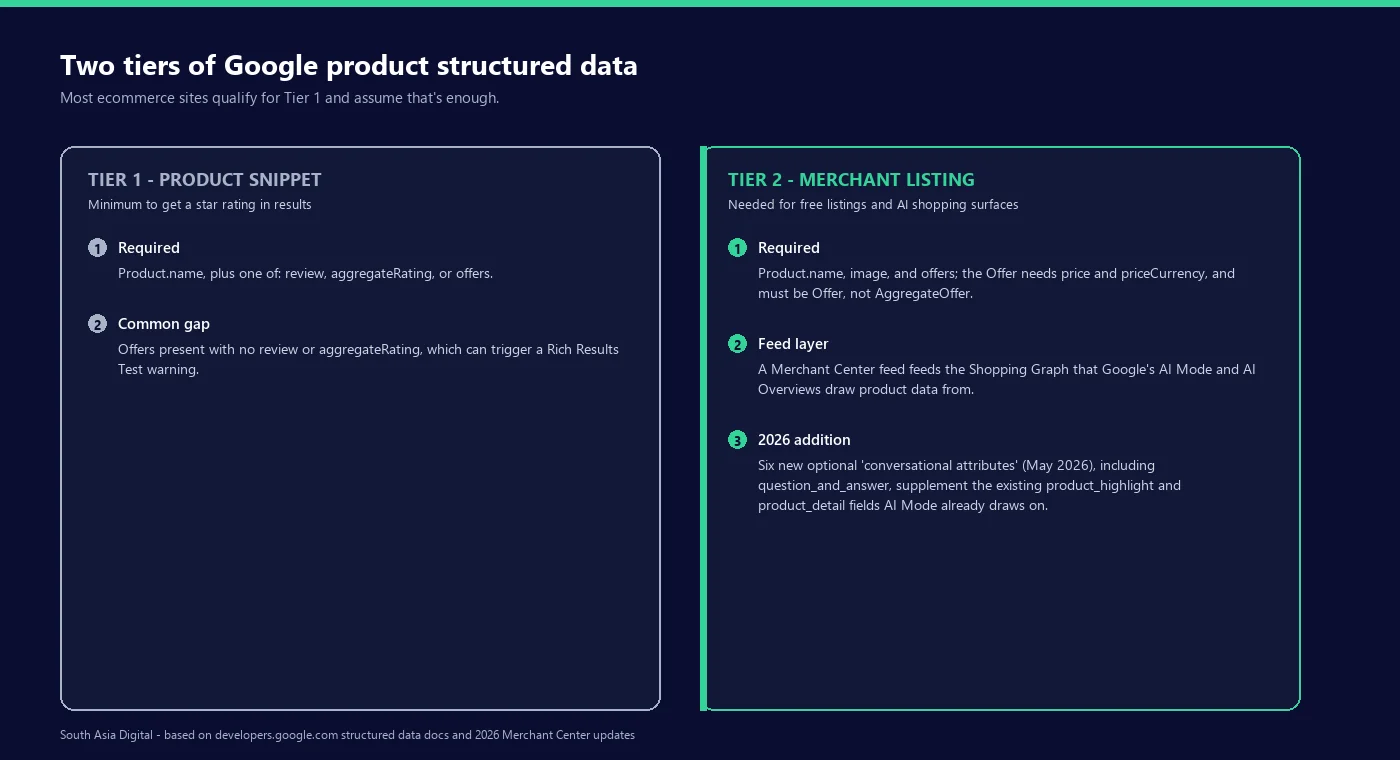
A page can pass Google’s Rich Results Test for a basic product snippet and still fail the stricter merchant-listing bar that free listings and AI shopping surfaces check against. If your Offer is missing a currency code, or your product markup uses AggregateOffer because you list the same product at several prices, you’ll often see the star rating in results while staying invisible to the surfaces this article is about.
Do reviews affect whether AI cites your product?
Yes, but only reviews that meet Google’s review-snippet rules, which got notably stricter in 2026. Marked-up review content has to be visible on the page itself, not just present in the schema, and has to rate one specific item rather than a category or list of products. Google’s review-snippet guidelines explicitly ban fake and undisclosed incentivized reviews, including reviews written in exchange for money, discounts, or free products unless that incentive is clearly disclosed. A page with glowing but generic five-star markup and no visible reviews to back it is exactly the pattern these rules target.
Google also added support for Pros and Cons markup inside product review snippets in 2026. It only triggers alongside standard Review properties, including an author name and the item being reviewed, so it’s an addition to solid review markup, not a replacement for it.
What about category and comparison pages for ecommerce GEO?
They matter most for the queries a shopper asks before picking a specific product: “best running shoes for flat feet,” “wireless earbuds under $100.” A single product page can’t answer that, no matter how well structured it is. What earns a citation here is the same pattern that works anywhere in GEO: open with a direct recommendation, state the specific criteria you used, name specific alternatives and who each one fits, and skip the generic feature-list format that reads the same on every competing page. A comparison page that hedges on every pick doesn’t give an AI system anything confident enough to quote.
| Surface | What it draws product data from | Where to focus first |
|---|---|---|
| Google AI Overviews / AI Mode | Shopping Graph (Merchant Center feed), structured data on the page, and organic rankings. | Feed accuracy and freshness, then merchant-listing-grade structured data. |
| ChatGPT / Perplexity | Crawled product and category pages, third-party review sites, and editorial comparisons. | On-page content quality, visible reviews, and comparison pages with a specific, confident recommendation. |
If you sell online, try this first
Work through this in order. Each step takes under an hour, and the first three will tell you whether your problem is structural or just a feed issue.
- Run your top product pages through Google’s Rich Results Test. Check specifically for the merchant-listing warnings, missing priceCurrency or an AggregateOffer where a plain Offer belongs, not just whether a basic product snippet passes.
- Check your Merchant Center feed for disapproved or limited products. A pricing mismatch between your feed, your page, and your markup is the single most common reason a product disappears from free listings.
- Confirm your reviews are visible on the page, not just in the schema. If the star rating only exists in markup with no review text a visitor can read, that’s exactly what Google’s review-snippet policy bans.
- Open your three highest-traffic category pages and check whether they open with a direct recommendation. If a reader has to scroll past three paragraphs of throat-clearing before you name a specific product, an AI system will skip straight to a competitor that didn’t make them wait.
- If you’re on Shopify, check the platform’s native GEO and AI discovery settings separately. We cover exactly what those features do and don’t handle here, since they sit on top of everything in this article rather than replacing it.
If you’d rather have someone audit your product and category pages against both structured-data tiers instead of working through this by hand, that’s part of what our Generative Engine Optimization service does for ecommerce clients, and you can reach us directly here if you want a second set of eyes on your feed and your markup.
Common questions about GEO for ecommerce
What is GEO for ecommerce?
Structuring product, category, and review content so AI shopping assistants, Google’s AI Overviews and AI Mode, ChatGPT, and Perplexity, can read it accurately enough to cite or recommend a specific product. It spans your Merchant Center feed, your on-page structured data, your visible reviews, and your category or comparison pages.
Do I need a Google Merchant Center feed to appear in AI Mode shopping results?
Google hasn’t stated a feed is strictly required, but the Shopping Graph that AI Mode and AI Overviews draw product data from is populated primarily through Merchant Center. In practice, a clean, current feed is the most reliable way to be eligible for free listings and AI-powered shopping surfaces at all.
What’s the difference between a product snippet and a merchant listing in Google Search?
A product snippet only needs Product.name plus one of review, aggregateRating, or offers, and is enough for a basic star rating in results. A merchant listing needs more: Product.name, image, and offers, with the Offer carrying price and priceCurrency and typed correctly as Offer rather than AggregateOffer. Only the merchant-listing tier qualifies a product for free listings and most AI shopping surfaces.
Do fake reviews hurt AI citation chances?
Yes. Google’s review-snippet guidelines explicitly ban fake and undisclosed incentivized reviews, and require that marked-up review content be visible on the page a visitor sees, not just present in the schema. Pages with review markup that doesn’t match what’s shown on-page are the pattern this policy targets directly.
Does GEO for ecommerce replace SEO or paid search?
No. AI shopping traffic currently converts well and is growing fast, but it’s still a fraction of total retail traffic. The feed and structured-data work GEO for ecommerce requires also improves standard Shopping ads and organic product-snippet eligibility, so it supports existing SEO and paid channels rather than competing with them.
Most of the fixes in this article aren’t a redesign. They’re a feed audit, a schema correction, and making sure your reviews say on the page what your markup claims. Start with the Rich Results Test on your three best-selling products this week, since that’s usually where the gap between a product snippet and a merchant listing shows up first.
Written by Nadir Yaqoob, founder of South Asia Digital. Nadir has a software engineering background and runs the agency’s AI SEO and GEO work for SaaS and Shopify clients directly.