Most SEO case studies show a dramatic before-and-after: a site that was struggling, then wasn’t. That’s a real, useful story, and we’ve told it before, in a case study on recovering a job board site after a Google spam update hit it hard. But it’s not the only kind of SEO success worth showing, and it’s arguably not even the most common one behind a genuinely healthy site.
This case study is different. One of our long-standing clients, a US-based handmade and forged knife Shopify store we’ve worked with for years, not months, has kept growing and holding its page-1 rankings the same disciplined way the whole time: a structured monthly plan, not a one-time fix revisited only when something breaks. The clearest recent proof of that discipline actually working under pressure: the site held steady through two separate, confirmed Google spam update rollouts in the last two months, without the dramatic swings that hit a lot of sites during exactly that kind of algorithm volatility.
We’re not naming the client. This is real, ongoing client work, and every screenshot and figure below is real Search Console data or a real, redacted Google search result, not a projection or invented case-study math. The point of sharing it isn’t a flashy before-and-after, the recent update resilience included. It’s showing what a structured, disciplined SEO plan actually looks like when it’s sustained over years, using the last two months as one clear, checkable example of it holding up.
Key Takeaways
- The client: a US-based handmade and forged knife Shopify store, a long-standing, multi-year South Asia Digital client, not a new build or a recent-decline recovery.
- The result: years of steady, disciplined SEO work, not a single fix, is what’s kept the site growing and holding page-1 rankings for its real target keywords, including “hand forged knife,” “damascus pocket knife,” and Google Shopping visibility for “bowie knife.” The most recent proof of that: it stayed stable through two separate, verified Google spam update rollouts in roughly the last two months.
- The two updates, verified: Google’s August 2026 spam update (August 18-21) and the September 2026 spam update, which began rolling out on September 24 and, by Google’s own account, can take up to two weeks to fully complete.
- Why it held: a structured, ongoing monthly plan, a defined link-building cadence, proactive technical monitoring, and deliberate AI Overview and GEO visibility work, sustained over years rather than run as a one-time project.
- The real Search Console numbers: 7.23K clicks and 478K impressions over the most recent 3 months, average CTR 1.5%, average position 8.6, both clicks and impressions fluctuating within a consistent, stable range rather than trending sharply up or down.
- A genuine secondary win: Google AI Overview impressions for the site climbed from roughly 1,000 a day to a peak near 1,400 a day over the most recent 28 days, a real gain layered on top of the stability, not the headline result itself.
- Honest caveat: this is one client’s real numbers, no revenue or profit figures are published here per client confidentiality, and stability through two updates isn’t a guarantee for every site or every future update.
What “Consistency” Actually Meant in Practice
This client isn’t a recent onboarding. The relationship has run for years, and the work has never been structured as a one-time audit-and-fix project. It’s an ongoing monthly plan with the same core components repeated, checked, and adjusted every month, not a burst of activity followed by long stretches of silence. That distinction matters more than it sounds like it should, because a lot of SEO work that looks good on paper is actually front-loaded: a big initial push, then nothing, until something breaks and a new project gets commissioned to fix it. This client’s plan was built specifically to avoid that pattern.
A defined monthly link-building cadence, not a one-time burst
Link building here runs on a fixed monthly cadence rather than a front-loaded campaign that tapers off once the initial project ends. New, relevant backlinks are pursued and evaluated every month against the same standard, is this a real, relevant placement a search engine would trust, not a bulk-purchased link with no topical connection to handmade knives or the craft and outdoor niches this store actually sits in. A site with a steady, ongoing link profile that keeps growing in small, real increments looks fundamentally different to Google’s systems than a site that got a pile of links once and then went quiet, and that difference tends to matter most exactly when an algorithm update is actively re-evaluating trust signals across the web.
Proactive technical monitoring, not reactive firefighting
The technical side of this account is checked on an ongoing basis rather than only when something visibly breaks. That means catching the kind of small, boring problems that Shopify stores accumulate over time, a theme update quietly stripping structured data, a seasonal collection page losing its canonical tag, a product variant creating a duplicate URL, before those problems compound into something that shows up as a real ranking loss. A store that’s been live and actively selling for years accumulates far more of this kind of technical debt than a brand-new site simply because there’s more history, more app installs, and more theme changes for something to quietly go wrong in. Catching it early, every month, is a large part of why there was nothing sitting there for an update to catch the site on.
Deliberate AI Overview and GEO work, not an afterthought
Getting cited in Google’s AI Overviews and staying visible as search shifts toward AI-generated answers isn’t something this account treats as a separate, occasional project. It’s part of the same ongoing plan: structured data kept current and valid, product and category content formatted so a direct answer can actually be extracted from it, and consistent entity and trust signals maintained across the site rather than left to erode. We’ve written more generally about how to get into Google’s AI Overviews for SEO and about entity mapping in SEO, and both are the same category of ongoing work applied here, not a one-off add-on.
The Results: Page-1 Rankings That Didn’t Move
The clearest evidence here is simply what still shows up in a real Google search. Below are three real, current search results for this client’s actual target queries, captured with the store’s name covered since we’re not naming the client, but with the rankings, pricing, and review counts left visible exactly as they appear.
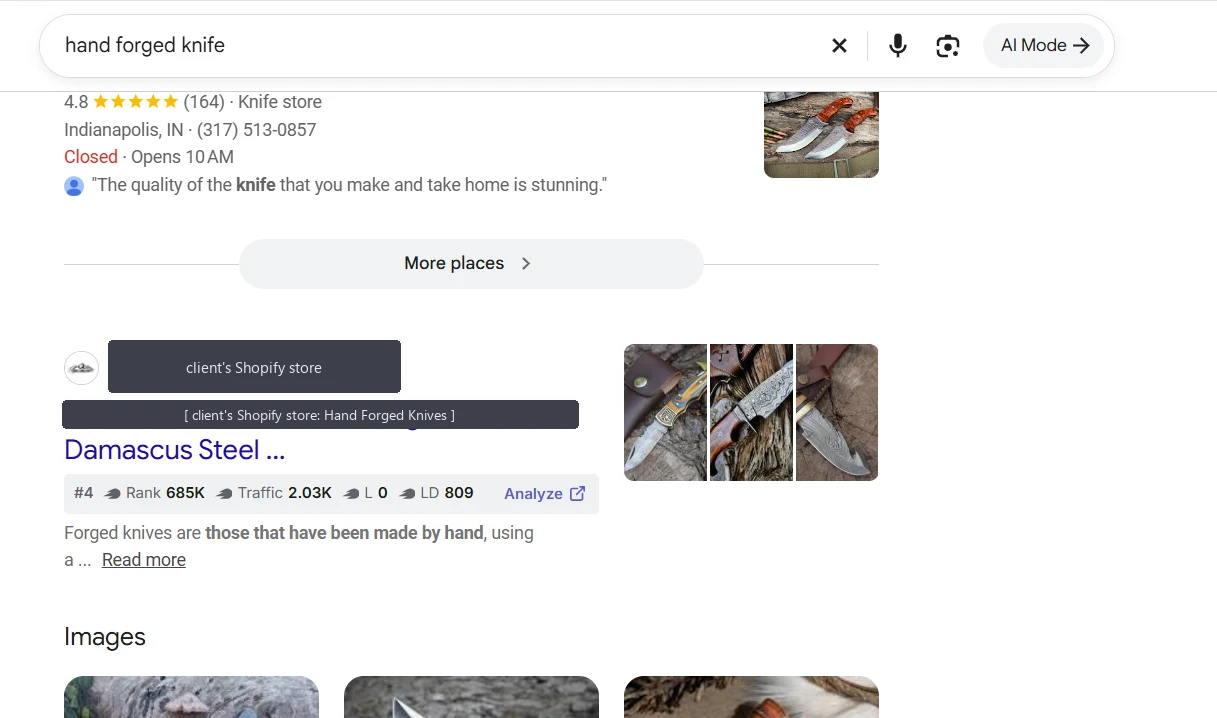
For “hand forged knife,” a genuinely competitive query for this niche, the client’s store ranks organically on page 1, with its product listing and images appearing in the results a real searcher would actually see.
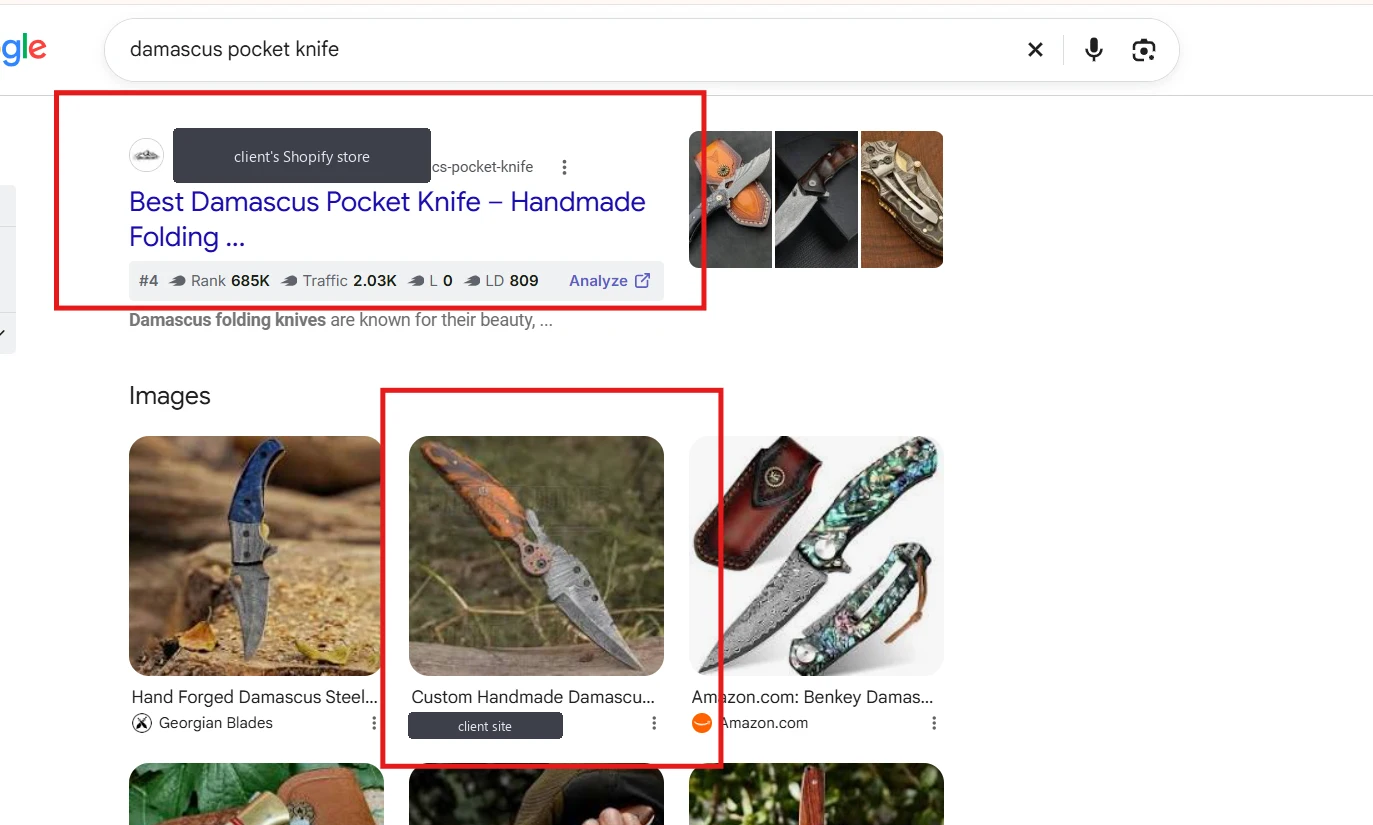
Same pattern for “damascus pocket knife”: the store’s own product page ranks on page 1, and one of its product photos appears in the Images results directly below, a second, independent visibility signal for the same query.
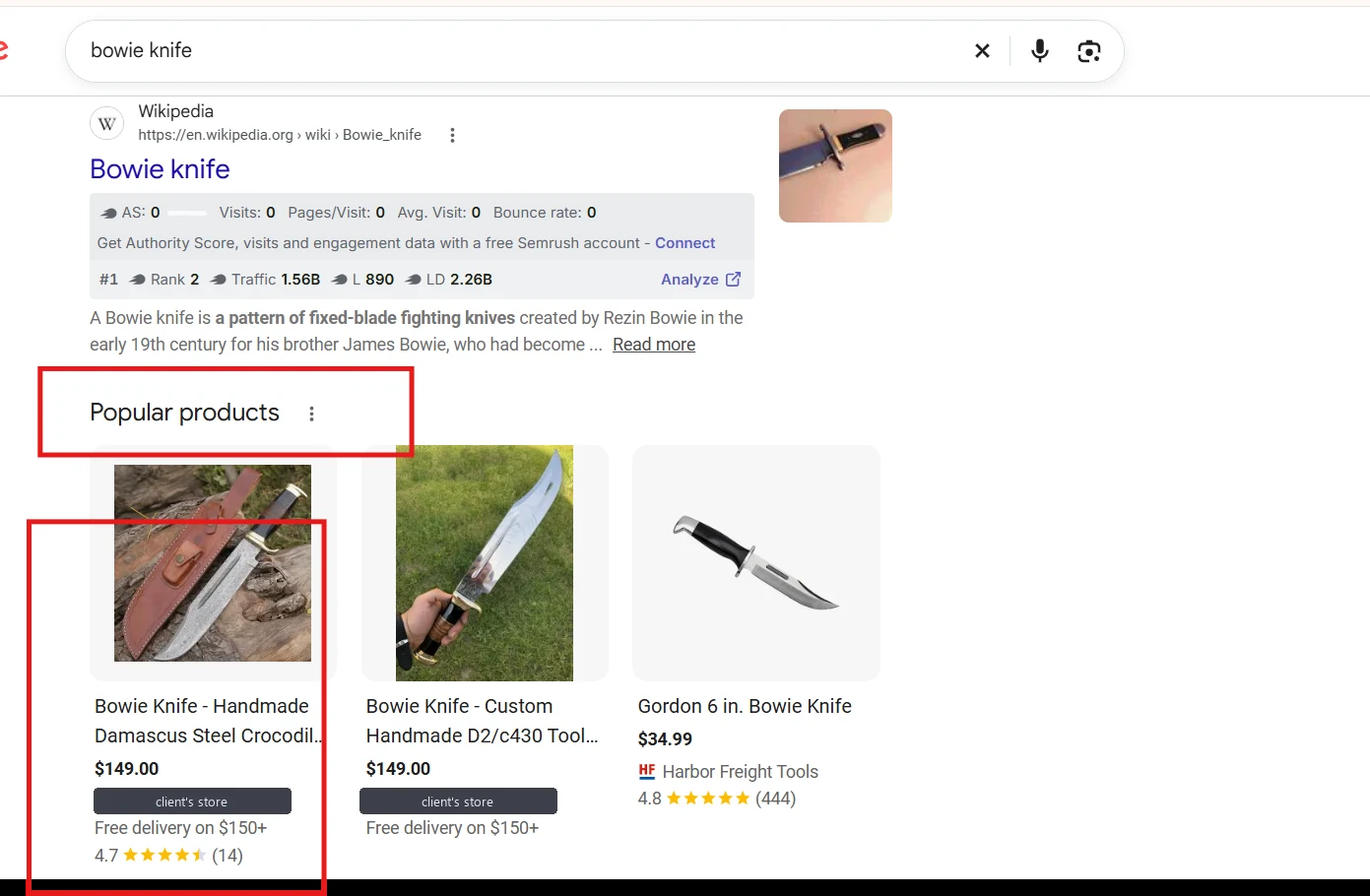
For “bowie knife,” a broader, more competitive query, the client’s store shows up twice in Google’s “Popular products” Shopping results, both handmade Damascus steel bowie knives priced at $149.00, one carrying a real 4.7-star rating from 14 reviews. That’s genuine commercial visibility on a query most single-location knife makers would struggle to appear on at all.
Real target-keyword visibility like this is worth pairing with the site’s own Search Console numbers, because rankings on a handful of queries and account-wide traffic can tell different stories. Here, they tell the same one.
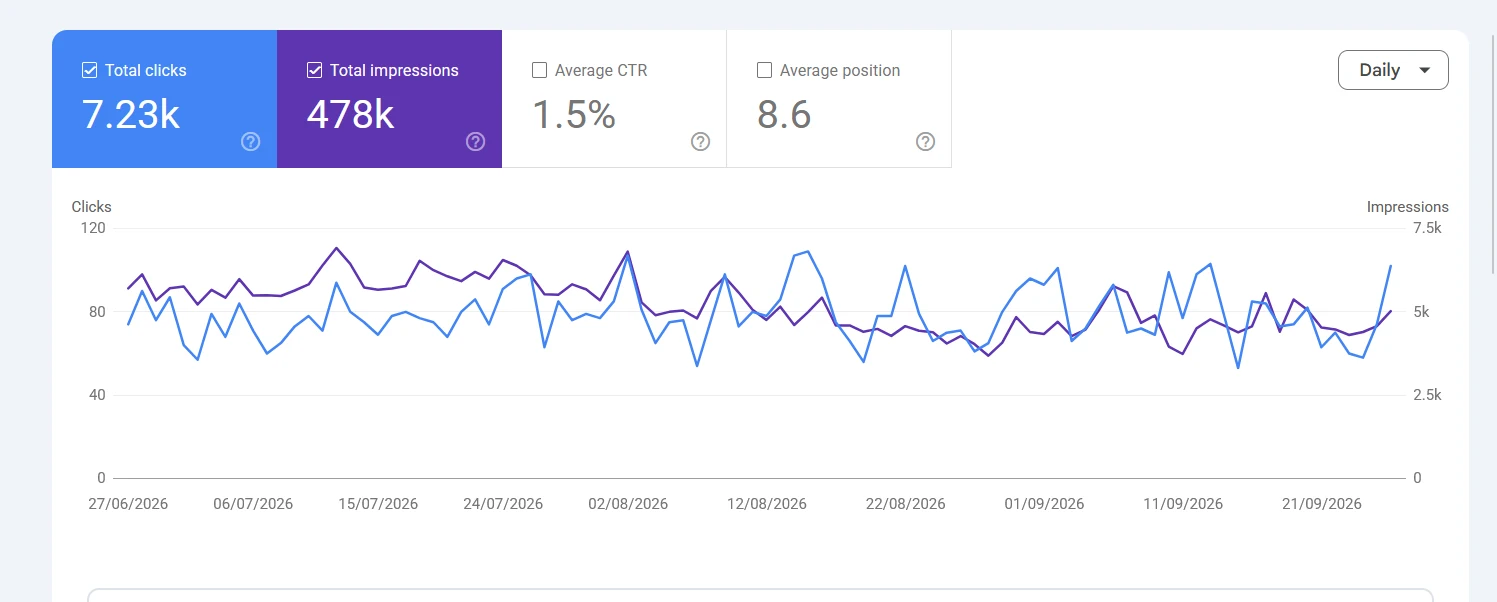
Over the 3-month window from June 27 to September 26, 2026, a window that fully contains the August 2026 spam update and the first two days of the September 2026 spam update’s rollout, the site logged 7.23K total clicks and 478K total impressions, at a 1.5% average CTR and an average position of 8.6. Look at the shape of that chart rather than just the totals: both clicks and impressions bounce within a consistent, fairly narrow band across the entire three months. There’s no cliff, no sudden collapse, no unexplained dead zone the way the job board in our other case study experienced. That flat, stable, slightly noisy line is the actual result this case study is documenting, not a dramatic recovery arc.
There’s also a genuine secondary win worth showing honestly rather than folding into the stability story, since it’s a different kind of result.
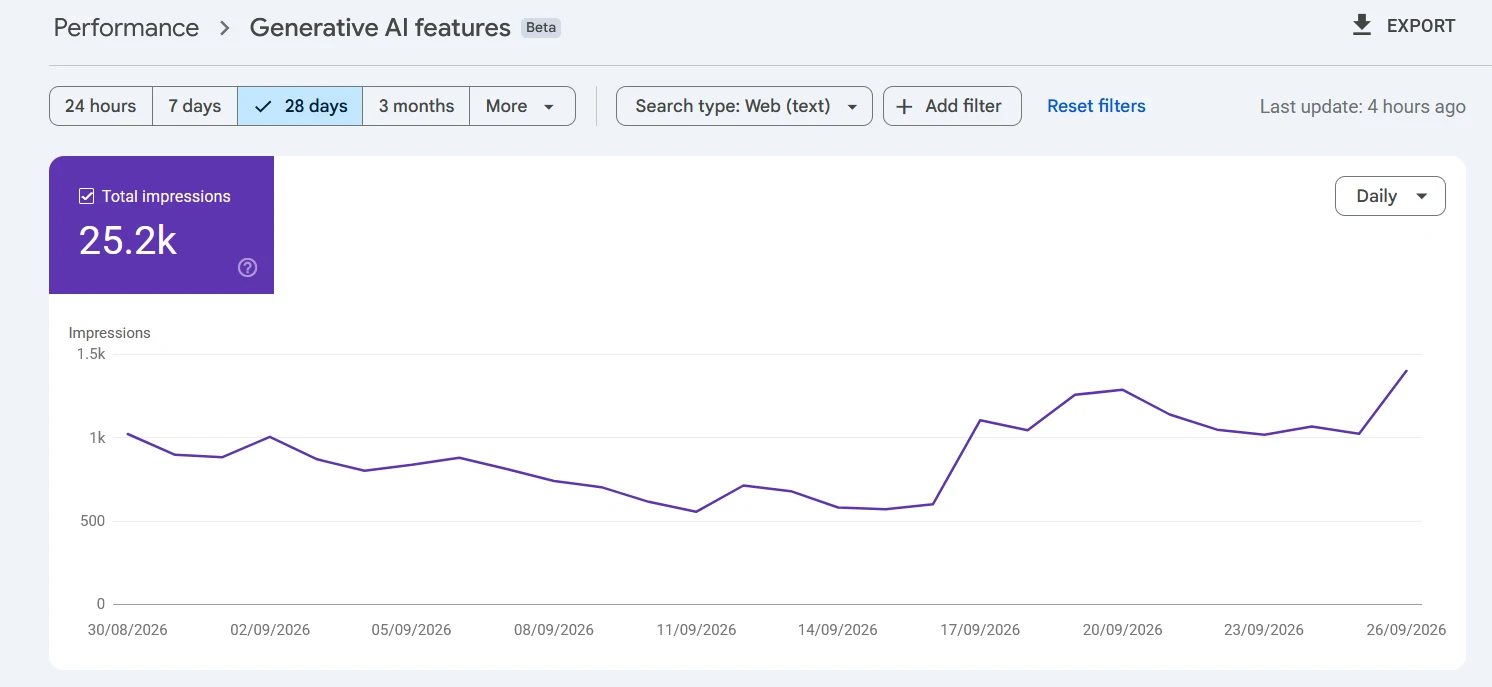
Google AI Overview impressions for the site totaled 25.2K over the most recent 28 days. The trend starts around 1,000 impressions a day, dips slightly through early-to-mid September, then steps up clearly around September 17 and climbs to a peak near 1,400 a day by September 26. That’s real, ongoing growth in a genuinely newer visibility channel, on top of stable traditional rankings, not instead of them. We think that combination, holding the base while a newer channel grows, is a more honest picture of what ongoing SEO work is actually supposed to produce than either number alone.
| Metric | Real Figure |
|---|---|
| GSC total clicks, 3 months (Jun 27 to Sep 26, 2026) | 7.23K |
| GSC total impressions, 3 months | 478K |
| GSC average CTR, 3 months | 1.5% |
| GSC average position, 3 months | 8.6 |
| AI Overview impressions, most recent 28 days | 25.2K, climbing from ~1,000/day to a peak near 1,400/day |
| Confirmed spam updates covered by this window | August 2026 (Aug 18-21) and September 2026 (began Sep 24) |
Verifying the Two Updates, Not Just Asserting Them
A claim like “this site survived two Google updates” is easy to write and easy to get wrong, so we checked it against Google’s own record before putting it in this article, the same way we verified update timing for the job board case study linked above. Google has run four confirmed spam updates in 2026 as of this writing: March, June, August, and September, described by industry trade coverage as the most active year for spam updates since 2021. The two that actually fall inside this client’s most recent three-month Search Console window, and the two this case study’s “two updates in two months” claim refers to, are the August 2026 spam update and the September 2026 spam update.
| Update | Rollout Dates | Status as of This Article |
|---|---|---|
| August 2026 spam update | August 18-21, 2026 | Fully complete, well inside the 3-month window above |
| September 2026 spam update | Began September 24, 2026 | Still actively rolling out; Google’s own guidance says this one can take up to two weeks |
The September 2026 spam update is genuinely still in progress as this article is being written, which is worth being upfront about. The site’s rankings hadn’t moved as of the most recent data pulled for this article, but a rollout that Google itself says can take up to two weeks isn’t finished yet, so this is an honest snapshot of a still-unfolding update, not a claim that the story is fully closed. We’ll treat that as an open point rather than pretend otherwise. What we can say with confidence, verified against Google’s own status reporting rather than assumed, is that both updates are real, dated, and both fall inside the stable window shown in the chart above, not picked to make a flattering story fit.
What This Doesn’t Prove
This is one client’s real, ongoing result, not a universal guarantee, and it’s worth being honest about the limits of what this case study can actually show.
- The September update isn’t finished yet. As covered above, Google’s own rollout window for the September 2026 spam update extends up to two weeks from its September 24 start. We’re reporting what’s true as of this writing, not claiming a final, closed outcome for an update that’s still actively rolling out.
- This is one client, over one specific window. A multi-year relationship and a stable three-month Search Console window are genuinely meaningful, but they’re not a promise that every client, or this client in every future update, will see the same outcome. Algorithm updates are inherently unpredictable at the individual-site level, and no agency can honestly guarantee immunity from all future volatility.
- No revenue or profit figures are published here. This is a genuinely profitable, established business, and we know real figures from working with the client directly, but those numbers are confidential per the client’s explicit instruction and aren’t included anywhere in this article, not even in general or rounded form.
- This is genuine, disclosed South Asia Digital client work. We’ve run this account’s ongoing SEO for years and we’re the ones publishing this case study. We think the approach and the real numbers above are worth sharing honestly, but that vendor relationship is part of the context you should weigh this against.
The kind of ongoing, structured work behind this result, ongoing link building, technical monitoring, and AI Overview and GEO visibility work run as one continuous plan rather than a one-time project, is the same category of work covered under our SEO services and, for Shopify and other online stores specifically, our e-commerce marketing services.
Want Rankings That Hold Steady Through the Next Update?
This is the same structured, ongoing SEO approach behind the stability above, a defined monthly plan instead of a one-time project.
Frequently Asked Questions
What does it actually mean that a site “didn’t move” during a Google update?
It means the site’s real Search Console clicks, impressions, and average position stayed within a consistent, fluctuating range across the update windows instead of dropping sharply or spiking unnaturally. For this client, the 3-month chart shows clicks and impressions bouncing within a stable band from June through September 2026, a window that covers the entire August 2026 spam update and the first days of the September 2026 spam update, with no cliff or collapse either time.
What’s the difference between a Google spam update and a core update?
A spam update specifically targets pages and sites that violate Google’s spam policies, unnatural links, scaled low-value content, and similar patterns, and tends to affect specific pages or sections that match a known policy. A core update re-evaluates ranking more broadly across a site’s overall quality and topical relevance. Both can move rankings, but the two updates covered in this case study, August and September 2026, were both spam updates specifically.
What does a monthly SEO plan actually include for a Shopify store like this?
For this client, it’s a defined link-building cadence pursued every month rather than in one burst, ongoing technical monitoring to catch Shopify-specific issues like broken structured data or duplicate variant URLs before they compound, and deliberate work to stay visible in Google’s AI Overviews, keeping structured data current, formatting content for direct extraction, and maintaining consistent entity and trust signals across the site.
Why does AI Overview visibility matter alongside regular rankings?
Search is increasingly answered directly inside AI-generated summaries, not only through a list of blue links, so a site that ranks well but never gets cited in those summaries is missing a growing share of real visibility. For this client, AI Overview impressions grew from roughly 1,000 a day to a peak near 1,400 a day over the most recent 28 days, a genuine gain layered on top of stable traditional rankings, not a replacement for them.
Does staying stable through two updates mean every client of yours is guaranteed the same result?
No, and we wouldn’t claim that. This is one long-standing client’s real, verified result over one specific window, and the September 2026 update referenced here is still actively rolling out as of this writing. Algorithm updates affect individual sites unpredictably, and no honest agency can promise immunity from every future update. What we can say is that this client’s stability lines up with years of the same structured, ongoing work described above, not a one-time fix applied right before the updates hit.
Why isn’t the client’s name or revenue included in this case study?
The client asked not to be named, and we’re honoring that by describing the business only generically, as a US-based handmade and forged knife Shopify store, throughout this article. The client also gave us permission to describe the business as genuinely profitable and established in general terms, but not to publish any specific revenue or profit figures, so none appear anywhere in this article, including in rounded or approximate form.