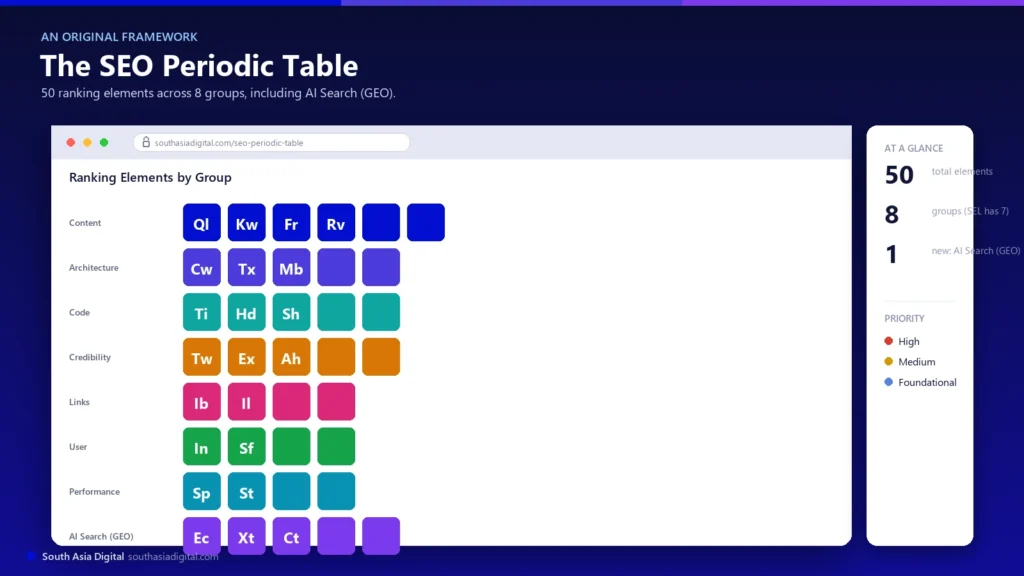
This SEO periodic table covers 50 ranking and visibility elements across 8 groups. Every element gets a real example and a practical tip you can act on, not a one-line abstract description, and each one is tagged with an honest read on how much it matters right now instead of treating every factor as equally important.
The eighth group is the one most SEO reference content skips entirely: AI Search (GEO). AI Overviews, ChatGPT, and Perplexity now answer a growing share of searches directly, and this table covers the 6 real elements that determine whether a page actually gets chosen for that job, grounded in the same AI-search work published elsewhere on this site.
Below is the full table: 50 elements across 8 groups, one of them entirely new. Skim the summary first, then use the group tables further down as a working audit checklist for your own site.
Key Takeaways
- This SEO periodic table covers 50 elements across 8 groups, each with a real example and a practical tip.
- The 8th group, AI Search (GEO), covers entity clarity, AI-crawler access, extractability, citability, AI Overview inclusion patterns, and the non-determinism problem.
- Every element includes a real example and a practical implementation or measurement tip, not just an abstract one-line description.
- Elements are tagged High, Medium, Foundational, or Rising priority, a defensible read of relative emphasis grounded in documented Google changes (E-E-A-T’s 2022 update, mobile-first indexing’s completion, Core Web Vitals swapping in INP), not an invented precise percentage.
- The full table below is rendered as a single image you can save directly.
What Is an SEO Periodic Table?
An SEO periodic table takes the same idea as the chemistry periodic table on your old classroom wall and applies it to search ranking. Instead of chemical elements grouped by atomic properties, you get SEO elements grouped by category, each with a short chemical-style symbol and a plain description of what it actually is. It’s a way of turning a long, scrolling list of ranking factors, or as people search for it in different ways, SEO factors, components of SEO, or simply the elements of SEO, into one visual reference instead of another article.
This periodic-table format for SEO factors, sometimes searched for as the periodic table of SEO success factors, first appeared in 2011 and has been updated in various forms since, typically organizing factors into a handful of groups like Content, Architecture, Code, Credibility, Links, User, and Performance, each with a short abstract description and its own symbol.
What follows is our own version of that same idea, built around real examples, practical tips, and full coverage of AI-driven search.
Where Most SEO Periodic Tables Fall Short
Most periodic-table style SEO reference content, this one included until we rebuilt it, shares the same five gaps:
- No AI Overview or generative-search coverage. Most existing tables don’t address AI Overviews, ChatGPT, or Perplexity at all, despite those systems now answering a meaningful share of searches directly.
- Abstract descriptions, no examples. Each factor typically gets a short definition and nothing else: no worked example, no implementation checklist, no way to check whether you’re actually doing it.
- Every factor presented as equally important. There’s usually no signal for which factor deserves real attention right now versus which one is legacy housekeeping most sites already handle correctly.
- No downloadable graphic. Most versions live as an interactive page element, not a static image or PDF you can save, print, or drop into a deck.
- Local, ecommerce, and news-specific factors get dropped. Niche-specific signals rarely get their own space once a table tries to stay broadly applicable.
This version fixes the first four directly. On the fifth, we’re being honest rather than forcing a thin ninth group back in: the niche-specific signals that matter most, proximity for local, product schema for ecommerce, freshness cadence for news, live inside the relevant existing groups below, called out where they apply.
The Full SEO Periodic Table
Here’s the whole thing at once: 50 elements, 8 groups, color-coded by category. Think of the eight sections further down as eight linked SEO tables you can scan independently or read straight through.
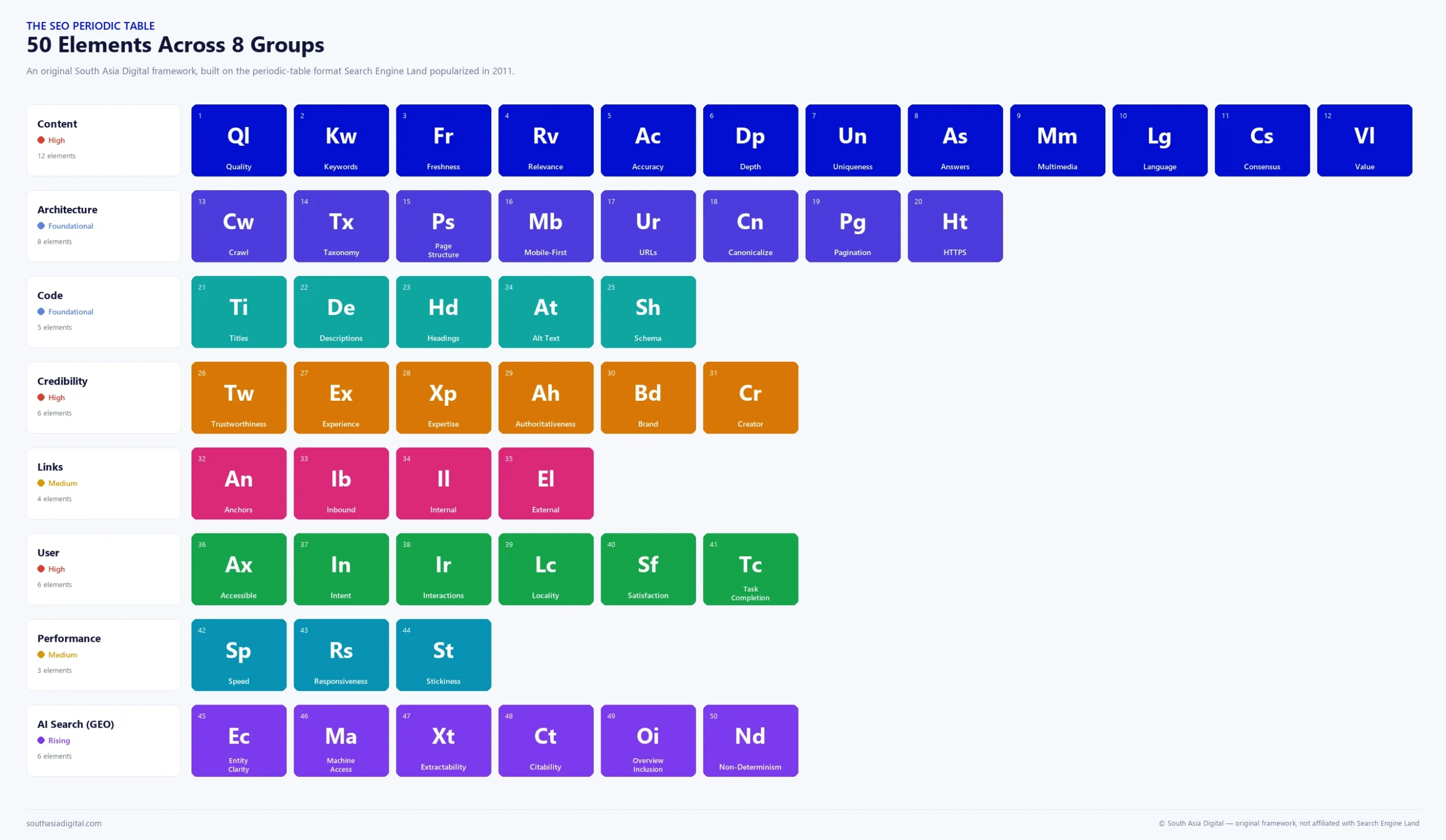
Every tile above carries a group-level priority tag: High, Medium, Foundational, or Rising. None of these are invented precise percentages, because no one, including Google, publishes exact ranking-factor weights. They’re a defensible read of relative emphasis based on documented algorithm changes and Google’s own public statements, laid out here before you get to the group-by-group detail:
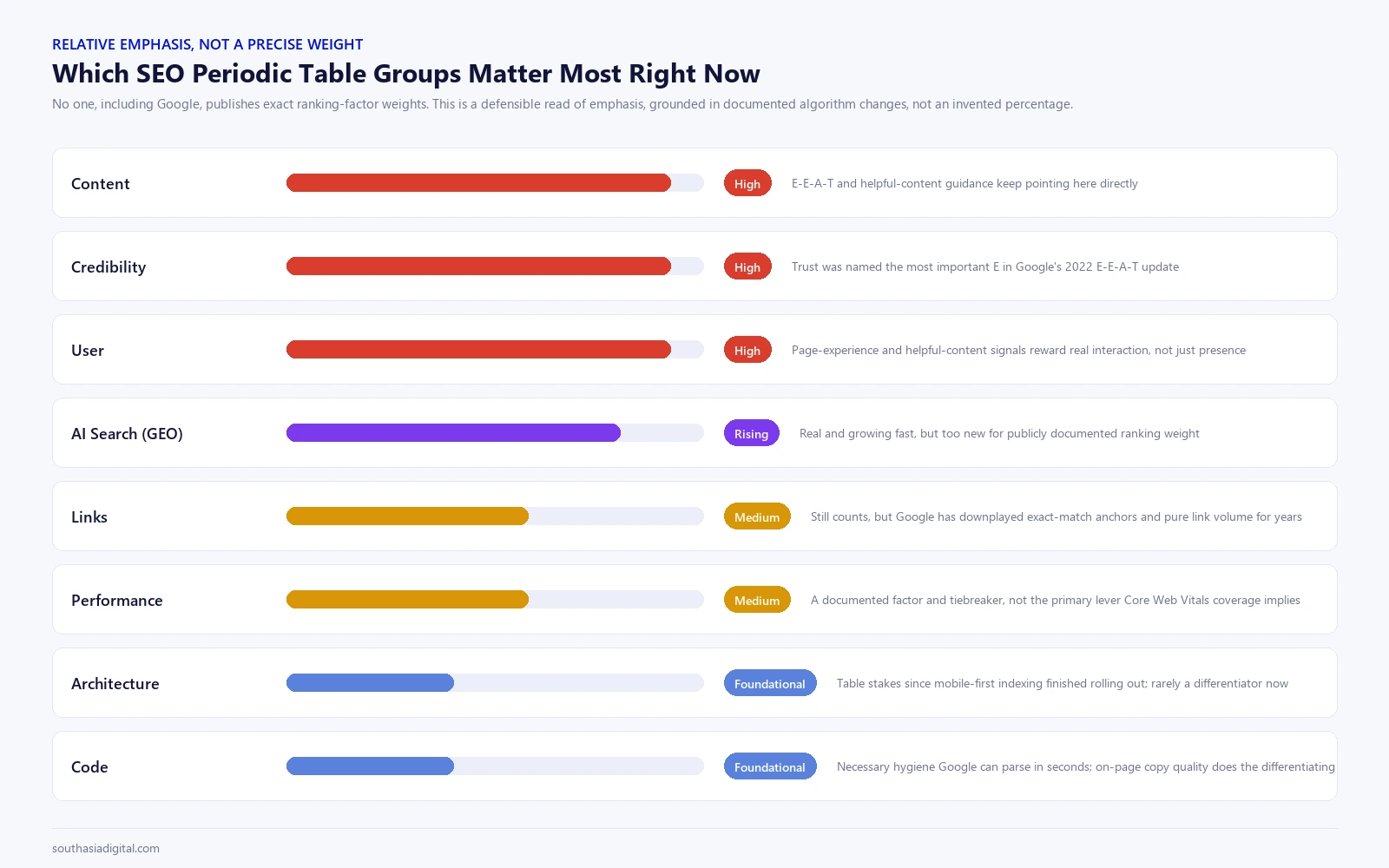
Now the detail behind every tile, group by group, with a real example and a practical tip for each of the 50 elements.
Content Elements (12): Priority High
Content carries the most weight of any group here, and it’s the group Google’s own guidance keeps returning to directly: the Helpful Content system, folded into core ranking in 2023, and the Search Quality Rater Guidelines both describe content quality in terms close to several of the 12 elements below.
| Symbol | Element | What It Means | Example | Tip |
|---|---|---|---|---|
| Ql | Quality | Content that Google’s Search Quality Rater Guidelines would rate as demonstrating real expertise, not just presence. | A recipe page explaining why searing at high heat locks in a crust signals real technique; one that just lists steps doesn’t. | Read Google’s free public Rater Guidelines once and self-audit against its own “Lowest quality” checklist. |
| Kw | Keywords | Matching the actual words your audience searches with, not just the underlying concept. | A page built around “customer relationship software” misses the volume sitting on “CRM software,” the term people type. | Check Search Console’s Performance report for the exact phrasing already driving impressions before assuming you know it. |
| Fr | Freshness | How recently a page was meaningfully updated, weighted by whether the query itself deserves a fresh answer. | “iPhone 17 review” needs this year’s page; “how photosynthesis works” doesn’t need a 2026 timestamp to be correct. | Update dateModified only when you’ve changed something real; Google’s systems can tell a fake refresh from a real one. |
| Rv | Relevance | How directly a page’s actual content matches what the searcher wants, beyond just containing the keyword. | “Best Running Shoes” spending its first three paragraphs on running history is on-topic but low relevance to a ready buyer. | Read your own first 100 words as the searcher would; if you’d bounce, that’s the fix to make first. |
| Ac | Accuracy | Factual correctness, weighted more heavily on YMYL (health, finance, legal) topics. | A finance article stating an old tax bracket with no “current as of” note is wrong the moment brackets change. | Add a visible “current as of” date near any figure that changes on a schedule, like tax rates or pricing. |
| Dp | Depth | Whether a page actually covers a topic’s real sub-questions instead of skimming the surface. | A “how to start a podcast” guide skipping hosting platforms and monetization isn’t comprehensive, however well-written. | List every subtopic competitors cover that you don’t; depth is closing that list, not adding word count. |
| Un | Uniqueness | Original information, analysis, or data not already available on pages that outrank you. | A roundup that only restates five competitors’ claims adds nothing a reader couldn’t piece together themselves. | Ask what your page has that a page stitched from your five competitors wouldn’t: original data usually answers it. |
| As | Answers | Whether a page directly answers the actual question, ideally near the top, in a form Google can lift into a snippet. | A “what is a domain broker” page burying the definition three scrolls down makes both Google and the reader work for it. | Write the direct answer to your own H1 as the very next sentence, then build supporting detail underneath. |
| Mm | Multimedia | Images, video, and other non-text formats that genuinely support the content, not decorative filler. | A “how to tie a bowline knot” page with a real annotated diagram clears up ambiguity text alone struggles with. | For step-by-step content, ask whether one annotated image resolves more confusion than another paragraph would. |
| Lg | Language | Writing at the level and register your actual audience uses, including localization for target regions. | A UK-targeted page saying “vacation” and “diaper” instead of “holiday” and “nappy” reads as subtly foreign to its audience. | Match spelling, currency, and date conventions to your primary region’s Search Console data, not your CMS default. |
| Cs | Consensus | Whether a specific claim on your page matches or contradicts what other reputable sources say about the same fact. | Publishing “founded in 2003” when every other source, including the company’s own site, says 2001 is a checkable mismatch. | Cross-check any specific, checkable fact against a primary source before publishing, not another article’s summary. |
| Vl | Value | Genuine additional value beyond what’s already available for the same query, close to Google’s own rater-guideline phrasing. | A comparison page with pricing verified against each vendor’s current page adds value a two-year-old roundup can’t. | Before publishing, name one concrete thing your page adds that the current top 3 results don’t. |
Architecture Elements (8): Priority Foundational
Architecture is necessary, and it’s also table stakes. Mobile-first indexing finished rolling out to essentially all sites by 2023-2024, and most established platforms handle sitemaps, crawlability, and canonical basics correctly by default now. This group rarely differentiates a site anymore; getting it wrong actively hurts, but getting it merely right doesn’t win you much.
| Symbol | Element | What It Means | Example | Tip |
|---|---|---|---|---|
| Cw | Crawl | Whether Google’s crawlers can reach and process the pages you want indexed, governed by robots.txt and crawl budget. | A 50,000-product store with no sitemap and thin internal linking can leave new products undiscovered for weeks. | Watch Search Console’s Crawl Stats report for a sudden drop in pages crawled per day, an early real symptom. |
| Tx | Taxonomy | How categories and subcategories are organized, ideally reflecting how your audience thinks, not your internal org chart. | One flat “Gear” category burying 40 subtypes is harder to navigate than clear, task-based subcategories. | Build categories from real Search Console query data and competitor pages, not warehouse SKU groupings. |
| Ps | Page Structure | Clean, semantic HTML that both search engines and assistive technology can parse reliably. | Styled div tags instead of real h2 tags look fine visually but give crawlers no outline to parse from. | View your page’s outline with a heading-structure browser extension; it should read like a sensible table of contents. |
| Mb | Mobile-First | Google indexes the mobile version of your page as primary, a rollout confirmed complete for essentially all sites by 2023-2024. | Hiding a key comparison table on mobile to save space hides it from Google’s indexing entirely, not just mobile visitors. | Use Search Console’s URL Inspection tool on the mobile rendering specifically; missing there means missing from the index. |
| Ur | URLs | Clean, descriptive, reasonably short URLs that hint at page content before anyone even clicks. | /products/item?id=48219&cat=12 tells a searcher nothing; /products/waterproof-hiking-boots does. | Set the slug manually at publish time for anything auto-generated from a numeric ID; don’t accept the CMS default. |
| Cn | Canonicalize | Explicitly telling search engines which version of a page is the real one when duplicates exist. | A product reachable at two different URLs needs one clear canonical tag, or engines are left guessing which to index. | View-source a page with a known duplicate-URL risk and confirm the canonical points to the version you want ranking. |
| Pg | Pagination | How multi-page listings are structured so engines understand them as one connected series. | A 12-page category listing with no clear link path between pages can leave page-8 products effectively orphaned. | Since Google retired rel=next/prev support in 2019, make sure paginated pages stay reachable through real crawlable links. |
| Ht | HTTPS | Serving your site over a secure connection, confirmed as a ranking signal by Google since 2014. | Any page still on plain HTTP, or mixed-content warnings from HTTP resources on an HTTPS page, flags a basic trust problem. | Run your domain through a free SSL checker; this is one of the few elements here that’s genuinely binary, pass or fail. |
Code Elements (5): Priority Foundational
Code elements are the ones Google can parse in seconds, and getting them technically right is necessary hygiene rather than a differentiator. Two competing pages with identical title tags and schema still get separated by everything in the Content and Credibility groups above and below.
| Symbol | Element | What It Means | Example | Tip |
|---|---|---|---|---|
| Ti | Titles | The title tag, still one of the clearest single-page relevance signals, though Google has rewritten unhelpful ones since 2021. | A generic title like “Home” or “Untitled Page 4” on a real product page wastes the clearest keyword signal a page has. | Front-load the primary keyword and keep titles under roughly 60 characters so Google is less likely to rewrite it. |
| De | Descriptions | The meta description, confirmed by Google as not a direct ranking factor but a real driver of click-through rate. | A blank meta description leaves Google to auto-generate a snippet, often a stray sentence that doesn’t sell the click. | Write a unique meta description for every important page; treat it as ad copy for a ranking you’ve already earned. |
| Hd | Headings | A logical H1-H6 hierarchy that outlines a page’s structure for readers and crawlers alike. | Three separate H1 tags, or one that jumps from H2 straight to H5, hands crawlers a broken outline. | Keep exactly one H1 per page and check heading order doesn’t skip levels; most SEO extensions flag both automatically. |
| At | Alt Text | Descriptive text on every meaningful image, required for accessibility and how engines understand image content. | alt=”IMG_4021″ tells a screen reader nothing; “navy canvas tote bag, front view” tells both a person and a crawler something real. | Describe what’s actually in the image for someone who can’t see it, not a keyword-stuffed guess or the raw filename. |
| Sh | Schema | Structured data that labels entities and facts in machine-readable form; Google says it doesn’t directly boost rankings but does enable rich results. | Product and Offer schema make a page eligible for price and availability snippets; the same page without it isn’t, regardless of ranking. | Validate every schema block with Google’s Rich Results Test before publishing; one malformed field can disqualify it silently. |
Credibility Elements (6): Priority High
Credibility is where the most real, documented change has happened in the last few years. Google’s December 2022 update to its quality rater guidelines added Experience as a fourth E and stated plainly that Trust is the most important member of the group, a genuine shift most sites still haven’t fully absorbed.
| Symbol | Element | What It Means | Example | Tip |
|---|---|---|---|---|
| Tw | Trustworthiness | Whether a page and site can be relied on as accurate and safe; Google’s 2022 update called this the most important of the four Es. | A store with no refund policy, address, or way to reach a real person reads as untrustworthy regardless of copy quality. | Audit for the basics raters check first: a real About page, visible contact info, and clear policies. |
| Ex | Experience | First-hand, lived experience with the topic, added as the fourth E in December 2022 to reward people who actually did the thing. | A review with the reviewer’s own photos and a specific failure after three months of use reads as genuinely experienced. | Add one detail only someone who actually did it could know: a real timestamp, an unexpected result, an original photo. |
| Xp | Expertise | Demonstrated knowledge and skill, part of the original E-A-T concept since 2014, distinct from Experience’s first-hand-use angle. | A legal explainer written by a licensed attorney carries expertise a well-researched generalist’s version doesn’t. | For YMYL topics, credit the actual reviewer or author by name and credential, not a generic Editorial Team byline. |
| Ah | Authoritativeness | Whether a site or author is recognized by other reputable sources as a go-to reference on a topic. | A site other publications routinely cite has built real authoritativeness a new site making the same claims hasn’t yet. | Track who’s already citing you in Search Console’s Links report as a rough proxy for authoritativeness over time. |
| Bd | Brand | Recognition of your brand name itself, including branded search volume and unlinked mentions, tied to broader trust signals. | A company showing up in “[Company Name] reviews” searches independent of any campaign has a signal a new name doesn’t yet. | Track branded search volume in Search Console over time as a slow but real indicator of compounding trust. |
| Cr | Creator | Clear, verifiable authorship, an explicit part of Google’s helpful content guidance, especially for YMYL content. | Financial advice with no author name, or one attributed to nobody discoverable, gives readers and Google nothing to evaluate. | Give substantial articles a named author with a real bio page linking to credentials, not a shared Staff Writer byline. |
Link Elements (4): Priority Medium
Links still count, but Google has spent over a decade publicly downplaying exact-match anchor text and raw link volume specifically, starting with the 2012 Penguin update. Real, relevant links still matter; manufactured ones are a bigger liability than they’re worth.
| Symbol | Element | What It Means | Example | Tip |
|---|---|---|---|---|
| An | Anchors | The clickable link text, penalized when manipulated with exact-match commercial anchors at scale since Penguin (2012). | A backlink profile where 80% of links use the exact anchor “best cheap car insurance” reads as manufactured, not earned. | Mix brand name, naked URL, descriptive phrase, and exact keyword anchors naturally rather than repeating one. |
| Ib | Inbound | Links from other sites, still among the signals Google has publicly named among its top few, alongside content. | One link from a genuinely relevant industry publication typically outweighs dozens from unrelated low-quality directories. | Judge a link opportunity by relevance and the linking site’s real audience first, raw authority score second. |
| Il | Internal | Links from your own pages to other pages on your site, helping crawlers and distributing topical relevance. | A cornerstone guide nothing else on the site links to is effectively an island for readers and crawlers alike. | Add at least one contextual internal link into every new article from an existing relevant page. |
| El | External | Links out to authoritative sources, which support Trustworthiness and Accuracy rather than “leaking” value as old advice claimed. | A statistic cited with a link to the original study reads more trustworthy than the same claim with no citation. | Link to the primary source whenever you cite a specific, checkable fact, not another blog’s summary of it. |
User Elements (6): Priority High
User elements sit at the center of what Google’s page-experience and helpful-content systems actually reward: real interaction and real needs met, not raw engagement metrics used as a proxy for them. Note the honest caveat on Interactions below; Google has repeatedly said it doesn’t use dwell time directly as a ranking factor.
| Symbol | Element | What It Means | Example | Tip |
|---|---|---|---|---|
| Ax | Accessible | Whether a page can actually be used by people with disabilities, per WCAG guidance, overlapping with technical SEO signals. | Insufficient color contrast or no keyboard navigation fails real users before it ever fails a ranking signal. | Run an automated accessibility checker (WAVE, Lighthouse) on key templates; issues overlap heavily with Page Structure and Alt Text. |
| In | Intent | Matching the actual reason behind a search (informational, navigational, transactional, commercial), not just its literal words. | “Best CRM software” signals investigation, not readiness to buy; a single-product sales pitch mismatches that even if it ranks. | Look at what already ranks for your query before writing; if every top result is a comparison and yours isn’t, fix that first. |
| Ir | Interactions | On-page behavior (dwell time, scroll depth); Google has repeatedly said it doesn’t use raw engagement as a direct ranking factor. | A high bounce rate from a page that fully answers a simple question fast isn’t necessarily a failure; the visitor got what they needed. | Use interaction data to spot real content problems (a tutorial step where readers exit), not as a raw ranking lever to chase. |
| Lc | Locality | Relevance to a searcher’s location, central to Google’s documented local-ranking factors: relevance, distance, prominence. | A plumber’s page never naming its actual service suburb competes worse for “[city] plumber” than one that does. | Name your real service area, city and neighborhood level, in page copy and your Google Business Profile, not just a footer address. |
| Sf | Satisfaction | Whether a searcher’s underlying need was actually met, the core of Google’s own “Needs Met” rater rating scale. | A “kitchen remodel cost” page that only says “it depends” with no real range fails the need that sent someone there. | Ask honestly whether the searcher would feel answered by the end of the page; if not, it needs another pass. |
| Tc | Task Completion | Whether a page lets someone finish what they came to do, not just read about it, most relevant for transactional and how-to intent. | A “how to cancel a Shopify subscription” guide that never links the actual settings page leaves the task unfinished. | End task-oriented content with the real next step, a direct link or specific button name, not a vague summary. |
Performance Elements (3): Priority Medium
Performance is a documented ranking factor, and Google has also been explicit that it functions more as a tiebreaker than a primary lever, particularly when comparing pages that are otherwise close on content and relevance.
| Symbol | Element | What It Means | Example | Tip |
|---|---|---|---|---|
| Sp | Speed | How quickly a page loads and becomes usable, measured by Largest Contentful Paint, part of Core Web Vitals since 2021. | An uncompressed 3MB hero image alone can push mobile LCP well past the 2.5-second “good” threshold. | Run PageSpeed Insights before and after each single change so you know exactly what moved the number. |
| Rs | Responsiveness | How fast a page responds to clicks and taps, measured by Interaction to Next Paint, which replaced First Input Delay in March 2024. | A page that loads fast but takes 2 seconds to open a tapped mobile menu fails INP with a good LCP score. | Test INP specifically; a site can pass the older checks people remember while failing today’s actual interaction metric. |
| St | Stickiness | Whether a site earns repeat, direct visits over time, a longer-horizon signal tied to brand and product quality. | A reference page bookmarked and revisited monthly signals durable value a one-time listicle click doesn’t. | Track direct and returning-visitor traffic in GA4 alongside organic sessions to see who’s coming back on their own. |
AI Search (GEO) Elements (6): The Group Most SEO Tables Are Missing
Priority: Rising. This group is genuinely new territory, real and moving fast, but young enough that no one, us included, can publish a documented ranking weight for it the way E-E-A-T’s 2022 update can be cited directly. What follows is grounded in our own published research on each of these six elements, linked below where we’ve covered it in more depth.
| Symbol | Element | What It Means | Example | Tip |
|---|---|---|---|---|
| Ec | Entity Clarity | Whether engines and AI systems can identify precisely which real-world things a page is about, and how they relate. | A page on Salesforce that never states it’s a CRM company founded in 1999 gives an AI system less to work with than one that does. | Build an entity map before writing. See our guide to entity mapping in SEO. |
| Ma | Machine Access | Whether AI crawlers (GPTBot, Google-Extended, and similar) can reach your content, via robots.txt and optionally llms.txt. | Blocking GPTBot in robots.txt to stop AI training scraping also opts you out of citation in tools that use that same crawler for retrieval. | Check robots.txt for AI-crawler rules first. See our llms.txt guide for what it can and can’t do. |
| Xt | Extractability | Whether an AI system can lift a clean answer out of your page without interpreting buried or ambiguous phrasing. | A one-sentence definition right after an H2 is far easier for a generative system to extract than the same fact in paragraph four. | Write the direct answer first under every heading, per our AI Overview guide. |
| Ct | Citability | Whether content is structured so generative systems can confidently attribute an answer back to you, via schema and real Q&A phrasing. | An FAQ phrased as “does Shopify handle SEO automatically?” gives an AI system a ready-made, attributable answer pair. | Phrase FAQ headings as the literal question someone would type or ask a voice assistant, not a marketing rephrasing. |
| Oi | Overview Inclusion | The observed pattern that pages already ranking well organically are also the pages most often cited inside AI Overviews. | Multiple independent studies of AI Overview citations found cited sources overlap heavily with a query’s existing top organic results. | Treat strong organic ranking as the prerequisite. Track citation over time with our AI visibility tools guide. |
| Nd | Non-Determinism | AI systems don’t return the same answer to the same prompt every time, or to every user, which makes one manual spot-check unreliable evidence. | Four different ChatGPT accounts asking the same question can get four different answers from sampling and memory alone, not content changes. | Read why ChatGPT doesn’t give the same answer to everyone and, for real measurement, our AI-visibility-tool methodology comparison. |
How to Use This as an Audit, Not Just a Reference
Treat this less like a poster and more like a working checklist. Go group by group, starting with whichever priority tag matters most for your actual situation, not necessarily the order it’s presented here. A new site with no credibility signals should probably work through Credibility and Content before worrying about Responsiveness. A technically solid but AI-invisible site should start at the AI Search group before touching anything else on this page.
If you’d rather have someone run this audit against your own site than work through all 50 rows yourself, that’s the kind of technical and content SEO audit our team runs as part of South Asia Digital’s SEO services, mentioned here plainly, not as a hard sell.
Frequently Asked Questions
What is the SEO periodic table?
An SEO periodic table organizes SEO ranking elements into a chemistry-style reference grid, grouped by category, with a short symbol and description for each one, a format that’s existed in different forms since 2011. This is an independently built version covering 50 elements across 8 groups, including a dedicated AI Search (GEO) group.
How many elements are in this SEO periodic table?
50, across 8 groups: Content (12), Architecture (8), Code (5), Credibility (6), Links (4), User (6), Performance (3), and AI Search / GEO (6).
Is there an official SEO periodic table?
No single official version exists. The format has appeared in different forms from different SEO publishers since 2011. This version is independently researched and structured differently from what’s out there: every element includes a worked example and a practical tip, elements are tagged by relative priority, and it adds a full AI Search (GEO) group covering AI Overviews, ChatGPT, and Perplexity.
What are the most important SEO factors right now?
Based on documented changes rather than guesswork, Content, Credibility, and User elements carry the most weight right now, reflecting Google’s 2022 E-E-A-T update, which named Trust the most important of the four Es, and its ongoing helpful-content and page-experience systems. Architecture and Code elements remain foundational rather than differentiating, since most established sites already handle the basics correctly.
What’s the difference between SEO elements and SEO factors?
Nothing meaningful. Elements, factors, and components of SEO are different names used interchangeably across this table and elsewhere for the same underlying idea: the individual things Google’s and AI systems’ ranking and citation decisions actually weigh.
Does this cover AI Overviews and generative search?
Yes, directly, in the AI Search (GEO) group: entity clarity, AI-crawler access, extractability, citability, AI Overview inclusion patterns, and the non-determinism problem that makes a single manual check unreliable evidence.
Can I get this SEO periodic table as a downloadable chart or PDF?
Yes, in effect. The full table above works as a single visual SEO chart you can save directly as an image, right-click and save. There’s no separate PDF, but nothing here is locked inside an interactive page element.