The best point-of-sale display design agency depends on what you need produced, where the displays will be installed, and whether you need creative design only or complete manufacturing and rollout support.
Our leading choices are KSF Global for international, end-to-end retail display programmes, Genesis Retail Displays for custom POS displays in Australia, Medallion Retail for strategy-led retail display programmes in the United States, Smurfit Westrock for scalable paper-based and corrugated displays, and Frank Mayer for permanent retail displays across multiple US locations.
This guide covers companies that design physical point-of-sale and point-of-purchase displays. It does not cover POS payment software, checkout systems, or retail management platforms.
A physical display should also support the wider customer journey. Packaging, retail messaging, product landing pages, and your e-commerce marketing strategy should communicate the same offer rather than operating as separate campaigns.
Best POS Display Design Agencies Quick Comparison
| Agency | Best for | Main market | Design and prototyping | Production and rollout |
|---|---|---|---|---|
| KSF Global | International end-to-end programmes | UK and international | Design and physical prototypes | Manufacturing, warehousing, logistics and deployment |
| Genesis Retail Displays | Australian retail rollouts | Australia | Industrial design, renders and prototypes | Local and overseas manufacturing, distribution and installation |
| Medallion Retail | Strategy-led retail programmes | United States | Display strategy, design, engineering and prototyping | Production and rollout support |
| Smurfit Westrock | Paper-based and corrugated displays | International | Structural and graphic display design | Large-scale manufacturing and distribution |
| Frank Mayer | Permanent multi-location displays | United States | Custom display design and engineering | Manufacturing, assembly, warehousing and distribution |
| ARNO | Premium multi-material displays | Europe and international | Retail design, engineering and project development | Manufacturing, shipping and installation |
| Great Northern Instore | Temporary and permanent displays | North America | Shopper insight, creative and structural design | Printing, fabrication, assembly and execution |
| IGE Group | Permanent fixtures and branded installations | United States | Concepts, engineering, mock-ups and prototypes | Domestic and overseas production and installation |
| Bubble | Integrated branding, packaging and POS creative | United Kingdom | Creative concepts, digital mock-ups and optional prototypes | Managed printing, logistics and installation |
| LX Concept | Campaign-led POS materials and displays | Belgium and Europe | Graphic design, 3D design and custom display concepts | Print, signage and POS material production |
How We Selected These Agencies
We reviewed publicly accessible service pages, portfolios, processes, and case studies available in July 2026. Companies were prioritised based on:
- Clear specialisation in physical POS, POP, or retail displays
- Evidence of completed retail display projects
- Design and structural-development capabilities
- Access to prototyping and production
- Logistics, distribution, or installation support
- Experience with different materials and display formats
- Geographic suitability for regional or international campaigns
- Transparency about the projects they are best equipped to handle
This is an independent editorial comparison based on publicly available information. We have not commissioned projects from every company listed, and no agency has paid for inclusion. Capabilities, production locations, and minimum project requirements can change, so confirm the current scope directly with each provider before appointing one.
1. KSF Global
Best for: international brands needing one partner for design, manufacturing, and deployment
Base and coverage: United Kingdom, with international manufacturing and logistics capabilities
Pricing: custom quotation
KSF Global provides an end-to-end retail display service covering initial research, creative development, value engineering, prototyping, manufacturing, warehousing, logistics, and deployment. Its process runs through five stages: decoding the project brief and shopper requirements, designing the display concept, developing and testing a prototype, manufacturing the approved display, and delivering and deploying it in the target market.
This complete process makes KSF Global a strong option for companies that don’t want to coordinate separate designers, manufacturers, freight companies, and installation partners. The company works with metal, wood, acrylic, plastic, glass, electrical components, lighting, and digital screens; its manufacturing page states it generally does not accommodate cardboard-only projects, making it more suitable for permanent or semi-permanent displays than basic short-term corrugated stands.
Why KSF Global is ranked first: it provides one of the clearest publicly documented end-to-end processes among the companies reviewed, particularly relevant when the project involves different materials, several markets, or substantial logistical coordination.
Potential limitation: brands looking only for low-cost cardboard shelf displays may find KSF Global’s multi-material and international capabilities more extensive than required.
2. Genesis Retail Displays
Best for: custom-designed POS displays for Australian retailers
Base and coverage: Sydney, Australia, with local and overseas manufacturing
Pricing: custom quotation
Genesis Retail Displays is an Australian design agency and manufacturer specialising in custom point-of-sale materials for products sold through physical retailers. Its capabilities include industrial and structural design, concept sketches and renders, physical prototypes, cardboard, permanent and interactive displays, Australian and overseas manufacturing, pre-packing and distribution, and installation of permanent and interactive units.
The company publishes an extensive gallery of completed displays, including projects associated with retailers such as Bunnings, Officeworks, and Big W, giving potential clients more evidence to evaluate than a portfolio consisting only of polished renders. Genesis can also produce physical prototypes before full production, important for checking product fit, stability, assembly, customer interaction, and the amount of shelf or floor space required.
Why Genesis ranks highly: it combines creative design, industrial design, manufacturing, and practical knowledge of Australian retail environments, especially relevant for brands that need displays produced for national Australian distribution.
Potential limitation: its strongest public evidence relates to the Australian market. Brands planning a primarily European or North American rollout should confirm international logistics and installation arrangements before proceeding.
3. Medallion Retail
Best for: strategy-led display and shopper-experience programmes
Base and coverage: New York, United States
Pricing: custom quotation
Medallion Retail plans, creates, produces, and supports in-store signage, display, and shopper-experience programmes. Its work is not limited to how the display looks; the company considers the target shopper, placement within the store, available footprint, product differentiation, brand communication, materials and substrates, production costs, shipping requirements, and ease of assembly for store employees.
Medallion also has a dedicated prototype-development service. Full-scale prototypes can be used to test structure, product accessibility, material choices, print quality, and ease of assembly before a wider rollout begins. Its published retail display examples include work for Converse, Zwilling, and K-fee.
Why Medallion Retail is included: it’s a strong option for brands that need shopper strategy and retail marketing thinking alongside physical design. Its public process shows attention to both creative presentation and the practical constraints that affect the final rollout.
Potential limitation: Medallion presents itself as a broader retail marketing agency rather than solely as a display manufacturer. Clients should establish which production stages are handled directly and which involve manufacturing or implementation partners.
4. Smurfit Westrock
Best for: scalable paper-based, corrugated, and promotional displays
Coverage: international
Pricing: custom quotation
Smurfit Westrock designs and manufactures retail displays and signage for brands operating across different sectors and markets. Its display portfolio includes floor displays, counter displays, standees, tent cards, totems, promotional signage, corrugated retail displays, and modular paper-based display systems, particularly relevant for brands that need high-volume displays supported by large-scale packaging and manufacturing infrastructure.
Its published customer stories provide useful evidence of how structural design can solve operational problems. For example, its Wilkinson project involved a modular POS system designed to support different products and display sizes across several European markets.
Why Smurfit Westrock is included: the company offers considerably greater production scale than a typical creative agency, a strong candidate for repeatable temporary displays, paper-based retail campaigns, and multi-market programmes where consistency and manufacturing capacity matter.
Potential limitation: Smurfit Westrock is most strongly associated with paper-based packaging and display solutions. Brands seeking premium permanent fixtures made primarily from wood, metal, acrylic, or integrated electronics may require a more specialised multi-material partner.
5. Frank Mayer
Best for: permanent custom displays across multiple US locations
Base and coverage: United States, with nationwide deployment
Pricing: custom quotation
Frank Mayer designs and manufactures custom retail displays for enterprise and growth-stage companies. The company identifies its ideal project as one involving permanent displays expected to remain in stores for more than a year, regional or nationwide deployment, custom engineering rather than standard fixtures, strict brand and quality requirements, and a substantial number of retail locations.
Its services extend beyond creative design: Frank Mayer provides production, assembly, warehousing, and distribution options, allowing completed displays to be shipped to retail locations or distribution centres. Published case studies include interactive lighting displays, modular product systems, merchandising displays, and countertop demonstrator units.
Why Frank Mayer is included: it’s unusually clear about the projects it is and isn’t suited for, making it easier for buyers to determine whether its permanent-display model fits their programme.
Potential limitation: the company explicitly focuses on custom permanent display programmes. It may not be the most practical choice for a small quantity of temporary campaign stands or a short seasonal promotion.
6. ARNO
Best for: premium, complex, and multi-material retail displays
Base and coverage: Germany, with international project capabilities
Pricing: custom quotation
ARNO designs and produces permanent and temporary POS displays, shop-in-shop systems, and wider retail environments. Its teams cover visual and retail design, engineering, multi-material manufacturing, printing and finishing, packaging, project management, international shipping, and on-site installation. ARNO works across wood, metal, plastics, and other materials, and its services can cover an individual display or a wider branded retail environment involving furniture, wall systems, gondola ends, and shop-in-shop installations.
The company also considers retailer requirements such as available floor area, maximum fixture height, safety requirements, and restricted materials during the development process.
Why ARNO is included: it’s suitable for brands that need the display to function as a permanent branded environment rather than a temporary promotional unit. Its combination of design, production, and international installation is relevant to premium and technically complex projects.
Potential limitation: its extensive manufacturing and shopfitting capabilities may be excessive for a straightforward printed display or a limited local campaign.
7. Great Northern Instore
Best for: North American temporary and permanent display programmes
Coverage: North America
Pricing: custom quotation
Great Northern Instore combines shopper insight, creative design, structural development, printing, fabrication, and assembly. Its available display formats include counter displays, endcaps, floor displays, interactive displays, pallet displays, power wings, retail signage, and standees, and the company works with both corrugated displays and permanent structures made from materials such as metal, wood, wire, and plastic.
Great Northern publishes completed examples across consumer goods, food and beverage, toys, electronics, and home-improvement products, and states it has received more than 100 industry awards.
Why Great Northern Instore is included: its ability to work across temporary, permanent, and interactive formats gives brands flexibility when they have several display types within the same retail programme.
Potential limitation: the public website strongly emphasises North American programmes. Businesses planning installations outside that region should confirm international manufacturing, freight, and implementation support.
8. IGE Group
Best for: permanent fixtures, branded installations, and technology-enabled displays
Base and coverage: Colorado, United States, with domestic and international production options
Pricing: custom quotation
IGE Group designs and produces retail storefronts, product showcases, permanent brand installations, and custom fixtures. Its development capabilities include initial concepts and sketches, renderings, engineered drawings, mock-ups, working prototypes, manufacturing, digital and audiovisual integration, multi-location project management, and installation. IGE owns a domestic production facility in Colorado and works with additional production partners in the United States, Mexico, and China.
Material capabilities include wood, glass, metal, acrylic, laminates, solid surfaces, graphics, and lighting, making the company more suitable for substantial permanent installations than basic printed promotional materials.
Why IGE Group is included: it has a useful combination of custom fabrication and digital-technology experience. Brands considering illuminated, interactive, or audiovisual elements can keep more of the project within one production workflow.
Potential limitation: retail display is one part of a wider business that also handles exhibits and trade-show environments. Smaller promotional-display projects may not make full use of its fabrication infrastructure.
9. Bubble
Best for: brands needing packaging, campaign creative, and POS design from one UK agency
Base and coverage: Nottinghamshire, United Kingdom
Pricing: custom quotation
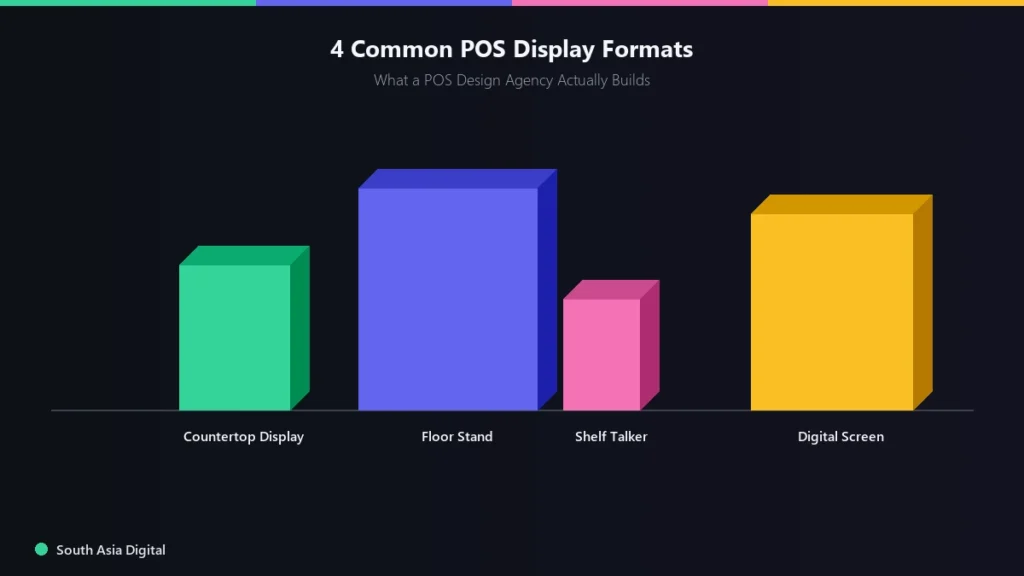
Bubble is a full-service creative and marketing agency offering dedicated point-of-sale design services. It can design countertop displays, window displays, freestanding display units, shelf talkers, promotional stands, retail signage, and digital screen displays. Bubble’s process covers planning, creative design, production preparation, and implementation; it states it can manage printing, logistics, and installation, while physical prototypes can be created where needed.
The agency also has branding and packaging designers in-house, making it possible to develop the packaging and POS materials as one connected visual system. The same principle should apply online: displays using QR codes, product demonstrations, or digital content need a fast, mobile-friendly destination supported by effective web design and development.
Why Bubble is included: it’s suitable when the main challenge is creating a consistent retail campaign rather than engineering a complex permanent fixture. Its integrated creative capabilities can help prevent the packaging, display, and promotional materials from looking like separate projects.
Potential limitation: Bubble is primarily a creative agency that manages production rather than a large specialist manufacturing company. Brands planning complex engineering or international mass production should clarify the production model and supplier responsibilities.
10. LX Concept
Best for: European campaigns combining POS materials, print, and branded promotional assets
Base and coverage: Belgium and surrounding European markets
Pricing: custom quotation
LX Concept provides campaign strategy, branding, graphic design, packaging, POS displays, and production. Its POS offering includes counter displays, shelf cards, posters, banners, floor graphics and doormats, cardboard and rigid signage, custom demonstration stands, themed in-store promotions, and 3D visualisations. Because LX Concept provides design and production services, it can carry a campaign across print, signage, packaging, promotional items, and physical retail materials.
Why LX Concept is included: it’s a practical choice for brands that require a coordinated set of campaign assets rather than one technically complex display structure. Its Belgium base can also be useful for campaigns centred on Benelux or nearby European markets.
Potential limitation: its public website provides less information about structural engineering, physical prototype testing, and international installation than several of the specialist manufacturers ranked above.
Which POS Display Agency Is Best for Your Project?
There is no single agency that will be the best choice for every retail campaign.
| Project requirement | Agencies to consider |
|---|---|
| Complete international design-to-deployment service | KSF Global or ARNO |
| Australian retail rollout | Genesis Retail Displays |
| Strategy and shopper experience | Medallion Retail |
| High-volume corrugated displays | Smurfit Westrock or Great Northern Instore |
| Permanent US retail displays | Frank Mayer |
| Permanent branded installations | IGE Group or ARNO |
| Packaging and POS creative under one agency | Bubble |
| European campaign materials | LX Concept |
| Interactive or digital display integration | Genesis, IGE or Great Northern |
| Warehousing and multi-location distribution | KSF Global or Frank Mayer |
Use this table as a starting point rather than a final appointment decision. The quality of the outcome will also depend on the project team, budget, retailer requirements, production volume, and available schedule.
POS Design Agency vs Display Manufacturer
A POS design agency and a display manufacturer do not always perform the same job.
A creative design agency may help with shopper messaging, campaign concepts, graphic design, packaging consistency, display artwork, digital mock-ups, and brand guidelines.
A specialist display manufacturer may help with structural engineering, materials, physical prototypes, weight testing, tooling, manufacturing, assembly, warehousing, freight, and installation.
Some companies on this list provide both services. Others concentrate more heavily on either creative development or physical production. Before requesting proposals, decide whether you need creative design only, a production-ready structural design, design and prototyping, design, manufacturing and delivery, or a complete programme covering design, production, distribution, and installation. This prevents you from comparing proposals that cover entirely different scopes.
What Should a POS Display Design Brief Include?
A useful brief should give the agency enough information to design for the real retail environment.
Product information. Provide the product dimensions, packaged weight, number of product variations, and how customers are expected to interact with it.
Retail environment. Name the retailers or store formats involved. Include allocated floor or shelf space, height limits, retailer specifications, safety rules, and installation restrictions.
Campaign objective. Clarify whether the display needs to introduce a new product, improve visibility, explain an unfamiliar product, encourage trial, support a promotion, increase basket size, hold additional stock, or create a premium brand experience.
Brand and message. Provide your visual identity, packaging files, campaign assets, and the main customer message. The display headline and benefit hierarchy should align with your wider content marketing strategy so shoppers receive a consistent explanation across physical and digital channels.
Display lifespan. State whether the display is required for a short promotion, several seasonal campaigns, or a permanent installation.
Production quantity. The number of stores and displays can significantly affect material choices, production methods, and unit economics.
Distribution and installation. Explain whether completed displays need to be delivered to one warehouse, multiple distribution centres, or individual stores, and clarify who will assemble and install them.
Measurement. Define what success means: product sales, units sold per store, display compliance, customer interactions, QR-code scans, product demonstrations, dwell time, or stock replenishment frequency.
How to Evaluate POS Display Agencies
Ask for photographs from real stores. Renders are useful during design, but they don’t show how a display performs under store lighting, beside competing products, or after repeated customer contact. Ask to see installed display photographs, close-ups of joints and finishes, displays holding the actual product, different store environments, and photographs taken after the initial installation.
Review relevant projects. A visually impressive cosmetics display does not automatically prove that an agency can engineer a heavy power-tool unit or distribute thousands of cardboard stands. Look for projects with similar product weight, display lifespan, materials, store count, retail environment, customer interaction, and geographic coverage.
Ask what happens after approval. Clarify who is responsible for engineering, prototyping, material testing, tooling, manufacturing, quality control, packing, freight, store installation, and replacement parts.
Request a physical prototype. A physical prototype can expose issues that are difficult to see in a digital render, including incorrect product fit, weak shelves, poor balance, difficult assembly, blocked product access, inaccurate colours, excessive weight, unclear messaging, and accessibility problems.
Check the retailer’s requirements. The display must comply with the retailer’s specifications, not only the brand’s creative preferences. Confirm requirements covering maximum dimensions, weight, materials, fire resistance, stability, sharp edges, electrical safety, accessibility, assembly time, and disposal and recycling.
Compare complete costs. The cheapest design quotation may not produce the lowest final project cost. Request an itemised proposal covering creative design, structural engineering, prototype rounds, tooling, materials, printing, manufacturing, packing, warehousing, freight, duties, installation, replacement units, and project management, so it’s easier to compare agencies using the same scope.
What Materials Are Used for POS Displays?
Corrugated cardboard is commonly used for temporary campaigns, floor-standing display units, shelf-ready packaging, and countertop units. It’s lightweight, printable, and generally easier to transport than permanent fixtures, though coatings, laminates, plastic accessories, and adhesives can affect whether the complete display is recyclable.
Acrylic and plastic are used for clear product holders, illuminated displays, premium countertop units, and reusable fixtures. They create a more permanent finish than cardboard but may cost more to manufacture and transport.
Wood and engineered wood are frequently used for permanent displays, premium products, and shop-in-shop environments. The design must account for weight, store installation, and long-term wear.
Metal can provide strength for heavy products and long-term retail installations, and may be combined with wood, acrylic, wire, graphics, and lighting.
Digital components can include screens, lighting, touch interfaces, sensors, product demonstrations, and QR codes, and require additional planning for power, software, content updates, maintenance, and technical support.
How Much Does POS Display Design Cost?
There is no reliable standard price for a custom POS display. Cost depends on display size, materials, structural complexity, number of prototype rounds, printing and finishes, production quantity, tooling, electronics, packaging, freight, installation, number of stores, and countries involved.
A temporary cardboard countertop unit and a permanent interactive shop-in-shop display are fundamentally different products. Price comparisons are only useful when every agency is quoting against the same brief and responsibilities.
How Long Does a POS Display Project Take?
The schedule should be divided into separate stages: briefing and retailer requirements, initial concepts, design revisions, structural engineering, prototype production, prototype testing and approval, manufacturing, quality control, packing and freight, and store installation. Permanent, interactive, and international projects usually require more coordination than temporary, locally produced materials.
Ask every agency to identify the approval deadline, the final artwork deadline, the prototype lead time, the manufacturing lead time, freight time, installation dates, and contingency time. Don’t base the schedule only on the promised manufacturing date; a display that’s completed but hasn’t reached the stores is not a completed campaign.
Frequently Asked Questions
What is point-of-sale display design?
Point-of-sale display design is the creation of physical retail materials used to present products, communicate promotions, and influence buying decisions inside a store. Examples include countertop units, floor-standing display units, shelf talkers, endcaps, pallet displays, signage, interactive displays, and digital screens.
Is POS display design the same as POS software design?
No. POS display design concerns physical merchandising and promotional materials in retail environments. POS software design concerns payment terminals, checkout interfaces, inventory systems, and transaction software.
What is the difference between POS and POP displays?
Point of sale generally refers to the location where the transaction is completed. Point of purchase can refer more broadly to the area where the customer considers and selects a product. In practice, POS display and POP display are often used interchangeably by agencies and manufacturers.
Do I need a design agency or a manufacturer?
Choose a design agency when you mainly need campaign strategy, messaging, artwork, and visual concepts. Choose a manufacturer when you already have a concept but need engineering, materials, prototyping, and production. Choose an end-to-end provider when you want one company to manage both stages.
Should I request a physical prototype?
A physical prototype is recommended when the display carries products, uses unfamiliar materials, contains interactive components, or will be produced in substantial quantities. It allows structural, visual, and usability problems to be corrected before full manufacturing begins.
Can one POS display work in every retailer?
Not always. Retailers can have different requirements for dimensions, materials, weight, safety, assembly, and product placement. A modular design may be adapted across several retailers, but the specifications still need to be checked individually.
How should I choose between the agencies?
Start with geography, project type, and required services. Then compare relevant case studies, prototype capabilities, production arrangements, logistics support, limitations, and the completeness of each quotation.
Final Recommendation
Choose the agency whose capabilities match the physical realities of your campaign, not simply the company with the most visually impressive portfolio.
For an international end-to-end programme, begin with KSF Global. For Australian retail distribution, consider Genesis Retail Displays. For US strategy-led programmes, review Medallion Retail. Smurfit Westrock is a strong candidate for scalable paper-based displays, while Frank Mayer is particularly relevant for permanent multi-location installations.
Before making a final appointment, send the same detailed brief to a shortlist of two or three companies and compare their proposed materials, prototype process, production responsibility, logistics, and total project cost.
South Asia Digital does not design or manufacture physical retail displays. However, we can support the online side of an omnichannel retail campaign through e-commerce strategy, content, and website development. Contact our team to discuss the digital experience supporting your in-store rollout.