
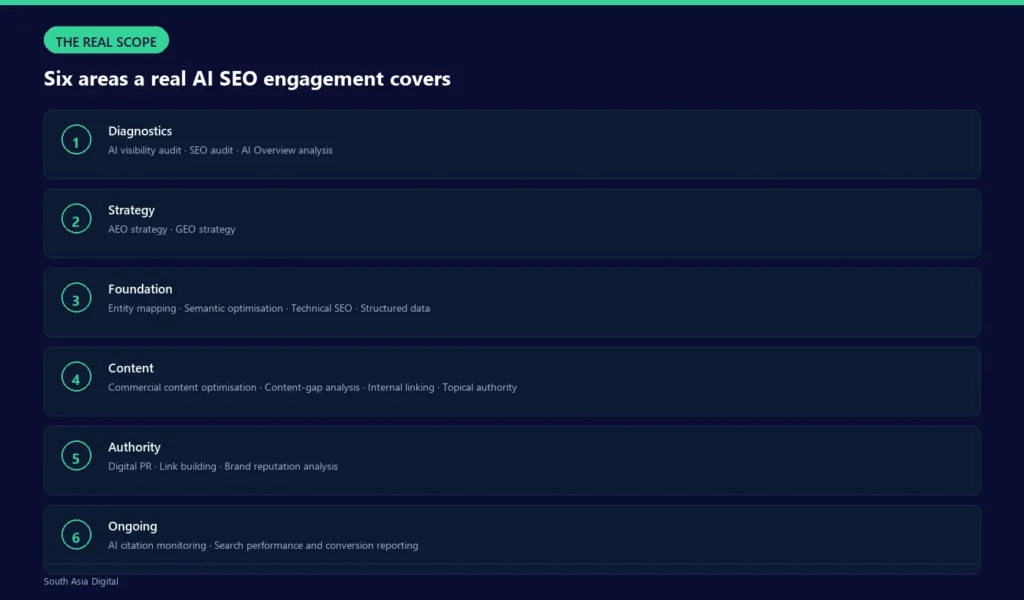
“AI SEO services” has become one of those phrases vague enough to mean almost anything, a single audit, a monthly content subscription, or a full program covering technical SEO, entity work, and AI citation tracking together. Before signing anything, it’s worth knowing what a genuine AI SEO engagement actually covers, and just as important, what the actual research says works versus what agencies simply claim works.
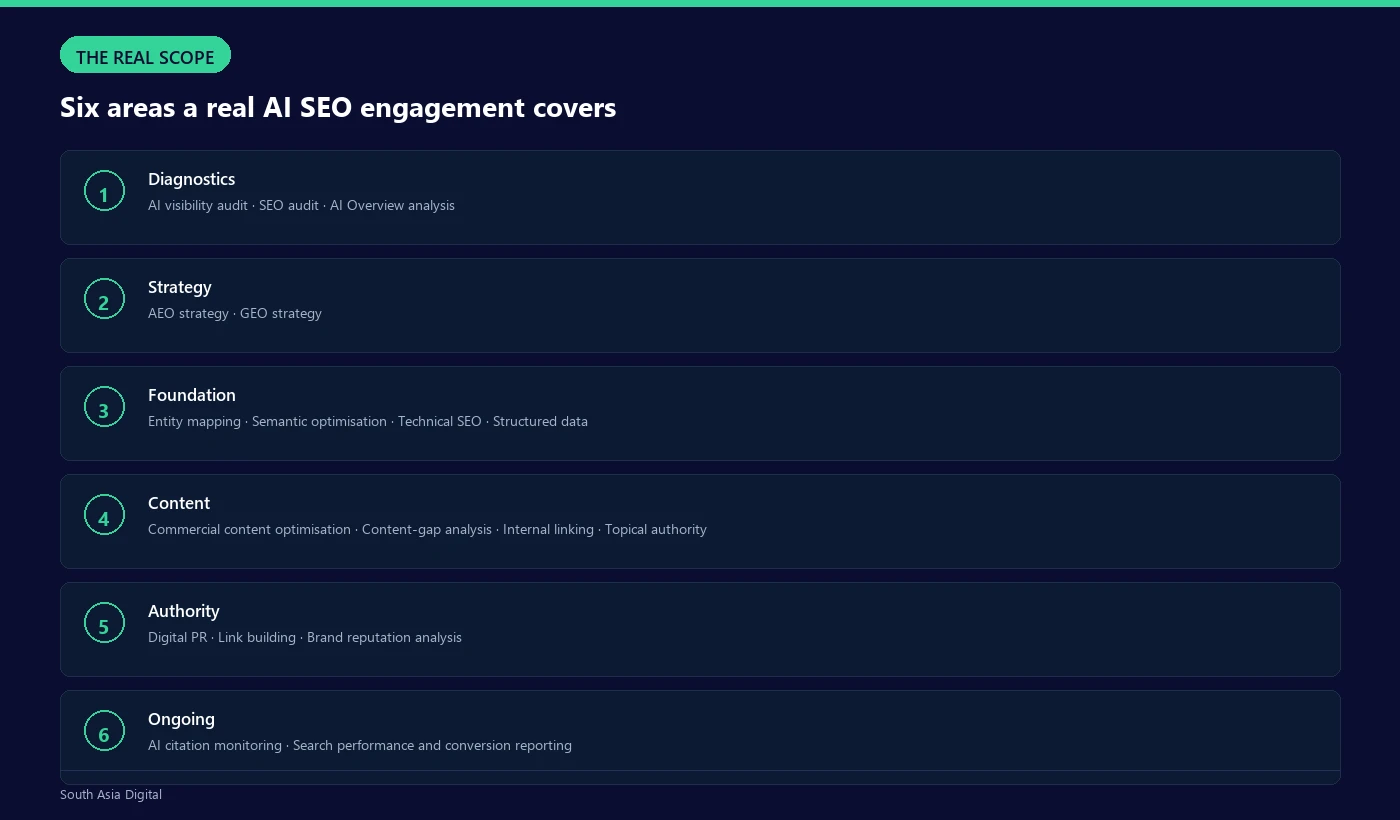
This breaks down what we actually include in our own AI SEO services, grouped into six areas, with real study data for each one, including where the research disagrees with itself.
Key Takeaways
- A real AI SEO engagement starts with diagnostics (AI visibility audit, SEO audit, AI Overview analysis) before any strategy gets written. The overlap between AI Overview citations and top-10 organic results reportedly fell from 76% to 38% during 2026, per one industry analysis, meaning ranking well is no longer a reliable predictor of getting cited.
- Structured data’s effect on AI citation is genuinely contested: Ahrefs’ controlled study of 1,885 pages found schema produced no measurable lift on AI Mode or ChatGPT and a 4.6% decline on AI Overviews, while separate association studies from UC Berkeley and Semrush reported 22-39% citation lifts. Both can’t be fully right, and we explain why below.
- Backlinks correlate weakly with AI Overview visibility (Ahrefs found r=0.218 for raw backlink count across 75,000 brands), while unlinked brand mentions correlate far more strongly (r=0.664 in the same study). Most link-building pitches for “AI SEO” don’t mention this.
- Topical authority, the breadth of a domain’s coverage within a subject, correlates with AI citation at r=0.41, reportedly a stronger predictor than Domain Authority.
- AI citation monitoring should be ongoing, not a one-time report, since citation status shifts as the underlying research above keeps changing month to month.
1. Diagnostics, before any strategy gets written
A real engagement starts by establishing where a site actually stands, not with a template strategy deck. That means an AI visibility audit (checking whether a brand currently shows up in ChatGPT, Perplexity, and Google AI Overviews for relevant queries), a standard SEO audit (crawlability, indexation, technical health), and specifically a Google AI Overview analysis, looking at which of a site’s existing queries are already triggering AI Overviews and whether the brand is being cited in them.
This step matters more than it used to. One industry analysis cited by SEOClarity/Brainlabs reports that the overlap between AI Overview citations and a page’s own top-10 organic ranking fell from roughly 76% to 38% over the course of 2026, and that Gemini cites Google’s own top-10 results only around 15% of the time. If that holds, a page ranking well is increasingly a weak signal for whether it’s actually getting cited, which is exactly why the audit step can’t be skipped in favor of assuming good rankings already cover it.
2. Strategy specific to AEO and GEO, not interchangeable with general SEO strategy
An AEO strategy (answer engine optimization, structuring content so it can be extracted as a direct answer) and a GEO strategy (generative engine optimization, structuring content and entities so generative AI systems can cite it accurately) are related to traditional SEO strategy but not identical to it. Both should be documented separately from a general content calendar, since answer-first structure and citation-readiness require different planning than a standard keyword-targeted content plan.
3. Foundational technical and semantic work, where the evidence is genuinely mixed
- Entity mapping: identifies the specific people, products, and concepts a site needs to be unambiguously associated with.
- Semantic optimisation: makes sure content uses language and structure that clearly signals meaning, not just keyword matches.
- Technical SEO: crawlability, site speed, indexation, exactly as important as it always was. No AI layer replaces it.
- Structured data: gives AI systems a machine-readable version of a page’s content, not just a human-readable one.
Here’s the part worth being honest about: the research on whether schema markup actually improves AI citation genuinely disagrees with itself.
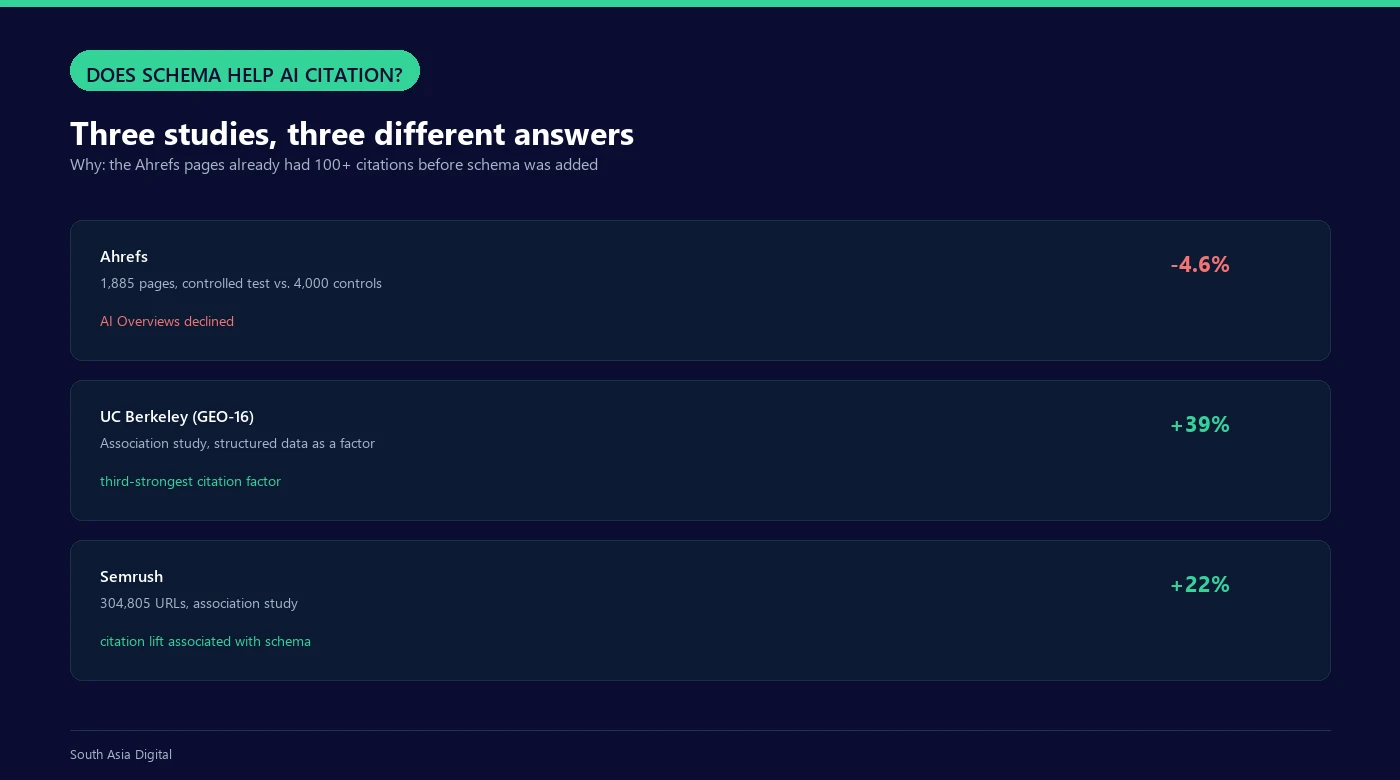
- Ahrefs (controlled test): 1,885 pages that added JSON-LD schema, matched against 4,000 control pages. AI Mode and ChatGPT barely moved (both statistically indistinguishable from noise). AI Overview citations actually declined about 4.6%.
- UC Berkeley (association study): structured data was the third-strongest factor associated with citation, a +39% lift.
- Semrush (association study, 304,805 URLs): a +22% citation lift associated with structured data.
Why the gap: Ahrefs’ test pages already had over 100 AI Overview citations each before schema was added, so the controlled test measures whether schema helps pages that already cite well, not whether it helps a page get noticed in the first place, which is closer to what the association studies capture. Our honest read: treat structured data as a baseline eligibility requirement and a genuine aid to machine parsing, not a guaranteed citation lever on its own.
4. Content work built for extraction, not just volume
- Commercial content optimisation: restructuring existing pages that should be converting but aren’t.
- Content-gap analysis: identifies what competitors cover that a site doesn’t.
- Internal linking: connects related content so both search engines and AI crawlers understand how pages relate to each other.
- Topical authority development: builds depth across a subject area over time, rather than isolated posts.
This is one of the better-supported areas in the research:
- Wellows study: topical authority, the breadth of keywords a domain ranks for within a subject, correlates with AI citation at r=0.41, reportedly explaining more variance than Domain Authority does.
- Kevin Indig’s research: 32.9% of pages cited by AI systems appeared only in “query fan-out” results, the related sub-questions a system generates around a main query, not the primary search itself. A single well-optimized page can miss a third of its real citation opportunity if the surrounding topic cluster isn’t built out.
- Semrush (50,000 brands): only 15.2% of ChatGPT product categories currently have a clearly dominant cited brand, meaning most categories are still genuinely contestable.
5. Off-site authority: the research says this differently than most pitches claim
Digital PR, link building, and brand reputation analysis remain part of a real AI SEO program, but the data suggests they matter for a different reason than agencies typically pitch them.
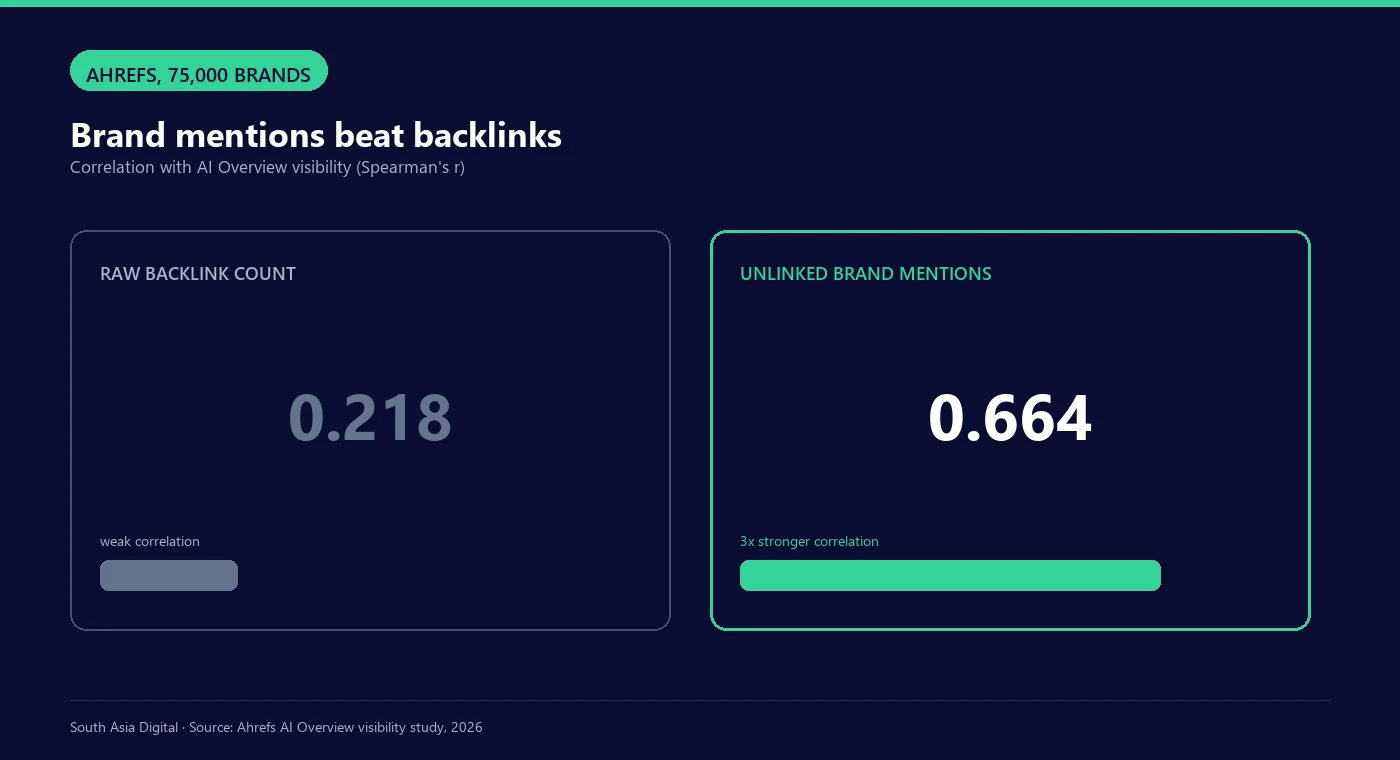
- Ahrefs (75,000 brands): raw backlink count correlated with AI Overview visibility at only r=0.218, Domain Rating at r=0.326, both weak. Unlinked branded web mentions correlated at r=0.664, roughly three times stronger.
- SALT.agency (5,825 URLs): backlinks correlated somewhat better with ChatGPT, Perplexity, and Gemini specifically (0.39-0.42) than with Google AI Overviews (around 0.25).
- Greenflag (finance pages): a tenfold difference in followed backlinks corresponded to only about 10% more citations, a much flatter relationship than traditional link-building pitches usually imply.
The practical read: link building still has a role, mainly as an eligibility threshold and because it often coincides with genuine brand mentions, but digital PR and brand reputation work that generates unlinked mentions in articles, forums, and reviews appears to carry more weight for AI citation specifically than pure link volume does. This is the opposite of how a lot of “AI SEO” packages are actually sold.
6. Ongoing monitoring, not a one-time report
AI citation monitoring tracks whether a brand is actually being cited by ChatGPT, Perplexity, and AI Overviews over time. Given how much the research above has shifted within a single year, the 76%-to-38% organic/AI-Overview overlap decline, the schema findings flipping depending on study design, this isn’t a category where a one-time audit stays accurate for long. Search performance and conversion reporting ties the whole program back to what actually matters: whether visibility is translating into traffic and revenue.
What this looks like as a checklist
| Area | What it should include | What the research shows |
|---|---|---|
| Diagnostics | AI visibility audit, SEO audit, AI Overview analysis | Organic/AI Overview overlap reportedly fell 76%→38% in 2026 |
| Foundation | Entity mapping, semantic optimisation, technical SEO, structured data | Schema evidence genuinely conflicts: null/negative in controlled tests, +22-39% in association studies |
| Content | Content-gap analysis, internal linking, topical authority | Topical authority r=0.41 with citation; 32.9% of cited pages found only via fan-out queries |
| Authority | Digital PR, link building, brand reputation analysis | Brand mentions r=0.664 vs. backlinks r=0.218-0.326 |
If an agency’s proposal is missing more than one or two of these six areas, or pitches heavy link building as the primary AI SEO lever without mentioning brand mentions at all, it’s worth asking why directly. For more on how to tell whether a specific consultant is actually doing this work, see our guide to vetting an AI SEO consultant.
FAQ
What should be included in AI SEO services?
Six real areas: diagnostics, AEO/GEO strategy, foundational technical and semantic work, content built for extraction, off-site authority, and ongoing AI citation monitoring. A package missing most of these is incomplete, not a budget-friendly version of the same thing.
Does adding schema markup actually improve AI citations?
The evidence genuinely conflicts. Ahrefs’ controlled study found no measurable lift on AI Mode or ChatGPT and a decline on AI Overviews, while separate association studies from UC Berkeley and Semrush found 22-39% lifts. The likely explanation is that those studies measured different things, schema’s effect on pages that already cite well versus its effect on getting noticed at all. Treat schema as a baseline requirement, not a guaranteed growth lever.
Do backlinks still matter for AI SEO?
Less than most link-building pitches suggest. Ahrefs found raw backlink count correlated weakly with AI Overview visibility (r=0.218) across 75,000 brands, while unlinked brand mentions correlated far more strongly (r=0.664). Backlinks still function as an eligibility threshold, but brand mention volume appears to be the stronger lever specifically for AI citation.
How often should AI citation monitoring happen?
It should be ongoing, not a one-time report. The underlying research itself is shifting quickly, organic-to-AI-Overview overlap dropped significantly during 2026 alone, so a single snapshot audit goes stale within months, not years.