
Most agencies pitching “AI SEO” right now are running the same process they ran in 2022 with the word “AI” added to the proposal. That’s not automatically a scam, some of the fundamentals genuinely haven’t changed, but it means the label alone tells you nothing. The only way to actually tell a real AI SEO consultant from a relabeled one is to ask specific questions and see whether the answers are specific back.
This is a practical vetting checklist, not a sales pitch. We cover what we think honestly matters, including questions that would make us uncomfortable too if we couldn’t answer them well.
Key Takeaways
- A real AI SEO consultant treats ChatGPT, Perplexity, and Google AI Overviews as genuinely different systems with different citation behavior, not one undifferentiated “AI” target.
- Ask to see actual schema markup they’ve deployed for a real client. “We do structured data” without a live example is not an answer.
- Ask whether their changes survive if you cancel the contract. If the work disappears the moment you stop paying, it was rented visibility, not owned improvement.
- Ask directly whether any past client got penalized and how it was handled. A consultant with zero penalty history across enough clients has either been lucky or hasn’t been doing this long.
- Generic recommendations that would read identically for any business in your niche are the clearest sign nobody actually looked at your site.
What a real AI SEO consultant actually does differently
The honest answer is: less than most sales pages suggest. Crawlability, site speed, backlinks, and keyword relevance are still the foundation, no AI layer replaces that. What changes is the content layer, specifically answer-first structure, entity clarity, and structured data built so both a human reader and a language model can extract a clear answer, the same distinction we lay out in full when comparing AI SEO agency work against traditional SEO work. This article is narrower: how to tell whether a specific consultant is actually doing that work, or just using the term.
The one question that separates a real answer from a rehearsed one
Before the full list, here’s what a single question actually sounds like asked both ways, because the difference is more obvious in dialogue than in a bullet point.
You ask: “If I cancel after six months, does the work we did stay in place?”
Rehearsed answer: “Absolutely, we build for the long term and our clients see compounding results that continue well beyond any engagement.”
Real answer: “The schema markup, the content restructuring, and the technical fixes stay, those are changes to your site, not ours. What stops is the monitoring and the monthly adjustments, so you’d lose the ongoing optimization layer, not the foundation we already built.”
Notice the real answer names specific things (schema, content restructuring, technical fixes) and specific things that stop (monitoring, monthly adjustments). The rehearsed answer is confident and says nothing concrete. That gap, specific versus confident-sounding, is the pattern to listen for across every question below.
Questions to ask before you hire
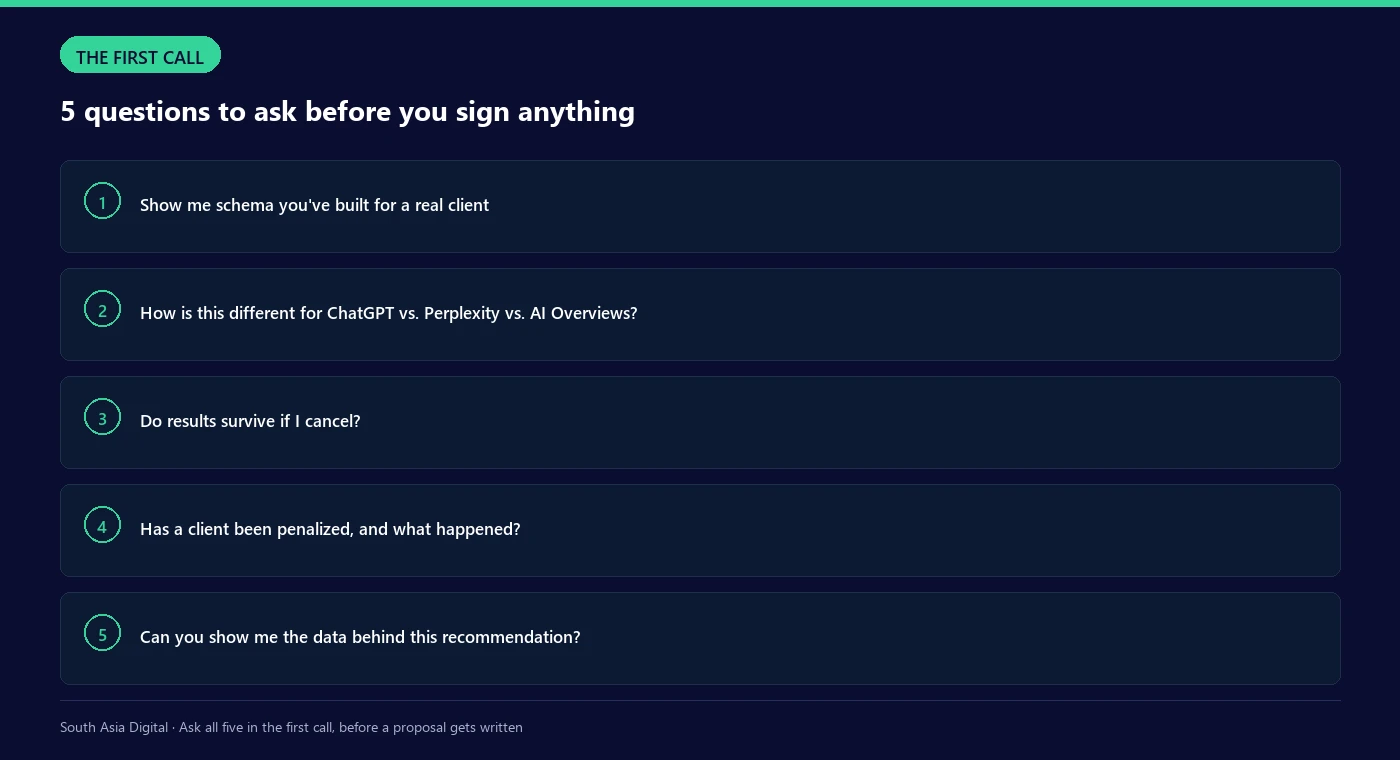
Ask all of these in the first call, before any proposal gets written.
“Show me schema markup you’ve deployed for a real client”
Not a slide with a generic code snippet, an actual live URL where you can view page source and see FAQPage, Article, or Organization schema in place. If they can’t pull this up on the call, they haven’t done it recently enough to have an example ready.
“How is your approach different for ChatGPT versus Perplexity versus Google AI Overviews?”
These three systems retrieve and cite sources differently, Perplexity runs a live web search on every query with no exceptions, while ChatGPT decides per-query whether a search is even worth running. A consultant who gives you one undifferentiated “AI optimization” answer for all three either doesn’t know the difference or is choosing not to explain it.
“Has a past client been penalized, and what happened?”
A flat “never” from someone who’s worked with dozens of clients over several years is a bigger red flag than an honest answer involving a real penalty and a real recovery process. Google’s algorithm changes enough that a consultant who’s been doing real, substantive work for long enough has almost certainly navigated at least one update that hurt a client. How they describe handling it tells you more than whether it happened.
“Can you show me the data behind this specific recommendation for my site?”
Ask them to pull up your actual Search Console or analytics data and explain a recommendation in reference to it. A recommendation that would read identically if you swapped in a competitor’s name is generic advice repackaged as a strategy, the same test we’d want applied to our own proposals before anyone signs one.
Red flags
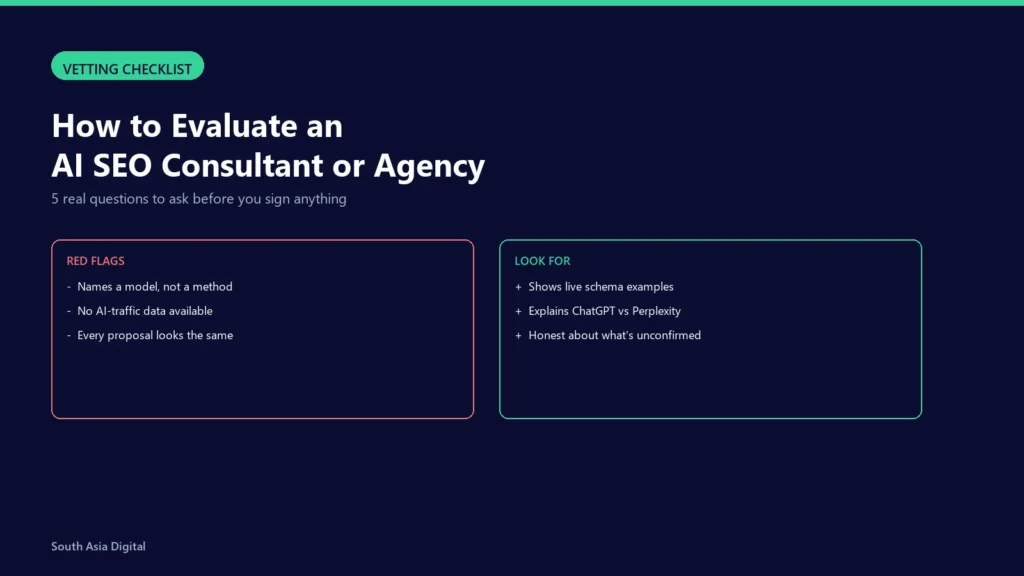
- They answer “what’s your method” with a model name. “We use GPT-4 and Claude” describes a tool, not a methodology. Ask what they actually do with those tools.
- Content volume gets pitched as the strategy. Large quantities of AI-generated, informational-only content marketed as “building topical authority” without any conversion-focused content mixed in is a volume play, not a strategy.
- Link building that sounds risky when described plainly. Paid placements at scale, link exchanges, or anything resembling a private blog network are the same red flags they always were, AI framing doesn’t change what Google’s spam policies actually penalize.
- They go quiet when asked for AI-traffic-specific data. If they’re selling AI visibility but can’t tell you what share of your traffic currently comes from AI Overviews, ChatGPT, or Perplexity referrals, they’re not actually tracking the thing they’re charging you to improve.
- Every proposal looks the same. If the strategy document could be handed to any business in your general industry with the name swapped, nobody did real research on your specific site, the same generic-recommendation test from the question above, just visible before you’ve even hired them.
Look for
- They ask for access before they pitch. A consultant who wants to see your Search Console, analytics, and current site structure before proposing anything is working from your actual data, not a template.
- They talk about reversibility. A real answer to “what happens if this change doesn’t work” includes how it gets rolled back, not just how it gets implemented.
- They stay current on platform-specific changes. Google’s AI features and documentation change often enough that a consultant who can’t name a recent change without checking notes is behind, not just being modest.
- They’re honest about what’s unconfirmed. None of the major AI platforms have published an exact, confirmed citation ranking formula. A consultant who says so plainly, rather than promising a guaranteed formula, is telling you the truth about the current state of the field.
How to run the actual vetting call
| You ask | Red flag answer | Real answer |
|---|---|---|
| What’s your methodology? | Names an AI model or tool | Describes a specific process with steps |
| Show me schema you’ve built | Generic slide or none available | Live URL, visible in page source |
| Do results survive cancellation? | Confident, no specifics | Names exactly what stays and what stops |
| Has a client been penalized? | Flat “never,” no detail | Honest account, explains recovery |
We built our own AI SEO work around the same four questions above, and our case studies are the live URLs we’d actually hand you if you asked the schema question yourself.
FAQ
How do I know if an “AI SEO” pitch is just relabeled traditional SEO?
Ask how their approach differs for ChatGPT, Perplexity, and Google AI Overviews specifically. A relabeled pitch treats all three as one undifferentiated target. A genuine AI SEO approach explains the real behavioral differences between them, since each platform retrieves and cites sources differently.
What’s the single best question to ask an AI SEO consultant?
Whether their changes survive if you cancel. Real technical and content improvements stay in place after the engagement ends. If the value disappears the moment you stop paying, you were renting visibility through some ongoing mechanism, not building anything durable.
Should I be worried if a consultant admits a past client got penalized?
No, the opposite. A consultant who’s worked with enough clients over enough time has likely navigated at least one Google algorithm update that caused a problem. An honest account of what happened and how it was handled is a stronger signal than a flat denial that it’s ever happened.
Is it a red flag if a consultant can’t guarantee AI citation results?
No, the opposite is true. No AI platform has published a confirmed, exact citation ranking formula, so anyone guaranteeing specific AI citation results is overstating certainty that doesn’t exist yet. Honesty about that uncertainty is a sign of a consultant telling you the truth about the current state of the field.