
Inactive
Simplifying IT
for a complex world.
Platform partnerships
- AWS
- Google Cloud
- Microsoft
- Salesforce
AI chatbots
We build AI chatbots that answer real customer questions from your own content, capture leads, and hand over to a person when they should.
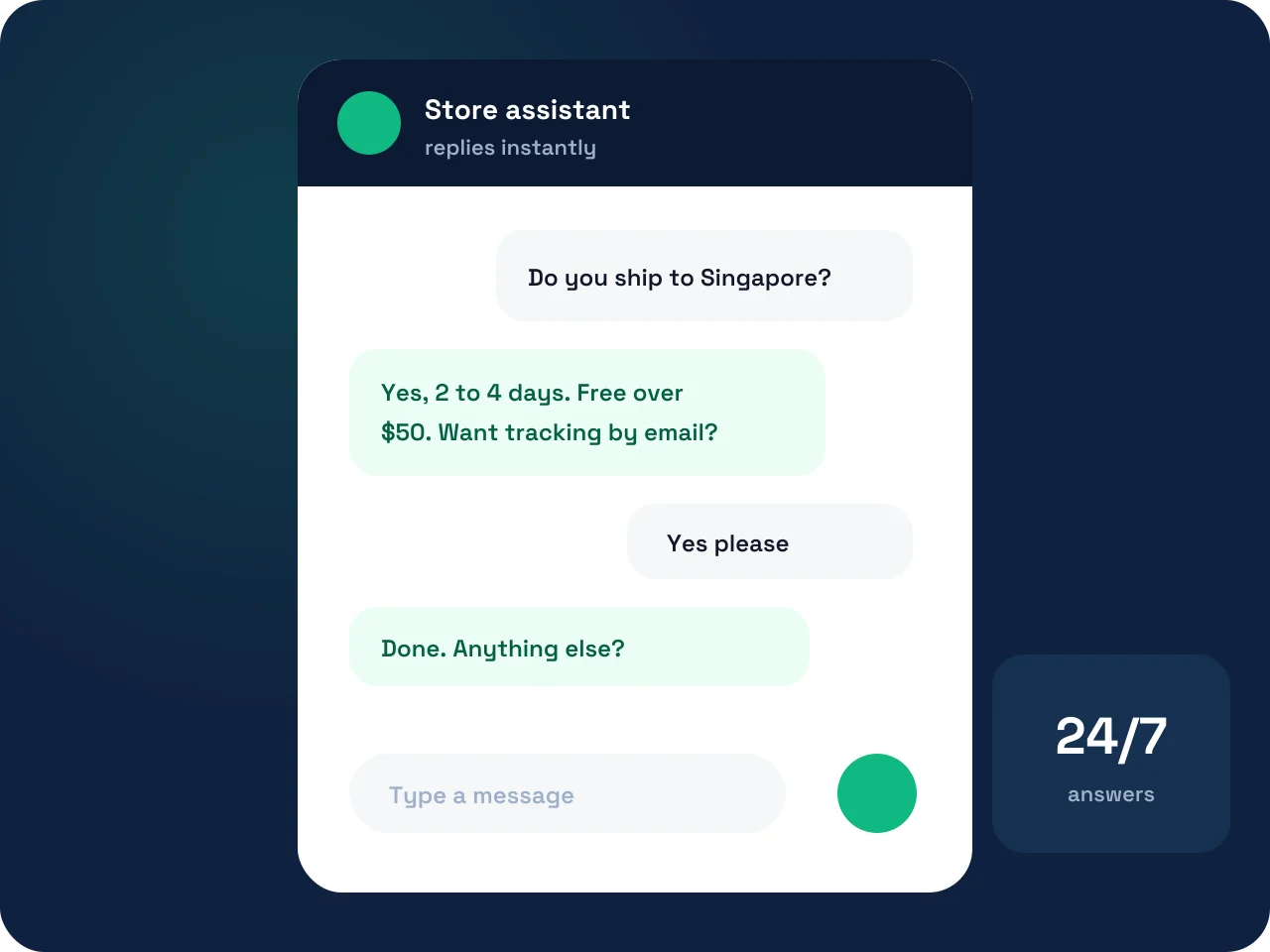
AI chatbot development is the work of designing, building and testing a conversational system that answers questions, qualifies leads or handles support, using your own content and systems instead of guessing. It is not plugging in a generic model and calling it done.
Properly done, it means defining what the bot should and shouldn’t answer, connecting it to your real help docs, product data or CRM, and testing it against odd, off-topic and edge-case questions before it ever talks to a customer.
See how this plays out in our case studies, or read about our how to measure chatbot ROI if you want to know what to track after launch.
The technology is good now. The setup usually isn’t.
A bot without your real content behind it will guess. Customers notice.
Being stuck in a loop is the fastest way to lose a sale.
Without tracking, you can’t tell if the bot helps or hurts.
Scoped around your real questions.
What people usually want to know when they first look into a chatbot build.
A rule-based bot follows fixed decision trees: if the customer says X, show reply Y. It’s predictable but breaks the moment someone phrases a question differently.
An LLM-powered bot reads the actual question and answers from your content, which handles more variation but needs guardrails so it doesn’t wander off-topic or invent an answer.
Most builds either call a model through an API and wrap it with your own logic and content, or start from a no-code chatbot builder and configure it for your use case.
API-based builds give more control over scope, guardrails and integrations. No-code builders are faster to launch but limit how much you can customise the handover and testing steps.
A website widget is the usual starting point, but most support and sales questions on this agency’s client base come through WhatsApp as well.
Where your customers already ask questions should decide where the bot lives, not the other way round.
Before any content gets connected, we define what the bot should answer, what it should hand off, and what it should simply decline.
A bot with no defined scope will try to answer everything, which is exactly how it starts making things up.
Before launch, we run the bot through odd, unrelated and edge-case questions on purpose, to see where it guesses instead of saying it doesn’t know.
A bot that can’t admit uncertainty will eventually give a customer a wrong answer with full confidence.
Your content changes, prices change, policies change. A chatbot connected to stale content starts giving stale answers.
We build in a update and review cycle so the bot keeps reflecting what’s actually true about your business.
Scope comes before code. Testing comes before launch.
1Week 1
We map the questions the bot should answer, what it should hand off, and what content it will draw from, help docs, product pages, policies.
You get: a clear scope document before anything gets built.
2Weeks 2–3
We connect the bot to your real content and systems: website, WhatsApp, Shopify, CRM or helpdesk, and set up the handover path to a person.
You get: a bot wired into the tools you already use.
3Before launch
We deliberately throw odd, off-topic and ambiguous questions at the bot to see where it guesses instead of saying it doesn’t know or handing over.
You get: a documented list of what the bot was tested against before it talks to a customer.
4Ongoing
You get reporting on questions, leads and resolution rate, and we update the bot’s content as your business changes.
You get: a bot that keeps matching what’s actually true about your business.
Chatbot capability is easy to oversell in a demo. These checks help you see past that.
Written by Nadir Yaqoob, Founder of South Asia Digital · Last updated October 2026
We treat a chatbot as a scoped, tested system before it’s a sales feature: what it should answer, what it should hand off, and what happens when it isn’t sure, are decided and tested before launch, not discovered afterwards from complaints. See examples of our work on the case studies page.
We are a Dubai-based agency and we work with clients worldwide. Chatbot builds, integrations and ongoing maintenance are largely remote, so this applies equally wherever your customers are.
Sources we draw on: OpenAI’s safety best practices documentation · NIST’s AI Risk Management Framework · Nielsen Norman Group’s chatbot UX research.
This work is priced by scope, so we’ll give you a fixed quote after a 20-minute call. No hourly surprises.
Your own content: help docs, product pages and policies you give us. It does not invent answers from general internet knowledge.
Yes. We build for website, WhatsApp and Shopify, depending on where your customers already ask questions.
It hands over to a person by email, WhatsApp or your CRM instead of guessing. Where that handover point sits is something we tune with you.
Most builds go live in two to four weeks once we have access to your content and target platforms.
A rule-based bot only matches fixed phrases and breaks on anything unexpected. An AI chatbot reads the actual question and answers from your content, but needs scope and testing so it doesn't wander off-topic.
Before launch we run the bot through odd, unrelated and edge-case questions on purpose, to see where it guesses instead of saying it doesn't know or handing over to a person.
No. The bot answers from the content and systems you give it; it isn't used to train a general-purpose model. We can confirm the specific data handling for your build on a call.
There isn't a fixed price because it depends on how many conversation flows and integrations are involved, and whether custom training is needed. We give a fixed quote after a short call rather than billing by the hour.
Both are possible. A one-time build covers the initial scope and launch. Ongoing work adds maintenance and retraining as your content, prices or policies change, which keeps the bot's answers accurate over time.
Book a strategy call. Send us your URL beforehand and we’ll have already looked at it when we talk, so you get specifics, not a sales pitch.