
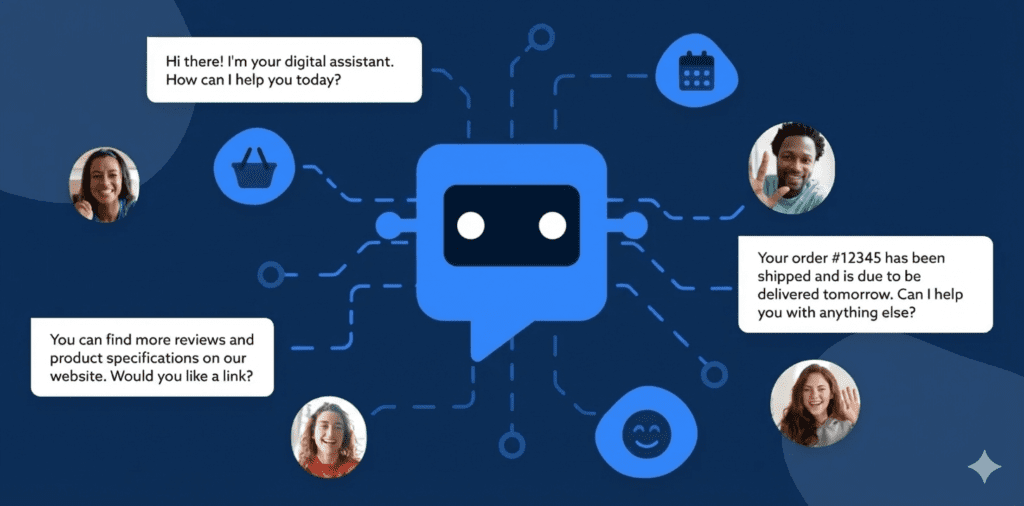
A chatbot can sound impressive and still waste money. When people ask, “Does anyone have a chatbot that has actual and measurable ROI?” they want proof, real numbers, a clear before-and-after story showing the bot saved time, cut costs, or helped customers buy.
This guide explains how measurable chatbot ROI works in 2026, how to track it without guessing, and which tools make it easiest to prove.
What “Measurable Chatbot ROI” Actually Means
Measurable ROI means the chatbot creates value you can count. It is not “more chats” or “more messages”; it is fewer tickets, faster answers, lower support costs, or more sales.
This matters because customer expectations have risen sharply. According to Zendesk’s 2026 CX Trends Report, 81% of consumers now expect instant responses, and 74% expect support to be available around the clock.
And if you sell online, hesitation costs money. Baymard Institute’s 2026 data puts average documented cart abandonment at 70.19%, meaning most shoppers who add to cart never complete their purchase.
A well-built chatbot does not just talk. It removes friction at the exact moment customers need an answer.
Why Most Chatbots Fail to Deliver ROI
Most chatbot ROI problems come from predictable mistakes. Teams launch a bot, see more activity, and assume it is working. Measurable ROI only appears when the bot reduces real work and improves real outcomes.
| Failure Reason | What It Looks Like | Why It Hurts ROI |
|---|---|---|
| Wrong metrics | Tracking chat volume, not outcomes | “Chats started” proves nothing about savings or sales |
| No system integrations | Bot cannot access orders, returns, or policies | High escalation rate, low containment |
| Poor escalation rules | Bot guesses instead of handing off | Wrong answers create refunds and complaints |
| No post-launch owner | Nobody reviews failed conversations | Performance stalls, ROI flatlines |
| No baseline set | No “before” data to compare | Cannot prove improvement to stakeholders |
Two Chatbot ROI Paths That Work
A chatbot creates measurable ROI in two main ways. The strongest programmes track both simultaneously because savings and sales often happen at the same time.
Path 1 – Cost-Saving ROI (Support Automation)
This is the fastest ROI path for most businesses. The chatbot handles repeat questions without agent time, and as containment grows, the support queue shrinks.
Common wins include order tracking queries, shipping timelines, returns and exchange policies, store hours, and basic product questions. These are high-frequency, low-complexity tickets that drain agent time daily.
Path 2 – Revenue ROI (Sales Assistance)
This path improves conversion by answering buying questions instantly. It reduces hesitation and prevents checkout drop-offs at the moments customers are most likely to leave.
Common wins include size and availability questions, delivery timelines, return policy clarifications, and payment method queries. Answering these in real time keeps the purchase moving forward.
4 Metrics That Prove Chatbot ROI
These four metrics give the clearest picture of whether a chatbot is delivering real business value. They connect bot activity directly to cost savings and revenue outcomes.
| Metric | What It Measures | What a Good Result Looks Like |
|---|---|---|
| Containment Rate | % of chats resolved without a human | 50–80% depending on use case |
| Ticket Deflection Rate | % of issues that never become tickets | Meaningful drop in helpdesk queue within 60–90 days |
| Cost Per Resolution | Cost to solve one customer issue | Should decrease as containment grows |
| Revenue Influenced | Sales attributed to or assisted by chat | Tracked via post-chat purchase events |
1) Containment Rate
Containment rate is the percentage of conversations the chatbot resolves without escalating to a human. This is the clearest signal that the bot is doing real support work rather than just generating chat activity.
When containment rises, your team handles fewer repeat questions, and your cost per resolution falls automatically.
2) Ticket Deflection Rate
Ticket deflection rate measures how many issues never become support tickets because the chatbot solved them or guided successful self-service. When deflection improves, response times usually improve too, because the queue is smaller.
This metric is especially powerful when you can show a downward trend in ticket volume week over week.
3) Cost Per Resolution
Cost per resolution is how much it costs to solve one customer issue across all channels. When a bot increases containment, this number should fall, making the ROI calculation straightforward.
Track this monthly and compare it against your pre-bot baseline to demonstrate financial impact clearly.
4) Revenue Influenced
Revenue influenced measures how much the bot contributes to completed purchases. Track it in two ways: attributed revenue (purchase immediately after chat) and assisted revenue (bot helped first, purchase came later).
Together, these tell you whether the chatbot is a sales tool, not just a support deflection layer.
A Simple Chatbot ROI Formula You Can Use Today
Use this formula to calculate and communicate ROI clearly to clients or stakeholders.
ROI (%) = (Net Benefit ÷ Total Cost) × 100
Total cost includes the monthly subscription, setup time, integrations, content work, and ongoing weekly maintenance — not just the platform fee.
Net benefit comes from two sources: support savings (tickets avoided × cost per ticket) and revenue lift (extra sales influenced by chat). Add both together before dividing by the total cost.
How to Measure Chatbot ROI Without Guessing
Clean tracking is the difference between proving ROI and assuming it. The goal is a reliable before-and-after view that stakeholders can trust.
Step 1 – Set a Baseline (14–30 Days Before Launch)
Record what normal looks like before the bot goes live. Track ticket volume by topic, average response time, resolution time, and conversion rate. Without a baseline, improvement is impossible to prove.
Step 2 – Start With High-Repeat, Low-Risk Questions
Begin with questions that happen every day — order tracking, delivery times, returns, payment queries. Quick wins build containment fast and create early proof for stakeholders.
Step 3 – Track Outcomes, Not Chat Activity
Do not only count chats started. Track what happened next: resolved by bot, escalated to human, ticket created, and purchase after chat. These outcome events are your actual proof metrics.
Step 4 – Build a Weekly ROI Scorecard
A weekly scorecard keeps the bot accountable. It tracks containment, deflection, cost per resolution, and revenue influence — and surfaces the top failed questions so you know exactly what to fix.
Step 5 – Improve Weekly Using Failed Conversations
ROI grows through small, consistent upgrades. Update weak answers, tighten escalation rules, improve links to help pages, and fix gaps in policy wording every week. Without this loop, performance stalls.
How to Choose a Chatbot That Can Deliver Measurable ROI
The simplest buying rule is this: pick a chatbot that shows proof metrics in reports you can export and act on.
| Buying Criteria | What to Look For | Red Flag |
|---|---|---|
| Reporting | Resolved vs escalated, trends over time | Only shows “chats started” |
| Integrations | Connects to helpdesk, CRM, order system | Standalone widget with no data links |
| Safe escalation | Hands off smoothly with context passed | Bot guesses or loops when unsure |
| Data exports | Works in your existing dashboards | Locked inside a proprietary report view |
| Pricing model | Tied to outcomes (resolutions, deflections) | Flat fee with no performance signal |
Top 5 Chatbots That Deliver Measurable ROI in 2026
These tools stand out because they connect chatbot performance to outcomes like resolutions, deflection rates, and revenue, not just conversation counts.
1) Intercom Fin AI Agent
Intercom makes ROI easier to prove because it uses resolution-based pricing. Fin is priced per resolved conversation, which means cost is tied directly to a measurable outcome rather than seat count or chat volume.
How it proves ROI: You can show exactly how many issues were resolved, what each resolution cost, and how that compares to agent-handled tickets.
Best for: SaaS support teams that need strong reporting and a clear, auditable definition of “resolved.”
2) Zendesk AI Agents
Zendesk supports measurable ROI through structured dashboards that show AI agent performance over time, volume handled, escalation patterns, and BSAT scores — all filterable and exportable.
How it proves ROI: Performance trends and coverage gaps are visible in a consistent report format that stakeholders can read without interpretation.
Best for: Teams already running Zendesk who want seamless dashboards and controlled support workflows.
3) Gorgias
Gorgias is built specifically for eCommerce, connecting chatbot ROI directly to Shopify workflows. Their platform targets high-volume tickets — order tracking, shipping status, returns — which are the easiest wins to measure and the fastest to deflect.
How it proves ROI: WISMO (Where Is My Order?) deflection and order-status containment are trackable in their native dashboard, with time-saved-per-agent reporting.
Best for: Shopify brands with repeat delivery and return queries, especially during peak sales periods.
4) ManyChat
ManyChat supports measurable ROI through conversion tracking across chat flows. You can tie lead captures, sign-ups, and purchases directly to specific DM automations on Instagram and WhatsApp.
How it proves ROI: Flow completion rates and conversion events give you a direct line between chat activity and commercial outcomes.
Best for: Brands using Instagram DMs and WhatsApp automations for lead generation and promotional campaigns.
5) Tidio Lyro AI
Tidio pushes measurable ROI through a resolution rate guarantee. If Lyro does not lift your resolution rate to at least 50%, Tidio offers a refund, making resolution rate the central proof number for every client conversation.
How it proves ROI: Resolution rate trend and handoff rate together tell a clear story: the bot is solving issues, or it is not.
Best for: SMBs that need quick setup, easy-to-read reporting, and a low-risk entry point into AI support automation.
The Most Common Chatbot ROI Traps (And How to Avoid Them)
Chatbot ROI fails for two main reasons: teams cannot measure outcomes clearly, or nobody improves the bot after launch. Both problems are avoidable.
| Trap | Why It Happens | The Fix |
|---|---|---|
| Tracking volume, not outcomes | Easy metrics feel like proof | Switch to containment, deflection, cost per resolution |
| No baseline before launch | Team skips the setup phase | Record 14–30 days of data before going live |
| Automating complex cases first | Ambition outpaces capability | Start with top 10 high-repeat, low-risk questions |
| Skipping integrations | Faster to launch without them | Connect helpdesk and order system before launch |
| No weekly review loop | Nobody owns post-launch performance | Assign one person to review failed chats every week |
Frequently Asked Questions
How do you measure the true value of an AI chatbot?
True value comes from outcomes you can track, not from chat volume. The clearest proof comes from four metrics: containment rate, ticket deflection rate, cost per resolution, and revenue influence.
Set a 14–30 day baseline before launch, track those four numbers weekly, and compare before vs after in a single scorecard. That is how you build a proof case that stakeholders trust.
Why are businesses adopting AI chatbots in 2026?
Businesses are adopting chatbots because customer expectations for instant, 24/7 support have reached a point where human-only teams cannot scale to meet them cost-effectively. A chatbot handles repeat questions instantly, reduces ticket load, and improves response times without adding headcount.
When connected to real systems, helpdesk, order data, and knowledge base, it becomes a measurable efficiency tool rather than a chat widget.
Is chatbot ROI only about hard numbers?
No. Chatbots create hard ROI and soft gains at the same time. Hard numbers include reduced tickets, lower support costs, and more conversions. Soft gains include better customer experience, faster replies, and higher trust because customers get clear answers when they need them.
Track both: ROI metrics prove the money impact, and satisfaction scores confirm the experience did not drop.
How do chatbots improve customer experience?
Chatbots improve customer experience by reducing wait time and removing confusion at key decision moments. They answer simple questions instantly, guide customers to the right page, and escalate to a human when the question requires one.
The best chatbots are accurate, consistent, and available around the clock — which makes customers feel supported rather than stuck.
What are the best chatbot options for enterprise businesses?
For enterprise, the best chatbot setups combine helpdesk and CRM integrations, strong governance and escalation rules, and dashboards that connect bot performance to business outcomes. Common enterprise-ready examples include support bots that resolve policy questions and route complex tickets, internal IT or HR bots that handle FAQs and create tickets when needed, and customer service bots that manage order tracking and returns with a human fallback for exceptions.
The right choice depends on which platform you already use, Zendesk, Intercom, Salesforce, or HubSpot,t and whether your primary goal is cost-saving or revenue ROI.
What types of AI chatbots work best on a website?
| Chatbot Type | Primary Goal | Best ROI Metric |
|---|---|---|
| Customer support bot | Reduce tickets, improve containment | Containment rate, cost per resolution |
| Sales guidance bot | Help customers choose and convert | Revenue influenced, cart abandonment rate |
| Lead generation bot | Capture and qualify leads | Lead capture rate, booked calls |
| Omnichannel bot | Web + WhatsApp + Instagram | Cross-channel containment |
| Hybrid bot | AI answers + human escalation | Containment + CSAT combined |
The strongest ROI usually comes from hybrid bots that combine accurate AI answers with clean escalation rules and full system integrations.