
Inactive
Simplifying IT
for a complex world.
Platform partnerships
- AWS
- Google Cloud
- Microsoft
- Salesforce
For real estate agents
When buyers and sellers search your name, they see Zillow, Realtor.com and Google profiles you may never have checked, sometimes shaped by people who were never your client. We help make sure what they find is accurate and fair.
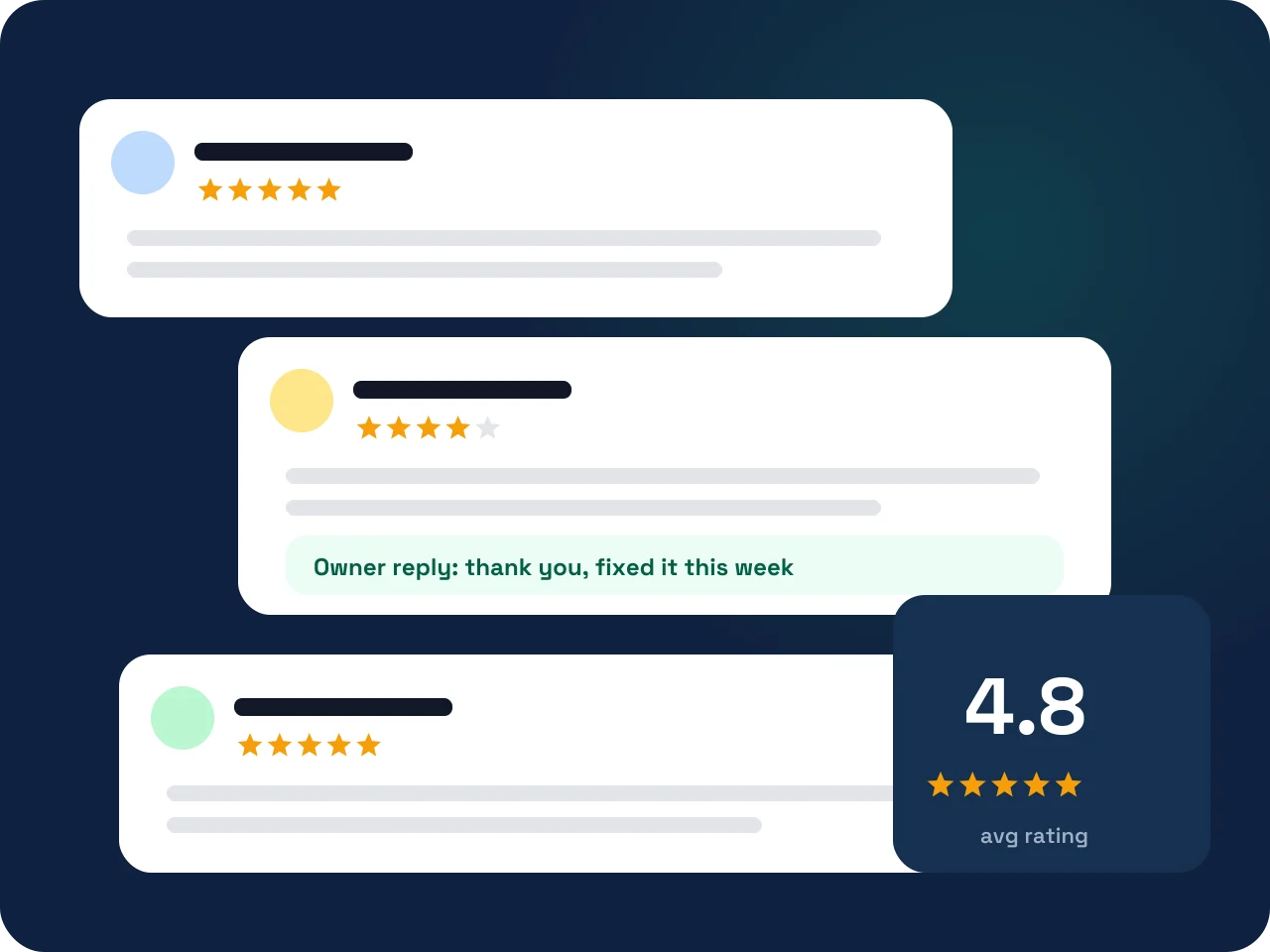
Reputation management for real estate agents is the ongoing work of making sure what buyers and sellers find when they search an agent’s name, or a brokerage’s name, is accurate, current and fair: correct profiles on sites like Zillow, Realtor.com and Trulia, a steady flow of genuine reviews tied to real closed transactions, and a considered way of responding to criticism that stays inside Fair Housing law and the NAR Code of Ethics.
It isn’t about hiding anything. The National Association of Realtors’ Code of Ethics and Fair Housing law limit what an agent can claim and how an agent can respond in public, so this work operates inside both constraints rather than around them.
It sits alongside, not instead of, your own brokerage and compliance obligations. See how this applies more broadly on our reputation management page.
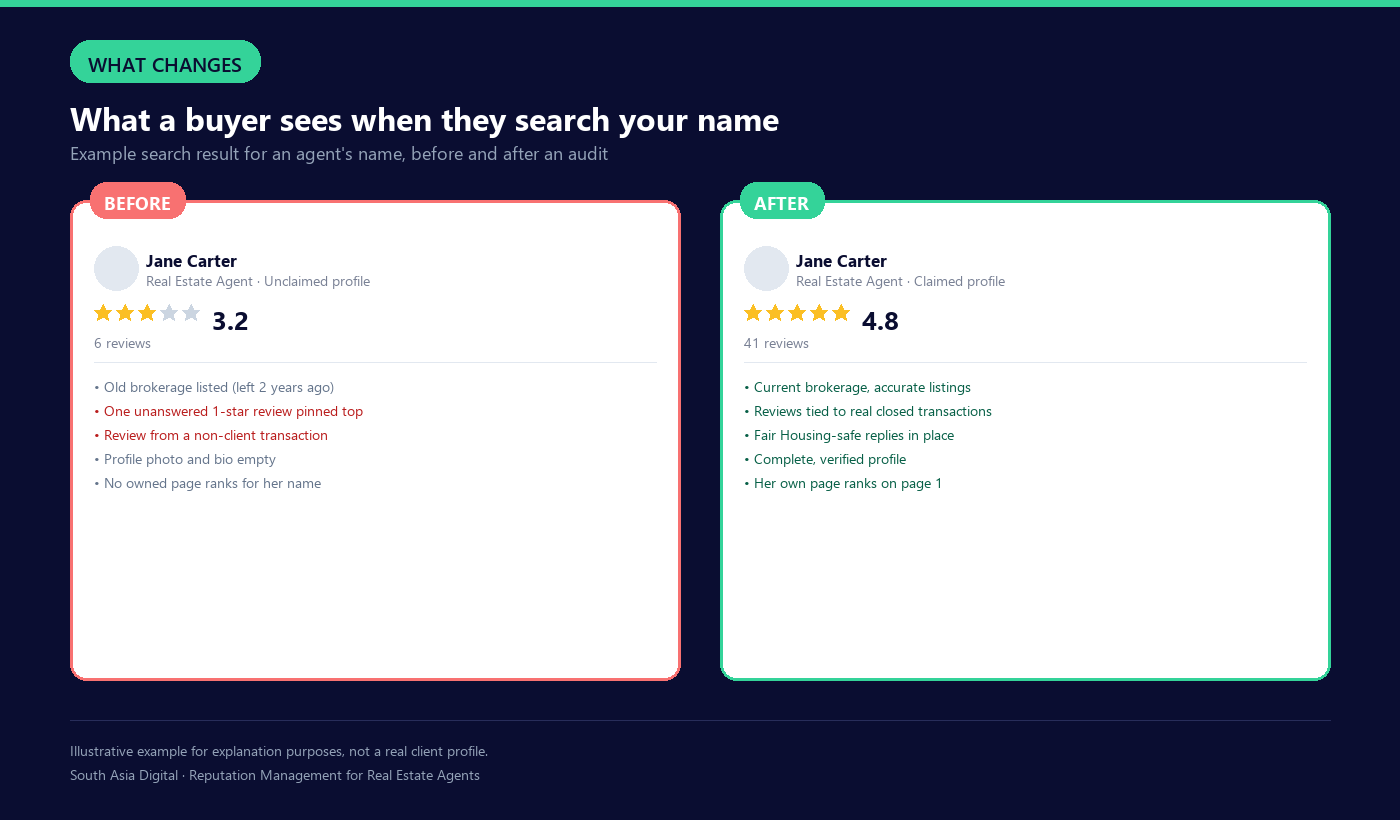
Most reputation problems get worse when ignored.
Zillow, Realtor.com and Trulia create agent profiles automatically, often with an old brokerage, missing listings or the wrong photo.
With few reviews, a single negative one shapes the whole picture.
Your name search is owned by directories, not you.
In a transaction, the other side’s agent represents a different client, but that client, or even the opposing agent, can sometimes leave a review that affects your name, and platform rules don’t always catch it.
Built on genuine reviews and accurate information.
We help you get more genuine reviews, respond well to criticism, and make sure the first page of results about you is accurate and up to date.
We don’t write fake reviews, we don’t try to get honest negative reviews removed, and we don’t promise to make legitimate news disappear. Those tactics break platform rules and usually make things worse when they come out.
We also won’t suggest reply language that could be read as steering, commenting on a neighborhood, a school district, or ‘who a home is right for’ is a Fair Housing risk even when the intent is harmless. That protects you and keeps every reply inside NAR’s Code of Ethics.
What agents and brokers usually want to know before they start.
A public reply that comments on a neighborhood, a buyer’s budget, or ‘the right fit’ for a property can brush up against Fair Housing language, even when the goal is just to correct the record.
The safer pattern is a short, general reply that invites the reviewer to contact you directly, without discussing the specifics of who they are or what they were looking for.
NAR’s Code of Ethics (Article 10, Fair Housing) and Standard of Practice 10-5 extend to all of a REALTOR’s public activity, which includes how you respond to reviews online, not just listing descriptions.
Review requests and responses need to stay inside those same limits, since they’re a form of your public communication as a REALTOR.
A review about slow communication or a missed showing is a different problem from one alleging misrepresentation or a Fair Housing violation, and the two shouldn’t get the same response.
The first can be acknowledged generally and taken as feedback. The second needs to go through your broker, your E&O insurer, or legal counsel, not a marketing reply.
These profiles are often built from MLS data, and the details, current brokerage, headshot, past sales, can be wrong or years out of date.
Each site has its own claiming and correction process. Zillow in particular ties reviews to a screen name tied to your public profile URL, so fixing one doesn’t fix the others.
You can ask every client, at closing, when the relationship is freshest. You can’t offer anything in exchange for a review, and Zillow specifically requires the reviewer to have been on your side of a real transaction, not just someone you met at an open house.
A routine that treats every closing the same way is what keeps review requests both effective and compliant with platform rules.
The reviewer is free to describe their own transaction in as much detail as they choose. You generally shouldn’t confirm, deny or add detail about a specific deal in a public reply, regardless of whether the review is accurate.
If the review alleges something serious, like misrepresentation or an ethics violation, that’s a conversation for your broker or legal counsel, separate from how it’s handled publicly.
The work moves in stages. Fixing what’s wrong comes first; a repeatable routine follows.
1Week 1
We review Zillow, Realtor.com, Trulia, Google and your name’s search results to find what’s wrong, outdated or missing.
You get: a clear list of what needs claiming or correcting, and where.
2Weeks 2–3
We claim and fix the profiles that are wrong, and put a Fair Housing-safe reply standard in place for handling criticism.
You get: accurate profiles and a clear standard for how your team responds.
3Ongoing
We set up a consistent way to ask every client for a review at closing, inside NAR’s Code of Ethics and each platform’s own rules.
You get: a steady flow of genuine reviews instead of a one-time push.
4Ongoing
We watch your name across these platforms and respond using the same Fair Housing-safe standard every time, not case by case.
You get: a plain report on what changed and what’s new.
Real estate adds Fair Housing and NAR ethics rules that general reputation advice ignores. These checks help you tell who actually accounts for that.
Written by Nadir Yaqoob, Founder of South Asia Digital · Last updated October 2026
We treat Fair Housing compliance as a constant, not a judgment call made reply by reply. Every response standard we build assumes a public reply should never comment on a buyer or seller’s background, a neighborhood’s demographics, or who a property is ‘right for,’ no matter how the review is worded.
This is reputation and marketing work, not legal advice. NAR’s Code of Ethics and Fair Housing rules can vary by state and local board, so specific compliance questions should go to your broker or legal counsel. We work with agents and brokerages worldwide; see examples of our broader work on the case studies page.
This work is priced by scope, so we’ll give you a fixed quote after a 20-minute call. No hourly surprises.
Yes. Keep the reply general, invite the reviewer to contact you directly, and avoid commenting on the specifics of the deal or the other party.
Only if it breaks the platform’s own rules, like being fake or from someone who wasn’t party to a real transaction. A genuine negative review, even an unfair one, usually stays up. Zillow specifically requires reviews to come from someone on your side of a real transaction.
Yes. Standard of Practice 10-5 extends the Code, including Fair Housing under Article 10, to all of a REALTOR’s public activity, which includes how you request and respond to reviews online.
Yes, and it’s one of the more unusual problems in real estate specifically. The other side of a transaction has its own agent and client, and that client, or even the opposing agent, can sometimes leave a review that affects your name. Platform rules differ on whether that’s allowed, which is part of what we check when auditing your profiles.
That’s different from a general complaint about communication or responsiveness, and it should go through your broker or legal counsel rather than a marketing reply.
Yes. Claiming and correcting these profiles is part of the work, and each site has its own verification process. Zillow in particular ties reviews to a screen name on your public profile URL.
By asking every client at closing, never offering anything in exchange, and keeping the ask consistent across every transaction rather than only asking clients you expect to leave a good review.
It’s priced by scope, based mainly on how many profiles and agents are involved, so we give a fixed quote after a short call rather than billing by the hour.
Book a strategy call. Send us your URL beforehand and we’ll have already looked at it when we talk, so you get specifics, not a sales pitch.