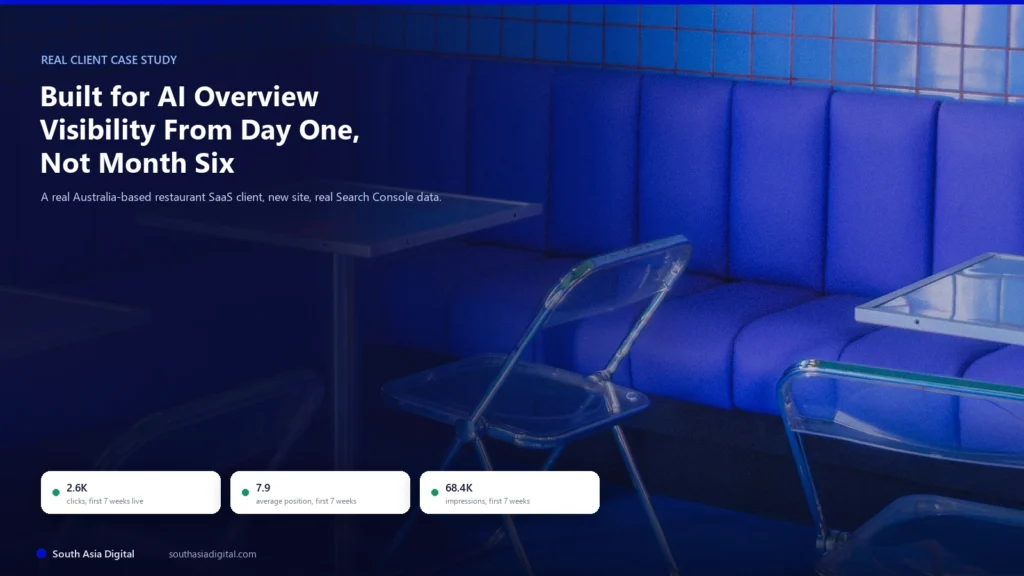

Google Search has changed. Ranking number one is no longer enough. Now, Google displays AI-generated summaries at the top of results. These summaries pull answers from multiple sources and show users a direct response before they even scroll.
If you are wondering how to get into Google AI Overview for SEO, you are asking the right question at the right time.
This guide explains exactly how AI Overview works, what Google looks for, and how to structure your content so your website has a strong chance of being featured. If implemented properly, this strategy can increase visibility, authority, and high-intent traffic.
What Is Google AI Overview?
Google AI Overview is a search feature powered by Google’s generative AI models. It creates a summarized answer at the top of search results by combining information from multiple trusted sources.
Instead of showing only blue links, Google now provides:
- A summarized explanation
- Supporting bullet points
- Context from multiple websites
- Source citations
This changes SEO completely.
Traditional SEO focused on ranking position. AI Overview SEO focuses on becoming a source that Google trusts enough to summarize.
If you want to understand how to get into Google AI Overview for SEO, you must first understand one thing:
Google selects sources based on clarity, authority, structure, and semantic coverage — not just backlinks.
Why AI Overview Is the Future of SEO
AI Overview appears mainly for:
- Informational queries
- Comparison searches
- “How to” searches
- Definition-based searches
- Strategic or educational queries
For example:
- How does AI SEO work
- What is technical SEO
- Best SEO strategies 2026
- How to rank with AI
These are high-intent searches.
If your content appears inside AI Overview:
- You gain authority positioning
- You receive higher trust signals
- You attract qualified traffic
- You strengthen brand visibility
This is why learning how to get into Google AI Overview for SEO is becoming more important than traditional ranking tactics alone.

How to Get Into Google AI Overview for SEO
Now let’s break down the real strategy.
1. Start With a Direct, Structured Answer
Google’s AI model prefers content that answers a question clearly within the first 100 words.
If your article targets:
“How to get into Google AI Overview for SEO”
Your introduction should immediately define it.
Example structure:
- 2 to 3 short paragraphs
- Clear explanation
- No fluff
- No vague storytelling
Google’s AI extracts structured answers, not emotional narratives.
2. Cover the Topic Completely (Topical Depth Wins)
Surface-level articles do not get featured.
To increase your chances:
You must cover:
- What AI Overview is
- How it selects sources
- Ranking signals
- Content structure
- Schema markup
- Semantic SEO
- Entity optimization
- E-E-A-T principles
- Real implementation steps
Google prefers content that covers a topic comprehensively in one place.
Depth builds selection probability.
3. Use Semantic SEO and Entity Optimization
AI models read relationships between terms.
If you are targeting how to get into Google AI Overview for SEO, your article must naturally include related entities such as:
- Generative AI
- Machine learning
- Natural language processing
- Large language models
- Google Search
- Structured data
- E-E-A-T
- Knowledge graph
- Content authority
- Crawlability
This builds contextual relevance.
Do not keyword stuff. Build semantic density.
4. Structure Content for AI Extraction
AI Overview pulls structured sections.
Use:
- Clear H2 and H3 headings
- Bullet lists
- Tables
- Step-based frameworks
- FAQ sections
Avoid long unbroken paragraphs.
Think like this:
Can a machine easily extract this section?
If yes, you are increasing your probability.
5. Answer Multiple Related Questions
Google AI often combines answers from multiple queries.
Instead of writing one narrow article, expand with:
- What is Google AI Overview
- Why AI Overview matters for SEO
- How to optimize for AI search
- How AI selects sources
- How schema helps AI
This increases semantic breadth.
When someone searches how to get into Google AI Overview for SEO, Google wants sources that show authority, not narrow blog posts.
6. Implement E-E-A-T Properly
Experience, Expertise, Authoritativeness, Trustworthiness.
To strengthen E-E-A-T:
- Add author profile
- Include real experience examples
- Use data-backed statements
- Reference trusted sources
- Add internal linking to related articles
Google’s AI does not trust anonymous thin blogs.
Authority matters more than ever.
7. Use Structured Data Markup
Schema increases clarity for machines.
Add:
- FAQ schema
- Article schema
- Organization schema
- Breadcrumb schema
Structured data does not guarantee AI Overview inclusion, but it improves machine understanding.
If you are serious about how to get into Google AI Overview for SEO, schema implementation is not optional.
8. Build Topical Authority, Not Single Posts
AI Overview selection favors domains with subject authority.
If South Asia Digital wants to rank for AI SEO topics, you need:
Cluster Strategy Example:
Pillar:
- AI SEO Complete Guide
Supporting Articles:
- Server log analysis for AI SEO
- How AI crawlers read websites
- AI SEO for local businesses
- Technical SEO for AI indexing
- Entity-based SEO strategy
Internal linking strengthens contextual authority.
One article rarely wins. A cluster does.
9. Improve Technical SEO Signals
Google AI still depends on traditional crawling and indexing.
Ensure:
- Fast loading speed
- Mobile optimization
- Clean HTML structure
- Proper heading hierarchy
- Crawlable internal links
- No duplicate content
AI cannot feature what Google cannot crawl properly.
10. Optimize for Search Intent Depth
AI Overview often appears for complex informational queries.
To win:
- Answer beginner level
- Provide advanced strategy
- Add real-world examples
- Include implementation steps
Layered depth improves extractability.
Content Formatting That Increases AI Overview Selection
Below is a simple extraction-friendly format:
Step 1: Direct definition
Step 2: Clear numbered framework
Step 3: Supporting bullet points
Step 4: Comparison table
Step 5: FAQ section
This structure increases machine readability.
AI Overview Optimization Checklist
| Area | What to Do | Why It Matters |
|---|---|---|
| Content Structure | Use clear H2 and H3 headings | Improves extractability |
| Semantic SEO | Add related entities | Builds contextual authority |
| Internal Linking | Link to cluster pages | Strengthens topical trust |
| Schema Markup | Add FAQ and Article schema | Improves machine clarity |
| E-E-A-T | Show expertise and experience | Builds trust signals |
| Technical SEO | Optimize speed and crawlability | Ensures indexing |
Common Mistakes That Prevent AI Overview Inclusion
If you are serious about learning how to get into Google AI Overview for SEO, you must first understand what disqualifies content. Most websites are not excluded because they lack effort. They are excluded because they lack structure, depth, and clarity.
Here are the major mistakes that quietly block your content from AI Overview selection.
1. Writing Generic SEO Advice
One of the biggest reasons websites fail to appear in AI Overview is publishing content that says the same thing as everyone else.
Generic content looks like this:
- Focus on keywords
- Build backlinks
- Improve user experience
- Write quality content
This advice is everywhere. Google’s AI system has already seen it thousands of times.
AI Overview favors:
- Specific frameworks
- Step-by-step implementation
- Real examples
- Data-driven insights
- Clear definitions
If your content could apply to any blog on the internet, it will not stand out. To increase your chances of being featured, your article must demonstrate depth and real expertise.
When discussing how to get into Google AI Overview for SEO, avoid repeating surface-level advice. Provide detailed, strategic guidance that shows actual understanding of AI-driven search.
2. No Structured Headings
AI models extract content in segments. If your article is one long wall of text, it becomes difficult for Google’s system to understand where answers begin and end.
Common structural mistakes include:
- Skipping heading hierarchy
- Using vague headings like “Introduction” or “Conclusion” only
- No H2 or H3 breakdown
- Long paragraphs with no separation
AI Overview prefers:
- Clear H2 and H3 sections
- Question-based subheadings
- Numbered steps
- Bullet points
Structured formatting increases extractability. If a machine cannot quickly identify the core answer in your content, it is less likely to pull it into AI Overview.
When creating content about how to get into Google AI Overview for SEO, think about how easily a machine can summarize your sections.
3. Thin 800 Word Articles
Short content is not automatically bad. But thin content that barely scratches the surface will not be considered authoritative.
AI Overview often pulls from sources that:
- Cover a topic comprehensively
- Answer multiple related questions
- Provide layered explanations
- Include supporting context
An 800 word article on a complex topic like AI SEO will rarely compete with a 2500 word structured guide that covers definitions, strategy, examples, technical implementation, and future trends.
Depth signals authority.
If your goal is inclusion in AI Overview, aim for completeness rather than word count. Cover the entire subject, not just one angle of it.
4. Keyword Stuffing
Some website owners still believe repeating the primary keyword as many times as possible improves ranking. This approach does the opposite in AI-driven search.
AI systems understand context. They evaluate:
- Natural language patterns
- Semantic relationships
- Topic coverage
- Readability
Overusing a phrase like how to get into Google AI Overview for SEO in every paragraph will reduce content quality and may trigger spam signals.
Instead, use:
- Natural variations
- Related entities
- Contextual synonyms
- Supporting terminology
Semantic richness beats repetition.
5. No Semantic Variation
AI Overview relies heavily on semantic analysis. It does not only look at exact keyword matches. It evaluates topic relationships.
For example, if you are writing about how to get into Google AI Overview for SEO, your article should naturally include related terms such as:
- Generative AI
- Large language models
- Natural language processing
- Structured data
- Knowledge graph
- Search intent
- Entity optimization
- E-E-A-T
If your article repeats one phrase but ignores related concepts, it appears shallow.
Semantic depth signals topical authority.
6. No Internal Linking
Internal linking is one of the most overlooked factors in AI Overview optimization.
Why it matters:
- It shows topical clusters
- It strengthens authority within a subject
- It helps Google understand content relationships
- It distributes ranking signals across pages
If you publish one standalone article about AI SEO but have no supporting content, Google may not view your site as a subject authority.
A better approach is:
Pillar page
Supporting cluster pages
Contextual internal linking between them
When building content around how to get into Google AI Overview for SEO, link to related technical SEO guides, AI content strategies, and entity optimization articles on your site.
Authority is built through networks, not isolated pages.
7. Weak Domain Authority Signals
AI Overview often pulls from websites that demonstrate:
- Expertise
- Consistency
- Trust
- Brand recognition
If your domain:
- Has very few quality backlinks
- Publishes inconsistent topics
- Lacks author credibility
- Shows minimal real-world experience
It becomes harder to earn inclusion.
This does not mean new websites cannot appear. It means you must compensate with:
- Exceptional depth
- Clear expertise
- Structured clarity
- Strong content clusters
Authority today is topical, not just backlink-based.
8. Ignoring E-E-A-T Signals
Experience and expertise matter more in AI-driven search.
Common mistakes include:
- No author bio
- No credentials
- No proof of experience
- No case studies
- No real insights
Google wants to feature sources that demonstrate real-world understanding.
If you are teaching how to get into Google AI Overview for SEO, show:
- Practical examples
- Real optimization processes
- Implementation strategies
- Observed results
Authority must be visible, not implied.
9. Outdated Content
AI Overview favors current, updated, relevant information.
If your article:
- References old SEO practices
- Ignores AI changes
- Mentions outdated tools
- Has not been updated in years
It becomes less competitive.
SEO for AI search evolves quickly. Regular content updates signal freshness and relevance.vely.
Advanced Strategy: Reverse Engineer AI Overview Results
Reverse engineering AI Overview results is one of the smartest ways to improve your chances of inclusion. When you search your target keyword, carefully analyse the sources Google selects. Notice how they structure their answers, how quickly they address the main question, and how clearly their sections are organised. Pay attention to formatting, use of bullet points, and how directly they respond to search intent. Then elevate your own content. Add deeper explanations, clearer frameworks, updated insights, and stronger authority signals. The goal is not to replicate what already ranks, but to produce a more complete, more structured, and more valuable resource. If you want to master how to get into Google AI Overview for SEO, strategic improvement always beats imitation.
Search your target keyword.
Study:
- Which websites are cited
- How their sections are structured
- What headings they use
- How concise their answers are
Then improve.
Make your content:
- More structured
- More detailed
- More updated
- More authoritative
Outperform. Do not copy.
Future of AI Overview and SEO
Search is changing fast. Google is moving toward smarter results that understand text, images, and even context together. We are seeing more conversational answers, clearer summaries, and results that try to predict what users really mean, not just what they type. SEO is not going away, but it is no longer just about getting clicks. It is about being trusted enough for Google’s AI to reference and summarise your content. Brands that learn how to get into Google AI Overview for SEO now will not just keep up with the shift, they will stay ahead of it.
Google is moving toward:
- Multimodal AI search
- Conversational results
- Context-based summaries
- Intent prediction
SEO will not disappear. It will evolve.
Instead of ranking for clicks, you will optimize for inclusion.
Brands that learn how to get into Google AI Overview for SEO early will dominate visibility.
How South Asia Digital Can Help
At South Asia Digital, we are best ai seo agency specialise in AI-First SEO strategies designed specifically for modern search environments.
We do not focus only on rankings. We focus on inclusion.
Our services include:
AI Overview Optimisation Strategy
We analyse AI-generated results for your target keywords, reverse engineer the structure, and rebuild your content to increase extractability and selection probability.
Topical Authority & Content Clustering
We create pillar pages and supporting clusters that position your domain as a subject expert, strengthening your chances of AI Overview inclusion.
Semantic SEO & Entity Optimisation
We expand your content beyond keywords by building contextual relevance using structured entities and related concepts.
Technical SEO for AI Search
We optimise crawlability, site architecture, schema markup, and performance to ensure your content is machine-readable and AI-friendly.
E-E-A-T Strengthening
We help establish author credibility, trust signals, and experience-based content frameworks that align with Google’s quality standards.
Competitive AI Overview Analysis
We audit competitors appearing in AI Overview and create outperform strategies rather than imitation tactics.
If you are serious about understanding how to get into Google AI Overview for SEO and turning that visibility into authority and revenue, the strategy must be deliberate.
AI Overview is not luck.
It is engineered.
And that is exactly what we do at South Asia Digital.
Final Takeaway
Google AI Overview is changing how visibility works. It is no longer just about ranking at the top of search results. It is about becoming a trusted source that Google’s AI system selects, summarises, and presents to users.
If you want to win, you must move beyond traditional SEO tactics.
To truly understand to get into Google AI Overview for SEO, focus on:
- Structured, extractable content
- Deep topical authority
- Strong semantic coverage
- Clear search intent alignment
- Technical optimisation
- E-E-A-T credibility signals
- Content clusters, not isolated posts
AI Overview rewards clarity, completeness, and authority.
Websites that adapt early will dominate visibility in the next generation of search.
Frequently Asked Questions
What is Google AI Overview in SEO?
Google AI Overview is an AI-generated summary shown at the top of search results that combines information from multiple trusted websites to provide users with direct answers.
Does ranking number one guarantee AI Overview placement?
No. AI Overview selection depends on clarity, authority, structure, and semantic coverage — not just ranking position.
How long should content be for AI Overview optimization?
Comprehensive content between 2000 and 3000 words performs better because it covers topics in depth.
Does schema guarantee inclusion?
No, but it improves machine understanding and increases the probability of being selected.
How many times should I use my primary keyword?
Use it naturally within context. For this article, how to get into Google AI Overview for SEO has been integrated strategically without overuse.